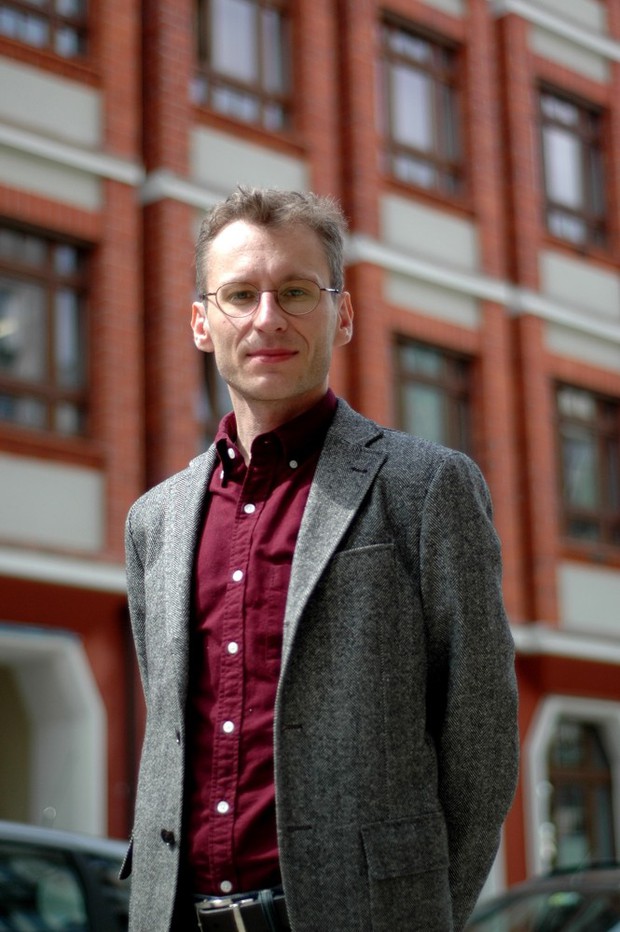
Marcin Tereszewski serves as Assistant Professor in the Department of English Literature and Comparative Studies at the University of Wrocław and has been Deputy Director of the Institute of English Studies for Community Relations since September 2024. He is also an active board member of the Polish Association for the Study of English (PASE). His academic credentials include a PhD (2010) from the University of Wrocław, with doctoral research on silence and emptiness in Samuel Beckett's work under Professor Ewa Kębłowska-Ławniczak. Dr. Tereszewski's research centers on psychogeography and dystopian literature, specializing in J.G. Ballard's fiction to examine urban space, identity, and societal collapse. His scholarship extends to Beckett studies, exploring inexpressibility and the aesthetics of failure through theoretical frameworks like heterotopia and thing theory. Publication trends reveal sustained engagement with British science fiction, particularly Ballard's New Wave works, analyzed through psychogeographical and cultural lenses. Recent scholarship increasingly incorporates environmental humanities, as evidenced by 2024 publications on waste studies and hinterlands in Ballard's fiction. He has co-edited significant academic volumes including 'Literary and Cultural Representations of the Hinterlands' (Routledge, 2024) and 'Production of Emotions: Perspectives and Functions' (Peter Lang, 2016), demonstrating leadership in collaborative research initiatives. No information was found regarding doctoral advisees, research grants, scientific awards, or dedicated research laboratories in available sources.
Professor Agata Bonenberg is a distinguished faculty member at Poznań University of Technology, where she serves in the Faculty of Architecture, Institute of Interior Architecture and Industrial Design. With expertise spanning architecture and urban planning (75%) and mechanical engineering (25%), she has established herself as a leading researcher in accessible design, sustainable architecture, and the integration of information technology in architectural practice. Her research interests encompass interior architecture with emphasis on accessible design for elderly and disabled populations, sustainable materials (particularly mycelium-based composites), urban revitalization, and cultural factors influencing contemporary architecture. She has made significant contributions to understanding how demographic changes and sustainable development solutions shape modern architectural practice. Professor Bonenberg's recent publications reveal a strong focus on innovative sustainable materials, particularly mycelium composites, and their applications in interior design. Her work combines technical precision with human-centered design principles, as evidenced by her studies on eye-tracking in living room environments and accessible space education methods. She has also conducted important comparative research on historical watercourse restoration in cities across different continents. Supervised 4 doctoral dissertations on diverse architectural topics Authored the monograph 'Cityscape in the Era of Information and Communication Technologies' (2018) Developed patented designs including modular storage units for disabled individuals Editor of multiple volumes of Zeszyty Naukowe Politechniki Poznańskiej Co-editor of MDPI publications on architectural engineering and sustainability Her work bridges theoretical research with practical applications, particularly in designing environments that accommodate diverse user needs while maintaining aesthetic quality. Professor Bonenberg maintains active international collaborations, as reflected in her publications with researchers from Italy, China, Switzerland, and other countries, contributing to a global dialogue on sustainable and inclusive architectural practices.
Professor Zbyszko Królikowski is a faculty member at Poznań University of Technology, where he works in the Faculty of Computer Science and Telecommunications, specifically in the Institute of Computer Science. He holds the academic title of Professor (indicated by "prof. dr hab. inż.") and has been actively contributing to the field of computer science, particularly in database systems and data warehousing. His scientific work spans multiple disciplines, with 75% focus on Computer and Information Sciences and 25% on Information and Communication Technology. Professor Królikowski has established himself as an expert in data warehousing, having authored a comprehensive monograph titled "Data warehouses: logical and physical data structures" published in 2007. His research interests primarily revolve around database systems, with specific focus on: Data warehousing and OLAP analysis Logical and physical data structures for databases Sequential data analysis Materialized views and query optimization Database performance evaluation Evolution of data warehouse systems Professor Królikowski has maintained an active research profile with publications spanning nearly two decades, from the early 2000s to 2021. His work shows a consistent focus on database technologies, evolving from traditional relational database systems to more contemporary approaches including in-memory architectures and graph databases. Analysis of his publication trends reveals a progression from theoretical database modeling to practical applications in production planning and modern database technologies. He has contributed to the academic community not only through his publications but also by supervising doctoral research. Notably, he supervised Mikołaj Morzy's dissertation on "Advanced database structures supporting effective association discovery" in 2004 and has served as a reviewer for numerous other doctoral dissertations in related fields. Professor Królikowski has collaborated extensively with other researchers in the database community, particularly with scholars from Poznań University of Technology including Tadeusz Morzy, Bartosz Bębel, and Robert Wrembel. These collaborations have resulted in numerous joint publications that have contributed significantly to the field of data warehousing and database systems.
Professor Piotr Marciniak is a distinguished academic at the Poznań University of Technology, where he serves in the Faculty of Architecture and the Institute of Architecture and Heritage Protection. With the academic title of Professor (Prof. Dr. Hab. Eng. Arch.), he has established himself as a leading expert in architecture and urban planning, particularly focusing on historical conservation and modernist architecture. His scholarly contributions are extensive, with 74 scientific articles, 63 book chapters, 8 books, and numerous architectural realizations to his name. Professor Marciniak's research primarily centers on the conservation of historical architecture, with special attention to modernist buildings and wooden structures in heritage contexts. He has made significant contributions to understanding architectural developments in Poznań during the Polish People's Republic era (1945-1989) and their relationship to broader European experiences. Professor Marciniak has supervised doctoral students, including Michał Duda (2023) and Agnieszka Rumież (2018), and has served on editorial boards for journals such as 'Kronika Miasta Poznania' and 'Porównania.' His international recognition is evident through his contributions to 'The Bloomsbury Global Encyclopedia of Women in Architecture 1960-2020,' where he authored entries on several prominent Polish women architects. His recent publications demonstrate continued active engagement with contemporary conservation challenges, particularly regarding wooden structures in historic buildings and the revitalization of historical urban contexts. As an architectural practitioner, Professor Marciniak has participated in numerous building projects, primarily residential complexes in Poznań and Łódź, often collaborating with architect Piotr Litoborski. This practical experience informs his academic work, creating a valuable bridge between theoretical research and practical application in architectural conservation and design.
Professor Sławomir Rosolski is a distinguished academic at the Poznań University of Technology, where he serves in the Faculty of Architecture, Institute of Architecture and Heritage Protection. Holding the academic titles of PhD, DSc, Engineer, and Architect, Professor Rosolski has established himself as a leading expert in sustainable architecture and heritage conservation. His educational background includes a doctoral dissertation titled 'Inverse problems in architectural design' from 1998, supervised by Edward Szczechowiak. Over his career, he has progressed to the rank of Professor, contributing significantly to architectural education and research at Poznań University of Technology. His work bridges theoretical exploration with practical implementation, creating a virtuous cycle between academic research and real-world architectural practice. Professor Rosolski's research primarily focuses on sustainable architecture with particular emphasis on nearly zero-energy buildings (nZEB). His work represents a critical intersection between historical building conservation and contemporary energy efficiency standards. He has pioneered approaches to adapting heritage structures to meet modern environmental requirements without compromising their historical integrity. His publications consistently address both pro-ecological and pro-social dimensions of sustainable construction, recognizing that environmental sustainability must be balanced with social needs and historical context. His recent publications demonstrate a strong trend toward practical applications of sustainable architecture, particularly in campus development and historical building renovation. Professor Rosolski has led significant projects including the design of the nearly zero-energy building for the Faculty of Architecture and Faculty of Management Engineering at the Poznań University of Technology 'Warta' campus, demonstrating his commitment to implementing sustainable principles in real-world architectural practice. 2024: Published 'Sławomir Rosolski. Selected Thoughts and Works' 2023: Authored multiple publications on nearly zero-energy buildings and sustainable campus development 2022: Researched historical buildings' potential for urban electromobility 2021: Developed technical solutions for upgrading historical buildings to nZEB standards Professor Rosolski has supervised doctoral students, including Natalia Regimowicz whose 2013 dissertation examined shop windows as urban activation elements. His academic leadership extends to guiding research that addresses current socio-economic needs in architecture and urban planning, with a particular focus on sustainable development challenges. Students working with Professor Rosolski can expect engagement with both theoretical frameworks and practical design challenges, particularly in the areas of sustainable building design, historical renovation, and campus planning. His architectural practice complements his academic work, with numerous implemented projects including residential buildings, urban development concepts, and historical renovations. The synergy between his theoretical research and practical application makes Professor Rosolski a valuable resource for students interested in sustainable architecture that respects historical context while addressing contemporary environmental challenges.
Professor Katarzyna Słuchocka is a faculty member at the Poznań University of Technology, Faculty of Architecture, Institute of Interior Architecture and Industrial Design. She holds the academic title of Professor with habilitation (Dr. Hab.) in Architecture and urban planning, which constitutes 100% of her scientific discipline according to the Act 2.0. Her ORCID identifier is 0000-0002-0492-2761 and she can be contacted at katarzyna.sluchocka@put.poznan.pl. Her research interests span multiple areas within architecture and urban planning: Architectural heritage and conservation Perception processes in architecture Organic architecture, particularly the works of César Manrique Post-war urban reconstruction Graphic communication in architectural design Relationships between art, space, and architecture Professor Słuchocka maintains an active research profile with publications spanning from 2016 to projected 2025 works. Her recent publications demonstrate a consistent focus on architectural perception, historical contexts, and the integration of artistic elements in architectural theory and practice. She frequently collaborates with researchers including Adam Nadolny, Yulia Ivashko, and Borys Siewczyński. Her notable scholarly contributions include: Monograph 'Obiekt architektoniczny - dzieło sztuki' (Architectural object - work of art, 2020) Monograph 'Forma, obraz, słowo' (Form, image, word, 2021) Edited volume 'Added Value: interdisciplinary spaces of education' (2019) Curated exhibition 'biel' (white) at Kolegiacki Art Gallery (2016) Professor Słuchocka actively supervises doctoral students and engages in both architectural practice and artistic creation, demonstrating the integration of theory and practice that characterizes her academic approach.
Dr. Agnieszka Ciurej is a geological researcher specializing in micropaleontology, stratigraphy, and geotourism, with active publication output from 2016-2023. Her work centers on calcareous microfossils (dinocysts and coccoliths) from Cretaceous and Oligocene periods, primarily in Polish regions including the Świętokrzyskie and Tatra Mountains, with extensions to Ukraine and the Carpathians. Her research interests demonstrate three interconnected pillars: Paleoenvironmental reconstruction through microfossil analysis of sea-level changes, oceanic anoxic events, and greenhouse climate conditions Economic geology investigations of mineralization processes and historical mining sites like the Teresa Adit Geotourism development focusing on geological heritage valorization and accessibility for disabled visitors in mountain regions Analysis of her 15 most recent publications reveals consistent methodological diversity spanning field geology, micropaleontological analysis, and geochronology techniques. Her 2023 output particularly emphasizes new species discovery (Stomiosphaerina bakae), copper mineralization studies, and luminescence dating comparisons, reflecting ongoing research momentum. Dr. Ciurej maintains active national and international collaborations, with co-authors from Ukraine, Netherlands, Sweden, and Lithuania. Her work with Polish institutions like the Pedagogical University in Kraków and geological surveys demonstrates embeddedness in national research networks while addressing globally relevant paleoenvironmental questions. Her research program shows strong integration of fundamental geological science with practical applications in heritage management and resource studies. The Teresa Adit mine site serves as a recurring case study connecting historical mining, geological processes, and tourism development across multiple publications from 2019-2023.
Dr. Anna Tomkowska serves as an Assistant Professor at the Academy of Fine Arts in Warsaw within the Faculty of Conservation and Restoration of Works of Art. Her multifaceted roles include Assistant at the NOVUM Inter-Cathedral Studio (Faculty of Culture and History), Conservator for the Museum of the Academy of Fine Arts, and Coordinator for Student Government activities. Her academic foundation comprises a Master of Fine Arts in Conservation and Restoration of Sculpture (2011, Academy of Fine Arts in Warsaw), an Art History degree from University of Warsaw, and Intellectual Property Law certification. She earned her PhD in June 2022 with research on conserving ephemeral art in public spaces under Professor Iwona Szmelter's supervision. Dr. Tomkowska's research centers on modern and contemporary art conservation , particularly addressing challenges in preserving transient works, sculptures, architectural elements, and paintings within public environments. Her methodology integrates material science, art history, and legal frameworks to develop innovative conservation strategies for 20th-21st century heritage. She has received significant recognition including an honorable mention for her master's thesis in the Coming OuT Best Diplomas competition (2011) and representation of Central and Eastern Europe at UNESCO's World Heritage Young Professionals Forum in Bahrain. Active collaboration with Zachęta National Gallery of Art and private collectors Extensive conservation work for artists: Alina Szapocznikow, Mirosław Bałka, Wojciech Fangor, Katarzyna Kozyra Founder and Editor-in-Chief of ICAR – International Journal of Young Conservators Her NOVUM Studio serves as a research hub advancing conservation science through physical/chemical testing, documentation development, and interdisciplinary methodologies for contemporary artistic heritage.