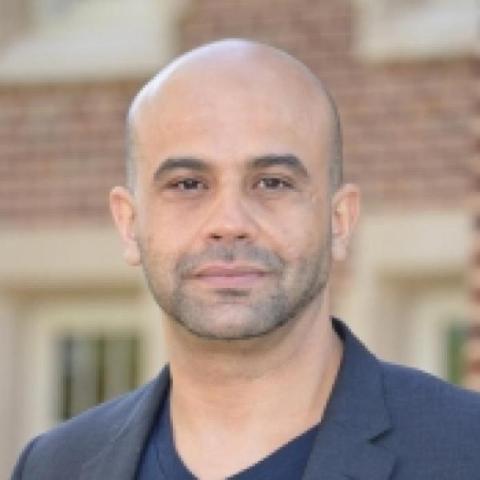
David A. Smith is an Associate Professor at the Khoury College of Computer Sciences, Northeastern University. His research focuses on Natural Language Processing (NLP) and computational linguistics, with applications in machine translation, information retrieval, digital humanities, and social sciences. He is a founding member of the NULab for Texts, Maps, and Networks, a research center focused on digital humanities and computational social sciences. Smith's work has been funded by grants from the Mellon Foundation, NEH, and IMLS, supporting projects such as the Viral Texts initiative analyzing 19th-century newspaper networks and the Oceanic Exchanges project tracking transnational information flows. He has contributed to advancements in OCR for historical texts, text reuse detection, and computational analysis of classical languages. He has advised numerous PhD students, including Shijia Liu, Si Wu, and Ryan Muther, and teaches courses like Natural Language Processing and Information Retrieval. His research has been featured in outlets like Wired and the Economist .
Emma Trentman is an Associate Professor of Arabic at the University of New Mexico (UNM) and Director of the Language Learning Center. Her research focuses on Applied Linguistics, particularly on language learning during study abroad programs, virtual exchange, and the impact of language ideologies on multilingual approaches. Research Interests: Multilingualism, Language Ideologies, Study Abroad Programs, Intercultural Communication, Arabic Language Education, and Curriculum Development. Key Publications: Co-editor of Language Learning in Study Abroad: The Multilingual Turn (2021), with works featured in The Modern Language Journal , Foreign Language Annals , and Critical Multilingualism Studies . Teaching: Offers Arabic language courses and the Languages Capstone class, integrating critical perspectives into language pedagogy. Editorial Work: Co-editor for Critical Multilingualism Studies Journal , advocating for plurilingual practices in education. Publications: Explores topics such as translanguaging, sociolinguistic competence, and decolonizing language learning frameworks across diverse contexts (Egypt, Tanzania, China). Advocacy: Engages in critical discussions on equity, identity, and sociocultural dimensions in language education.
Georges Kostakiotis is a Senior Lecturer at the National Institute for Oriental Languages and Civilisations (INALCO) in Paris, France, specializing in Modern Greek language and literature. His academic appointment falls under CNU Section 15, covering Arabic, Chinese, Japanese, Hebrew and other languages and literature. He serves as Head of the TEMPO course for Modern Greek and teaches across multiple levels from L1 through L3, including text study, written and oral practice of Greek, Modern Greek thematic courses, specialized Greek text corpora, and technical translation at M1 and M2 levels. Dr. Kostakiotis's research focuses on the intersection of language pedagogy and literary studies. He investigates teaching oral communication from both practical and theoretical perspectives, examining how literary texts function as effective pedagogical tools in foreign language classrooms. His work develops specialized strategies for teaching Greek to Latin-speaking audiences, leveraging linguistic connections while addressing acquisition challenges. Additionally, he explores literary representations of politics and urban worlds, situating Greek literature within broader European and Balkan contexts through the CREE (Centre de Recherches Euro-Méditerranéennes et Euro-asiatiques) research center. Analysis of Dr. Kostakiotis's publication record from 2009-2024 reveals consistent scholarly engagement with Greek literature's relationship to Balkan cultures and historical contexts. His work demonstrates particular interest in how Greek literature addresses themes of foreignness, crisis, and identity through comparative analysis with other Balkan literary traditions. His research spans pedagogical approaches to language teaching, literary analysis of Greek texts, historical examinations of Greek literature, and cultural studies of Greek communities in the Balkans. Dr. Kostakiotis has been instrumental in organizing numerous academic events that bridge language pedagogy and literary scholarship. He has coordinated multiple conferences and study days focused on language teaching methodology, including sessions on oral communication techniques, vocabulary acquisition strategies, and assessment approaches. In the realm of literature and cultural studies, he has organized scholarly gatherings examining Greek-Romanian relations, Phanariote history, women's perspectives in Greek literature, and urban studies with particular attention to cities like Thessaloniki and Alexandria. His collaborative work, including co-edited volumes on Greek-Romanian relations, demonstrates his commitment to fostering academic dialogue across national and disciplinary boundaries.
Ilham Khuri-Makdisi serves as Associate Professor of History at Northeastern University's College of Social Sciences and Humanities, specializing in Middle Eastern history with emphasis on Ottoman Eastern Mediterranean cities during the late 19th and early 20th centuries. Her research examines global and intra-imperial connections, movements of people and ideas, and transnational radical networks across the Ottoman Empire and Mediterranean world. Her educational background includes a PhD in History and Middle Eastern Studies from Harvard University (2004). This foundational training informs her interdisciplinary approach to Ottoman studies within global historical frameworks. Professor Khuri-Makdisi's research interests center on Ottoman Eastern Mediterranean urban history, global radical movements, intellectual history, and translation studies. She investigates socialism and anarchism in Beirut, Cairo, and Alexandria through diverse social groups including intellectuals, dramatists, and workers. Current projects explore Arabic-Ottoman Turkish translations and position the nahda (Arab Renaissance) within broader Ottoman and global contexts, revealing intricate cultural exchanges that shaped modern Middle Eastern thought. Her publications demonstrate consistent engagement with transnational intellectual and social currents, particularly examining how concepts of 'the social' evolved in Arabic thought and how fin de siècle Egypt functioned as a nexus for radical networks. These works collectively emphasize the interconnectedness of Ottoman territories with global movements, challenging nationalist historiographies through meticulous analysis of cross-border ideological flows. As an educator, she teaches foundational courses including Introduction to Middle Eastern History (HIST 1185), Modern Middle East (HIST 1290), and Capstone (HIST 4701), employing diverse sources from architectural records to political speeches to examine Europe-Middle East relations, imperialism, state formation, and social movements since the 19th century.
Max Cavitch is an Associate Professor of English at the University of Pennsylvania's School of Arts & Sciences, specializing in American literature, psychoanalytic studies, and cinema. He joined Penn in 1999 after earning his B.A. from Yale and Ph.D. from Rutgers. His research spans 19th- and 20th-century literature, African American studies, and interdisciplinary fields like animal studies and gender theory. Cavitch has authored influential works such as *American Elegy* (2007) and co-edited volumes on Whitman and early American studies. He directs Penn's Psychoanalytic Studies program and edits the blog *Psyche on Campus*, honored with the 2022 American Psychoanalytic Association's Excellence in Journalism Award. His teaching includes courses on psychoanalysis, autobiography, and American poetry. Cavitch has held fellowships from the Fulbright Foundation, Newcombe Foundation, and others. His recent projects explore world autobiography, psychoanalysis in academia, and the history of 'ashes' as a conceptual and material symbol. Award-winning scholar and educator, Cavitch's work bridges literary criticism with clinical theory, media studies, and transnational frameworks. He advises doctoral students in American literature and affiliated programs, maintaining active collaborations with institutions like the McNeil Center for Early American Studies and the Psychoanalytic Center of Philadelphia.
Noah D. Gardiner serves as Associate Professor and Director of Undergraduate Studies in the Department of Religious Studies at the University of South Carolina's College of Arts and Sciences. His academic journey includes a Ph.D. in Near Eastern Studies from the University of Michigan (2014), followed by positions as Lecturer in Islamic Studies at Michigan and a postdoctoral fellowship at Annemarie Schimmel Kolleg, Rheinische Friedrich-Wilhelms Universität Bonn. Gardiner's scholarly focus centers on Islamic thought and culture with particular emphasis on Sufism, esotericism, occult sciences, and manuscript culture in the 12th-15th century Arabic-speaking Mediterranean. His research explores the 'science of letters and names' (ʿilm al-huruf wa-al-asmaʾ), religious cosmology, and apocalypticism, examining how mystical ideas move between religious margins and centers. His work reveals significant connections between Islamic occult traditions and other esoteric systems like Jewish Kabbalah. His extensive publication record includes the monograph Ibn Khaldūn versus the Occultists at Barqūq's Court (2020), co-editing the special issue Islamicate Occultism: New Perspectives (2017), and numerous articles in leading journals. His current research focuses on the 13th-century Sufi occultist Aḥmad al-Būnī and the broader occult renaissance in 14th-15th century Cairo. Gardiner actively contributes to the scholarly community through his role as co-organizer of the international online workshop 'Islamic Occult Studies on the Rise' and administrator of the scholarly resource site islamicoccult.org, which showcases emerging scholarship in Islamic esotericism. He teaches courses spanning foundational religion studies to specialized topics including Islam, Qur'an, Hadith, Islamic Theology, Sufism, and Religion and the Fantastic.
Reyhan Durmaz is an Associate Professor of Religious Studies at the University of Pennsylvania, affiliated with the School of Arts & Sciences and multiple interdisciplinary programs. Her research focuses on Syriac Christianity, medieval religious dynamics, and the intersection of Christianity and Islam in late antiquity. She holds a Ph.D. from Brown University (2019) and has received prestigious fellowships such as the Dumbarton Oaks Junior Fellowship and the Charlotte Newcombe Dissertation Fellowship. Her seminal book Stories between Christianity and Islam (2022) examines the transmission of saints' stories between religious traditions, earning Honorable Mention from the Middle East Medievalists. Current projects include a study of rural Christianity in the medieval Middle East through soldier-monk narratives and an analysis of the 19th-century Arabic newspaper Kawkab America . She co-leads the Digital Photograph Archive project Visualizing Countryside , documenting medieval religious sites. Dr. Durmaz teaches courses on global Christianity, material culture, and late antiquity, and serves as co-chair of the Philadelphia Seminar on Christian Origins. Her work bridges historical analysis, textual scholarship, and digital humanities, addressing themes of religious identity, cultural exchange, and marginalized communities.
Zainab Hermes is an Associate Instructional Professor in the Department of Near Eastern Studies at the University of Chicago, where she has taught since 2018. She holds a PhD in Linguistics from the University of Illinois at Urbana-Champaign (2018), earned through experimental research combining phonetics and neuroscience methodologies. Education PhD in Linguistics, University of Illinois at Urbana-Champaign (2018) Research Interests Her work focuses on experimental linguistics, particularly the articulation of Arabic dialects (Cairene, Lebanese, Jordanian, Saudi). Key projects involve: MRI studies of vocal tract configurations for back consonants MEG investigations of neurological representations during Arabic diglossic code-switching Self-paced reading studies on L2 acquisition of Arabic grammatical gender Publications & Methodologies Her research employs advanced imaging techniques (rt-MRI, EMA) and neurolinguistic methods (MEG) to analyze speech production and processing. Her teaching includes courses on Arabic linguistics, dialectology, and academic reading. Academic Contributions She collaborates on interdisciplinary studies bridging phonetics, neuroscience, and language acquisition frameworks.
Lisa L. Wynn is Professor in the School of Social Sciences (Discipline of Anthropology) at Macquarie University in Sydney, Australia. She serves as Associate Editor of American Ethnologist (2022-2027) and previously held leadership positions including President of the Australian Anthropological Society (2020) and membership on the AAS Executive Committee (2018-2021). Wynn earned her PhD in 2003 from Princeton University's Anthropology Department, followed by postdoctoral positions at Princeton's Office of Population Research and Center for Health and Wellbeing. Her research program centers on gender, reproductive health technologies, sexuality, and religion, with continuous fieldwork in Egypt since 1998. More recently, she has expanded her work to examine ethics review bureaucracies, lay understandings of infectious disease, and young adult vaping behaviors in Australia. Her methodological approach combines deep ethnographic engagement with critical analysis of how power structures intersect with medical technologies and bodily experiences, particularly among marginalized communities. Analysis of her recent publications reveals an evolving trajectory that maintains her foundational interest in Middle Eastern contexts while increasingly addressing digital spaces (as seen in studies of online fatwas) and contemporary health crises (including pandemic responses and vaping culture), with consistent attention to bodily autonomy and reproductive justice. Her significant scholarly contributions have been recognized through multiple prestigious awards: Vice Chancellor's Teaching Excellence Award from Macquarie University (2009) Australian Award for Teaching Excellence (2012) OLT National Teaching Fellowship (2012-2014) Leeds Honor Prize from the Society for Urban, National, and Transnational/Global Anthropology (2008) Wynn actively mentors graduate researchers specializing in gender, sexuality, medicine and technology, with particular emphasis on sexual and reproductive health. Her research program has received substantial funding from the Social Science Research Council, Australian Research Council, Office of Learning and Teaching, and Hort Innovation. Notably, she co-led a major international project to develop multilingual sexual and reproductive health resources that have reached millions of users across 208 countries. She also created a free online ethics training program for humanities and social sciences researchers at Macquarie University. Through collaborations with Cambridge Reproductive Health Consultants and other partners, Wynn has successfully translated academic research into accessible public resources, including evidence-based information on medication abortion available in six languages (English, Spanish, French, Arabic, Turkish, and Farsi).
Dr. Khaldoun H. Shami is a Lecturer in Documentary Film at the School of Media, Language and Communication Studies, within the School of Art, Media and American Studies at the University of East Anglia (UEA), Norwich, UK. He is actively involved in research, teaching, and academic event organization, and is currently accepting PhD students. Education: PhD in Film, Television and Media, University of East Anglia MA in Documentary Practice, Brunel University London Master of Communication in Screen Studies, Universiti Sains Malaysia Diploma in Leadership for Media, United Nations University, Tokyo His research focuses on Middle Eastern documentaries and TV news, with a strong emphasis on secularism, minority representation, censorship, and industrial challenges in media production. He specializes in ethnographic documentary, cinéma vérité, militant cinema, and alternative radio, contributing to broader discourse in media studies and film theory. His work explores how media shapes identity, resistance, and public discourse in politically sensitive contexts. Dr. Shami is the director of the documentary Secular | Aa'La'Ma'Ni (2024), which presents filmmaker perspectives from Lebanon, Tunisia, Jordan, and Palestine on religion, sectarianism, and censorship. His research contributes to the UN Sustainable Development Goals, particularly in the area of quality education and inclusive media representation. Scientific Awards: Vice-Governor of Jakarta Award in Relief (2008) USIM Film Award - Documentary, Kuala Lumpur (2009) University of Jordan Excellence Award in Community Service (2005) Dr. Shami has been actively involved in academic and public engagement, serving as a peer reviewer for the Journal of Political Ideologies and as a Community Radio Consultant for Japan Platform JPF. He has organized and participated in numerous events, including the International Symposium on Media and the Middle East, focusing on resistance, activism, and visual stereotypes. He also contributes to public film screenings and academic forums, such as the Al Jazeera Forum for Journalism Faculties in the Arab World. He is a member of the Research and Symposium Committee for Media and the Middle East at UEA, collaborating with scholars internationally. His work bridges academic research with practical filmmaking and community outreach, fostering interdisciplinary dialogue on media, religion, and society.
Professor Eric Atwell is a Professor of Artificial Intelligence for Language at the University of Leeds' School of Computer Science, part of the Faculty of Engineering and Physical Sciences. He holds additional roles as a LITE Fellow at the Leeds Institute for Teaching Excellence (40% part-time), Turing Fellow at the Alan Turing Institute, and member of the Leeds Institute for Data Analytics (LIDA) and Language at Leeds (LATL). His research focuses on AI applications in corpus linguistics, text analytics, and computational analysis of religious and medical texts, with a strong emphasis on Arabic and Islamic studies. He leads the AI4L research group and has supervised over 60 research students and fellows, many of whom have pursued careers in academia, tech, and AI-driven fields. Education: PhD in Corpus Linguistics and Language Learning (University of Leeds, 2008), BA (First Class) in Computing and Linguistics (Lancaster University, 1981) Grants: Includes EPSRC-funded projects like Natural Language Processing with Arabic and Islamic Studies (£337K, 2013-2015) and EDUBOTS chatbots for education (£94K, 2019-2022) Teaching: Leads modules in Data Mining, Text Analytics, and AI across multiple programs, including online Masters and PhDs. Known for innovative teaching approaches and student support, receiving positive feedback for engagement and course design. Research Interests: AI applied to corpus linguistics, Quranic text analysis, Arabic NLP, chatbots for education, and decolonizing curricula. Notable projects include Quranic semantic search tools, Hadith corpus analysis, and AI-driven fact-checking systems. Publications: Over 277 publications, with recent work focusing on Quranic QA systems, Arabic dialect identification, and generative AI applications in education. His research is widely cited, earning recognition from ResearchGate for high readership. Awards: Recognized for his most-read research items on ResearchGate (June 2021). Gallup StrengthsFinder highlights his top traits as Learner, Achiever, Ideation, Intellection, and Maximizer. Labs/Teams: Leads the AI4L research group and collaborates with international institutions including SUSTECH Sudan, King Saud University, and SWJT University (China). Active in research networks like LIDA and LATL.
Professor Alberto Rigolio is a scholar of Classics and Ancient History at Durham University, specializing in the Eastern Mediterranean during the Roman and Late Antique periods. He focuses on Syriac literature, Greco-Roman intellectual traditions, and the reception of classical texts in early Christian and Islamic contexts. Rigolio holds a D.Phil. from Oxford University and has held prestigious fellowships at Harvard, Princeton, and All Souls College, Oxford. He serves as Chair of the Board of Examiners at Durham and is a Fellow of the Higher Education Academy. His research explores the transformation of classical dialogue forms in late antiquity, the transmission of Greek texts into Syriac and Arabic, and the cultural intersections between Greco-Roman, Christian, and Islamic traditions. Key works include Christians in Conversation (Oxford UP, 2019), which examines late antique dialogue literature, and a forthcoming book on the emergence of Syriac literature supported by British Academy and Princeton IAS fellowships. Education: BA/Milan, D.Phil./Oxford, Postdoctoral Fellowships at Harvard and Princeton Affiliations: Institute of Medieval and Early Modern Studies, Durham Rigolio's articles analyze Syriac translations of Aristotelian works, Plutarch, and Themistius, revealing how Greco-Roman thought was adapted to meet religious and cultural needs. His projects include studies on Syriac rhetoric, the Roman household in late antique conflicts, and para-biblical narratives. He supervises postdoctoral researchers and PhD students on topics ranging from Syriac literary culture to late antique religious identity. Awards: British Academy Mid-Career Fellowship (2024), All Souls College Visiting Fellowship (2024) Grants: Leverhulme Trust, British Academy, American Philosophical Society He directs research labs examining Syriac intellectual culture and co-ordinates interdisciplinary projects on late antique translation movements. Rigolio is actively involved in public outreach, offering talks on Roman religion, Palmyrene military identity, and the Graeco-Syro-Arabic textual tradition.
Mohammad T. Alhawary is Professor of Arabic Linguistics and Second Language Acquisition at the University of Michigan's Middle East Studies department within the College of Literature, Science, and the Arts. He serves as Director of both the MA Program in Arabic for Professional Purposes (APP) and the MA Program in Teaching Arabic as a Foreign Language (TAFL). His educational background includes a Ph.D. from Georgetown University (1999). Prior to joining the University of Michigan, he contributed to developing Arabic and Middle Eastern Studies programs at various US institutions. Professor Alhawary's research spans both theoretical and applied Arabic linguistics, with particular focus on second language acquisition processes. His work examines how factors like age, input quality, output practice, and first language transfer affect Arabic language learning. He has made significant contributions to understanding Arabic language pedagogy, curriculum design, proficiency testing, and the application of technology in language learning. His research also extends to bilingualism, multilingualism, language impairment, and Arabic medieval grammatical traditions. His publications reflect a strong trajectory in Arabic linguistics research, with recent works focusing on practical language teaching applications, reading comprehension mechanisms, code-switching patterns in digital communication, and multilingual acquisition processes. The 2023 publication 'Teaching Arabic as a Foreign Language' represents his latest contribution to language pedagogy methodology. 2019 AATA Book Award for 'Arabic Second Language Learning and Effects of Input, Transfer, and Typology' As an academic leader, Professor Alhawary serves as Executive Director of the American Association of Teachers of Arabic and edits both the Journal of Arabic Linguistics Tradition and Al-'Arabiyya journal. He continues to develop empirical research on Arabic second language acquisition to inform teaching practices both in America and globally.
Hakan Özkan is a Privatdozent and Research Associate at the Institute of Arabic and Islamic Studies, Department of Middle Eastern Studies, University of Münster, where he has been working since 2007 in various capacities. He was awarded his Venia Legendi (Habilitation) in November 2019 for Arabic and Islamic Studies with his thesis 'History of Eastern Zajal – Dialectal Arabic Verse Poetry from the East of the Arab World.' His academic background includes a Franco-German doctorate completed in 2006 from Université de Provence and University of Cologne, supervised by Claude Audebert and Monika Gronke, with external reviewers including Wolfhart P. Heinrichs from Harvard University. His educational background includes: 2019: Venia Legendi for Arabic and Islamic Studies, University of Münster 2002-2006: Franco-German Doctorate in Arabic Studies and Narratology (Université de Provence and University of Cologne) 1995-2000: Master of Arts in Islamic Studies, Oriental Languages and Literatures (University of Cologne) 2000-2001: Course program in Modern Standard Arabic and Syrian-Lebanese dialect at Institut Français d'Etudes Arabes de Damas Özkan's research focuses on premodern Arabic dialect poetry, particularly zajal and muwashshaḥ forms, narratology, prosimeter literature, socio-literary history, and diachronic dialectology. His interdisciplinary approach bridges linguistic analysis with literary criticism, examining how dialectal forms evolved within Arabic literary traditions across different historical periods and geographical regions. He has conducted extensive field research in Arab countries including Syria, Egypt, Lebanon, Tunisia, and Morocco, with particular emphasis on the historical development of poetic forms from the Mamluk through Ottoman periods. His publication history demonstrates consistent scholarly contributions to Arabic literary studies, with his 2020 monograph 'History of Eastern Zajal' representing a landmark study in the field. His recent work has expanded to include analyses of religious poetry praising the Prophet Muhammad in zajal form, wine poetry in Arabic literary traditions, and the integration of dialects into Arabic language teaching methodologies. His scholarly output spans monographs, critical editions, encyclopedia entries, journal articles, and book chapters across multiple languages including German, English, French, and Turkish. Among his academic recognitions: 2018: Second place on shortlist for W2 Professorship for Arabic Language and Translation Science, University of Leipzig 2008: Offered Junior Professorship at American University in Cairo (declined) 2007: Second place on shortlist for maître de conférence position at University of Nancy 2007: Official Qualification from National University Council (CNU) for positions as maître de conférence at French universities Özkan has served on numerous academic committees, including appointment committees for professorships in Sinology and Arabic and Islamic Studies at the University of Münster. He has been a juror for the Sheikh Hamad Award for Translation and International Understanding in Doha and has served on the steering committee for the 'Translation for Dialogue' program of the Anna Lindh Foundation. His editorial work includes reviewing for Mamluk Studies Review, Die Welt des Islams, and Middle Eastern Literatures since 2012. His scholarly activities extend to linguistic fieldwork on Pontic Greek dialects in Turkey and organizing significant academic conferences including 'The Race Course of Literature – An-Nawāǧī and His Contemporaries' in 2018 at the University of Münster. His multilingual capabilities (Arabic, Turkish, German, French, English, Persian, Ottoman Turkish, and knowledge of Modern Greek) enable his comparative work across multiple linguistic and cultural traditions in the Mediterranean region.
Nizar F. Hermes serves as Associate Professor and Department Chair in the Department of Middle Eastern and South Asian Studies at the University of Virginia, concurrently holding the position of Director of Graduate Studies. His office is located in 141 New Cabell Hall, with Spring 2025 office hours held Tuesdays from 12:00-3:00 PM. He maintains dual professional email contacts through the university system. His academic foundation includes: PhD in Comparative Literature, University of Toronto Dr. Hermes' research program centers on North African and Mediterranean literary traditions, with deep specialization in premodern Arabic-Islamic cultural production. His work investigates poetic representations of urban spaces, cross-cultural encounters between the Islamic world and Europe, and the transmission of literary heritage across the Mediterranean. Particular attention is given to Maghribī poetic imagination, elegiac traditions, and the intersection of literature with food history and refugee experiences. His methodological approach combines close textual analysis with historical contextualization to reveal continuities in Arab literary consciousness. Analysis of his recent publications (2014-2025) reveals three dominant scholarly trajectories: 1) The literary reconstruction of North African cities through poetic elegies, 2) Cross-cultural encounters documented in Arabic travel literature and folk poetry, and 3) The representation of European 'others' in medieval Arabic texts. His 2024 monograph 'Of Lost Cities' synthesizes these threads while his edited volume 'The City in Arabic Literature' (2018) establishes foundational frameworks for urban studies in Arabic literary criticism. No scientific awards or fellowships were documented in the source materials. While his role as Director of Graduate Studies indicates active mentorship responsibilities, specific student advisees and grant funding details were not provided in the available documentation. His scholarly output demonstrates sustained engagement with graduate education through publications on teaching methodologies for Arabic humanistic literature. No dedicated research laboratories or formal collaborative teams were referenced, though his co-edited volumes and multi-author publications suggest active participation in scholarly communities focused on Mediterranean studies and comparative literature.