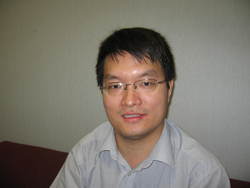
Xiaoqiang Wang is a Professor in the Department of Scientific Computing at Florida State University (FSU). His research focuses on numerical analysis, applied partial differential equations, mathematical biology, image processing, and scientific computing. He holds a Ph.D. from Pennsylvania State University (2005). His work emphasizes phase-field modeling for elastic bending energy, biological microstructures, and computational methods for complex systems. Notable contributions include advancements in centroidal Voronoi tessellation algorithms for image segmentation and high-performance computing techniques for scientific visualization. Recent publications highlight innovations in topology-preserving phase-field models, neural network-based energy minimization, and stochastic resource competition models. His research bridges theoretical mathematics with practical applications in biophysics, materials science, and biomedical engineering. Wang collaborates actively with interdisciplinary teams, contributing to FSU's computational science initiatives. His lab focuses on developing novel numerical methods and simulations for biological and physical systems, reflecting a commitment to both foundational and applied research.
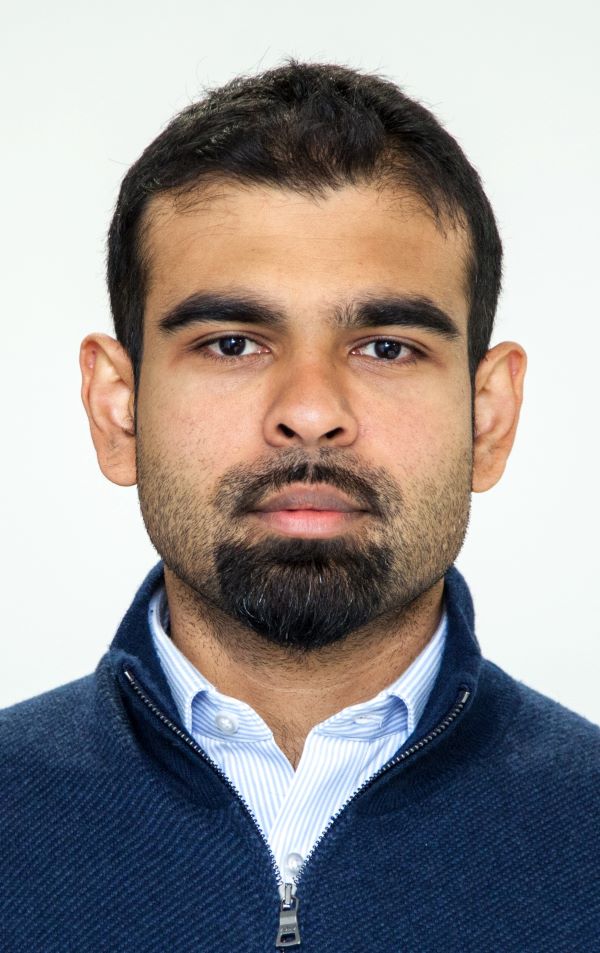
Dr. Shakir Jiffri is a Lecturer in Aerospace Engineering at Swansea University's School of Aerospace, Civil, Electrical and Mechanical Engineering. His research focuses on Linear and Nonlinear Structural Dynamics, Aeroelasticity, and Active Control methods, particularly in flutter suppression and non-smooth systems. He has contributed to experimental studies on feedback linearisation and nonlinear control strategies, with applications in aeroelastic systems and robotics. Teaches modules including Strength of Materials, Engineering Mechanics, and Aerospace Control. Supervised PhD and MSc students in active control methodologies and inertial amplifier concepts. Research interests include: Aeroelasticity, Nonlinear Control, and Structural Dynamics. Recent work addresses composite panel optimization and vibration control in robotic systems. His publications span journals like Journal of Guidance, Control, and Dynamics and Mechanical Systems and Signal Processing, emphasizing experimental validation of control strategies.
Tania Cerquitelli is a Full Professor in the Department of Control and Computer Science (DAUIN) at Politecnico di Torino, where she leads research in data science, concept-drift management, and inclusive AI technologies. She is a member of SmartData@PoliTO, the GEDI Observatory for Gender Equality, and serves in leadership roles related to social affairs and community policies at the university level. She also acts as a scientific advisor for the partnership with Accenture. Her research interests span Data Science , Concept-Drift Management , Database Systems , Conversational Data Science , and Industry 4.0 . She applies AI and machine learning to industrial, societal, and ethical challenges, particularly in promoting inclusive communication and gender equality in research. The most recent publications highlight her work in explainable AI, concept drift detection, multimodal diagnostics, and AI for social good. Her research integrates machine learning, natural language processing, and computer vision to address real-world problems in manufacturing, healthcare, agriculture, and education. She is an Associate Editor for several prestigious journals including Expert Systems with Applications , Computer Networks , Future Generation Computer Systems , and Knowledge and Information Systems . She has served on the program committees of major conferences such as ECML PKDD, EDBT/ICDT, and ACM KDD, and has been a reviewer and selection committee member for ETH Zurich and EMPA. She actively supervises PhD students and teaches a wide range of courses including Data Science and Database Technologies, Business Intelligence for Big Data, and Gender and Diversity in Research. She is involved in multiple national and international research projects such as E-MIMIC, WEBFARE, and EnABLES, focusing on inclusive AI, smart data, and industrial applications. Her lab affiliations include the DBDM - Database and Data Mining Group (DAUIN) and the Interdepartmental Center SmartData@PoliTO - Big Data and Data Science Laboratory , where she contributes to advancing data science methodologies and their societal impact.
Renaud Lambiotte is Professor of Networks and Nonlinear Systems at the Mathematical Institute, University of Oxford. He holds a PhD in Physics from Université libre de Bruxelles and has held research and faculty positions at ENS Lyon, Université de Liège, UCLouvain, Imperial College London, and the University of Namur. He is currently an active academic in applied mathematics and network science. His research focuses on complex systems, particularly dynamics on networks, temporal networks, and stochastic processes. He applies these to social and brain networks, data mining, and urban systems. His work bridges theoretical modeling and real-world data, emphasizing the structure and evolution of complex systems. His recent publications demonstrate strong trends in network theory, including hypergraphs, community detection, multidimensional dynamics, and data quality in network interventions. He also explores applications in urban air quality and gentrification, showing a commitment to socially relevant complex systems research. Scientific Awards: Prix Wernaers 2013 Prix Wernaers 2016 Prix Wernaers 2020 Verdickt-Rijdams 2016 de l'Académie royale de langue et de littérature françaises He is the co-founder of L’Arbre de Diane, a publishing initiative at the science-literature interface, which received multiple awards. He teaches advanced courses such as Differential Equations II and Networks. He is affiliated with the Machine Learning and Data Science and the Oxford Centre for Industrial and Applied Mathematics research groups. He has authored or co-edited key texts in the field, including A Guide to Temporal Networks and Modularity and Dynamics on Complex Networks , and has published around 130 peer-reviewed articles. His research is supported by ongoing collaborations and active publication output, indicating sustained academic leadership.
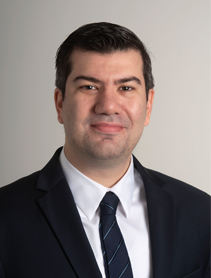
Dr. Hakki Erhan Sevil is an Associate Professor in the Department of Intelligent Systems and Robotics at the University of West Florida, within the Hal Marcus College of Science and Engineering. He holds a Ph.D. in Mechanical Engineering from the University of Texas at Arlington and has extensive research experience in robotics, intelligent systems, and autonomous control. His work spans theoretical and applied domains, focusing on resilient and intelligent robotic systems. Ph.D., Mechanical Engineering, University of Texas at Arlington M.S., Mechanical Engineering, Izmir Institute of Technology B.S., Mechanical Engineering, Izmir Institute of Technology Dr. Sevil's research interests lie at the intersection of robotics, artificial intelligence, and control systems. He specializes in autonomous navigation, fault detection and isolation (FDI), multi-agent coordination, computer vision, and bio-inspired computational methods. His work emphasizes real-world implementation in unmanned and self-sustained systems, particularly in challenging environments. His recent publications and projects highlight a strong trend toward intelligent, resilient, and distributed robotic systems. Themes include entropy-based behavior modeling for UAV swarms, assistive robotics for household tasks, post-disaster damage assessment using aerial vision, and advanced guidance for GPS-denied navigation. These reflect a multidisciplinary approach combining machine learning, control theory, and robotics engineering. 2024 Faculty Excellence in Teaching Award, UWF 2024 Faculty Excellence in Undergraduate Research Mentoring Award, UWF DURIP Grant ($478,000) from ONR (with IHMC) USDA Grant ($728,000) with New Mexico State University US Air Force SBIR/STTR Grant ($110,000) with Catalano Aerospace AFWERX Funding for Distributed Behavior Research Dr. Sevil actively mentors Ph.D. and M.S. students and leads the Sevil Research Group, which has secured multiple internal and external grants from NSF, NASA, ARL, ONR, and USDA. He has served as PI and Co-PI on funded projects and advises student teams that have won national awards. His lab, the Intelligent Systems and Robotics Lab, is highlighted in university communications and national challenges. The group collaborates with IHMC, NMSU, and industry partners, fostering innovation in autonomous systems. The Sevil Research Group operates within the Intelligent Systems and Robotics Lab at UWF, conducting cutting-edge research in autonomous navigation, swarm intelligence, and resilient robotics. The lab collaborates with the Institute for Human and Machine Cognition (IHMC), New Mexico State University, and private aerospace firms. It supports student-led projects, participates in national robotics challenges, and maintains active GitHub repositories for open research dissemination.
Virginia Pallante is a Postdoctoral Researcher at the Netherlands Institute for the Study of Crime and Law Enforcement (NSCR) since 2020, specializing in ethological analysis of human behavior within criminological contexts. Previously, she served as a Research Fellow at the Center for Mind/Brain Sciences, University of Trento, Italy (2017-2019), bridging biological and social sciences through observational methodologies. Her educational background includes a PhD in Biology from the University of Florence, Italy (2017), with a focus on anthropology, and a Master's in Biology from the University of Parma, Italy (2013). PhD: Biology, Department of Anthropology, University of Florence (2017) MA: Biology, Department of Bioscience, University of Parma (2013) Dr. Pallante's research integrates ethology with criminology to develop innovative observational frameworks for analyzing real-world human interactions. Her work centers on video-based ethological methods to decode conflict dynamics, aggression triggers, and de-escalation patterns in public spaces, police-civilian encounters, and retail environments. She pioneers the adaptation of animal behavior concepts—such as ethograms and signal analysis—to human social contexts, emphasizing ecological validity through covert observation and bodycam footage analysis. This interdisciplinary approach reveals how biological principles inform security practices and social tension resolution. Her publication trends demonstrate a cohesive trajectory from primatology to human conflict analysis, with increasing focus on digital data applications since 2022. Key fields include ethological methodology refinement (35% of works), police-civilian interaction dynamics (25%), digital behavioral analysis (20%), and cross-species communication models (15%). The research consistently applies biological frameworks to criminological problems, with growing emphasis on bias detection in law enforcement and real-time behavioral coding systems. Dr. Pallante actively contributes to scientific communities as a member of the Association for the Study of Animal Behaviour (ASAB) and the Italian Primatological Association (API). Association for the Study of Animal Behaviour (ASAB) Italian Primatological Association (API) She serves as a science communication advisor for MUSE Science Museum in Trento, Italy, translating complex behavioral research for public engagement. Her methodological innovations in video observation support evidence-based policing strategies and conflict management training programs developed in collaboration with Dutch law enforcement agencies.
Caroline Crockett is an Assistant Professor in the Department of Electrical and Computer Engineering at the University of Virginia, part of the School of Engineering and Applied Science. She holds a Ph.D. in Electrical Engineering from the University of Michigan and a B.S. from the University of Virginia. Her academic role emphasizes teaching and engineering education research. B.S., Electrical Engineering, University of Virginia, 2015 Ph.D., Electrical Engineering, University of Michigan, 2022 Her research interests are centered on engineering education, particularly how students develop conceptual understanding in core electrical engineering topics and learn to troubleshoot. She also has a background in machine learning and image reconstruction, though her current work focuses on pedagogy. She actively engages undergraduate students in research projects related to education and is a member of IEEE and ASEE. Her recent publications reflect a strong trend toward engineering education research, especially in signals and systems comprehension and affective student responses to active learning. Earlier work includes advanced image reconstruction techniques using bilevel optimization, showing a transition from technical signal processing to educational research. Caroline Crockett does not supervise graduate students or maintain a research lab, but she mentors undergraduates interested in engineering education. She has taught several key courses including Fundamentals of ECE 2, Fundamentals of ECE 3, and an Introduction to Machine Learning. She is committed to undergraduate instruction and curriculum development. She is involved in the broader academic community through her memberships in IEEE and ASEE, contributing to educational research and dissemination through conferences and publications. Outside of her academic duties, she enjoys knitting, reading, crafts, and spending time with her family and rescue dog Oreo. She is also a licensed amateur radio operator.
Murphy Yuezhen Niu is an Assistant Professor and Stansbury Chair in Computer Science at the University of California, Santa Barbara (UCSB), since 2024. She holds an adjunct role as Adjunct Assistant Professor at the University of Maryland, College Park, and the University of Maryland Institute for Advanced Computer Studies. Niu earned her Ph.D. in theoretical and mathematical physics from MIT (2018) and a B.A. in Physics from Peking University. Her research focuses on quantum computing paradigms, including quantum control optimization, quantum error correction, quantum machine learning, and scalable quantum architectures. Her work applies deep reinforcement learning and generative models to quantum systems, with contributions to superconducting qubit-based processors, ion traps, photonic systems, and neutral atom qubits. Niu's research emphasizes reducing the computational cost of quantum digitization while achieving real-world impacts. Notable achievements include the Claude E. Shannon Research Assistantship for her work in photonic quantum computation and quantum cryptography. Niu’s publications (2021–2025) span topics like quantum error correction thresholds, hybrid analog-digital quantum simulators, and machine learning-driven quantum decoding. Her research bridges theoretical physics and applied quantum computing, with a focus on fault-tolerant architectures and scalable quantum control protocols. Education: Ph.D., Physics, MIT (2018) B.A., Physics, Peking University Awards: Claude E. Shannon Research Assistantship Labs/Teams: Google Quantum AI Team (former role) UCSB Quantum Computing Research Group
Prof. Dr. Sarah Dégallier Rochat is Head of the strategic thematic field 'Humane Digital Transformation' at Bern University of Applied Sciences (BFH). She holds a joint appointment as Professor at the School of Engineering and Computer Science and serves as co-leader of the Computer Perception and Virtual Reality Lab (cpvrLab) within the Institute for Human-Centered Engineering. Her educational background includes: Ph.D. in Robotics from École Polytechnique Fédérale de Lausanne (EPFL) Master's in Mathematics from EPFL Teaching Diploma in Mathematics from Haute École Pédagogique de Lausanne Psychology studies at University of Lausanne Her research focuses on human-centered technological development with emphasis on: Designing inclusive human-machine interfaces through participatory approaches Developing upskilling strategies for industrial workforce adaptation Examining how techno-narratives shape societal perceptions of technology Creating collaborative robotic systems for agile manufacturing (Cobotics) Exploring mixed reality interfaces for worker augmentation Her publications demonstrate strong interdisciplinary focus on robotics and human-centered AI, with recent works exploring human augmentation in industry, ethical AI implementation, and participatory robot programming. The trajectory shows increasing emphasis on socio-technical systems and workforce empowerment. Significant awards include: Industry 4.0 Shapers Award (2019) CHIRA Best Paper Award (2023) She leads multiple research projects funded by Innosuisse, SNF, and EU programs, including: CODIMAN (Cobotics and workplace humanization) Agile Robotics for High-Mix Low-Volume Production Upskill at Work (digital literacy initiatives) Augmented workers with mixed reality interfaces As founder of Auto-Mate Robotics, she develops flexible robotic cells for industrial applications. She co-leads the Computer Perception and VR Lab and serves on advisory boards including the Swiss Cobotics Competence Center and EUA Task Force on AI.
Ming Gu is a Professor in the Department of Mathematics at the University of California, Berkeley . He specializes in Numerical Linear Algebra and Scientific Computing , with a focus on developing efficient algorithms for structured matrices and large-scale data analysis. Organized Matrix Computations and Scientific Computing Seminars (2009-2017) Published 15+ papers on QR algorithms , Toeplitz matrices , randomized algorithms , and low-rank approximations His research addresses rank-revealing factorizations , randomized subspace iteration , and preconditioning techniques , often bridging numerical analysis with applications in machine learning and optimization . Students advised by him (e.g., Jiaming Wang, Onyebuchi Ekenta) have explored spectrum-revealing CUR decomposition and truncated SVD . Contact: mgu@math.berkeley.edu Office: 861 Evans Hall, UC Berkeley
Pierre Duchesne is a Full Professor in the Department of Mathematics and Statistics at the University of Montreal . He serves as Professor-responsibility for the M.Sc. and Ph.D. in Statistics programs (2000-2004). His research focuses on applied statistics with emphasis on: Time Series Analysis (univariate and multivariate models, serial correlation testing, portmanteau statistics) Sampling Theory (robust estimation methods, calibration estimators) Multivariate Analysis (ARCH effects, vector autoregressive models, causality testing) Applications in Econometrics and Financial Econometrics His work combines theoretical development with practical implementation through: Wavelet-based diagnostic methods Simulation studies for model validation Software development (S-PLUS/SAS) for statistical analysis Collaboration with organizations like Statistics Canada and Canadian Journal of Statistics He has served as Associate Editor for journals including Computational Statistics & Data Analysis (CSDA) and Canadian Journal of Statistics (CJS/RCS) .
Dr. Sueda Saylan is an Assistant Professor at the Faculty of Engineering, Özyeğin University, since 2024. Her academic journey includes a Ph.D. in Interdisciplinary Engineering (2016) from Masdar Institute (now Khalifa University), postdoctoral research at Khalifa University (2016-2022), and an MSCA Postdoctoral Fellowship at Bilkent University (2022-2024). She has also held visiting researcher positions at MIT (2014) and the University of Tokyo (2016). Education Doctorate: Interdisciplinary Engineering, Masdar Institute of Science and Technology (2016) Master's: Microelectronic Manufacturing Engineering, Rochester Institute of Technology (2004) Bachelor's: Mechanical Engineering, Middle East Technical University (2002) Dr. Saylan's research focuses on memristive devices , photovoltaics , and light-matter interactions at micro/nanoscale . Her work bridges materials science and electronic engineering, with recent publications on memristor-based sensors, spectral filtering in silicon, and machine learning integration for biomedical diagnostics. Key trends from her 15 most recent articles (2013-2025) include: Advancing memristor technology for radiation sensing and vacuum monitoring Optimizing photovoltaic efficiency through light management and antireflection coatings Developing compact, low-power diagnostic devices for pathogen detection Exploring nanoscale electrode materials and switching mechanisms Applying Fourier transforms and interferometry in optical systems Scientific Awards Marie Skłodowska-Curie Actions (MSCA) Postdoctoral Fellowship (2022-2024) Dr. Saylan has received research support from prestigious programs and has contributed to interdisciplinary projects involving semiconductor physics, optical engineering, and biomedical diagnostics. Her collaborations span institutions like Khalifa University, MIT, and the University of Tokyo.
Guillermo Gallego is a Professor of Robotic Interactive Perception at the Faculty of Electrical Engineering and Computer Science , Technische Universität Berlin , holding the Einstein Center Digital Future (ECDF) Professorship since 2019. His research bridges robotics , computer vision , and applied mathematics , focusing on optimization methods for interdisciplinary imaging and control problems. Education : PhD in Electrical and Computer Engineering (Georgia Tech, 2011), MS in Mathematics (Georgia Tech, 2009), MS in Electrical Engineering (Georgia Tech, 2007), MS in Mathematical Engineering (Universidad Complutense de Madrid, 2005). Gallego's work explores event-based vision to enhance robot perception through low-latency sensing and real-time 3D reconstruction . He previously held postdoctoral positions at the Institute of Neuroinformatics (University of Zurich/ETH Zurich) and Technical University of Madrid (Marie Curie Experienced Researcher). His interdisciplinary projects span applications in ocean remote sensing , autonomous driving , and space exploration . Key scientific awards include the Fulbright Fellowship (2005-2010) and Marie Curie Experienced Researcher (2011-2014). His recent publications focus on event camera algorithms for optical flow , SLAM , and noise estimation , reflecting his leadership in event-based vision research. Collaborations include institutions like University of Zurich , Georgia Tech , and University of Pennsylvania . Research Grants : Funded through ECDF and Marie Curie programs. Labs : Affiliated with the Einstein Center Digital Future and Institute of Neuroinformatics (Zurich/ETH Zurich).
Dr. Felipe Rincón is a Senior Lecturer in Algebra at Queen Mary University of London, affiliated with the School of Mathematical Sciences and the Centre for Combinatorics, Algebra and Number Theory. He works at the intersection of combinatorics, tropical geometry, and algebraic geometry, focusing on matroid theory and its connections to tropical geometry. Research Interests Combinatorics Matroid theory Tropical geometry Algebraic geometry His research explores how combinatorial structures like matroids influence geometric and algebraic objects, particularly through tropicalization. Key topics include tropical ideals, moduli spaces, and applications to compressed sensing. Recent Publication Trends Dr. Rincón’s work bridges abstract combinatorics (e.g., matroid subdivisions, positroids) with applied fields (e.g., signal processing). He investigates tropicalization of algebraic varieties, CSM cycles, and the balance properties of tropical ideals. Advising and Grants He advises PhD students Benjamain Dobres, Samuel-Louis Gardiner, and Xiaoan Yang, and leads the EPSRC-funded project Matroids in tropical geometry (2021-2023, £210,270). Labs and Teams Dr. Rincón is a core member of Queen Mary’s Combinatorial Algebraic Geometry Research Group and the Centre for Combinatorics, Algebra and Number Theory, collaborating on international programs like the Barcelona CRM Intensive Research Program (2026).
Manohar N. Murthi serves as an Associate Professor in the Department of Electrical & Computer Engineering at the University of Miami's College of Engineering. His academic profile shows active engagement across both technical engineering domains and social science research, with recent publications spanning quantum computing applications, neural network models for biomedical signal processing, and political conspiracy theories. Dr. Murthi's research interests bridge multiple disciplines, with primary focus areas including machine learning, quantum computing, signal processing, belief theory, and conspiracy theory research. His work demonstrates a unique interdisciplinary approach that connects electrical engineering methodologies with social science applications, particularly in analyzing belief systems and misinformation patterns. The breadth of his research is evident in publications ranging from technical algorithms for Dempster-Shafer belief theory to sociological studies on White Replacement theory and QAnon conspiracy beliefs. Analysis of his recent publications (2020-2024) reveals two distinct but complementary research trajectories: technical work in quantum tensor networks, graph neural networks, and belief theory frameworks; and social science applications examining conspiracy theories, political extremism, and misinformation. His technical papers often develop novel computational frameworks for uncertainty quantification and data analysis, while his social science work applies these methodologies to understand belief formation and political behavior. This dual focus creates a distinctive research profile that connects engineering rigor with social science insights. Dr. Murthi maintains active research collaborations, particularly with Kamal Premaratne, across multiple publications in both engineering and political science journals. His work has been published in venues including IEEE transactions, The Journal of Politics, and Politics, Groups and Identities, demonstrating successful cross-disciplinary scholarship. His research appears to be supported by collaborative grants, though specific funding sources aren't detailed in the available information. While specific laboratory information isn't provided in the source material, Dr. Murthi's research suggests involvement in computational laboratories focused on machine learning, signal processing, and data analysis. His work with sEMG signals for gesture recognition indicates potential connections to biomedical engineering labs, while his belief theory research suggests computational theory groups. His interdisciplinary approach likely involves collaboration across multiple research teams within and beyond the College of Engineering.