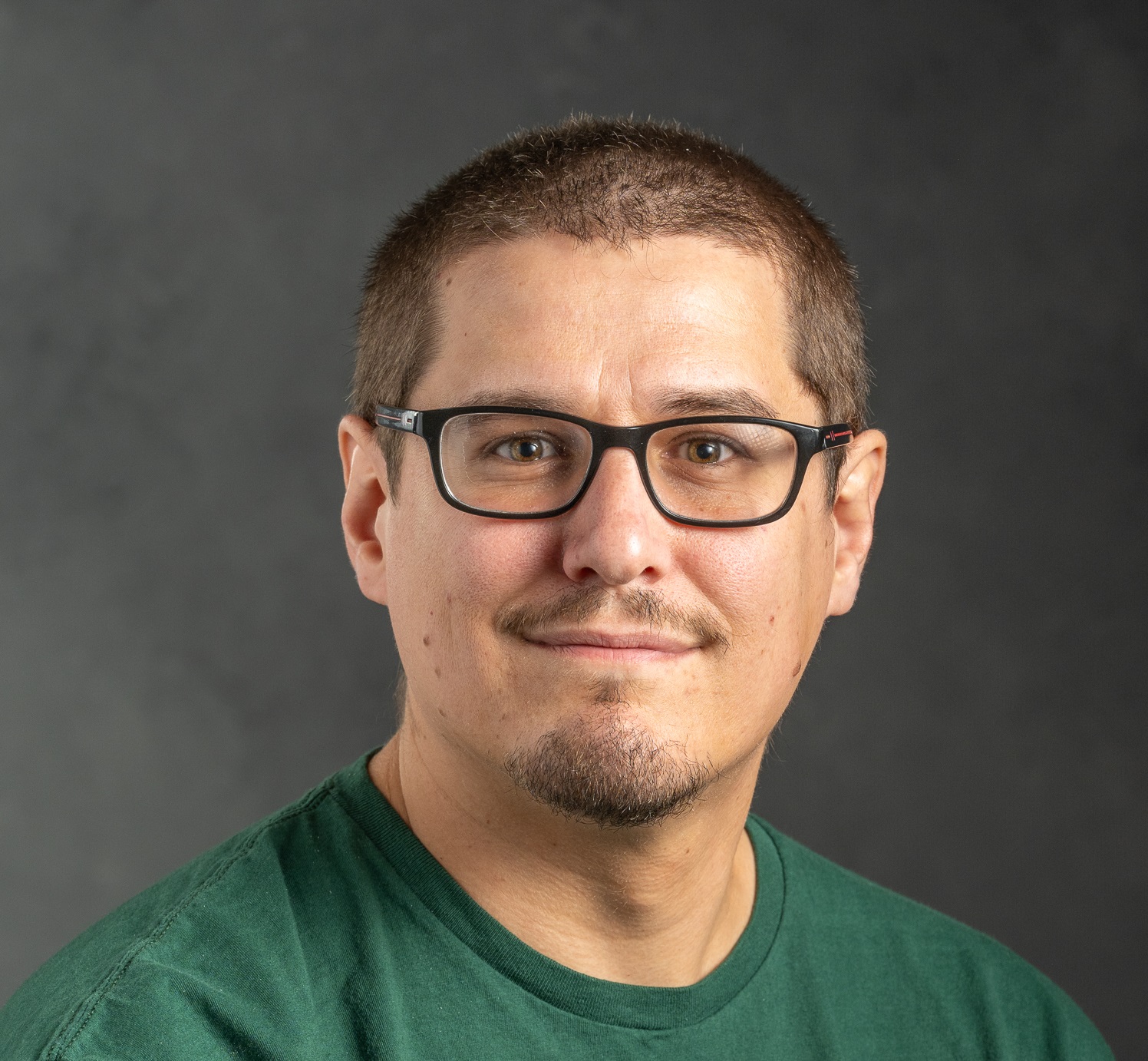
Christian A Parkinson is an Assistant Professor at Michigan State University , affiliated with the Departments of Mathematics and Computational Mathematics, Science and Engineering. His research spans mathematical modeling, computational methods, and interdisciplinary applications in epidemiology, control theory, and differential geometry. Research Interests : Mathematical epidemiology, path planning algorithms, reaction-diffusion systems, stochastic modeling, differential geometry, and network science. Email : chparkin@msu.edu His recent publications focus on: Hamilton-Jacobi equations for optimal path planning in multi-agent systems Reaction-diffusion models for epidemics with human behavior Differential geometry approaches to hyperbolic surfaces Network models for disease-opinion coevolution Environmental crime modeling using level sets He teaches MTH 890: Readings in Mathematics , emphasizing advanced computational and theoretical frameworks.
Herb Winful is a Professor of Optics at the University of Michigan's College of Engineering, Department of Electrical and Computer Engineering. He specializes in nonlinear optics, laser physics, quantum tunneling , and photonics , with a focus on phenomena like superluminal group velocities, frequency comb generation, and light storage via stimulated Brillouin scattering. Research areas span quantum tunneling times , nonlinear photonic materials , and coherent beam combining in fiber laser arrays. His work includes frequency comb spectroscopy using quantum-well diode lasers, ultrafast erbium fiber lasers , and negative group delay engineering in birefringent waveguides. The article list reveals expertise in supercontinuum generation , evanescent wave dynamics , photonic crystals , and nonlinear pulse manipulation . Key subfields include stimulated Brillouin/Raman scattering , parabolic similaritons , and time-domain modeling of optical systems. Award-winning scientific contributions include resolving the Hartman effect paradox and optimizing fiber laser arrays for high-power applications. His research bridges theoretical insights with practical innovations in optical engineering and quantum optics .
Professor Isabella Dobrescu is Head of the School of Economics at the University of New South Wales (UNSW) Business School and co-chair of the STEP UP initiative in Education. She serves as an editor for the Journal of Pension Economics & Finance and maintains an active research program spanning labor economics, public finance, health economics, and applied econometrics. Her educational background includes a Ph.D. in Economics with Honors from the University of Padua (2009), an M.Sc. in Economic Mathematical Modeling Summa cum Laude from West University of Timisoara (2005), and dual bachelor's degrees in Economics from Nottingham Trent University and Finance Summa cum Laude from West University of Timisoara (2003). Dobrescu's research has evolved from structural work on consumption and saving dynamics to pioneering applications combining theory, empirical analysis, and randomized controlled trials to improve educational outcomes through technology. Her recent work focuses on financial literacy interventions for high school students through the STEP UP program, while maintaining her longstanding research on aging populations, retirement decision-making, and risk behavior. Her publication portfolio demonstrates consistent output across labor economics, health economics, and applied econometrics, with recent emphasis on educational technology interventions and financial decision-making in retirement contexts. The research shows methodological diversity spanning structural modeling, nonparametric partial identification techniques, and experimental approaches. UNSW Business School Research Impact Award (2021) UNSW President's Award for Building Collaborations (2019) UNSW Scientia Education Fellowship (2017) Australian Government Office of Learning & Teaching Citation (2016) ARC Early Career Research Fellowship (2012) Dobrescu has secured over AU$2.5 million in competitive research funding since 2010, including major ARC Linkage grants and substantial UNSW strategic investments. She leads the STEP UP initiative which has received over AU$650,000 in funding for financial literacy outreach programs. Her collaborative approach is evident in numerous multi-investigator projects with colleagues including Bateman, Thorp, Motta, and Newell across economics, finance, and education domains. As Head of the School of Economics and co-chair of STEP UP, Dobrescu leads research teams focused on educational interventions using technology, retirement decision-making, and the economics of aging. Her Playconomics platform represents a significant innovation in experiential economics education, receiving media coverage from major outlets including The Sydney Morning Herald and The Australian.
Fabio Furini is an Associate Professor at the Department of Computer Science, Automatics, and Management (DIAG) at Sapienza University of Rome since September 2021. Prior to this position, he served as a CNR researcher at IASI-CNR in Rome (2020-2021), Maître de Conférences at Université Paris-Dauphine, France (2013-2019), postdoctoral researcher at Université Paris-13, France (2012-2013), and research fellow at the University of Bologna (2011-2012). His educational background includes a Ph.D. in Control Engineering and Operations Research from the University of Bologna in 2011. He further obtained the Habilitation à Diriger des Recherches (HDR) in France in 2017 and the National Scientific Qualification for Full Professor in Operations Research in Italy in 2019. Fabio Furini conducts theoretical and methodological research on Combinatorial Optimization and Operations Research. His primary focus is on developing exact algorithms based on decomposition and reformulation techniques for integer linear programming problems. His research spans various applications including network optimization, graph theory, and combinatorial problems such as the maximum clique problem, bin packing problem, and vertex separator problem. His work often bridges theoretical developments with practical applications in transportation, logistics, and network security. His recent publications demonstrate a strong focus on exact algorithms for combinatorial optimization problems, particularly in network interdiction, bin packing with temporal constraints, and graph-based problems. His work consistently combines integer programming techniques with combinatorial search methods to develop novel formulations and efficient solution approaches that advance the state-of-the-art in these domains. Among his notable scientific awards are the Prime d'encadrement doctoral et de recherche (PEDR), which he received annually from 2014 to 2020, recognizing him among the top 15% of researchers in the French university system. He also holds the prestigious Habilitation à Diriger des Recherches from France (2017) and the National Scientific Qualification for Full Professor in Operations Research from Italy (2019). Fabio Furini has been actively involved in supervising PhD students and has served as principal investigator for numerous national and international research projects. His extensive network includes over 60 co-authors across European and American universities. He is also a member of the editorial boards for three prestigious international journals: Omega, Annals of Operations Research, and Discrete Applied Mathematics. His research activities include collaborations with various institutions across Europe and the United States, including Imperial College London and the University of Colorado. These collaborations have resulted in a robust research program focused on advancing the theoretical foundations and practical applications of combinatorial optimization.
Saleh Javadi is a Senior Lecturer at the Department of Mathematics and Natural Sciences at Blekinge Institute of Technology (BTH) in Karlskrona, Sweden. He is actively engaged in research and teaching within the field of systems engineering. His educational background includes: B.Sc. in Electrical-Control Engineering from Amirkabir University of Technology (2009) M.Sc. in Electrical, Electronic and Systems Engineering from The National University of Malaysia (2013) Ph.D. in Systems Engineering from Blekinge Institute of Technology (BTH) (2021) Saleh Javadi's research focuses on signal processing, machine learning, and computer vision , with applications spanning remote sensing, intelligent transportation systems, and AI-driven industrial optimization. His work bridges theoretical advancements with practical implementations, particularly in SAR imagery analysis, drone-based agricultural monitoring, and traffic surveillance systems. His recent publications demonstrate a strong focus on remote sensing technologies, particularly Synthetic Aperture Radar (SAR) image processing and analysis. There's a clear trend toward applying machine learning techniques to solve complex problems in aerial and satellite imagery, traffic monitoring, and agricultural applications. His research shows interdisciplinary connections between computer vision, signal processing, and practical engineering applications. Saleh Javadi has received significant recognition for his innovative work: Innovator of the Year award (SKAPA – Innovation Prize in Memory of Alfred Nobel) in Blekinge for innovative efforts in optimizing and reducing energy consumption in industries by using artificial intelligence ÅForsk Entrepreneur's prize at the Swedish Innovation Council Day – Swedish Incubators & Science Park's annual conference in May 2019 Dr. Javadi is involved in practical applications of his research through projects such as "Artificiell intelligens AI kan reducera ogräsfrön i utsäde" (ongoing) and "Bekämpa Renkavle med hjälp av drönare och Artificiell Intelligens (AI)" (completed). His work demonstrates a strong commitment to translating academic research into real-world solutions that address industrial and environmental challenges. His research appears to be conducted within a collaborative framework, working with colleagues on drone technology, SAR image analysis, and AI applications across multiple domains including agriculture, maritime monitoring, and transportation systems.
Bo Markussen is a Professor at the University of Copenhagen within the Department of Mathematical Sciences . He is also a member of the Data Science Laboratory , where he contributes to statistical methodology and interdisciplinary collaborations. His academic journey began with a Cand.Scient (MSc) and PhD in Statistics from the University of Copenhagen, awarded in 1998 and 2002 respectively. 2012–present: Professor, Department of Mathematical Sciences, University of Copenhagen 2009–2012: Associate Professor, Department of Basic Sciences and Environment, University of Copenhagen 2006–2009: Assistant Professor, Department of Basic Sciences and Environment, University of Copenhagen Bo Markussen's research focuses on applied statistics , particularly in functional data analysis and multiple testing corrections in genetics . His work spans diverse domains including environmental science, agriculture, and public health. Recent research output highlights applications in Arctic climate data analysis, fire risk modeling, plant stress phenotyping, and nutritional biomarker prediction. His recent publications demonstrate a strong trend toward machine learning integration with statistical modeling , addressing challenges in high-dimensional data analysis and environmental risk assessment. Collaborations span institutions in Denmark and internationally, reflecting his engagement in pan-Arctic climate studies and tropical agricultural research. 2018–present: Associate Editor, Scandinavian Journal of Statistics 2017–2019: Chair, Danish Society for Theoretical Statistics 2015–2017: Board Member, Danish Society for Theoretical Statistics As a central figure in the Data Science Laboratory , Markussen leads statistical consultancy initiatives and contributes to methodological advancements. His expertise bridges theoretical statistics with real-world applications, particularly in handling complex datasets across biological and environmental domains.
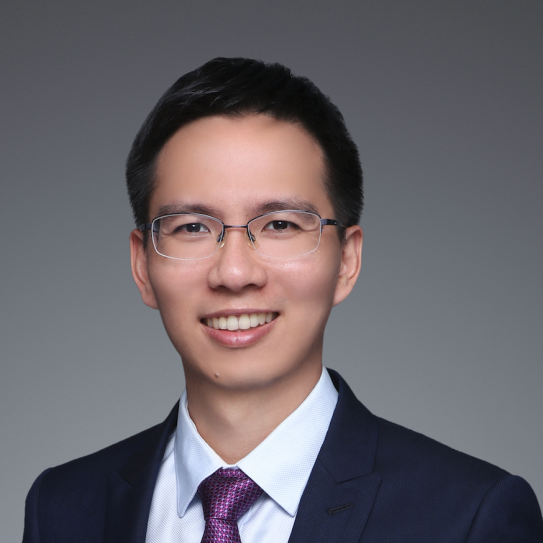
Zhibin Chen is an Assistant Professor of Engineering at NYU Shanghai and concurrently a Global Network Assistant Professor within the broader New York University system. Since January 2019 he has led research and teaching activities at the Division of Engineering and Computer Science in Shanghai, while maintaining university-wide collaborations through his Global Network appointment. Education Ph.D. in Transportation Engineering, University of Florida (2017) Research Interests Dr. Chen’s scholarship centres on Transportation Network Modeling and Optimization , Intelligent Transportation Systems , and Discrete Optimization . He integrates operations research, data science, and engineering to address emerging challenges in electric mobility, autonomous vehicles, and large-scale urban networks. Recent thrusts include: Data-driven analytics of electric-vehicle charging behaviour under usage heterogeneity. Optimization of charging and swapping infrastructure for electric buses and trucks. Network-level deployment and control strategies for connected and automated vehicles. Day-to-day traffic dynamics and equilibrium models with elastic demand. Pricing, policy, and incentive design for sustainable transportation systems. Scientific Awards Stella Dafermos Best Paper Award – awarded at the 95th Transportation Research Board Annual Meeting. Ryuichi Kitamura Paper Award – also conferred at the 95th TRB Annual Meeting. Editorial & Professional Service Dr. Chen currently serves on the Editorial Advisory Board of Transportation Research Part C: Emerging Technologies , shaping the editorial direction of the leading journal in his field. Grants & Collaborations While specific grant identifiers are not disclosed in the provided text, Dr. Chen’s extensive publication record in top-tier journals ( Transportation Science , Transportation Research Parts B, C, D , IEEE ITS , Applied Energy ) and his editorial role indicate sustained research funding and active collaboration with international partners across North America and China. Laboratories & Teams Operating within the Division of Engineering and Computer Science at NYU Shanghai , Dr. Chen leads a research group focused on next-generation mobility analytics, leveraging the university’s interdisciplinary ecosystem and NYU’s Global Network resources to advance smart and sustainable transportation.
Prof. Dr. Andrzej M Oleś serves as a Professor at the Institute of Theoretical Physics within the Faculty of Physics, Astronomy and Applied Computer Science at Jagiellonian University in Kraków, Poland. His research centers on condensed matter theory with emphasis on quantum materials and electronic structure phenomena. His primary research interests include spin-orbital coupling in transition metal compounds, electron correlation effects, doping mechanisms in metal oxides, and magnetic phenomena in antiferromagnetic/ferromagnetic systems. He employs advanced theoretical frameworks including model Hamiltonians and density functional theory to investigate quantum phases, lattice dynamics, and topological states in complex materials. Recent publications reveal a strong focus on kagome lattice systems (FeGe, RhPb), infinite-layer nickelates, and quantum computation optimization. His work demonstrates consistent exploration of charge density waves, topological surface states, and nonadiabatic quantum control across high-impact journals including Physical Review series and Condensed Matter. Oleś maintains an extensive international collaboration network with researchers from Italy, the United States, and other European institutions, as evidenced by co-authorship patterns across his publication record. His theoretical contributions address fundamental challenges in strongly correlated electron systems and quantum material design.
Dr. Clint Beiermann is an Assistant Professor in the Department of Plant Sciences at the University of Wyoming, specializing in Forage Crop Production and Weed Management. He holds a Ph.D. in Agronomy and Horticulture (Weed Science) from the University of Nebraska-Lincoln (2020), an M.S. in Agronomy (2017), and a B.S. in Agroecology with a Soil Science minor (2012) from the University of Wyoming. His research focuses on enhancing forage crop productivity and resilience through agronomic practices and weed management strategies. Key areas include crop-weed competition dynamics, herbicide efficacy against resistant weeds (e.g., Palmer amaranth), and optimizing weed removal timing in dry bean and forage systems. He actively seeks graduate students passionate about applied field weed science and forage crop systems. Teaching responsibilities include courses such as PLNT 2200 (Field Crop Production), PLNT 3030 (Ecology of Plant Protection), and PLNT 3031 (Applied Plant Protection). His peer-reviewed publications emphasize integrated pest management, herbicide strategies for weed control in crops, and plant breeding advancements (e.g., hard red spring wheat varieties). Research trends reflect a focus on sustainable agricultural practices, herbicide resistance mitigation, and precision agronomy. Dr. Beiermann’s work bridges applied research and practical solutions for agricultural challenges, with contributions to both forage and grain crop systems.
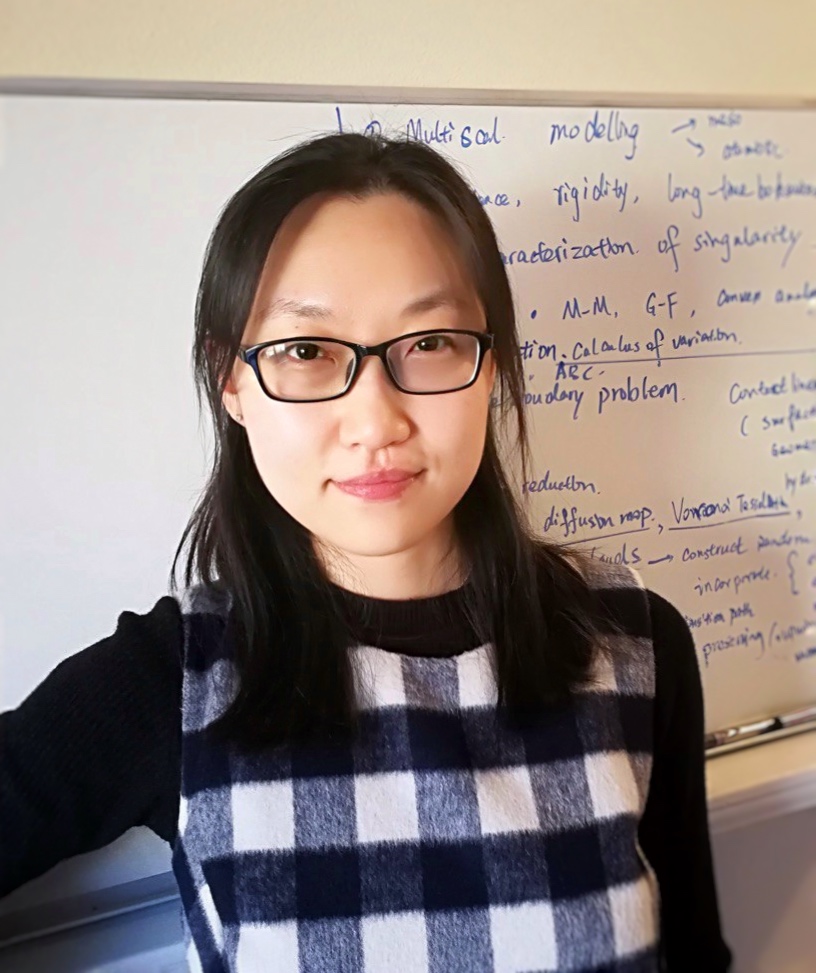
Yuan Gao is an Assistant Professor of Mathematics at Purdue University's Department of Mathematics (College of Science). His research focuses on analysis and computations of PDEs in materials science, biology, and microfluidics, with recent emphasis on optimal control, Hamilton-Jacobi equations, and non-equilibrium chemical reactions. His work is supported by NSF awards DMS-2204288 and DMS-2440651. Previously, he held the William W. Elliott Assistant Research Professor position at Duke University (2019-2021). Research interests include PDE analysis in materials science (crystal growth, dislocation dynamics), numerical methods for interface dynamics, applied stochastic analysis (Langevin dynamics, transition path theory), and mean-field games for fluid systems. He organizes the PSU-Purdue-UMD Joint Seminar on Mathematical Data Science. Key publications span topics like dislocation evolution, Wasserstein gradient flows, and stochastic algorithms for rare events. Awards include NSF CAREER funding recognizing his contributions to mathematical analysis of non-equilibrium systems.
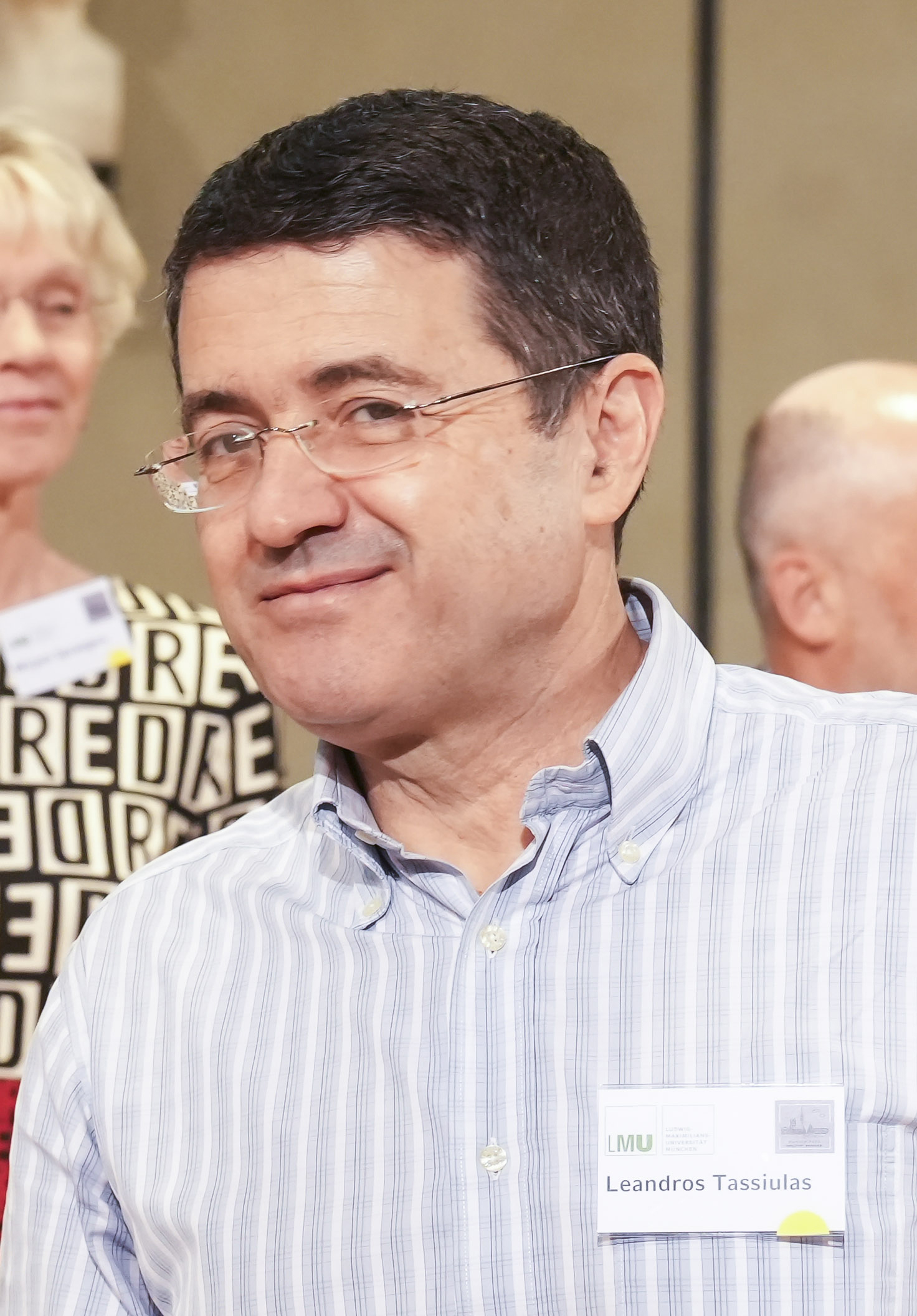
Leandros Tassiulas is the John C. Malone Professor of Electrical Engineering at Yale University, with additional appointments in Computer Science. His career spans faculty positions at the University of Thessaly, University of Maryland, University of Ioannina, and Polytechnic University. A Fellow of both IEEE (2007) and ACM (2020), he is renowned for contributions to network control theory, including the max-weight scheduling algorithm and back-pressure network policy. PhD in Electrical Engineering (1991) from the University of Maryland, College Park His research focuses on computer and communication networks , emphasizing mathematical models for complex networks , wireless system architectures , stochastic systems , and energy-efficient network design . Recent work explores quantum networking (Pant et al., 2019) and federated learning in edge environments (Jiang et al., 2022). Key publication trends include stability analysis (earlier works), mobile edge computing (2019), software-defined networking (2021), and smart grid optimization (2012-2013). The list includes monographs on network theory and patents for distributed bandwidth allocation (2011) and directional antenna protocols (2002). Scientific Awards ACM Fellow (2020) for network control contributions IEEE Koji Kobayashi Award (2016) for scheduling/stability analysis IEEE INFOCOM Achievement Award (2007) for resource allocation Bodossaki Foundation Prize (1999) for distributed systems NSF CAREER, ONR Young Investigator, and multiple best paper awards His work has been funded by the NSF, ONR, and IBM. Current projects bridge AI , quantum communication , and next-generation network architectures .
Dr. Chen Wang is an Assistant Professor in the Department of Computer Science and Engineering at the University at Buffalo. He holds a PhD from Nanyang Technological University and a B.Eng from the Beijing Institute of Technology. His research focuses on robotic perception, vision, and learning, emphasizing algorithm development for autonomous systems. He is affiliated with the Spatial AI and Robotics Lab (SAIR Lab) and serves as an Associate Editor for The International Journal of Robotics Research (IJRR) and IEEE Robotics and Automation Letters (RA-L) . His work spans neuro-symbolic AI, SLAM systems, and reinforcement learning for robotics. Dr. Wang's research interests include creating efficient algorithms with theoretical guarantees, open-source distribution, and real-world validation. He has contributed to areas like visual navigation, few-shot detection, and robot autonomy frameworks. His educational background in electrical engineering and robotics underscores his expertise in bridging theory and practical applications. Notable contributions include the iWalker framework for humanoid robots, AirSLAM for visual SLAM, and SuperPC for 3D point cloud processing. His editorial roles and conference service (e.g., CVPR Area Chair) reflect his leadership in the field. The SAIR Lab under his direction advances spatial AI, robotics, and autonomous systems through interdisciplinary collaboration.
Dr. Mehrdad Moallem is a Professor and Graduate Student Supervisor in the Department of Mechatronic Systems Engineering at Simon Fraser University (SFU). He holds a Ph.D. in Electrical & Computer Engineering from Concordia University (1997), an M.Sc. from Sharif University (1988), and a B.Sc. from Shiraz University (1986). His research focuses on control systems in sustainable energy, power electronics, energy harvesting, robotics, and embedded systems. He has authored/co-authored four technical books and serves on editorial boards for journals like IEEE/ASME Transactions on Mechatronics. Dr. Moallem has held academic roles at Duke University and the University of Western Ontario. His teaching includes courses on real-time control systems, mechatronics design, and microprocessors. Research interests span embedded control systems, nonlinear dynamics, and applications in renewable energy and robotics. Recent work includes IoT-enabled lighting systems for agriculture, RF cavity control, and smart energy harvesting. He emphasizes hands-on student projects and industry collaboration, such as the Siemens Certification Program and Industry 4.0 bootcamps. Dr. Moallem's lab develops innovative solutions for energy efficiency and automation, with a focus on sustainable systems and smart manufacturing. He actively advises graduate students on advanced topics like grid-connected inverters, motor drives, and vibration control.
Vanessa Bowden is a Senior Lecturer in the School of Psychological Science at The University of Western Australia. She serves as Graduate Research Coordinator for the School, Deputy Director of the Master of Industrial and Organisational Psychology program, and Co-Director of the Human Factors and Applied Cognition Laboratory. Her academic credentials include a PhD from The University of Western Australia and a Graduate Diploma in Human Factors and Safety Management Systems from the University of South Australia. Dr. Bowden's research expertise spans multiple domains within human factors and cognitive psychology. Her primary research interests include: Human interaction with technological systems Automation design and human-automation interaction Driver distraction and transportation safety Cognitive processes in complex work settings Situation awareness and workload management Prospective memory in applied contexts Her recent research has focused on understanding how humans interact with automated systems across various domains, from driving to air traffic control. Dr. Bowden has developed computational models of human decision-making with automated advice and has investigated the impact of automation transparency on operator performance. Her work has important implications for designing safer technological systems that optimize human performance. Dr. Bowden has received significant research funding, including an Australian Research Council Discovery grant (2024) for $924,198 for "A Unified Computational Model of How Humans Use Automated Advice" and multiple Department of Defence grants. Her research has been published extensively in top-tier journals in human factors and cognitive psychology. She has supervised numerous research students and currently accepts PhD and other Higher Degree by Research students. Dr. Bowden teaches several courses including Psychology of Training (PSYC5573), Industrial and Organisational Psychology (PSYC3309), and Perception and Sensory Neuropsychology (PSYC3318).
Professor Gareth Pierce is a leading academic at the University of Strathclyde, serving as Co-Director of the Centre for Ultrasonic Engineering and Academic Director of the UK Research Centre in Non-Destructive Evaluation (RCNDE). He specializes in robotics, autonomous systems, and non-destructive evaluation (NDT&E), with a focus on structural health monitoring (SHM) and advanced manufacturing. His work integrates robotics, AI, and ultrasonics to address challenges in aerospace, energy, and healthcare sectors. He holds a Spirit Aerosystems/Royal Academy of Engineering Research Chair and leads the £50M SEARCH (Sensor Enabled Automation, Robotics & Control Hub), which spans manufacturing and asset management applications. Education: BSc (Hons) in Pure and Applied Physics from the University of Manchester (1989), PhD in Fibre-Optic Interferometers for Laser-Generated Ultrasound from UMIST (1993). Additional qualifications include City & Guilds certifications in electrical installations and a PGDip in Psychological Wellbeing. Research Priorities Autonomous robotic inspection for manufacturing and asset management Integration of AI/machine learning with NDT&E systems In-process inspection for additive manufacturing and welding Ultrasonic and guided wave technologies for defect detection Key Achievements 2023 Anne Birt Award for NDT innovation Leadership roles in SRPe Robotics & UK HVM Catapult initiatives Over 270 research outputs, 86 projects, and a £50M research portfolio Teaching Course organiser for EE312 (Instrumentation & Microcontrollers) and contributes to advanced systems engineering education. Supervises student projects across engineering disciplines. Labs & Collaborations SEARCH Hub operates from Royal College R2.41 (manufacturing applications) and Technology Innovation Centre TIC 7.14 (asset management). Collaborates with global industry partners like Spirit Aerosystems and Högskolan Väst (Sweden).