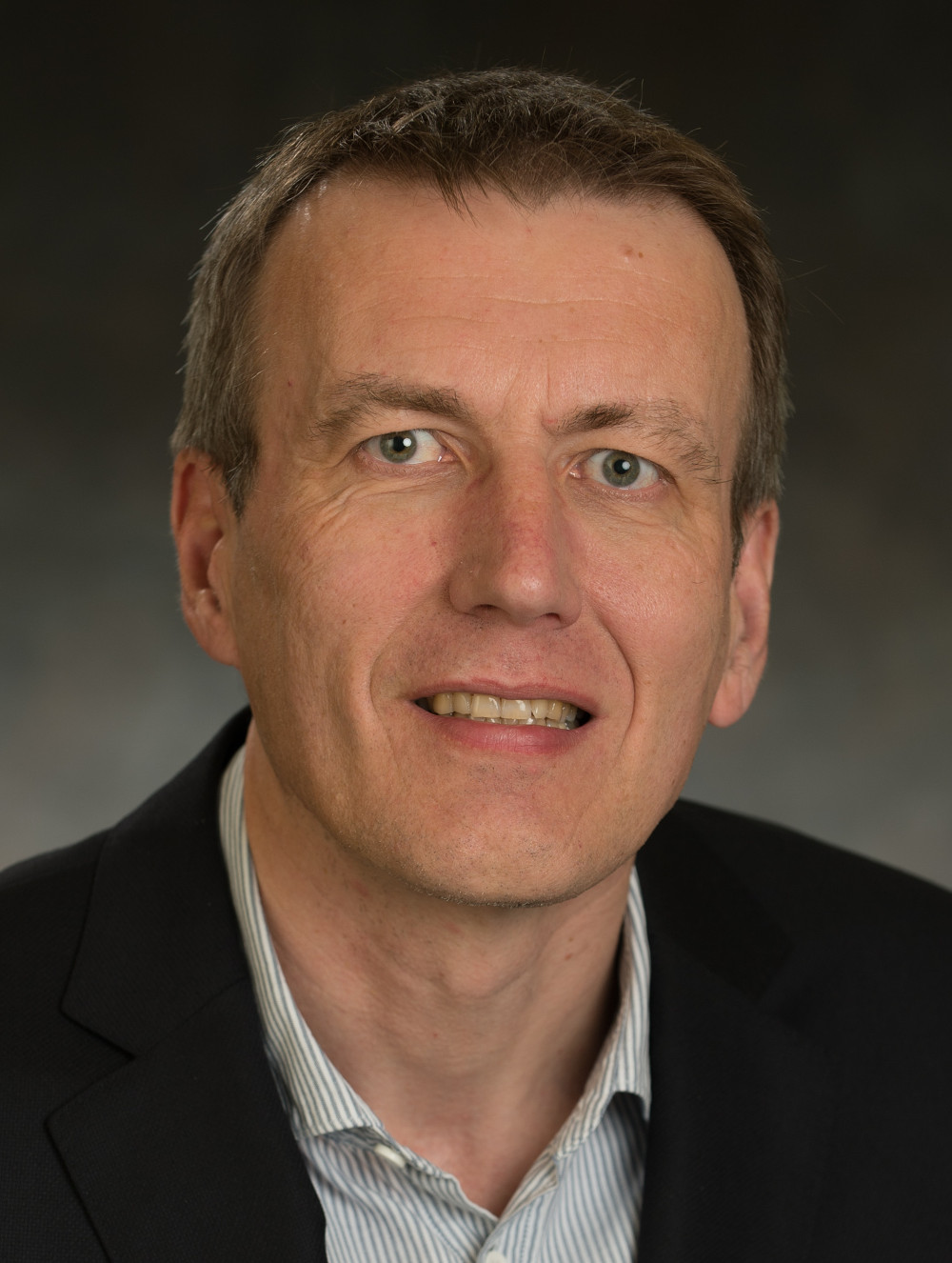
Lieven Vandenberghe is a Professor in the Electrical and Computer Engineering Department and Department of Mathematics at the University of California, Los Angeles (UCLA). His research focuses on convex optimization, semidefinite programming, and applications in signal processing, system identification, and control theory. Books: Co-author of Convex Optimization (2004) and Introduction to Applied Linear Algebra (2018) Courses: Teaches graduate-level courses in linear programming, convex optimization, and numerical computing (ECE236A/B/C, ECE133A/B) Software: Developer of CVXOPT, CHOMPACK, and SMCP for optimization algorithms His research group has produced significant work in sparse matrix computations, operator splitting methods, and applications to machine learning and control systems. Publications span topics like Bregman splitting, proximal gradient methods, and semidefinite programming for signal processing. His advisees include PhD students in optimization and postdoctoral researchers in applied mathematics.
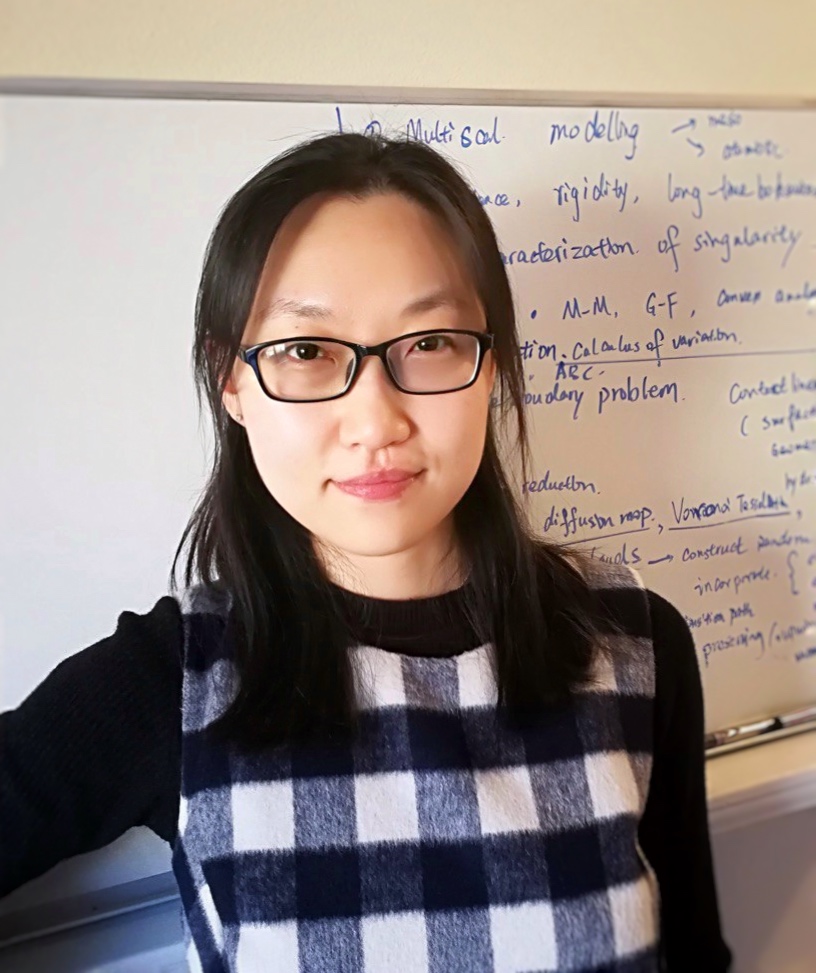
Yuan Gao is an Assistant Professor of Mathematics at Purdue University's Department of Mathematics (College of Science). His research focuses on analysis and computations of PDEs in materials science, biology, and microfluidics, with recent emphasis on optimal control, Hamilton-Jacobi equations, and non-equilibrium chemical reactions. His work is supported by NSF awards DMS-2204288 and DMS-2440651. Previously, he held the William W. Elliott Assistant Research Professor position at Duke University (2019-2021). Research interests include PDE analysis in materials science (crystal growth, dislocation dynamics), numerical methods for interface dynamics, applied stochastic analysis (Langevin dynamics, transition path theory), and mean-field games for fluid systems. He organizes the PSU-Purdue-UMD Joint Seminar on Mathematical Data Science. Key publications span topics like dislocation evolution, Wasserstein gradient flows, and stochastic algorithms for rare events. Awards include NSF CAREER funding recognizing his contributions to mathematical analysis of non-equilibrium systems.
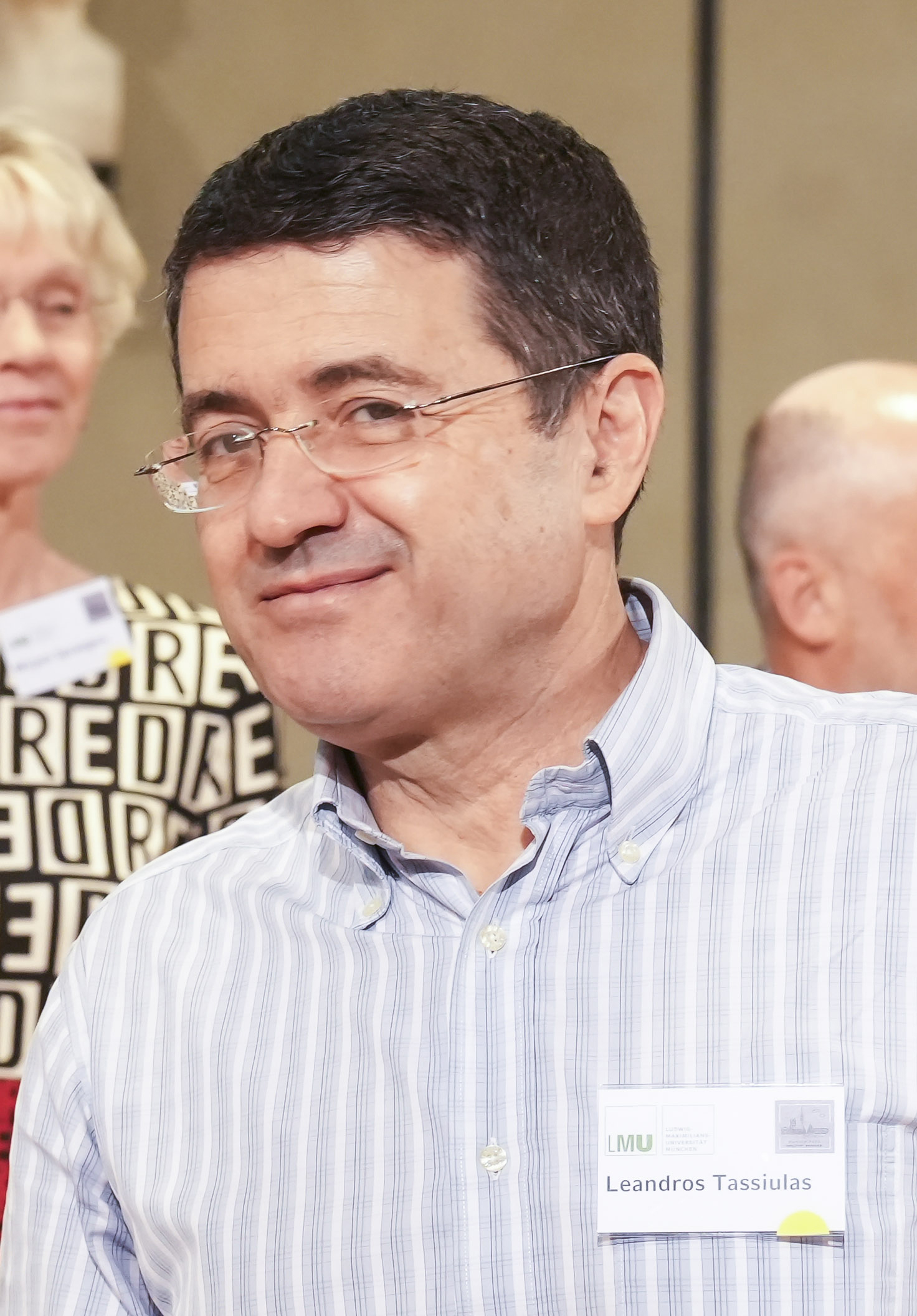
Leandros Tassiulas is the John C. Malone Professor of Electrical Engineering at Yale University, with additional appointments in Computer Science. His career spans faculty positions at the University of Thessaly, University of Maryland, University of Ioannina, and Polytechnic University. A Fellow of both IEEE (2007) and ACM (2020), he is renowned for contributions to network control theory, including the max-weight scheduling algorithm and back-pressure network policy. PhD in Electrical Engineering (1991) from the University of Maryland, College Park His research focuses on computer and communication networks , emphasizing mathematical models for complex networks , wireless system architectures , stochastic systems , and energy-efficient network design . Recent work explores quantum networking (Pant et al., 2019) and federated learning in edge environments (Jiang et al., 2022). Key publication trends include stability analysis (earlier works), mobile edge computing (2019), software-defined networking (2021), and smart grid optimization (2012-2013). The list includes monographs on network theory and patents for distributed bandwidth allocation (2011) and directional antenna protocols (2002). Scientific Awards ACM Fellow (2020) for network control contributions IEEE Koji Kobayashi Award (2016) for scheduling/stability analysis IEEE INFOCOM Achievement Award (2007) for resource allocation Bodossaki Foundation Prize (1999) for distributed systems NSF CAREER, ONR Young Investigator, and multiple best paper awards His work has been funded by the NSF, ONR, and IBM. Current projects bridge AI , quantum communication , and next-generation network architectures .
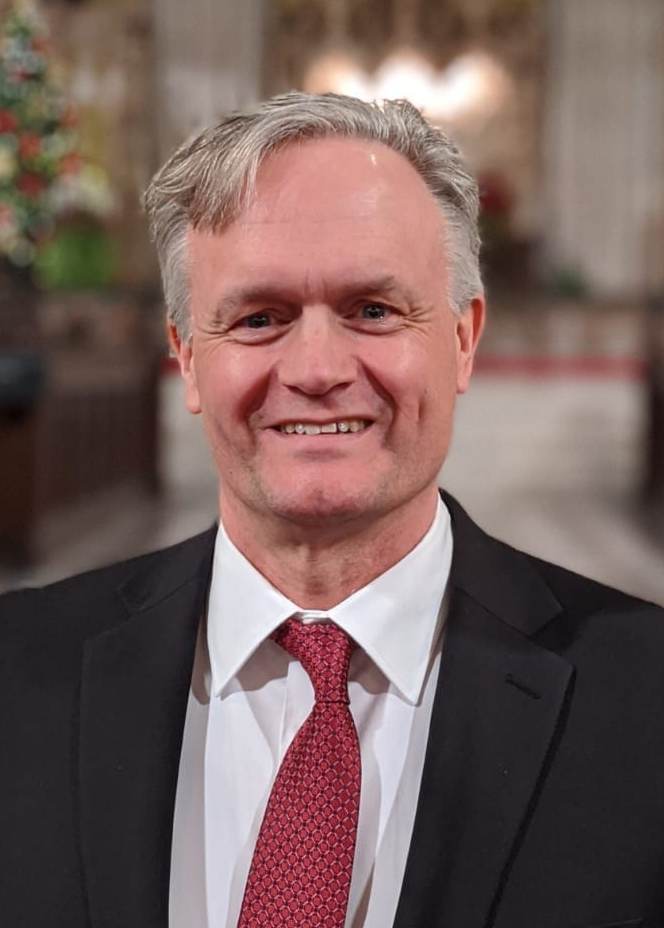
Dr. Constantin Christof is a Lecturer (Akademischer Rat auf Zeit) at the Department of Mathematics , Technische Universität München , with prior roles as a W2 Stand-in Professor at Universität Augsburg and Research Associate at TUM and TU Dortmund. His research focuses on Optimal Control of PDEs , Variational Inequalities , and Nonsmooth Optimization , with applications in Non-Newtonian Fluids and Neural Networks . May 2015 - July 2018: Dr. rer. nat. in Mathematics, TU Dortmund Oct. 2013 - July 2014: MAST (Part III of Mathematical Tripos), University of Cambridge Oct. 2009 - Sept. 2012: B.Sc. in Technomathematics and Mathematics, TU Dortmund Christof's work bridges Finite Element Error Analysis , Sensitivity Analysis , and Physics-Guided Machine Learning , particularly in problems involving Contact Mechanics and Parabolic PDE Constraints . His recent publications address challenges in Semilinear Elliptic PDEs , Obstacle Problems , and Nonsmooth Superposition Operators , with a focus on theoretical and numerical advancements. Scientific awards include the Dissertation Award and Best Graduate Award from TU Dortmund, and the Award for Academic Excellence by the Minister President of North Rhine-Westphalia. He has supervised 11 theses at the Master's and Bachelor's levels, covering topics from Neural Network Surrogate Models to Bingham Fluid Simulations .
Alfio Grillo is a Full Professor at the Department of Mathematical Sciences (DISMA) of Politecnico di Torino, with research interests in biomechanics, continuum mechanics, and mathematical physics. His expertise spans classical mechanics and multiscale modeling of biological tissues. Research Focus: Grillo's work integrates analytical mechanics with nonholonomic constraints, fractional calculus applications, and multiscale modeling of growth/remodeling phenomena in biological systems. Recent articles emphasize poroelasticity, viscoelastic composites, and bi-phasic material behavior. Scientific Contributions: Editorial roles in leading journals since 2014 Member of INdAM-GNFM since 2009 Recipient of National Scientific Qualification in 2017 €128,609 PRIN grant for multiscale biological modeling Academic Leadership: Supervises PhD students in Civil Engineering, Mathematics, and Mathematical Engineering. Teaches advanced courses in Differential Varieties, Variational Methods, and Porous Media Mechanics.
William R. Cluett is a Professor at the University of Toronto's Department of Chemical Engineering & Applied Chemistry within the Faculty of Applied Science and Engineering. He holds a B.Sc. from Queen’s University and a Ph.D. from the University of Alberta, and is a licensed Professional Engineer (P.Eng). Currently serving as Dean’s Advisor on Innovations in Undergraduate Education, Cluett bridges engineering principles with systems biology in his research. B.Sc., Queen’s University Ph.D., University of Alberta Cluett's research spans traditional process control and design, extending into systems biology where he collaborates with Professor Krishna Mahadevan. His work focuses on integrating engineering methodologies with biological systems, including multiscale modeling, dynamic metabolic engineering, and computational toxicology. His publications highlight trends in applying control theory to metabolic networks, developing algorithms for genome-scale modeling, and designing bistable cell factories. These contributions reflect interdisciplinary efforts between chemical engineering and computational biology. Scientific Awards & Recognitions: Fellow of Engineers Canada (2021) Medal for Distinction in Engineering Education (2021) OCUFA Teaching Award (2020) President’s Teaching Award (2018) Sustained Excellence in Teaching Award (2016) Bill Burgess Teacher of the Year Award (2014) Fellow, AAAS (2009) Fellow, Chemical Institute of Canada (1998) Syncrude Canada Innovation Award (1997) Cluett has contributed to major grants and collaborative projects in systems biology and metabolic engineering. He actively advises on undergraduate education innovations and maintains strong affiliations with the Department of Chemical Engineering & Applied Chemistry.
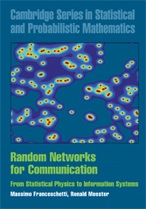
Massimo Franceschetti is a Professor in the Department of Electrical and Computer Engineering at the University of California, San Diego (UCSD), with faculty affiliation at Calit2. His research spans mathematical engineering, focusing on control, communication, computation, and sensing, particularly in complex networks and systems. He integrates tools from statistical physics, wave propagation, and information theory to analyze and design networked systems. Born in Naples, Italy, he studied at the University of Naples Federico II and the University of Edinburgh (European exchange program), graduating in 1997. He earned his M.Sc. (1999) and PhD (2003) from Caltech, where he received the Walker von Brimer Award and the C.H. Wiltz Prize for outstanding research and thesis. After postdoctoral work at UC Berkeley (2003-2004), he joined UCSD as faculty and held visiting positions at Vrije Universiteit Amsterdam, EPFL (Switzerland), and the University of Trento (Italy). He became an IEEE Fellow in 2018 and was nominated a Guggenheim Fellow in 2019. His research includes networked control systems , stochastic geometry , electromagnetic information theory , and social dynamical systems . Recent work explores non-invasive emotional contagion in social networks, quantum limits on information entropy, and the physics of wave propagation. His publications bridge information theory , machine learning , and network science , often applying percolation theory and random walks to explain scaling laws and wireless signal behavior. Scientific accolades include the S.A. Schelkunoff Transactions Prize , IEEE Communications Society Best Tutorial Paper Award , and the IEEE Ruberti Young Researcher Prize . He co-authored two books: Random Networks for Communication (2007) and Wave Theory of Information (2018). His students have pursued careers in academia (e.g., IIT-Bombay, Notre Dame) and industry (e.g., Google, IBM, Tesla). He teaches courses on network science , information theory , and control systems , emphasizing data-driven analysis and the physical foundations of communication. His group’s work impacts cyber-physical systems , quantum network coding , and epidemic modeling on networks .
Michael Fink is a researcher at the Chair of Automatic Control Engineering , Technical University of Munich . He holds an M.Sc. in Electrical Engineering and Information Technology (2020) and a B.Eng. in the same field from Technical University Munich and University of Applied Sciences Landshut (2018), respectively. Research Interests : Model Predictive Control (MPC) with focus on stochastic and robust variants Optimal control strategies for autonomous driving and vertical farming Constraint violation probability minimization in dynamic systems Publications span topics in: Time-optimal MPC for linear systems Stochastic and robust MPC frameworks Learning-based control for greenhouse climate systems Vertical farming optimization Contact: michael.fink@tum.de
Saleh Javadi is a Senior Lecturer at the Department of Mathematics and Natural Sciences at Blekinge Institute of Technology (BTH) in Karlskrona, Sweden. He is actively engaged in research and teaching within the field of systems engineering. His educational background includes: B.Sc. in Electrical-Control Engineering from Amirkabir University of Technology (2009) M.Sc. in Electrical, Electronic and Systems Engineering from The National University of Malaysia (2013) Ph.D. in Systems Engineering from Blekinge Institute of Technology (BTH) (2021) Saleh Javadi's research focuses on signal processing, machine learning, and computer vision , with applications spanning remote sensing, intelligent transportation systems, and AI-driven industrial optimization. His work bridges theoretical advancements with practical implementations, particularly in SAR imagery analysis, drone-based agricultural monitoring, and traffic surveillance systems. His recent publications demonstrate a strong focus on remote sensing technologies, particularly Synthetic Aperture Radar (SAR) image processing and analysis. There's a clear trend toward applying machine learning techniques to solve complex problems in aerial and satellite imagery, traffic monitoring, and agricultural applications. His research shows interdisciplinary connections between computer vision, signal processing, and practical engineering applications. Saleh Javadi has received significant recognition for his innovative work: Innovator of the Year award (SKAPA – Innovation Prize in Memory of Alfred Nobel) in Blekinge for innovative efforts in optimizing and reducing energy consumption in industries by using artificial intelligence ÅForsk Entrepreneur's prize at the Swedish Innovation Council Day – Swedish Incubators & Science Park's annual conference in May 2019 Dr. Javadi is involved in practical applications of his research through projects such as "Artificiell intelligens AI kan reducera ogräsfrön i utsäde" (ongoing) and "Bekämpa Renkavle med hjälp av drönare och Artificiell Intelligens (AI)" (completed). His work demonstrates a strong commitment to translating academic research into real-world solutions that address industrial and environmental challenges. His research appears to be conducted within a collaborative framework, working with colleagues on drone technology, SAR image analysis, and AI applications across multiple domains including agriculture, maritime monitoring, and transportation systems.
Bo Markussen is a Professor at the University of Copenhagen within the Department of Mathematical Sciences . He is also a member of the Data Science Laboratory , where he contributes to statistical methodology and interdisciplinary collaborations. His academic journey began with a Cand.Scient (MSc) and PhD in Statistics from the University of Copenhagen, awarded in 1998 and 2002 respectively. 2012–present: Professor, Department of Mathematical Sciences, University of Copenhagen 2009–2012: Associate Professor, Department of Basic Sciences and Environment, University of Copenhagen 2006–2009: Assistant Professor, Department of Basic Sciences and Environment, University of Copenhagen Bo Markussen's research focuses on applied statistics , particularly in functional data analysis and multiple testing corrections in genetics . His work spans diverse domains including environmental science, agriculture, and public health. Recent research output highlights applications in Arctic climate data analysis, fire risk modeling, plant stress phenotyping, and nutritional biomarker prediction. His recent publications demonstrate a strong trend toward machine learning integration with statistical modeling , addressing challenges in high-dimensional data analysis and environmental risk assessment. Collaborations span institutions in Denmark and internationally, reflecting his engagement in pan-Arctic climate studies and tropical agricultural research. 2018–present: Associate Editor, Scandinavian Journal of Statistics 2017–2019: Chair, Danish Society for Theoretical Statistics 2015–2017: Board Member, Danish Society for Theoretical Statistics As a central figure in the Data Science Laboratory , Markussen leads statistical consultancy initiatives and contributes to methodological advancements. His expertise bridges theoretical statistics with real-world applications, particularly in handling complex datasets across biological and environmental domains.
Jie M. Zhang is an Assistant Professor in the Department of Informatics at King's College London, specializing in the intersection of software engineering and artificial intelligence. Her research focuses on two main directions: AI for Software Engineering (leveraging AI technologies to automate software tasks) and Software Engineering for AI (applying SE principles to enhance AI system trustworthiness). Her educational background includes a PhD in Computer Science from Peking University, where she was supervised by Professors Lu Zhang and Dan Hao. Prior to joining King's College London, she was a Research Fellow at University College London working with Professor Mark Harman and Professor Federica Sarro. Dr. Zhang's research interests center on software testing, machine learning trustworthiness, fairness testing, bias mitigation in AI systems, and program analysis. Her work particularly examines how large language models can be utilized for code generation, test case creation, and program repair, while also developing techniques to detect and fix issues within AI models. Her recent publications demonstrate strong trends in evaluating and enhancing the trustworthiness of AI-generated code, with specific emphasis on fairness testing across various domains including autonomous driving systems, machine translation, and decision-making software. Her research increasingly focuses on the efficiency of generated code and detecting hallucinations in large language models. 2025 ACM Sigsoft Early Career Researcher Award for pioneering contributions to software engineering for AI IEEE TSE 2024 Best Paper Award for 'Stealthy Backdoor Attack for Code Models' FSE 2025 Distinguished Paper Award Royal Society International Exchange Grant recipient NMES Enterprise & Engagement Partnerships Fund recipient Dr. Zhang has served in numerous leadership roles across major software engineering conferences including as General Chair for AIware 2025, Area Chair for ASE 2025, and Steering Committee Member for ICST. She has advised multiple PhD students and received significant research funding for her work on LLMs and software engineering. Her research group collaborates with industry partners including Huawei and Facebook, and she leads projects such as ITEA GENIUS and ITEA GreenCode. She is actively involved with King's College London research hubs including the Trusted Autonomous Systems Hub, Security Hub, and Software Systems group, where her work contributes to developing trustworthy AI systems across multiple domains.
Fotios Petropoulos is a Professor at the University of Bath, holding the Management Chair in Management Science within the School of Management's Information, Decisions & Operations department. He also served as the Spyros Makridakis Chair in Forecasting at the University of Nicosia (2023–2023). His research focuses on time series forecasting, judgmental approaches, and integrating statistical and human judgment in decision-making processes. He has contributed to improving forecasting accuracy through temporal aggregation and hierarchical methods. Petropoulos holds a Doctor of Engineering (2012) and Bachelor of Engineering (2007) from the National Technical University of Athens. Editor of the International Journal of Forecasting (2020–present) Associate Editor of Foresight: The International Journal of Applied Forecasting (2015–2022) Director of the International Institute of Forecasters (2016–2018) His research interests emphasize forecasting processes, model selection, and the role of judgment in statistical models. Key areas include temporal aggregation, forecast reconciliation, and behavioral operations analytics. He has published over 100 peer-reviewed articles, focusing on topics like computational cost optimization, probabilistic forecasting, and scalable reconciliation methods. His work contributes to Sustainable Development Goals related to education and innovation. Recent articles highlight advancements in univariate forecasting efficiency, forecast selection criteria, and dynamic reconciliation. Petropoulos is a member of the Smart Warehousing and Logistics Systems group and actively participates in editorial boards of leading forecasting journals. His academic and professional roles bridge theoretical research and practical applications in operational decision-making.
Arian Novruzi is a Full Professor in the Department of Mathematics and Statistics at the University of Ottawa, Faculty of Science. His expertise lies in partial differential equations (PDEs), shape optimization, numerical analysis, and mathematical modeling. He holds an MSc from the University of Tirana and a PhD from the University of Nancy. His research integrates theoretical and applied mathematics, with a focus on fluid dynamics, biomedical applications, and engineering challenges. Education: MSc in Mathematics, University of Tirana PhD in Mathematics, University of Nancy Dr. Novruzi’s research interests include the analysis and numerical solutions of PDEs, optimization of geometric shapes for engineering systems, and modeling of complex physical phenomena such as blood flow and tumor radiation therapy. His work bridges pure mathematics with practical applications, addressing problems in fluid mechanics, materials science, and biomedical engineering. His recent publications highlight advancements in non-diffusive neural network methods for hyperbolic conservation laws, blood flow modeling using Navier-Stokes equations, and the optimization of convex domains for energy maximization. These studies emphasize both theoretical rigor and computational innovation. Awards: No scientific awards explicitly mentioned in the provided texts. Dr. Novruzi has supervised students such as Terence C. Ngouoko. His grants and collaborations are not detailed here, but his research has implications for energy-efficient engineering designs and medical treatments. He has authored a Springer textbook on PDEs, reflecting his commitment to educational resources in mathematical sciences.
Professor Wang Li-Lian is a faculty member in the Division of Mathematical Sciences at Nanyang Technological University (NTU), Singapore. He holds the rank of Professor of Applied Mathematics and has been affiliated with NTU since 2006, progressing through roles including Assistant and Associate Professor before his current position. His research focuses on spectral methods, computational acoustics/electromagnetics, and PDE-based image processing. He has supervised multiple PhD and Master's students, including Zhang Jing, Gu Ying, Yang Zhiguo, and others. Education and career highlights include a Postdoctoral Research Associate at Purdue University (2002-2003), followed by a Visiting Assistant Professorship (2003-2005). His academic work spans spectral element methods, fractional differential equations, and high-order numerical techniques for wave scattering problems. Notable contributions include advancements in spectral-Galerkin methods for nonlocal operators and exact nonreflecting boundary conditions for Maxwell's equations. Research interests emphasize high-accuracy numerical schemes, with applications to fractional PDEs, metamaterial simulations, and image processing. His publications (over 100+ articles) reflect expertise in spectral methods, computational physics, and mathematical modeling. Teaching responsibilities include courses on partial differential equations, numerical analysis, and scientific computing.
Benjamin Bloem-Reddy is an Assistant Professor of Statistics at the University of British Columbia (UBC), affiliated with the Department of Statistics within the Faculty of Science. His research focuses on probabilistic approaches in statistics and machine learning, emphasizing symmetry, causality, and model-driven scientific knowledge acquisition. Prior to UBC, he completed his PhD under Peter Orbanz at Columbia University and a postdoc with Yee Whye Teh at the University of Oxford. He holds a physics background from Stanford and Northwestern Universities. Education: PhD in Statistics, Columbia University Postdoctoral Research, CSML Group, University of Oxford Physics degrees from Stanford and Northwestern Universities Research Interests: Bloem-Reddy explores symmetry in modeling and inference, causal discovery, and integrating scientific models with statistical frameworks. His work includes developing hypothesis tests for symmetry, causal inference via cocycles, and leveraging invariance properties in neural networks. He collaborates with scientists to apply statistical methods to domain-specific problems. Awards: Best Student Poster Award at NeurIPS 2014 Workshop on Networks Teaching & Advising: He teaches courses like STAT 460/560 (Statistical Inference) and advises a vibrant research group. His students include Boyan Beronov, Kenny Chiu, and Johnny Xi. He emphasizes recruiting curious, mathematically skilled students aligned with his research themes. Grants & Funding: Supported by NSERC, CANSSI, and UBC, with computational resources from ARC at UBC.