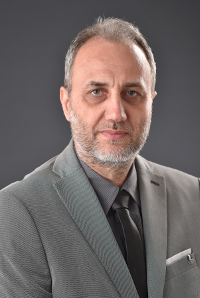
Nebojša Bačanin Džakula is an academic affiliated with Singidunum University's Faculty of Mathematics, specializing in Computer Science. He earned his PhD in 2015 with a thesis on improving swarm intelligence metaheuristics for global optimization. His research focuses on AI-driven solutions for cybersecurity, energy forecasting, and optimization algorithms. He has authored/co-authored books on cloud computing and web programming. His work bridges metaheuristics with machine learning, addressing challenges in IoT security, renewable energy prediction, and healthcare diagnostics. He actively contributes to conferences like Sinteza and IEEE events, emphasizing practical applications of AI and optimization in real-world scenarios. Education: Completed doctoral studies at the Faculty of Mathematics (2009–2015). Extensive industry certifications include Microsoft, CompTIA, and Oracle credentials, enhancing his technical expertise. Research Interests: Develops hybrid models combining metaheuristics (e.g., PSO, GA) with deep learning for tasks like intrusion detection, price forecasting, and medical diagnostics. Specializes in optimizing neural networks and feature selection using advanced algorithms. His work often addresses societal challenges in sustainability, cybersecurity, and healthcare. Recent Publications: Focus on AI-driven solutions for IoT security, renewable energy prediction, and medical diagnostics (e.g., Parkinson’s detection via LSTM networks). His articles appear in prestigious journals like Engineering Applications of Artificial Intelligence and Applied Soft Computing.
Miloš Racković serves as a full Professor in the Department of Mathematics and Informatics at the University of Novi Sad, Serbia. He maintains active academic engagement through the Laboratory for the development of information systems, with his office located in the Information technologies and systems office (DMI&DF) on the second floor, room 49. Contact is available via telephone (485)-2868 or email rackovic@dmi.uns.ac.rs, and his personal website (http://www.is.pmf.uns.ac.rs/rackovicm/) provides additional resources. His research spans foundational and applied computer science, with seminal contributions in fuzzy database systems including PFSQL query language development and prioritized fuzzy logic for relational databases and XML. He has pioneered deep learning methodologies through innovative classification techniques using negative and missing features in convolutional neural networks. Additional expertise includes high-performance computing implementations of Lattice Boltzmann methods using OpenCL, robotics (symbolic modeling and trajectory planning), and blockchain applications for Industry 4.0 production processes. His sports analytics work applies neural networks to basketball player and referee movement analysis. Analysis of his 2012-2025 publications reveals a strategic evolution toward interdisciplinary applications, particularly in industrial transformation (blockchain-enabled traceability) and sports analytics. His work consistently bridges theoretical computer science with practical implementations, demonstrating increasing focus on real-world problem solving while maintaining strong foundations in database theory and computational methods. Professor Racković leads the Laboratory for the development of information systems, which focuses on advancing information system methodologies through formal modeling extensions (including Petri net innovations) and practical implementations for uncertainty management. The laboratory's work spans from foundational research in fuzzy logic systems to applied projects in high-performance computing and blockchain integration, fostering innovation in information technology development.
Славица Кордић is an Associate Professor at the Department of Applied Computer Science, Faculty of Technical Sciences, University of Novi Sad. She has been employed at the institution since 1998 and holds the academic rank of ванредни професор. Her teaching responsibilities include multiple courses in undergraduate and master's programs related to computer science and informatics. She received her B.Sc. in Electrical Engineering (1998), M.Sc. in Technical Sciences (2006), and Ph.D. in Technical Sciences (2013), all from the Faculty of Technical Sciences, University of Novi Sad. Her research and professional focus lies in applied computer science and informatics, with contributions to the field through academic teaching and scholarly activities. She has been actively involved in the academic community at the Faculty of Technical Sciences, where she continues her role as a faculty member.
Marko T. Milojkovic is a full professor at the Faculty of Electronics, University of Nis, leading the Department of Automation since 2022. He holds a PhD in Systems Management (2012), Master's in Automation (2008), and a Bachelor's in Computer Engineering & Informatics (2003), all from the same institution. His research focuses on adaptive control systems, neural networks, and dynamical systems modeling, with 27 papers in impact-factor journals. He currently heads the Laboratory for Modeling, Simulation and Systems Management and participates in 2 national and 2 international projects. Education: PhD: Systems Management (2012) MSc: Automation (2008) BSc: Computer Engineering & Informatics (2003) Research interests include neuro-fuzzy systems, MIMO system optimization, and endocrine neural networks applied to adaptive control. His publications demonstrate expertise in quasi-orthogonal filters, sliding mode control, and time-series forecasting. No scientific awards are explicitly mentioned, but his extensive project participation highlights active collaboration in control systems and automation. Prof. Milojkovic's work bridges theoretical modeling and practical applications, with recent emphasis on intelligent control systems and nonlinear dynamics. His laboratory facilitates interdisciplinary projects addressing complex system management challenges.
Prof. Igor Dejanović is a Regular Professor at the Department of Informatics, Faculty of Technical Sciences, University of Novi Sad. He holds a BSc (2000) and MSc (2008) in Computer Science from the same institution, followed by a PhD in 2012 with a thesis on 'Contributions to Methods of Rapid Software Development Based on Extensible Domain-Specific Specifications'. Positions Held: 2000–2004: Technical Associate at Faculty Computing Center 2004: Selected as Assistant Professor 2008: Promoted to Assistant Professor 2012: Promoted to Associate Professor 2017: Promoted to Full Professor Research focuses on domain-specific languages, software patterns, model-driven development, and software configuration management. He has contributed extensively to software engineering methodologies and education in technical informatics.
Dr. Srboljub Simić is a full professor at the University of Novi Sad's Faculty of Science, Department of Mathematics and Informatics. His research focuses on applied analysis, particularly in fluid dynamics, thermodynamics, and mathematical physics. He specializes in multi-component gas mixtures, shock wave propagation, and non-equilibrium systems, with contributions to extended thermodynamics and kinetic models. His work bridges theoretical analysis and computational methods, addressing challenges in capillary phenomena, diffusion processes, and hyperbolic systems. Recent research emphasizes multi-temperature models for polyatomic gases and the mathematical treatment of shock structures. His articles explore entropy production, energy methods for Boltzmann equations, and numerical studies of diffusion in complex mixtures. These contributions advance understanding of rarefied gases and non-equilibrium flows, often employing advanced analytical techniques like the maximum entropy principle and asymptotic analysis. No scientific awards or grants are explicitly mentioned in the provided texts. Dr. Simić has not listed formal advisees, though his teaching includes courses like Mathematical Foundations of Economics and English language training for students. His professional activities include organizing academic events like the 7th International Congress of Serbian Society of Mechanics. Research collaborations and affiliations are centered within the university's mathematics and informatics department, with international involvement in fields like computational fluid dynamics and thermodynamic systems analysis.
Stefan Ćirković is a Teaching Associate in the Department of Information Technologies at the Faculty of Technical Sciences in Čačak, University of Kragujevac. His office is located at Saint Sava 65, 32102 Čačak, Serbia. He is currently pursuing doctoral studies in Information Technology (2023–present) at the same institution. Education: Doctoral Academic Studies – Information Technology, University of Kragujevac (2023–present) Master of Academic Studies – Information Technology, University of Kragujevac (2022–2023) Basic Academic Studies – Information Technology, University of Kragujevac (2018–2022) Specialized Program – Cybersecurity, University of Kragujevac (2024) Research Focus: Ćirković specializes in applied artificial intelligence with significant work in cybersecurity, medical imaging, and network systems. His research demonstrates strong emphasis on practical AI implementations including real-time object detection (YOLO algorithm), anomaly detection in networks, federated learning for healthcare applications, and cybersecurity techniques using large language models. His work frequently intersects with medical informatics, particularly in diagnostic applications. Publication Trends: Recent publications (2024–2025) show predominant focus on AI/ML applications across multiple domains. Cybersecurity remains a core theme with novel approaches to web application security and network anomaly detection. Medical applications feature prominently, especially in diagnostic imaging (kidney stones, skin cancer) and hemodialysis optimization. Methodologically, there's consistent exploration of deep learning architectures and real-time systems. Laboratory Affiliations: Associated with the Computer Science Laboratory at the Faculty of Technical Sciences in Čačak. Utilizes institutional resources including the Moodle e-learning platform and Microsoft 365/Teams infrastructure for academic activities.
Živko Bojović is affiliated with Singidunum University, holding a doctoral degree in Telecommunications and Signal Processing from the University of Novi Sad. His career includes roles as an engineer and manager in telecommunications companies like Telekom Srbija and PTT Serbia. He has extensive experience in academic publishing, with monographs on network technologies and textbooks on software-defined networking (SDN) and IoT applications. His research focuses on cybersecurity, machine learning applications in healthcare, smart government systems, and network virtualization. Education: PhD in Telecommunications (2011), Postgraduate studies in Telecommunications (2000-2001), Bachelor’s in Electronics with Telecommunications (1986-1992). He also completed high school in Peć with a mathematical focus. Research Interests: He explores advanced networking technologies including SDN, 5G/6G networks, IoT security, and educational technology innovations. His work bridges theoretical advancements with practical implementations in healthcare diagnostics and public sector digitization. Recent studies include applying machine learning to predict thrombosis and thyroid cancer metastasis, reflecting his interdisciplinary approach. His articles collectively highlight trends in smart systems (e.g., government services, energy grids) and network security, with frequent contributions to journals like Computer Applications in Engineering Education and Journal of Network and Systems Management . The Wiley Top Cited Article award (2020-2021) recognizes his impactful work on rapid transition to distance learning during crises. Prof. Bojović holds IEEE membership and sits on editorial boards for journals like Inventi Impact: Software Engineering . He actively participates in EU Horizon projects focusing on 6G privacy and smart city analytics.
Miloš Dobrojević serves as a Professor at Singidunum University's Faculty of Informatics and Computing in Belgrade, Serbia. His academic foundation includes doctoral, postgraduate, and bachelor studies at the University of Belgrade's Faculty of Mechanical Engineering. His research spans Artificial Intelligence , Internet of Things , and Computer Vision with emphasis on practical applications. Key focus areas include metaheuristic optimization of neural networks for tasks like crop yield prediction, medical diagnostics, and cybersecurity. Recent work demonstrates strong industry relevance in precision agriculture, drone detection systems, and sustainable homestead automation. Analysis of his 15 most recent publications reveals a consistent pattern of applying modified metaheuristics to enhance deep learning models across diverse domains. His work bridges theoretical AI advancements with real-world implementations in agriculture, healthcare, and energy systems. Scientific Contributions: Author of 3 textbooks including 'Veb informacioni sistemi' (2024) and 'Veb programiranje' (2021) Published 40+ journal/conference papers between 2003-2025 Active contributor to Springer book chapters on AI applications Dobrojević's work demonstrates strong practical orientation with projects in Serbian renewable energy transition, flood prevention systems, and municipal e-government solutions. His recent collaborations with researchers like N. Bacanin and M. Zivkovic show consistent output in high-impact journals. Current projects focus on generative AI for medical data and computer vision for agricultural optimization. His laboratory work centers on IoT-based monitoring systems for environmental applications, particularly water management in mountainous regions. Ongoing research explores drone detection networks and waste classification systems using advanced computer vision techniques.
Petar Biševac is a Lecturer at the Faculty of Informatics and Computing within Singidunum University , Belgrade. His academic work focuses on applied artificial intelligence and machine learning. Education : Not explicitly detailed in available texts. Research Interests : Spanning Artificial Intelligence , Neural Networks , Image Processing , and Metaheuristic Optimization , his research emphasizes hybrid AI systems for biomedical signal processing, cryptocurrency forecasting, and image analysis. Publications : Recent works include anomaly detection in ECG/EEG signals, vehicle damage recognition, and Ethereum price forecasting using LSTM and metaheuristic algorithms. Collaborations : Frequently works with researchers like Nebojsa Bacanin, Milan Zivkovic, and Predrag Spalević. Contact : Email pbisevac@singidunum.ac.rs
Aleksandra Vulovic is a Researcher at the Department of Applied Mechanics and Automatic Control within the Faculty of Engineering Sciences, University of Kragujevac, Serbia. She holds a doctoral degree in mechanical engineering and bioengineering, with academic affiliation rooted in technical and technological sciences. Her research interests lie at the intersection of computer science, informatics, and engineering, particularly in applied mechanics and automatic control systems. This includes work in automation, mechanical system design, and interdisciplinary applications in bioengineering. No scientific awards or publications were listed in the available information. There is no mention of student advising, research grants, or leadership in labs or research teams in the provided text.
Milan Matijevic is a Full Professor at the Department of Applied Mechanics and Automatic Control, Faculty of Engineering Sciences, University of Kragujevac, Serbia. He has been serving in this role since his election on January 27, 2012. His research interests lie primarily in the domains of automation, mechatronics, applied informatics, and computer engineering. With a strong academic background from the Faculty of Mechanical Engineering in Kragujevac, his work emphasizes automatic control systems and intelligent engineering solutions. Although no specific list of publications or students is provided, his long-standing academic position and departmental affiliation suggest sustained contributions to engineering education and research. He is actively involved in the academic operations of the faculty. Prof. Matijevic has not been mentioned as receiving any specific scientific awards in the provided text. He advises students and contributes to academic programs within the Department of Applied Mechanics and Automatic Control. There is no explicit mention of grants or funded research projects in the available information. The Faculty of Engineering Sciences hosts various laboratories and research centers, particularly in automation and mechanical systems, where Prof. Matijevic likely participates in research and development activities.
Velibor Isailovic is an Associate Professor at the Faculty of Engineering Sciences, University of Kragujevac, Serbia, where he is affiliated with the Department of Applied Mechanics and Automatic Control. His academic work centers on information technology and control systems within engineering contexts. His research interests include Information Technology , Automatic Control , Applied Mechanics , Control Systems , Engineering Informatics , Mechatronics , and Industrial Automation . These fields reflect his interdisciplinary role bridging mechanical engineering and computing. While specific publications are not detailed in the source text, his affiliation with the Department of Applied Mechanics and Automatic Control suggests a focus on automation, robotics, and intelligent systems in industrial and mechanical applications. There are no listed scientific awards or honors in the provided information. Velibor Isailovic advises students within his department, though no named students are listed. He contributes to academic and research activities at the university, likely participating in funded projects related to automation and information systems in engineering. He is part of the research and teaching team within the Department of Applied Mechanics and Automatic Control, which is involved in various national and international research initiatives, laboratories, and technical developments.
Marija Blagojević is a Full Professor at the Department of Information Technologies within the Faculty of Technical Sciences in Čačak, University of Kragujevac, Serbia. With over fifteen years of experience in teaching and research, she has established herself as a leading academic in Information Technologies and Systems. Her work spans multiple domains including artificial intelligence, machine learning, and educational technologies, contributing significantly to both theoretical advancements and practical applications in these fields. Dr. Blagojević began her academic career at the Technical Faculty in Čačak in October 2007, initially conducting exercises for courses in Informatics Methodology and IT Applications-Practicum. She was appointed as an Assistant in June 2008 and has since advanced to her current position as Full Professor. Throughout her career, she has continuously expanded her expertise through various specialized courses including Oracle Academy courses in database design and programming, machine learning from Stanford University, and certifications in Huawei AI technologies. Her research interests primarily focus on the application of artificial intelligence techniques to solve complex problems across diverse domains. She has made significant contributions to neural network applications, developing models for predicting apricot yields, air pollution levels, and student success in programming courses. Her work in e-learning technologies demonstrates innovative approaches for adaptive course delivery using data mining techniques. She has also pioneered research at the intersection of AI and psychology, exploring concepts like 'Artificial Psychology' and 'PsAIchology'. Analysis of Dr. Blagojević's recent publications reveals a clear trajectory toward interdisciplinary applications of artificial intelligence. Her work increasingly bridges computer science with psychology, healthcare, and environmental science. A notable trend is her focus on explainable AI, ensuring complex machine learning models remain interpretable for end-users. Her research also demonstrates strong commitment to applying technology for social good, particularly in education and rural development contexts, as evidenced by projects like WINnovators Space. Scientific Awards and Recognitions Award from 'dr Milivoje Urošević' foundation for best graduating student in 2006/2007 Four awards from Technical Faculty for excellent academic results each school year Scholarship from Fund for Young Talents Scholarship from University of Kragujevac (as one of 11 best students) Scholarship from Čačak municipality Scholarship from 'Denise Hale' Foundation Award for the best second-place innovative idea from the Union of Engineers and Technicians of Serbia (February 2020) Recognition for the best female scientist with most research results at University of Kragujevac (February 2022) Dr. Blagojević has been actively involved in research supervision and grant-funded projects throughout her career. She has served as a reviewer for three scientific journals and participated in significant research initiatives including 'Development of new information and communication technologies using advanced mathematical methods' (Project III 44006) and 'Application of biomedical engineering in preclinical and clinical practice' (Project 41007). Her international collaboration includes participation in TEMPUS project 544482-TEMPUS-1-2013-1-IT-TEMPUS-JPHES and Erasmus mobility at Alexandru Ioan Cuza University of Iaşi. As a member of the Computer Science Laboratory at the Faculty of Technical Sciences, Dr. Blagojević contributes to a collaborative research environment focused on advancing information technologies. Her interdisciplinary approach connects computer science with psychology, healthcare, and environmental science, demonstrating how technology can address complex real-world challenges while enhancing educational outcomes and community development.
Valentina M. Nejkovic serves as a Full Professor at the Faculty of Electronics, University of Niš, within the Department of Computing. Elected to this rank in 2025 in the narrower scientific field of Computing and Informatics, she maintains a strong institutional affiliation with Serbia's University of Niš where she completed her entire academic formation. Her educational credentials include: Master's degree (2004) from the Faculty of Electronics in Niš, Department of Electrical Engineering and Computer Science Graduation (2001) from the same department and institution Research interests center on Semantic Web technologies and collaborative information systems, with specialized expertise in tagging systems, wiki-based knowledge management, and agile project methodologies. Her work bridges computational theory with practical applications in cultural heritage infrastructure and industrial ecology management, demonstrating interdisciplinary versatility through collaborations with energy sector researchers. Publication analysis reveals a distinct career evolution: early work (2002-2004) focused on power electronics and industrial welding applications, while her mature research (2005-2007) pivoted decisively toward computer science with eight significant contributions in semantic technologies and collaborative systems. This trajectory highlights her successful transition from electrical engineering applications to core computing research.