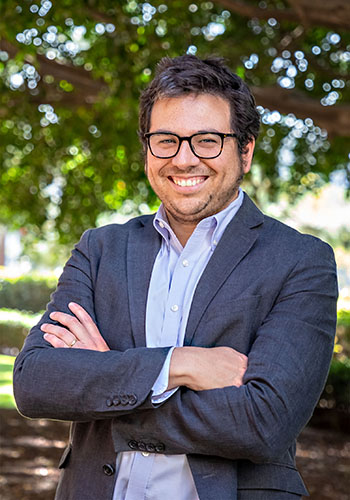
Felipe Jiménez is a Professor of Law and Philosophy at the USC Gould School of Law, specializing in contracts, private law theory, and legal philosophy. He teaches contracts, upper-level seminars, and undergraduate courses on private law, legal reasoning, and legal theory. Education: Graduated summa cum laude from Pontificia Universidad Católica de Chile LLM (Legal Theory) and JSD degrees from New York University His research integrates legal philosophy with practical applications in contract theory and adjudication. Jiménez's work addresses foundational questions in private law, including legal concepts, antitrust theory, and the philosophical underpinnings of contract law. He has a forthcoming book on contract theory with Oxford University Press. Felipe Jiménez's publications span constitutional adjudication, legal positivism, and formalist theories of contract law. His articles engage with theoretical debates in private law, tort law, and jurisprudence, often bridging philosophical rigor with doctrinal analysis. Jiménez previously practiced commercial litigation and international arbitration in Chile and New York before transitioning to academia.
Professor Michael Hutter is a faculty member at Albany Law School, where he teaches Advanced Evidence, Antitrust, Business Torts, and related courses. He has been a member of the faculty since 1976 and is recognized as a leading expert in New York Evidence Law. A.B., Brown University J.D., Boston College Law School As a scholar, Professor Hutter focuses on Evidence Law , Antitrust , and Business Torts , with his work cited by multiple courts and legislators. His Google Scholar publications demonstrate expertise in judicial procedure, trade secrets, and legal reform. Professor Hutter has served on the Commission on Judicial Nomination and contributed to legal education through his bi-monthly column in the New York Law Journal . He has argued appeals in the New York Court of Appeals, Appellate Divisions, and Second Circuit Court of Appeals. Teaching Awards from Western New England Law School and Albany Law School Elected member of the American Law Institute Fellow of the American Bar Association and New York State Bar Association
Herbert Hovenkamp is the James G. Dinan University Professor at the University of Pennsylvania Carey Law School. A leading scholar in antitrust law and competition policy, he holds the prestigious title of Fellow of the American Academy of Arts and Sciences and received the 2008 John Sherman Award from the U.S. Justice Department. His work spans antitrust theory, intellectual property, and legal history, with notable contributions to the Antitrust Law treatise and foundational texts like The Opening of American Law . Research focuses on digital platform regulation, monopolization, and the intersection of antitrust with innovation policy. He has advised on major antitrust cases involving Google, Meta, and other tech giants, emphasizing structural remedies and the consumer welfare standard. Recent publications address merger guidelines, labor market competition, and interoperability remedies. Key contributions include critiques of platform monopolies, analysis of the Sherman Act’s Section 2, and advocacy for evidence-based antitrust enforcement. His writings often bridge legal doctrine with economic principles, shaping debates on modern competition policy. Notable Awards: American Academy of Arts and Sciences Fellow (2008 John Sherman Award). Recent Cases: Advised on Google’s antitrust trials, FTC v. Meta, and Supreme Court cases like Apple v. Pepper . Grants & Funding: Extensive support for antitrust policy research from federal agencies and think tanks. Labs/Teams: Active in the Penn Program on Regulation and collaborates with the International Center for Law and Economics. His scholarship informs global antitrust reforms and U.S. policy debates on digital markets.
Prof. Nishantha Sampath Punchihewa is a Professor of Commercial Law and currently serves as Dean of the Faculty of Law at the University of Colombo, Sri Lanka. He has been a Senior Fellow in the sub-project 'Digital Access to Library Content – Legal Frameworks in Germany and Sri Lanka' at the Centre for Advanced Study since 2024. His academic journey includes LL.B. from the University of Colombo (2000), LL.M. from Augsburg and Munich (2009), and a doctoral thesis on intellectual property law in Sri Lanka (2015). He was admitted to the bar in 2001 and has held teaching positions at multiple Sri Lankan universities since then, formalizing his role as a full professor in 2022. His research focuses on intellectual property rights and innovation, competition law, consumer protection, biotechnological inventions, IT law, and the interplay between human rights and IP. Notable areas of study include Sri Lanka's legal frameworks for patents, copyrights, and geographical indications like Ceylon Tea. He advocates for enhancing SME access to IP-based financing and promoting second-tier patent systems for local innovators. Punchihewa’s work bridges legal theory with practical applications, addressing challenges in digital rights management, tourism IP strategies, and sustainable innovation policies. His publications emphasize Sri Lanka’s unique legal landscape and its alignment (or misalignment) with global standards in IP and antitrust matters. He has advised extensively on policy reforms related to technology transfer, education curricula integration of IP concepts, and leveraging IP assets for national economic growth. His contributions have positioned him as a leading voice in South Asian legal scholarship, particularly in balancing commercial interests with ethical and developmental priorities.
Tobias Lutzi is a Junior Professor for Private Law (Tenure Track) at the University of Augsburg and an external habilitation candidate at the Institute for Private International and Comparative Law at the University of Cologne . He serves as co-editor of MMR , a journal for digitalization law , and is the General Editor of conflictoflaws.net . His affiliations include the Scientific Council of the European Association of Private International Law (EAPIL) , the Young Academy of the Bavarian Academy of Sciences , and advisory roles for journals like Juristischen Schulung (JuS) and Zeitschrift für das Recht der digitalen Wirtschaft (ZDiW) . Research Focus : Private International Law, particularly international civil procedure and CISG German and comparative private law in the context of digital technology Challenges in cross-border climate litigation , AI ethics, and platform economy regulation Article Trends : His recent work spans digital jurisdiction , crypto-asset liability , and EU digital regulation (DSA/DMA) , with a focus on conflict of laws , recognition of judgments , and comparative analysis of punitive damages across jurisdictions. Scientific Contributions : Awarded the ICC Institute of World Business Law Prize (2019) and Lehrpreis der Fachschaft Jura (2020) Recipient of the Daimler and Benz Foundation scholarship (2023) and Rhodes Scholarship (2014) Authored monograph Private International Law Online (OUP 2020) and co-edited volumes on punitive damages , non-EU jurisdiction , and digital market regulations Team and Projects : Leads the Digital Law Research Center and Research Center for Japanese Law at Augsburg. Coordinates research projects on punitive damages , non-EU judgment enforcement , and digital market regulations , funded by the Daimler and Benz Foundation.
Giuseppe Colangelo is an Associate Professor of Law and Economics at the University of Basilicata and holds adjunct roles at LUISS Guido Carli (Rome, Italy) and the Transatlantic Technology Law Forum (TTLF). He specializes in innovation policy, competition law, and economic analysis of legal frameworks. His research bridges EU and U.S. antitrust approaches, focusing on digital markets, data governance, and transnational litigation. Education includes a Law degree from LUISS Guido Carli, an LL.M. in Competition Law from Erasmus University Rotterdam, and a Ph.D. in Law and Economics from LUISS. He has been a TTLF Affiliate since 2017. Key research interests include AI-driven collusion, antitrust implications of data accumulation, and interoperability policies. Over 15 publications analyze topics like anti-suit injunctions in SEP litigation, EU-US regulatory divergence in digital platforms, and privacy-antitrust intersections. His work emphasizes transatlantic comparative law and policy recommendations for addressing market power in tech sectors.
Hal J. Singer is a Managing Director at Econ One and an Adjunct Professor at the University of Utah. His career spans economics consulting and academic research, with a focus on telecommunications, antitrust, regulatory policy, and market competition. Key Affiliations: Econ One, University of Utah, Criterion Economics, LLC, Technology Policy Institute. Research Interests: Broadband regulation, wireless markets, antitrust analysis, merger impacts, and consumer welfare in high-tech industries. Recent Work Trends: Analyzes competition in telecom markets, regulatory frameworks for net neutrality, and antitrust implications in digital platforms. His publications often address policy decisions in the U.S. and international contexts. Notable Contributions: Co-author of influential studies on the Sprint/T-Mobile merger, Google/DoubleClick antitrust case, and economic impacts of broadband regulation.
Barry Rodger is a Professor of Law at the University of Strathclyde Law School since 1993. He holds academic qualifications from the University of Strathclyde, Oxford University, and the European University Institute. His research focuses on EU/UK competition law, private enforcement mechanisms, and international private law. He directs the Scottish Universities' Law Institute (SULI) and co-edits the Competition Law Review . Education: LLB (1st Class), University of Strathclyde (1988) BCL, Worcester College, Oxford University (1990) LLM in European, International & Comparative Law, European University Institute (1994) Key Projects: AHRC-funded Competition Law Comparative Private Enforcement (2014) OUP co-edited EU Antitrust Damages Directive (2018) Roles: Research Director (2014–2018), Co-Organiser of Competition Law Scholars' Forum (CLASF) His research explores competition law intersections with private law, including collective redress mechanisms and jurisdictional frameworks. He has contributed to empirical studies on competition litigation settlements and EU law application in Scottish courts.
Professor Okeoghene Odudu is the Herchel Smith University Senior Lecturer in Law at the University of Cambridge, Faculty of Law, and a Fellow of Emmanuel College. He is Co-Director of the Centre for European Legal Studies (CELS) and affiliated with the Centre for Law, Medicine and Life Sciences (LML). His academic work focuses on competition law, EU law, and the legal regulation of healthcare systems. MA (Cantab), Law, Sidney Sussex College, Cambridge MA (Keele), Criminology, funded by ESRC DPhil (Oxon), Aspects of Article 101 TFEU, supervised by Professor Paul Craig His research interests lie at the intersection of competition law and public services, particularly in the healthcare sector. He has extensively published on the application of EU competition law to NHS institutions, hub-and-spoke collusion, state aid, and the public/private distinction in EU law. His work combines doctrinal legal analysis with policy-oriented inquiry, often addressing contemporary regulatory challenges such as NHS privatization and crisis-driven competition law relaxation during the pandemic. His recent publications show a strong trend toward analyzing competition law in public service contexts, especially healthcare, and exploring doctrinal nuances in EU antitrust enforcement. He frequently contributes to high-impact legal journals and edited volumes on EU law and competition policy. Kennedy Memorial Trust Scholarship British Academy Mid-Career Fellowship (2011–2012) AHRB Doctoral Funding ESRC MA Funding Professor Odudu has served on the editorial boards of the European Competition Journal , Cambridge Yearbook of European Legal Studies , and Concurrences . He has supervised doctoral research and contributed to major research projects, including a British Academy-funded study on competition law in the NHS. His work is supported by prestigious fellowships and institutional affiliations. He is actively involved in the Centre for European Legal Studies and the Centre for Law, Medicine and Life Sciences, where he collaborates on interdisciplinary research on law, health, and regulation.
Professor Rochelle C Dreyfuss of the University of Cambridge, Faculty of Law, is a leading scholar in intellectual property law with a focus on international dimensions of patenting, trade secrets, and access to medicines. Her work bridges legal theory with practical implications for global innovation policy. Key research areas: TRIPS Agreement implementation Genetic material patenting Transnational IP dispute resolution Business method patent economics Trade secrecy and national security Global health policy impacts Her recent publications examine: Post-Brexit IP frameworks (2018) Experimental use defense in biotech (2017) Specialized patent adjudication (2017) Max Planck IP principles (2013) DNA patenting ethics (2013) Contact: Squire Law Library , Cambridge CB3 9DZ
Alberto Gambino serves as Full Professor of Private Law (IUS/01) and Deputy Vice-Rector at the European University of Rome. He holds multiple prestigious positions including Commissioner of the European Commission against Racism and Intolerance (ECRI) of the Council of Europe in Strasbourg, Member of the National Bioethics Committee, and Judge of the Patent and Trademark Appeals Commission at the Ministry of Enterprise and Made in Italy (MIMIT). Additionally, he is President of the Science & Life Study Center, CEI, and the Italian Academy of the Internet Code (IAIC). As a civil cassation lawyer, he owns the Gambino law firm and participates in managing research organizations and implementing national and international research projects. Professor Gambino's research spans numerous legal domains with particular emphasis on Civil Law, Corporate Law, Mergers and Acquisitions, Corporate Governance, and Intellectual Property. His work bridges traditional legal frameworks with emerging digital and technological challenges, particularly in the areas of bioethics, data protection, and internet governance. He has made significant contributions to understanding the intersection of law with information technology, media, telecommunications, and consumer protection in both national and European contexts. His scholarly output reveals a consistent focus on evolving legal challenges in the digital age, with recent publications examining antitrust issues in digital markets, sports governance, intellectual property in AI systems, and data protection frameworks. His work demonstrates a sophisticated understanding of how traditional legal principles must adapt to contemporary technological and social realities while maintaining core legal values. Commissioner of the European Commission against Racism and Intolerance (ECRI) of the Council of Europe Member of the National Bioethics Committee Judge of the Patent and Trademark Appeals Commission at MIMIT President of the Science & Life Study Center President of CEI President of the Italian Academy of the Internet Code (IAIC) Professor Gambino actively contributes to legal practice through his law firm while maintaining a robust academic profile. His editorial work with prestigious scientific journals and involvement in national and international research projects demonstrate his commitment to advancing legal scholarship. His expertise in both theoretical and applied law positions him as a key figure in shaping contemporary legal discourse, particularly in the intersection of traditional legal frameworks with emerging digital challenges.
Tammy Cowart is a Professor of Business Law at the Soules College of Business , University of Texas at Tyler. She serves as Chair of the Accounting, Finance & Business Law department and holds the Bart Brooks Professor of Ethics and Leadership title. Her academic career spans over two decades, with teaching and research focusing on legal and ethical frameworks in business contexts. J.D., Texas Tech University B.S., Texas A&M University Dr. Cowart's research interests center on intellectual property , corporate governance , privacy law , and ethical leadership . Her recent publications address pressing issues in patent ethics, algorithmic pricing fairness, and tax compliance. She has pioneered business ethics curricula approved for CPA candidates. Scientific awards and recognitions include: Outstanding Faculty Award (Texas Alpha Xi Chapter of Alpha Chi) Provost’s Excellence in Teaching Award Outstanding Student Organization Advisor Dr. Cowart has held administrative roles as Director of Undergraduate and Graduate Programs at Soules College of Business. She actively contributes to community organizations and legal associations, maintaining memberships in the State Bar of Texas, Academy of Legal Studies in Business, and Association for Practical and Professional Ethics.
Jennifer A. Gundlach is the Emily and Stephen Mendel Distinguished Professor of Law and Clinical Professor of Law at Hofstra University's Maurice A. Deane School of Law, where she also serves as Faculty Director of Public Justice Programs. She has previously held academic positions at American University’s Washington College of Law and Suffolk University Law School, where she was an Associate Clinical Professor and founded the Disability Advocacy Clinic. Education: JD, American University, Washington College of Law (1996) BA in History, Kenyon College (1993) Her research and teaching focus on clinical legal education, professional responsibility, legal ethics, disability law, and innovative pedagogical methods in legal education. She integrates insights from social science and educational theory to enhance law school curricula and student learning outcomes. Her work emphasizes metacognition, ethical skill development, and experiential learning. The most recent publications reflect a strong trend toward reforming legal education through intentional learning strategies, integration of ethics in early legal training, and modernizing civil procedure instruction. Her scholarship bridges theory and practice, focusing on access to justice, judicial gatekeeping of expert testimony, and the role of clinical supervision. Scientific Awards: Emily and Stephen Mendel Distinguished Professor of Law Professor Gundlach has been actively involved in advising and curriculum development, particularly through her leadership in clinical programs and curriculum reform. She has served on numerous national and institutional committees, including as a site evaluator for the American Bar Association’s law school accreditation process. She has not received externally listed grants in the provided text but has led significant programmatic initiatives such as the Disability Advocacy Clinic and Public Justice Programs. She is affiliated with several key academic and professional bodies, including the American Association of Law Schools (AALS), where she serves on the Executive Board of the Section for the Empirical Study of Legal Education and previously chaired the Section on Mental Disability and the Law. She is also active in the Sections on Clinical Legal Education and Teaching Methods. Additionally, she serves on the board of The Kenyon Review and the Advisory Committee for the Hofstra Law Center for Children, Families and the Law.
Kathryn E. Spier is the Domenico De Sole Professor of Law at Harvard Law School and a Research Associate at the National Bureau of Economic Research (NBER). She previously held faculty positions at Northwestern University’s Kellogg School of Management and Harvard University’s Economics Department. She served as President of the American Law and Economics Association (2015–2016) and has held editorial roles at the RAND Journal of Economics and the American Economic Review. Education: Ph.D. in Economics, Massachusetts Institute of Technology, 1989 B.A. in Mathematics and Economics, Yale University, 1985 Her research centers on law and economics, with a focus on litigation, contracts, tort law, antitrust, and business organizations. She employs theoretical and experimental methods to analyze settlement bargaining, platform liability, class actions, and product safety. Her work integrates insights from industrial organization and game theory to address legal and regulatory challenges. Recent publications explore the liability of digital platforms, class action waivers, IPO disclosure, and litigation finance. Her articles frequently appear in top journals such as the American Economic Review, RAND Journal of Economics, and Journal of Law, Economics, and Organization. The research demonstrates a consistent focus on incentive design, strategic behavior, and institutional mechanisms in legal contexts. Scientific Awards and Honors: Honorary Doctorate, BI Norwegian Business School, 2023 Garvin Prize in Law & Economics, Berkeley, 2001 National Science Foundation Graduate Fellowship, 1985–1988 Sidney J. Levy Teaching Award (twice), Kellogg, 2002 & 2006 Multiple Yale University prizes for academic excellence, 1984–1985 Olin Fellowship, University of Chicago Law School, 1993–1994 She has advised numerous doctoral students and collaborated extensively with scholars such as Albert H. Choi, Claudia M. Landeo, and J.J. Prescott. Her research has been supported by the National Science Foundation and the Searle Foundation. She is actively engaged in academic service, including editorial board memberships and leadership in professional associations. Professor Spier leads research initiatives on platform regulation and civil litigation reform. She teaches courses in analytical methods for lawyers, business strategy, and graduate workshops in contracts and organizations. Her work continues to shape policy debates on liability, antitrust, and consumer protection.
Professor Michael J. Hutter is a distinguished faculty member at Albany Law School, where he has served since 1976 and is recognized as the senior member of the faculty. He holds the rank of Professor of Law and teaches core subjects including Evidence, Antitrust, Business Torts, and Trade Regulation. His expertise is nationally recognized, particularly in New York evidence law, where he serves as a legal columnist and advisor to the state judiciary. His educational background includes an A.B. from Brown University and a J.D. from Boston College Law School, where he was Editor-in-Chief of the law review and elected to the Order of the Coif. After clerking for Judge Matthew J. Jasen of the New York Court of Appeals, he practiced litigation before transitioning to academia. Professor Hutter’s research focuses on evidence, antitrust, trade secrets, and business torts. His scholarship is widely cited by courts across New York and federal circuits, and has influenced state legislation. He has authored a major reference work, Model Jury Charges in Business Torts Cases , and published over 75 bi-monthly columns in the New York Law Journal on evidence developments. The 15 most recent publications reflect a consistent focus on evidence law, judicial procedure, and torts, with recurring themes in hearsay, business records, and appellate decisions in New York. His work bridges academic scholarship and practical legal application, particularly for judges and trial attorneys. Teaching Award, Albany Law School Teaching Award, Western New England Law School Highly Qualified Rating, New York State Bar Association Elected Member, American Law Institute Fellow, American Bar Association Fellow, New York State Bar Association Professor Hutter has advised and argued in numerous appellate cases, including landmark decisions in the New York Court of Appeals. He has served on multiple state commissions, including the Commission on Judicial Nomination and the Judicial Advisory Committee on Evidence, where he was appointed Reporter. He has delivered over 200 presentations to bar associations and legal education programs. He has also held leadership roles such as President of the Albany County Bar Association and Director of the Office of Capital Defenders. He is actively involved in judicial education, regularly presenting at programs for newly appointed judges and legal staff through the New York State Judicial Institute. He was appointed by the Chief Judge to compile a comprehensive Guide to New York’s evidence law, enhancing judicial access to consolidated legal rules.