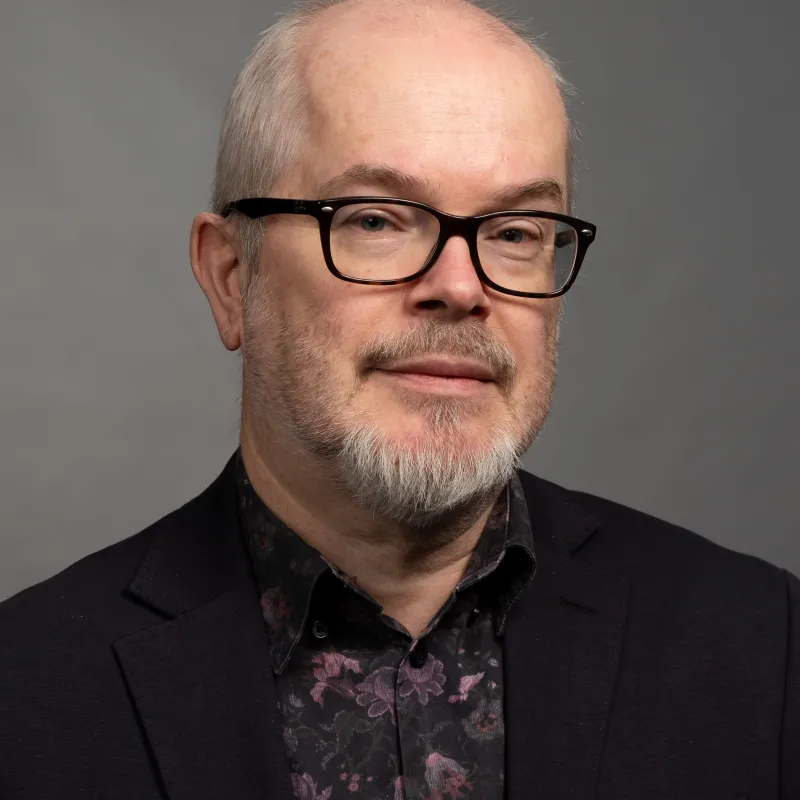
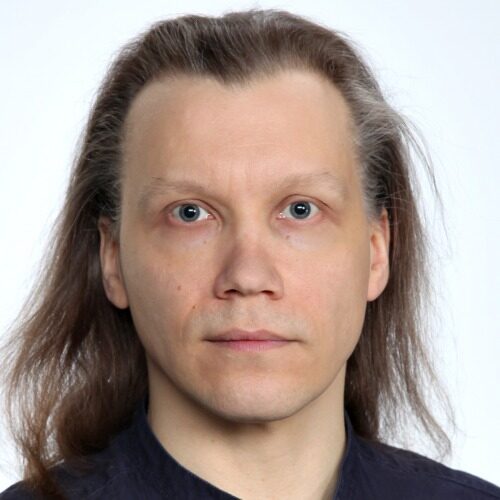
Minna Palmroth is a Professor of Computational Space Physics at the University of Helsinki 's Faculty of Science , leading the Department of Physics 's Space Physics Research Group. She directs the Kestävän avaruustieteen ja -tekniikan huippuyksikön (Centre of Excellence in Sustainable Space Science and Technology) and serves as the principal investigator for the Vlasiator hybrid-Vlasov simulation framework.
Riikka Koulu is an Associate Professor of Social and Legal Implications of AI at the University of Helsinki, holding joint appointments at the Faculty of Law and Faculty of Social Sciences. She serves as Director of the University of Helsinki Legal Tech Lab, an interdisciplinary research hub focused on law, technology, and society, and is an affiliated researcher at the Alexander von Humboldt Institute for Internet and Society in Berlin. In 2025, she will be an academic visitor at Oxford University. Education: Doctor of Law (OTT), University of Helsinki (awarded November 17, 2016) Title of Docent (digitalisation of law), University of Lapland (2020-present) Riikka Koulu is a socio-legal scholar specializing in the interconnections between law, technology, and society. Her research focuses on understanding law's role in shaping and being shaped by digitalized societies. She combines doctrinal and theoretical legal analysis with empirical research from a public law perspective. Her current work examines digital public administration, AI policy and regulation, European technology regulation, and the impact of digital technologies on legal decision-making. She is particularly interested in human oversight mechanisms and interface design in automated systems. Her recent publications reveal a strong focus on the legal implications of digital transformation, with particular attention to automated decision-making in public administration, algorithmic governance, and the changing nature of legal procedures in digital environments. Her work spans theoretical explorations of legal concepts in digital contexts and practical analyses of how technology is reshaping justice systems and public administration. Scientific Recognition: Title of Docent (digitalisation of law), University of Lapland (2020) Affiliated researcher, Alexander von Humboldt Institute for Internet and Society, Berlin (2019-present) Riikka Koulu actively supervises doctoral researchers through the Doctoral Programme in Law and has secured significant research funding for multiple projects. Her current research portfolio includes the ADM-Gov project (2022-2026) on automated administration governance, the REPAIR project (2022-2025) on algorithmic system maintenance, and the DARE project (2021-2026) on inclusive digital administration design. These projects involve collaboration with international partners and interdisciplinary teams. As Director of the University of Helsinki Legal Tech Lab, Koulu leads an interdisciplinary research hub that is part of the Network of Centers (NoC). The lab serves as a focal point for research on the intersection of law, technology, and society, bringing together scholars from legal studies, computer science, social sciences, and design disciplines to address pressing challenges in digital governance.
Jarno Vanne is a Professor at the Department of Computing Sciences, Faculty of Information Technology and Communication Sciences at Tampere University. His research focuses on video coding standards, real-time systems, and hardware acceleration, particularly in the context of FPGA implementations and open-source tools. He leads projects involving VVC (Versatile Video Coding), V-PCC (Volumetric Video Coding), and HEVC (High Efficiency Video Coding), with an emphasis on efficiency, low latency, and machine learning integration. Key research interests include point cloud compression, saliency-guided encoding, parallelization schemes, and real-time video communication protocols. His work often addresses challenges in multi-party video streaming, embedded systems, and encryption mechanisms for privacy protection. He has contributed to open-source projects like the UVG dataset, Kvazaar encoder, and CiThruS simulation frameworks. Recent publications highlight advancements in VVC intra encoding optimizations, machine learning-driven partitioning schemes, and FPGA-accelerated solutions for edge computing. His research bridges theoretical video coding algorithms with practical implementations, aiming to improve compression efficiency while maintaining real-time performance.
Kari Lappalainen is an Assistant Professor in the Department of Electrical Engineering at Tampere University, affiliated with the Faculty of Information Technology and Communication Sciences. His research focuses on photovoltaic power systems, energy storage technologies, and renewable energy integration. He leads studies on photovoltaic module aging, parameter identification, and energy storage system optimization for power smoothing and ramp rate control. Key research interests include: Photovoltaic module diagnostics and performance analysis Energy storage system design for hybrid renewable plants Impact of environmental factors (e.g., temperature, cloud cover) on PV efficiency Advanced modeling techniques for photovoltaic systems Recent work emphasizes real-time monitoring of PV degradation via current-voltage curve analysis and optimization of energy storage configurations to mitigate power fluctuations. Over 50 peer-reviewed publications demonstrate sustained contributions to renewable energy systems research. Notably absent are awards or formal advisee listings, though collaboration with institutions like EU PVSEC and frequent conference participation indicate active academic engagement.
Prof. Vesa Välimäki is an Audio Signal Processing Professor at Aalto University's School of Electrical Engineering, leading the Audio Signal Processing Research Group within the Aalto Acoustics Lab. He also serves as Vice Dean for Research and Head of the Doctoral Programme at the university. His research focuses on digital signal processing, machine learning, and their applications in audio, acoustics, and music technology, particularly in artificial reverberation, audio filter design, and virtual analog modeling. He has pioneered techniques like velvet noise for reverberation synthesis and contributed to open-source tools like FLAMO. His academic accolades include IEEE, AES, and AAIA Fellowships, along with multiple best paper awards at venues like DAFx and ICASSP. He has advised numerous students, including recipients of prestigious awards like the Huawei Master's Thesis Award. Prof. Välimäki has held editorial roles at the Journal of the Audio Engineering Society and organized major conferences such as SMC-17. His work extends to applied projects like acoustic optimization for early childhood education facilities and immersive audio in virtual reality (e.g., the 'Space Walk' project). Key Projects: NordicSMC (Nordic University Hub for Sound and Music Computing), Aalto Acoustics Lab, FLAMO library Grants: NordForsk funding (2018–2023), Foundation for Aalto University Science and Technology His research spans both theoretical advancements (e.g., diffusion models for audio restoration) and practical implementations (e.g., real-time equalizers, headphone compensation systems). He collaborates internationally, contributing to acoustic measurement techniques and noise reduction strategies for diverse environments.
Magnus Westerlund is a Senior Lecturer in Information Technology and Director of the Laboratory for Trustworthy AI at Arcada University of Applied Sciences in Helsinki, Finland. His industry background spans telecom and information management, and he holds a doctoral degree in Information Systems from Åbo Akademi University. He actively contributes to the Z-Inspection® network, focusing on ethical AI implementation and governance. Westerlund’s research emphasizes trustworthy AI, cybersecurity, and distributed systems. Key areas include AI regulatory compliance (e.g., EU AI Act), healthcare AI applications, blockchain security, and IoT edge solutions. His work bridges academia and industry, such as the Valohai-CSC collaboration for machine learning infrastructure in Finnish academia. His publications highlight practical AI assessment methods, ethical AI integration, and decentralized technologies. Notable contributions include frameworks for sustainable AI development, privacy-preserving autonomous systems, and smart contract-based IoT security protocols. Westerlund also explores educational innovations, such as integrating large language models (LLMs) into coding education. His research consistently addresses real-world challenges like pandemic-era healthcare AI, edge computing for IoT, and cybersecurity in autonomous systems.
Heikki Handroos is a Full Professor of Mechanical Engineering at LUT University, leading the Laboratory of Intelligent Machines since 1993. He holds a DSc (Technology) from Tampere University of Technology and has served as Vice-Dean of the Faculty of Technology (2007-2009) and currently chairs the Collegiate Body of LUT University. His research focuses on mechatronics, robotics, control systems, and fluid power, with over 300 publications and 2,400+ citations. He has supervised 34 doctoral theses and 150+ MSc projects, managed R&D projects exceeding €20M, and co-founded four tech startups. His work spans industrial collaborations, digital twin applications, and innovative robotics for nuclear energy (e.g., DEMO reactor maintenance systems). He has held visiting professorships in the U.S., Japan, and Russia, and actively contributes to academic editorial roles and professional societies like ASME and IEEE.
Teemu Malmi is a Professor in the Department of Accounting at the School of Business, Aalto University, Finland. He has been an influential figure in management accounting research, particularly in management control systems and performance measurement. His academic qualifications include a Doctoral degree (1997), Licentiate degree (1994), and Master's degree (1990), all in Business and Economics from the Helsinki School of Economics. His research interests span management control, performance measurement, digitalization in finance, public sector accounting, and organizational behavior. His work often integrates empirical analysis with case studies, including a notable investigation into Nokia’s management control challenges. He has published extensively in top-tier journals and contributed to major handbooks in accounting and information systems. The recent trend in his publications (2020–2025) reflects a growing emphasis on digital transformation, blockchain, data analytics, and the evolving role of finance functions. His research increasingly bridges traditional accounting with technology and public policy, especially in healthcare financing and sustainability. Scientific Awards: “Thirst for knowledge” (“Tiedon Jano”) award by JOKO Executive Education Oy (2001) Teemu Malmi has supervised at least five theses and led externally funded research projects, including the SOTE/Kaks project (2015–2016) on social and healthcare services. He has been actively involved in academic service, such as serving on editorial boards, hosting international scholars, presenting keynote lectures, and participating in funding organization committees. His media appearances demonstrate his engagement in public discourse on welfare policy and regional financing in Finland. There is no indication of part-time status, retirement, or former staff designation; he remains an active academic.
Koray Tahiroglu is a University Lecturer at Aalto University's School of Arts, Design and Architecture, specializing in Sound and Music Computing. His work bridges artificial intelligence, digital musical instruments, and embodied interaction, with a focus on deep learning applications in audio synthesis and human-AI creative collaboration. His research explores New Interfaces for Musical Expression (NIME), sonic interaction, and physical computing. He collaborates with SOPI Research Group and Google Brain Team (Magenta) on AI-driven artistic innovation. Recent Publications : 2024 studies on dance-sound cross-correlation and intra-action frameworks; 2023 work on AI-terity and deep learning syllabi; 2022 explorations of GAN synthesis, musical expectations, and lifeworld sonification. Scientific Awards : Co-Creative Artificial Intelligence of Music (2022) 2010 grant for scientific publications and artistic activities 2017 Honorable Mention for mobile cultural heritage research Tahiroglu contributes to digital art education and leads projects at Media Lab Helsinki, advancing sonic interaction and generative audio systems.
Prof. Pia Fricker is an Associate Professor and Vice Head of the Department of Architecture at Aalto University's School of Arts, Design and Architecture in Finland. She holds the Professorship of Computational Methodologies in Landscape Architecture and Urbanism, directing the Urban Studies and Planning Programme. Her research integrates urban design, landscape architecture, and digital design culture, focusing on data-driven methods, immersive environments, and adaptive urban development. Collaborations include ETH Zurich, Singapore University of Technology and Design, and Hafencity University Hamburg. Key projects include the Metaversity and Future Smart Cities initiatives. Fricker has led over 80 publications and exhibitions globally, including at the Venice Biennale and National Design Centre Singapore. She is an editorial board member for the Journal of Digital Landscape Architecture and peer reviewer for multiple journals. Awards include the Digital Landscape Architecture Award (2018) and DLA Scientific Merit Award (2021). Her teaching emphasizes computational pedagogy and digital innovation in design education. Education: PhD in Architecture (ETH Zurich, 2021) Postgraduate in Didactics (ETH Zurich, 2011) MAS in Computer Aided Architectural Design (ETH Zurich, 2003) MSc Arch in Urban Design & Landscape Architecture (Technical University of Karlsruhe, 2001) Research Interests: Computational design, parametric modeling, mixed reality, climate-adaptive ecosystems, generative AI, and sustainable urban development. Her work bridges emerging technologies with ecological and urban challenges, emphasizing interdisciplinary collaboration. Grants & Projects: Metaversity (2023–2025, Principal Investigator) Future Smart Cities Sasakawa (2023–2024, Principal Investigator) ABRA (2020–2023, Project Member) Awards: DLA Awards (2018, 2021) DLA Review Committee Awards (2020–2022) Exhibition Recognitions (Venice Biennale, National Design Centre Singapore) Labs/Teams: Leads the Urban Studies and Planning Programme and collaborates with interdisciplinary teams on projects like the RAILCORRIDOR Singapore initiative. Active in digital twin development and AI-driven design tools.
Eric Coatanea is a Professor at Tampere University, affiliated with the Automation Technology and Mechanical Engineering department within the Faculty of Engineering and Natural Sciences. His research focuses on manufacturing systems, causal graph networks, multi-disciplinary optimization, and AI integration in engineering design. He holds a BSc from University of West Brittany (1990), MSc from INSA Toulouse (1993), and teaching certification from Ecole Normale Supérieure (1994). Research interests include modeling manufacturing systems, additive manufacturing (e.g., Directed Energy Deposition), causal graphs for decision-making, and systems engineering. Notable awards include the Chevalier des Palmes Académiques (2018) and Marie-Curie Fellowship (2006–2008). Recent publications emphasize optimization algorithms combining AI (e.g., L-ANN-GWO), viscosity effects in 3D printing, and causal graph applications in MDO. His work bridges theoretical frameworks with practical engineering challenges, focusing on early design synthesis and sustainable manufacturing. Commitments include editorial roles (Journal of Integrated Design & Process Science), NSERC Canada advisory, and board memberships (Dynavio Cooperative Oy, Selko Oy). Current projects include LILIAM, ÄVE, and DIGITBrain initiatives.
Matti Tedre is a Professor at the School of Computing, Faculty of Science, Forestry and Technology, University of Eastern Finland. His research focuses on computer science education, ICT4D, social studies of computer science, and the history and philosophy of computer science. He leads the Technologies for Learning and Development research group and is involved in the Generation AI project (2022–2028), exploring AI education for security mindset development. His work bridges theory and practice, emphasizing educational technology, AI literacy, and participatory design. Recent projects include developing low-cost AI kits for novice learners and co-designing ML-driven apps with children. He collaborates globally on topics like K-12 computing education, data agency, and ethical AI integration in classrooms. Key contributions include studies on scaffolding in ML education, children’s understanding of algorithmic biases, and the role of generative AI in creative learning. His research also addresses challenges in Tanzanian ICT adoption, including financial management systems for informal groups and timetabling software for higher education institutions. Tedre’s interdisciplinary approach spans computer science, education, and sociology, with a focus on democratizing AI access and fostering critical digital literacy among youth and educators.
Professor Garg Vikas holds the position of Assistant Professor in the Department of Computer Science at the School of Science. His research spans quantum computing, artificial intelligence, and machine learning with applications in computational biology, healthcare, and drug design. He leads the HEALED/Garg project focused on human-steered machine learning for drug discovery and collaborates with institutions like MIT and industry partners. He co-founded YaiYai Oy, providing AI/ML solutions to global sectors. Education: PhD from MIT CSAIL under Tommi Jaakkola, with postdoctoral and industry experience at Amazon, Microsoft, and IBM. His work aligns with UN SDGs, particularly in healthcare and sustainable energy. Research interests include graph neural networks, generative models, and quantum AI. Recent projects involve climate modeling via physics-informed neural ODEs and optimizing quantum circuits using graph autoencoders. Key collaborations include MIT’s MLPDS Consortium and the Finnish Center for Artificial Intelligence. He supervises doctoral researchers like Yogesh Verma and postdocs such as Kogkalidis.
Dr. Otto Lappi is a Research Fellow at the University of Helsinki's Department of Digital Humanities, Faculty of Arts. His work bridges cognitive science and human performance in complex dynamic tasks, particularly focusing on predictive processing in visuomotor control. PhD in Cognitive Science Title of Docent at University of Helsinki Academy Research Fellow (2020-2025) His research explores: Cognitive mechanisms in high-speed sports and driving Predictive gaze strategies and steering control Flow states in skill acquisition VR and eye-tracking applications in archaeomusicology Neural substrates of domain expertise Recent publications analyze: Flow-state dynamics in visuomotor learning Predictive gaze behavior in automated driving Computational models of attention in distracted driving Chunking mechanisms in high-speed sports performance Scientific contributions include: Academy Research Fellow (Research Council of Finland) Editorial work on high-performance cognition Organizing cognitive science workshops As doctoral supervisor, he has guided: Samuel Tuhkanen (Predictive Gaze and Steering) Jesse Kuokkanen (Mechanistic Computationalism) Ida Maasalo (Driver Behavior) Markus Mattsson (Psychometrics)
Eetu Mäkelä is a Professor in Digital Humanities at the University of Helsinki, affiliated with the Helsinki Institute for Social Sciences and Humanities (HSSH). He holds a Doctor of Science in Computer Science and a Title of Docent in Computer Science. He supervises doctoral programs in History and Cultural Heritage, and Theology and Religious Studies. His research focuses on computational methods applied to humanities, including text reuse analysis, historical discourse studies, and digital cultural heritage. He leads the Helsinki Computational History Group (COMHIS) and participates in projects like CASCADE (computational semantic change analysis) and HPC-HD (high-performance computing for historical discourse analysis). Key research areas include computational analysis of historical texts, formulaic language in oral poetry, and linked open data applications in cultural heritage. Notable projects involve developing digital infrastructures for Finnic oral poetry and analyzing WWII data through linked open systems. Awards include the Best Paper Award at DHN 2020 and the Open Data Prize for the WarSampo system. Projects: CASCADE (EU Horizon Europe), HPC-HD (Academy of Finland), COMHIS (ongoing since 2018) Supervision: Doctoral programs in History, Cultural Heritage, and Theology Labs/Teams: Helsinki Computational History Group (COMHIS), leader of digital humanities initiatives