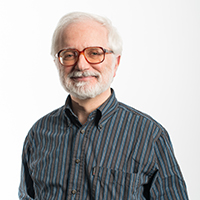
Lorenzo Strigini is a Professor of Systems Engineering at City St George's, University of London , where he has been affiliated since 1995 and served as Director of the Centre for Software Reliability from 2012–2024. His research focuses on dependability assessment , fault tolerance , and defense in depth for safety, security, and reliability in computer-based and socio-technical systems. He has also explored high-speed networking during his earlier career at the Italian National Research Council (IEI-CNR) and as a visiting scientist at UCLA and Bell Communications Research.
Regents' Professor Ronald C. Arkin is a leading figure in robotics and AI at the School of Interactive Computing at the Georgia Institute of Technology . He directs the Mobile Robot Laboratory and serves as Associate Dean for Research in the College of Computing. His work bridges autonomy , ethical decision-making , and human-robot interaction . Ph.D. in Computer Science, University of Massachusetts, Amherst (1987) Former STINT Visiting Professor at KTH Stockholm (1997-1998) Sabbatical Chair at Sony Intelligence Dynamics Laboratory (2005) Member of Robotics and Artificial Intelligence Group at LAAS/CNRS (2005-2006) Arkin's research focuses on robot ethics , autonomous agents , and multi-robot coordination . He explores the integration of moral emotions and ethical frameworks in robotic systems, particularly for applications in patient-caregiver mediation and subterranean exploration . His work also addresses deception mechanisms and formal performance guarantees for autonomous missions. Recent publications highlight advancements in heterogeneous robot teams for DARPA challenges, multi-modal control interfaces , and bio-inspired deception . His research spans artificial circadian systems , robotic nudges , and legal mediation in human-robot interactions. Regents' Professor, Georgia Institute of Technology Arkin has advised numerous projects on robot ethics and autonomous systems , contributing to grants like the 2018 EAGER award for Misdirection in Robot Teams . He leads the Mobile Robot Laboratory , developing frameworks for robotic autonomy and ethical governance in diverse environments.
Stefanos Nikolaidis is a tenured Associate Professor in the Department of Computer Science at the University of Southern California (USC), where he directs the Interactive and Collaborative Autonomous Robotic Systems (ICAROS) Lab. His research focuses on enabling robots to interact robustly with humans in dynamic environments through advancements in artificial intelligence, human-robot interaction, procedural content generation, and quality diversity optimization. Education: PhD in Robotics from Carnegie Mellon University (CMU) and MS in Computer Science from MIT. The ICAROS Lab develops interactive agents for real-world tasks while creating diverse testing scenarios to enhance system robustness. Research integrates AI techniques with human-centric design principles across applications like rehabilitation robotics, collaborative manufacturing, and socially interactive embodiments. Recent publications demonstrate trends in quality diversity optimization, human-aware planning, and policy adaptation. Notable works include AutoQD for behavior discovery, CMA-MA for multi-objective optimization, and applications in hair manipulation, rehabilitation personalization, and large language model integration. Scientific Awards: NSF CAREER Award (2022). He actively shares research updates via Twitter and has contributed software tools like pyribs for quality diversity optimization. His work spans theoretical advancements in optimization algorithms and practical implementations in assistive robotics.
Professor Alan Penn is a leading academic at University College London's The Bartlett School of Architecture , where he holds the title of Professor in Architectural and Urban Computing. He previously served as Dean of the Bartlett Faculty of the Built Environment from 2009 to 2019 and has been instrumental in establishing Space Syntax Ltd , a UCL knowledge transfer spin-out company. His affiliations include membership in the Space Syntax Laboratory, board membership of UCL Consultants Ltd, and trustee status at Shakespeare North Trust. Education: BSc (1978), Dip Arch (1980), MSc (1983) - all from University College London Alan Penn’s research investigates how spatial design influences social and economic behaviors through innovative space syntax methodologies . Key areas include: Agent-based simulations of human behavior Spatio-temporal representations of built environments Urban spatial network analysis Urban sustainability across multiple dimensions Cognitive markers in architectural design Historical urban growth modeling His recent publications demonstrate a strong focus on computational urbanism, evolutionary city patterns, and behavioral architecture. Research trends show interdisciplinary approaches combining architectural theory with: Machine learning applications Network science analysis Behavioral psychology insights Historical GIS techniques Complex systems modeling Public health considerations Scientific recognition includes: HEFCE Business Fellowship (2001-2005) KTP SE Region Award (2010) Multiple UCL Enterprise awards ‘Spirit of Enterprise’ Award (2008) As Principal Investigator he leads the £5m EPSRC-funded Urban Dynamics Lab , demonstrating sustained research excellence. His work extends to public engagement through: Shakespeare North Trust educational theatre development Media appearances (New Scientist, Slashdot) Public policy contributions
Axel Polleres is a full professor at the Institute for Data, Process and Knowledge Management in Vienna University of Economics and Business (WU Wien). He leads the department of Information Systems and Operations Management while maintaining active research in knowledge graphs, semantic web technologies, and ontology engineering. PhD and Habilitation from Vienna University of Technology Former positions at University of Innsbruck, Universidad Rey Juan Carlos, DERI Ireland, and Siemens AG Co-chair of W3C SPARQL working group Editorial board member for Semantic Web Journal and IJSWIS His research focuses on: Querying and reasoning over ontologies Graph schema languages (SHACL, SPARQL) Wikidata constraint formalization Ontology reuse in collaborative platforms Crisis management knowledge graphs FAIR data principles implementation Recent publications analyze knowledge graph evolution, constraint validation methodologies, and semantic web standardization efforts. Key topics include: OWL/RDF interoperability solutions Unit conversion systems for Wikidata Partition-based query processing frameworks Network resilience analysis for urban planning Open data platform discovery tools Temporal analysis of collaborative knowledge graphs He has co-organized major conferences like ISWC2023 and ESWC workshops while maintaining active roles in European research projects. Current work involves spatiotemporal knowledge graphs for city resilience and semantic web infrastructure development.
Jorge Camba is an Associate Professor at the School of Engineering Technology and holds a courtesy appointment in the Department of Computer Graphics Technology at Purdue University . He also serves as a Senior Research Scientist (by courtesy) in the Department of Industrial Engineering at the University of Naples Federico II , Italy. PhD in Systems and Engineering Management (Universidad Politécnica de Valencia, Spain) MSc in Digital Media (East Tennessee State University) MSc in Computer Science (Universidad de Vigo, Spain) His research explores intelligent CAD systems , digital manufacturing , and mixed reality environments , focusing on model quality assurance , design intent communication , and collaborative design tools . Recent work investigates spatial cognition in CAD education , geometric variability analysis , and annotation-driven knowledge management . Key trends in his publications include parametric modeling strategies , 3D annotation systems , and XR applications in design evaluation. Awards include the Purdue Faculty Scholar (2021) and I3B Fellow (2021). He has presented at conferences on topics like Industry 4.0 , space habitat design , and digital product quality .
Liz Campbell is Professor & Francine V McNiff Chair at Monash University's Faculty of Law. She holds adjunct professorships at University College Cork and is a visiting full professor at University College Dublin (2024-27). As convenor of the Monash Transnational Criminal Law Group, her work bridges corporate crime, organised crime, corruption, biometric evidence, and socio-legal contexts with a comparative and empirical focus. Extensive publications in leading journals and books, including Organised Crime and the Law (Hart, 2013) and The Criminal Process (OUP, 2019). Research funded by Research Council UK, AHRC, Law Foundation of New Zealand, Fulbright Commission, Modern Law Review, and Carnegie Trust. Key roles: Assessor for Australian Research Council, member of UK AHRC Peer Review College, and Law Council of Australia's Foreign Corrupt Practices Working Party. Her work impacts courts (Irish Supreme Court citations) and law reform commissions. She welcomes PhD students researching corporate crime, corruption, and biometrics, particularly from Asia and Global South regions.
Arianna Bisazza is an Associate Professor in the Computational Linguistics Group at the University of Groningen, where she leads the InClow research group focused on Interpretable, Cognitively inspired, Low-resource language models. Her work bridges computational linguistics, cognitive science, and language acquisition to develop more robust and interpretable language processing algorithms that can adapt to diverse linguistic phenomena worldwide. Dr. Bisazza's research interests span statistical modeling of human languages in multilingual contexts, with particular focus on improving language model performance for "challenging" or low-resource languages. Her work explores how insights from human language acquisition can inform better language modeling techniques, and she investigates methods to make state-of-the-art NLP systems more interpretable and transparent. As a cross-disciplinary researcher, she actively seeks to enhance our understanding of human language processing and evolution through computational modeling tools. Her recent publications reveal a strong emphasis on multilingual evaluation frameworks (like TurBLiMP and MultiBLiMP), interpretability of language models, and connections between human language acquisition and neural network learning. Her work consistently addresses the challenge of making language technology more robust across diverse linguistic structures and typological features. Outstanding Paper Award at the BabyLM Challenge (CoNLL'24 Shared Task) for "BabyLM Challenge: Exploring the Effect of Variation Sets on Language Model Training Efficiency" Dr. Bisazza currently leads a Vidi project funded by the Dutch Research Council (NWO) on improving low-resource language modeling through child language acquisition insights. She is also part of two national consortium projects funded by NWA-ORC initiatives: InDeep (Interpreting deep learning models for language, speech & music) and LESSEN (Low Resource Chat-based Conversational Intelligence). She supervises multiple PhD students, including two China Scholarship Council (CSC)-funded researchers working on simulating human patterns of language learning and change. Her earlier research was supported by a Veni grant (2017-2021) focused on understanding and improving the encoding of linguistic structure in Neural Machine Translation models. As head of the InClow research group, Dr. Bisazza oversees a team investigating interpretable, cognitively inspired approaches to low-resource language modeling. The group's work combines insights from cognitive science and linguistics with cutting-edge NLP techniques to develop language models that better reflect human language processing capabilities, particularly in resource-constrained settings.
Ilias Chalkidis is an Assistant Professor specializing in Natural Language Processing at the Department of Computer Science, University of Copenhagen. He is actively affiliated with the Natural Language Processing research section, contributing to both theoretical and applied advancements in the field. His research spans multiple high-impact domains with particular emphasis on: Legal natural language processing and multilingual legal reasoning Large language model applications in political and social contexts Fairness-explainability trade-offs in AI systems Innovative representation learning techniques for textual data Analysis of his recent publications reveals a strong focus on bridging legal informatics with cutting-edge NLP methodologies. His work on multilingual legal corpora (including the 689GB MultiLegalPile dataset) and legal decision influence prediction demonstrates practical applications for judicial systems. Simultaneously, his investigations into LLMs as voting assistants and European political spectrum analysis showcase innovative intersections between computational social science and language technology. His technical contributions to contrastive learning and hyperbolic embeddings provide foundational advances for document representation. Chalkidis actively participates in the research community through workshop organization (Natural Legal Language Processing Workshop 2023-2024) and conference presentations. His research has been published in top-tier venues including ACL, EMNLP, and ECAI, with significant citations reflecting community impact. While specific advising relationships aren't documented in the provided materials, his collaborative work patterns suggest active mentorship within the NLP research ecosystem.
Jamie J. Baker serves as Associate Dean and Director of the Law Library and Dean's Distinguished Service Professor of Law at Texas Tech University School of Law. She oversees all Law Library operations while teaching Civil Trial: Practice & Litigation Materials, Academic Legal Writing, Intro to the Study of Law, and Legal Practice research workshops for first-year students through the Excellence in Legal Research Program. Her educational background includes a B.S. in Political Science & Public Administration from Central Michigan University, an M.L.I.S. from Wayne State University's School of Library & Information Science, and a J.D. from Western Michigan University Cooley Law School, where she was recognized as the most outstanding editor of the Cooley Law Review. Professor Baker's research centers on cognitive computing applications in legal research, legal research pedagogy, and the evolving role of law librarianship. She examines how artificial intelligence disrupts traditional legal research methods and addresses the duty of technology competence for legal professionals. Her work bridges library science and legal education, focusing on practical implementation in academic settings. Analysis of her 15 most recent publications reveals consistent focus on AI's impact on legal research, with recurring themes including algorithmic regulation, technology competence ethics, and future law library services. Her scholarship spans law reviews, book chapters, and conference presentations, demonstrating interdisciplinary engagement between legal academia and library science. ABA Blawg 100 recognition Top-Ten Blog for Information Professionals Best of the Legal Blogs by Internet Legal Researcher Most outstanding editor of Cooley Law Review As an educator, she mentors students through specialized research workshops and legal writing instruction. Her professional engagement includes frequent presentations at major conferences like the American Association of Law Schools and American Association of Law Libraries annual meetings. She previously served as a Law Librarian and Adjunct Professor at Western Michigan University Cooley Law School and worked at the Michigan Supreme Court's Friend of the Court Bureau. Her influential blog, The Ginger Law Librarian, serves as a hub for discussions on AI in legal research and modern law librarianship, reflecting her commitment to advancing the profession through technological innovation.
Emily First is an incoming Assistant Professor in Computer Science at Rutgers University New Brunswick starting Fall 2025. She previously served as a postdoctoral researcher at UC San Diego under Sorin Lerner and earned her PhD in Computer Science at UMass Amherst under Yuriy Brun in the Laboratory for Software Engineering Research (LASER). Her research focuses on leveraging AI for theorem proving, working at the intersection of machine learning, software engineering, and programming languages. She specializes in creating tools for automated proof generation in proof assistants like Coq, Isabelle/HOL, and Lean. Her work explores how AI can enhance human reasoning across domains, with applications in software verification and formal logic systems. Recent publications show trends in neuro-symbolic AI, software verification, and LLM integration for formal methods. Her team's research has been recognized with ACM SIGSOFT Distinguished Paper Awards at ICSE, ACL, and ESEC/FSE conferences, along with workshop presentations at AI and Theorem Proving conferences. ACM SIGSOFT Distinguished Paper Award (ICSE 2025) ACM SIGSOFT Distinguished Paper Award (ACL Main 2024) ACM SIGSOFT Distinguished Paper Award (ESEC/FSE 2023) ACM SIGSOFT Distinguished Paper Award (ICSE 2022) Contact: emfirst@ucsd.edu (new email coming soon).
Fredrik Heintz is a professor at Linköping University's Department of Computer and Information Science within the Faculty of Science & Engineering. His research bridges artificial intelligence, education, and healthcare, focusing on AI literacy, synthetic data generation, and autonomous systems. Key affiliations: Linköping University (Faculty of Science & Engineering, Department of Computer and Information Science) Research Interests: Heintz's work spans multiple domains: Developing frameworks for AI literacy in K-12 education Creating fair synthetic healthcare data using GANs and bias-transforming techniques Advancing autonomous 3D exploration algorithms for dynamic environments Benchmarking tools for fairness, utility, and explainability in AI models Stream reasoning for real-time data analytics and knowledge extraction Evaluating ethical implications of AI in teacher education Scientific Contributions: His publications highlight collaborations with international researchers and significant grants from the Swedish Research Council, Knut and Alice Wallenberg Foundation, and VINNOVA. Notable projects include TransFusion for time-series generation, Bt-GAN for fair healthcare data, and DAEP for dynamic exploration planning. Funded by Wallenberg AI, Autonomous Systems and Software Program (WASP) ELLIIT Excellence Center at Linköping-Lund Mistra Geopolitics research program
Peter McBrien is an Associate Professor in the Department of Computing at Imperial College London, affiliated with the Faculty of Engineering. He holds dual affiliations with the Distributed Software Engineering group. His research focuses on conceptual modeling, ontology engineering, database systems, and temporal data management. He has been active in advancing techniques for data visualization, semantic web technologies, and relational database integration. Key research areas include: Ontology extraction from relational databases Type inference in transactional systems Schema transformation between heterogeneous models Peer-to-peer data integration protocols Temporal database systems His publication trends emphasize integration of heterogeneous data sources through formal methods, with notable contributions to OWL ontology implementation, hypergraph data models, and benchmarking big data query languages. Recent work focuses on Spark-based semantic reasoning and distributed knowledge exchange systems. Peter McBrien's research has been supported through Imperial College's infrastructure, with ongoing contributions to the AutoMed data integration framework and RoDEx protocols for unreliable networks. His work bridges theoretical foundations of data management with practical implementations in distributed systems.
Professor Sophia Drossopoulou is a Professor of Programming Languages in the Department of Computing at Imperial College London, part of the Faculty of Engineering. Her affiliations include the Centre for Cryptocurrency Research and Engineering and the Sound Programming Languages research group. She holds a visiting researcher position at Microsoft Research (UK) from May 2019 to May 2020. Her research focuses on foundational programming language design and formal methods, emphasizing concurrency, type systems, and program verification. Key areas include concurrent program reasoning (e.g., TaDA framework), memory management (reference capabilities, garbage collection), and secure systems (smart contracts, cyber-physical systems). She explores practical language extensions for performance optimization (e.g., cache locality) while maintaining safety guarantees through formal verification techniques. Her work spans theoretical contributions (formal semantics, logical frameworks) and applied systems (compilers, runtime verification tools like Zeno). Recent trends show strong engagement with actor-based models (Pony language), digital twins, and cybersecurity challenges in modern software systems. Awards and recognitions are not explicitly listed in the provided text, but her extensive publication record in top venues (ECOOP, POPL, TOPLAS) indicates academic impact. Her advising focuses on graduate students in systems programming and formal methods, though specific student names are not mentioned here. Labs and collaborations involve the Sound Programming Languages group at Imperial College, emphasizing interdisciplinary work between formal methods and practical language implementation. Current projects include improving concurrency semantics and verifying complex systems through compositional reasoning techniques.
Michael DeWeese is an Associate Professor of Physics and Neuroscience at the University of California, Berkeley. His research spans nonequilibrium statistical mechanics, machine learning theory, and systems neuroscience. He holds a BA in Physics from UC Santa Cruz (1988) and a PhD in Physics from Princeton (1995). Before joining UC Berkeley in 2007, he held postdoctoral positions at the Salk Institute and Cold Spring Harbor Laboratory. His work integrates principles from physics, neuroscience, and machine learning to address fundamental questions in theoretical and experimental biology, computation, and statistical mechanics. DeWeese Lab Website provides further details on ongoing projects and collaborations. Education: BA in Physics, UC Santa Cruz (1988) PhD in Physics, Princeton University (1995) Research Interests: Nonequilibrium Statistical Mechanics: Focuses on thermodynamic optimization, active matter, and non-equilibrium processes. Machine Learning Theory: Develops first-principles models to explain neural network performance and efficient algorithms for probabilistic models. Systems Neuroscience: Uses biologically inspired models to understand neural coding, sensory processing, and computational roles of neural networks. Advising & Grants: While no formal student advisees are listed, his lab actively collaborates across disciplines. Funding sources are not explicitly mentioned but likely involve NSF, NIH, or DOE grants based on research themes. His work on quantum control and neural networks suggests potential ties to interdisciplinary funding initiatives. Labs & Teams: Directs the DeWeese Lab, which bridges physics, neuroscience, and machine learning. Collaborations include institutions like the Helen Wills Neuroscience Institute (UC Berkeley).