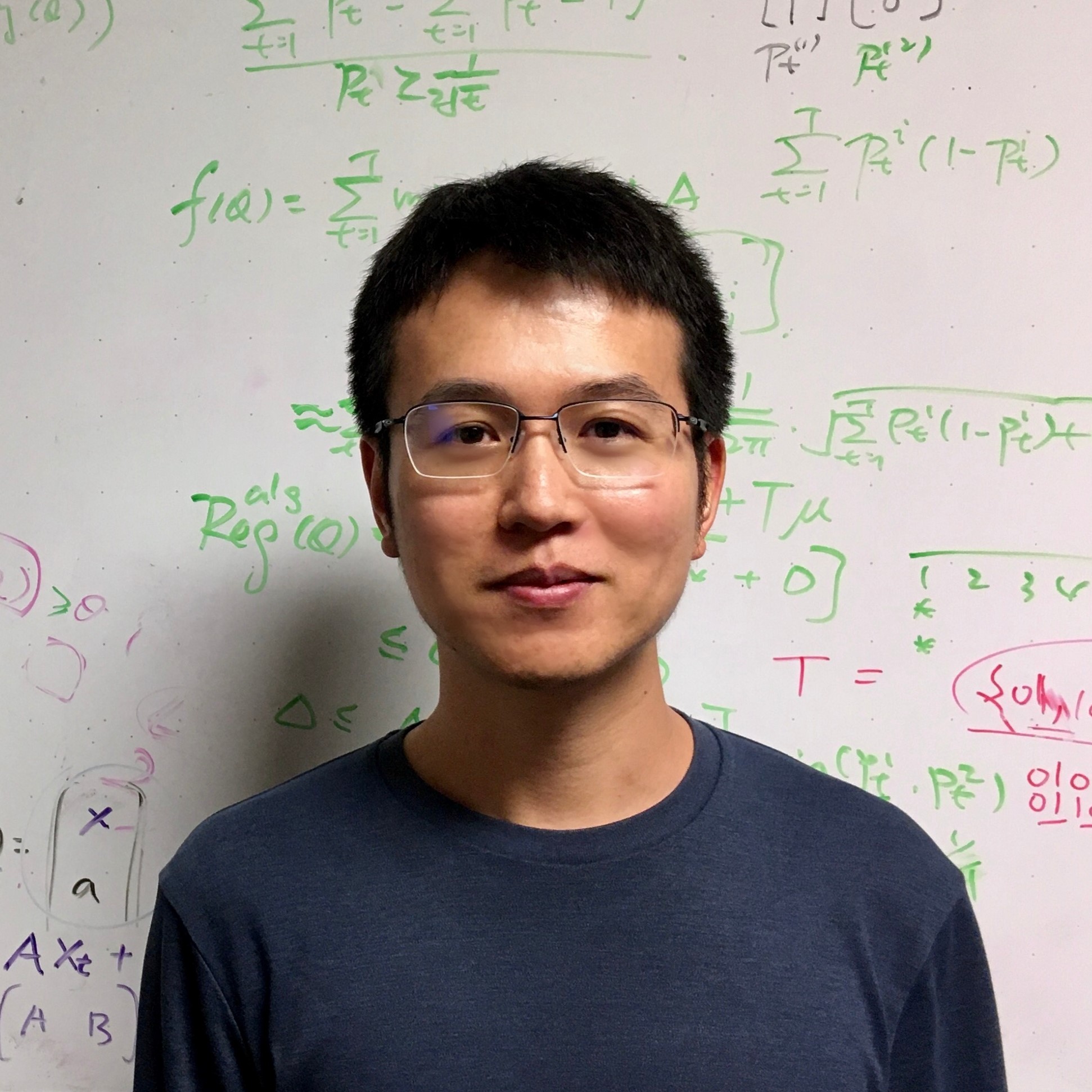
Shivaram Kalyanakrishnan is an Associate Professor at the Department of Computer Science and Engineering , Indian Institute of Technology Bombay , specialising in Artificial Intelligence and Machine Learning . His research spans sequential decision making , multiagent learning , multi-armed bandits , and humanoid robotics , with applications in robot soccer , computer games , and online advertising . He teaches advanced courses like CS 747: Foundations of Intelligent and Learning Agents and CS 748: Advances in Intelligent and Learning Agents , focusing on end-to-end system design and theoretical analysis. His scientific awards include the Best Student Paper Award at RoboCup International Symposium 2006 and nomination for Best Student Paper Award at AAMAS 2007 . His work on reinforcement learning and policy iteration has been published in leading venues such as IJCAI , ICML , and COLT , with recent contributions to railway scheduling and bandit algorithms. While no explicit list of advisees is provided, his research projects and publications suggest mentorship of students in collaborative efforts. Contact : shivaram@cse.iitb.ac.in .
Krishna Gummadi is a Scientific Director and Professor at the Max Planck Institute for Software Systems (MPI-SWS) in Germany, where he leads the Networked Systems Research Group. He also holds a professorship at the University of Saarland, demonstrating his dual commitment to research and academic instruction in computer science. His educational background includes: Ph.D. in Computer Science and Engineering from the University of Washington (2005) B.Tech. in Computer Science and Engineering from the Indian Institute of Technology, Madras (2000) Gummadi's research spans networked and distributed computer systems with a current focus on social computing systems. His work addresses critical challenges in algorithmic fairness, privacy in social media, trustworthiness of online identities, and information dissemination in social networks. He approaches these problems through interdisciplinary methods combining user-centric studies, data-centric analysis, and systems-centric design to create practical solutions that enhance fairness, transparency, and user control in online platforms. His methodology integrates large-scale observational studies, computational modeling, and system implementation to tackle complex human-computer interaction challenges at societal scale. His recent publications reveal a strong emphasis on fairness in algorithmic decision making, with significant contributions to quantifying and addressing discrimination in machine learning systems. His work bridges computer science, social science, and ethics, creating frameworks for fair classification, understanding media bias, and developing privacy-preserving techniques that maintain functionality while protecting user data. The research demonstrates a progression from technical system design to addressing societal implications of computing systems. Among his notable scientific achievements: ERC Advanced Grant in 2017 for 'Foundations for Fair Social Computing' Test of Time Awards at ACM SIGCOMM and AAAI ICWSM Casper Bowden Privacy Enhancing Technologies (PET) and CNIL-INRIA Privacy Runners-Up Awards IW3C2 WWW Best Paper Honorable Mention Multiple Best Paper awards across prestigious conferences Gummadi has advised numerous PhD students and postdoctoral researchers who have gone on to prominent positions in academia and industry. His ERC Advanced Grant has supported extensive research into fair social computing, while his leadership in major conferences (including serving as General Chair for ICWSM 2016 and Program Chair for WWW 2015) has shaped research directions in the field. His teaching portfolio includes courses on Distributed Systems, Human-Centered Machine Learning, and Social Media Analysis. He leads the Networked Systems Research Group at MPI-SWS, which has developed several publicly available systems including tools for fair classification, privacy risk assessment, trust evaluation in social media, and information diet management. The group's work bridges theoretical advances with practical implementations that address real-world challenges in social computing, with numerous software releases and datasets made available to the research community.
Daniel Kifer is a Professor in the Computer Science and Engineering department at Pennsylvania State University, with affiliations to the Huck Institutes of the Life Sciences. His work bridges computer science, privacy-preserving machine learning, and geoscience applications. With over 10,000 citations and a high h-index, he focuses on methods to unify theoretical and applied research. Research Interests: Differential Privacy, Privacy-Preserving Machine Learning, Physics-Informed Neural Networks, Landslide Prediction, and Formal Verification of Privacy Systems. Recent projects include grants from the National Science Foundation: SaTC: CORE: Small (2024): privacy-preserving user data embedding in machine learning pipelines. SaTC: CORE: Medium (2017-2023): formal methods for differential privacy and accuracy optimization. His research outputs span domains like geoscience, database systems, and policy analysis, emphasizing precision and scalability of privacy-preserving algorithms.
Vijay Vazirani is a Distinguished Professor in the Department of Computer Science at the University of California, Irvine , where he directs the ACO Center @ UCI . He earned his Ph.D. in Computer Science from UC Berkeley and a S.B. from MIT. Vazirani is a Guggenheim Fellow , ACM Fellow , and 2022 INFORMS John von Neumann Theory Prize recipient. Research Areas: Algorithmic Game Theory, Matching Markets, Computational Complexity, Approximation Algorithms His groundbreaking work includes co-founding algorithmic game theory and solving a 30-year-old problem with an NC algorithm for perfect matching in planar graphs . Recent research focuses on matching-based market design, with a $500K NSF grant for advancing algorithms in matching and market equilibria. His 15 most recent papers explore topics like core imputations, stable matching lattices, and Nash bargaining solutions. Scientific Awards: Guggenheim Fellowship ACM Fellow 2022 INFORMS John von Neumann Theory Prize Vazirani advises numerous Ph.D. students and postdocs, including Tung Mai , Thorben Trobst , and Rohith Reddy Gangam . He contributes to major workshops and co-edited foundational texts like Algorithmic Game Theory and Online and Matching-Based Market Design .
Baoyu Zhou is an Assistant Professor of Industrial Engineering at Arizona State University (ASU), School of Computing and Augmented Intelligence. He holds a PhD in Industrial and Systems Engineering from Lehigh University (2018–2022), an M.S. in Industrial Engineering from Lehigh University (2016–2018), and a B.E. in Mechanical Engineering from Shanghai Jiao Tong University (2012–2016). His research focuses on developing efficient algorithms for large-scale, stochastic, and constrained optimization problems, with contributions to sequential quadratic programming, nonsmooth optimization, and derivative-free methods. Before joining ASU, Zhou was a postdoctoral researcher at the University of Michigan (Department of Industrial and Operations Engineering) and the University of Chicago (Booth School of Business). He has received the Van Hoesen Family Best Publication Award and the Elizabeth V. Stout Dissertation Award. His work bridges optimization theory and practical applications, emphasizing scalability and robustness in complex systems. Zhou teaches courses such as IEE 470: Stochastic Operations Research at ASU and has guest-lectured at the University of Michigan. He actively contributes to the academic community through organizing conference sessions, reviewing for top journals, and participating in workshops at NeurIPS and SIAM. His group currently advises three PhD students focusing on optimization algorithms and their applications. Key research areas include large-scale continuous optimization, constrained stochastic optimization, and derivative-free methods. His publications span journals like SIAM Journal on Optimization and INFORMS Journal on Optimization, addressing challenges in nonlinear systems, variance reduction, and algorithmic convergence.
Joshua Ignatius is a Professor of Business Analytics at the Aston Business School, part of the College of Business and Social Sciences at Aston University. He focuses on research areas including supply chain analytics, prescriptive analytics, electronic commerce, and operations management. His work often addresses challenges such as information asymmetry in supply chains, user recommender systems, and logistics optimization. He is currently accepting PhD students in topics like Information Asymmetry in Supply Chains, User Recommender Systems, and Supply Chain Analytics. His research interests are centered on leveraging data-driven approaches to improve decision-making in supply chain and operational contexts. This includes studying disruption risk management, dynamic data modeling, and the integration of AI in cloud services. He also explores strategic decisions in e-commerce logistics, customer segmentation strategies, and environmental sustainability. Recent publications highlight his contributions to supply chain resilience, optimal security in cloud computing, and sustainable manufacturing processes. For instance, his 2025 work on supply chain network viability addresses disruption risks through dynamic data strategies. Another key area is the analysis of customer behavior in product upgrades, utilizing online review data to inform quality differentiation strategies. Dr. Ignatius has collaborated on projects involving platform information sharing, manufacturer encroachment, and logistics sourcing for e-commerce firms. His research often bridges theoretical frameworks with real-world applications, emphasizing practical solutions for operational challenges. He holds a strong record of supervising PhD students and guiding projects that combine academic rigor with industry relevance. His work frequently appears in leading journals such as the European Journal of Operational Research and Journal of Operations Management.
Prof. Dr. Andreas S. Schulz is a faculty member at Technische Universität München (TUM), holding a chair in the Department of Mathematics and the Department of Business and Economics. He previously served as the Patrick J. McGovern Chair of Management and Professor of Mathematics at MIT. His research focuses on mathematical optimization, algorithm design, and their applications in logistics, production, healthcare systems, and online advertising. He has held visiting professorships at institutions such as the Sauder School of Business (UBC) and ETH Zurich. Prof. Schulz’s research bridges operations research, theoretical computer science, and economics. He develops analytical methods to solve complex decision-making problems in business, including scheduling, resource allocation, and network optimization. A key interest is applying mathematical approaches to enhance healthcare delivery and system efficiency. Education: PhD in Operations Research (MIT), prior academic roles at MIT and visiting institutions. Key Achievements: Alexander von Humboldt Professorship (2014), Humboldt Research Award (2010), Glover-Klingman Prize (2006). Research Themes: Robust optimization, approximation algorithms, scheduling theory, and algorithmic game theory. His publications span topics like integer programming, optimal transport, and congestion games. He collaborates across disciplines, emphasizing practical applications of theoretical insights.
Debmalya Panigrahi is a Professor of Computer Science at Duke University and serves as Associate Chair in the Department of Computer Science since 2025. He received his Ph.D. in Theoretical Computer Science from the Massachusetts Institute of Technology (MIT), advised by David Karger, and also studied at the Indian Institute of Science and Jadavpur University. Ph.D., MIT, 2012 Indian Institute of Science Jadavpur University His research focuses on algorithms design and analysis, particularly in graph algorithms (minimum cuts, vertex connectivity, max-flows) and algorithms under uncertainty (online algorithms, learning-augmented frameworks). He also works on approximation algorithms, algorithmic game theory, and practical applications in advertising, AI, and network design. Recent publications address problems like network unreliability estimation, convex paging with fairness constraints, and hypergraph reliability. His work combines theoretical rigor with practical impact, including patents and prototypes. NSF CAREER Award He has received grants from the National Science Foundation (including multi-objective optimization projects), Google Inc., and the Indo-US Science and Technology Forum. He mentors graduate and undergraduate students, including current PhD candidates Ruoxu Cen and Anish Hebbar. Panigrahi is affiliated with Duke's theory group and collaborates with CS-econ, AI/ML, and database groups. He recently returned from a sabbatical at Berkeley (Simons Institute and UC Berkeley) and maintains strong ties with industry through roles at Google Research and Microsoft Research.
Anna R. Karlin is a Professor and the Bill & Melinda Gates Chair in Computer Science & Engineering at the University of Washington's Paul G. Allen School of Computer Science & Engineering. She serves as Associate Director of Graduate Studies and leads research in theoretical computer science within the Theory & Models of Computation focus area. Ph.D. from Stanford University (1987) Former researcher at Digital Equipment Corporation's Systems Research Center (5 years) Professor Karlin's research centers on theoretical computer science, with specific expertise in algorithm design and analysis, particularly probabilistic and online algorithms. Her work spans multiple interdisciplinary domains including algorithmic game theory, economics and computation, data mining, operating systems, networks, and distributed systems. Her research has evolved from foundational algorithmic work to impactful applications in market design, auction theory, and pricing mechanisms. Karlin's publication record demonstrates a consistent trajectory from classical theoretical computer science toward algorithmic game theory and mechanism design. Her recent work focuses on approximation algorithms for NP-hard problems, auction design, revenue maximization, and stable matching problems, with applications in online advertising, network economics, and resource allocation. She has developed influential algorithms for the Traveling Salesman Problem and made significant contributions to understanding interdependent valuations in combinatorial auctions. Bill & Melinda Gates Chair in Computer Science & Engineering Professor Karlin has advised numerous doctoral students throughout her career, with former students including prominent researchers like Jason Hartline, Frank McSherry, and Kira Goldner. Her collaborative research has been supported by various grants, including NSF funding (CCF-1813135 mentioned in her publications). She co-authored the influential textbook Game Theory, Alive with Yuval Peres, which serves as a rigorous introduction to game theory with applications across multiple disciplines. As a leader in theoretical computer science, Professor Karlin maintains active involvement in the Theory of Computation research group at the Allen School, fostering collaboration between theoretical foundations and practical applications in computer science.
Kannan Srinivasan is the H.J. Heinz II Professor of Management, Marketing and Business Technology at Carnegie Mellon University's Tepper School of Business, a position he has held since 1999. Prior to joining CMU, he taught at the business schools of the University of Chicago and Stanford University. His academic career spans over three decades with significant contributions to marketing science and data analytics. His educational background includes: Ph.D. in Management from University of California Los Angeles (1986) MBA in Marketing/Finance from Xavier School of Management, Jamshedpur, India (1980) BA in Engineering from University of Madras, Chennai, India (1978) Srinivasan's research focuses on advanced data analytics models applied to marketing problems, with particular expertise in internet-generated large-scale data analysis. His work bridges the gap between theoretical marketing models and practical business applications, especially in the areas of algorithmic pricing, consumer behavior analysis, and AI-driven marketing strategies. He has pioneered research in dynamic pricing systems, location-aware marketing technologies, and the economic implications of AI in consumer markets. Analysis of his recent publications reveals a strong trend toward examining the intersection of artificial intelligence, consumer welfare, and market dynamics. His work increasingly focuses on ethical implications of AI in marketing, algorithmic bias, and the socioeconomic impacts of digital platforms across various sectors including real estate, social media, and e-commerce. His scientific achievements include: Elected Fellow of the Informs Society of Marketing Science (2013) for lifetime contribution to the field Served as President of the Informs Society of Marketing Science Holds multiple patents related to time and location aware dynamic push content, dynamic pricing, and online advertising Srinivasan has advised numerous doctoral students whose careers have led them to faculty positions at top institutions including Duke, Harvard, Columbia, Yale, University of Chicago, Wharton, University of Michigan, and Indian Institute of Management Bangalore. He has extensive consulting experience with large firms and startups, translating academic research into practical business applications. His professional service includes editorial roles at prestigious journals including Management Science, Marketing Science, and Quantitative Marketing and Economics, as well as significant committee service within CMU including the Elliott D. Smith Award Committee and various Dean's Advisory committees. His research is organized around several key initiatives focused on applying advanced analytics to solve complex marketing problems, with particular emphasis on developing interpretable AI models that balance business objectives with consumer welfare considerations.
Claire Vernade is a Group Leader at the University of Tübingen in the Cluster of Excellence Machine Learning for Science. She leads an active research group focused on theoretical aspects of sequential decision making, with particular expertise in bandit problems and reinforcement learning theory. Her work bridges theoretical foundations with practical applications in scientific discovery. Her research interests span sequential decision making, bandit problems, theoretical Reinforcement Learning, Learning Theory, and principled learning algorithms. She has made significant contributions to understanding non-stationary environments, lifelong learning frameworks, and the theoretical foundations of bandit algorithms. Her work on "Eigengame: PCA as a Nash Equilibrium" received an Outstanding Paper Award at ICLR 2021. Dr. Vernade has been awarded prestigious grants including an Emmy Noether award (2022) for her FoLiReL project and an ERC Starting Grant (2024) for her ConSequentIAL project. Her current ERC project explores the role of Reinforcement Learning in developing Continual Learning agents, with applications to scientific domains like drug discovery and micro-chemistry. Emmy Noether award under the AI Initiative call (2022) ERC Starting Grant (2024) Outstanding Paper Award at ICLR 2021 She currently supervises three PhD students and actively recruits postdocs and PhD candidates through the IMPRS-IS and ELLIS doctoral programs. Her group collaborates extensively with the broader machine learning community, organizing workshops like FoRLaC at ICML 2024 and serving as co-chairs for tutorials at major conferences. Dr. Vernade is also deeply committed to diversity and inclusion in machine learning, co-leading initiatives like Women in Learning Theory and Tübingen Women in Machine Learning.
Haipeng Luo is an Associate Professor at the Thomas Lord Department of Computer Science, University of Southern California, holding the IBM Early Career Chair. He previously worked as a Postdoctoral Researcher at Microsoft Research, NYC, and has held visiting roles at Google and Amazon. His research focuses on developing practical machine learning algorithms with strong theoretical guarantees, particularly in online learning, bandit problems, reinforcement learning, and game theory. PhD in Computer Science, Princeton University (2011–2016) BSc in Computer Science, Peking University (2007–2011) His work spans adversarial and stochastic environments, addressing challenges in reinforcement learning, game dynamics, calibration, and omniprediction. Recent publications highlight advancements in regret minimization, game equilibrium computation, and robust optimization frameworks. Key contributions include algorithms for zero-sum games, bandit problems with feedback graphs, and theoretical analyses of convergence properties in multi-agent systems. Scientific accolades include Best Paper Awards at COLT 2021, COLT 2018, NeurIPS 2015, and ICML 2015. He has received prestigious grants such as the NSF CAREER Award (2020), Google Faculty Research Award (2020), and NSF CRII Award (2018). His students have secured academic and industry positions, and he actively teaches graduate courses in machine learning and online optimization.
Christos Nicolaides is an Assistant Professor at the Department of Business and Public Administration within the School of Economics and Management at the University of Cyprus (UCY), holding a secondary appointment as a Digital Fellow at MIT's Initiative on the Digital Economy. Previously, he spent three years as a James McDonnell Foundation-funded Postdoctoral Fellow at MIT Sloan School of Management. His educational background includes a PhD in Engineering from Massachusetts Institute of Technology (2014), SM from MIT (2011), MSc in Applied Mathematics from Imperial College London (2009), and BSc in Physics from University of Thessaloniki (2008). Nicolaides' research applies mathematical, statistical, and computational tools to large-scale empirical questions in social influence mediated by digital technologies. His work spans Data Science , Machine Learning , Social Networks , and Computational Social Science , with significant contributions to understanding human mobility patterns, disease transmission dynamics, and social contagion effects. His research has established novel methodologies for analyzing complex network structures in mobility data and social interactions. Analysis of his 15 most recent publications reveals a consistent focus on applying network science to real-world problems, particularly in pandemic response (12 publications), human mobility analytics (9 publications), and social contagion dynamics (7 publications). His work demonstrates increasing interdisciplinary integration, combining computer science, epidemiology, and organizational behavior since 2020. Marie S. Curie Fellow Two Highly Cited Papers by Web of Science (2017, 2020) Best Paper Award by Risk Analysis Society (2019) Professor of The Week by Poets & Quants (2020) As principal institutional investigator, Nicolaides has secured over €1 million in research funding from the European Commission, industry partners, Cyprus Innovation and Research Foundation, and Cyprus Ministry of Health. His current teaching includes Social Networks and Entrepreneurship, Introduction to Operations Management, and Quantitative Methods in Management. Media coverage of his work spans major outlets including The New York Times, CNN, Nature, and Science, with significant impact on public health policy discussions during the COVID-19 pandemic.
Patrick Jaillet is the Dugald C. Jackson Professor in the Department of Electrical Engineering and Computer Science at MIT's School of Engineering. He holds joint appointments with the Laboratory for Information and Decision Systems (LIDS), the Operations Research Center (ORC), the Operations Research and Statistics Group at MIT Sloan, and the Department of Civil and Environmental Engineering. Previously, he served as Head of Civil and Environmental Engineering at MIT (2002-2009) and Chair of the Department of Management Science and Information Systems at UT Austin (1997-2002). Dr. Jaillet's research focuses on online optimization and learning, sequential decision-making under uncertainty, and security and resilience in complex networks. His work spans theoretical foundations in optimization and machine learning with applications in transportation, online market analytics, and network security. He has developed mathematical frameworks for problems involving uncertainty, dynamic resource allocation, and strategic behavior in complex systems. His recent publications reveal strong trends in bridging theoretical optimization with practical machine learning applications. Key themes include Bayesian optimization for black-box functions, online learning with limited information, mechanism design for resource allocation, and network security applications. His work increasingly integrates large language models with traditional optimization techniques, reflecting the evolving landscape of AI-driven decision-making systems. Fulbright Scholar (1990) Fellow of the Institute for Operations Research and Management Science (INFORMS) Best Applications Paper Award at ICAPS 2019 Long-standing Associate Editor for top journals including Operations Research and Transportation Science Dr. Jaillet has advised over 40 doctoral students who now hold prominent positions in academia and industry, including faculty positions at MIT, Georgia Tech, and ETH Zurich, and research scientist roles at Amazon, Microsoft Research, and Google. His research has been consistently funded by major agencies including NSF, ONR, AFOSR, and international partners like Singapore NRF, with current projects focusing on learning algorithms for autonomous security and fundamental tradeoffs in optimization. He leads a vibrant research group spanning MIT's EECS department and ORC, with current funding supporting work on neural bandits, federated optimization, and network security applications. His research group operates at the intersection of theory and practice, with strong connections to industry through collaborations with IBM, Microsoft, Google, and various transportation and technology companies. The group maintains active partnerships with international institutions, particularly through SMART in Singapore, reflecting Dr. Jaillet's global research impact.
Ilie Sarpe is a postdoctoral researcher in the Division of Theoretical Computer Science at KTH Royal Institute of Technology, mentored by Prof. Aristides Gionis. He is an active member of both VandinLab and AIDA Lab, focusing on developing rigorous algorithms for temporal network analysis. His educational background includes: PhD in Computer Engineering from the University of Padova (2019-2023), with thesis on 'Efficient and Rigorous Techniques for the Analysis of Large Temporal Networks' Master's Degree in Computer Engineering (summa cum laude) from the University of Padova (2017-2019) Bachelor's Degree in Computer Engineering from the University of Padova (2014-2017) Sarpe's research centers on the design of scalable algorithms for data-mining problems, particularly in graph-mining and clustering. He specializes in probabilistic algorithms with rigorous theoretical guarantees, with a strong focus on temporal networks. His work integrates tools from sampling theory, probability, concentration inequalities, and statistical learning theory to develop efficient solutions for complex network analysis problems. His publications demonstrate a consistent focus on temporal network analysis, with recent work accepted at top venues including KDD 2024, WWW 2022, CIKM 2021, and SIAM SDM 2021. The research trajectory shows increasing sophistication in handling temporal motifs, dense subnetwork discovery, and centrality measures in evolving networks. His scientific recognition includes: SoBigData TNA Fellowship (2022) 3 years Ph.D. Fellowship (2019) Award for Scientific Degrees (2017) Two 'Mille e una lode' awards (2016, 2017) Sarpe actively supervises master's thesis projects in data mining at KTH and has secured research funding through the SoBigData TNA Fellowship. His research group affiliation with VandinLab and AIDA Lab provides collaborative opportunities across multiple institutions. He maintains active laboratory work focused on developing practical implementations of his theoretical algorithms, as evidenced by his GitHub repositories containing C++ implementations of his published methods.