Konstantinos Tyros is Associate Professor in Mathematics at the University of Athens, specializing in combinatorial analysis and Ramsey theory. His research connects density theorems in combinatorics with problems in Banach space geometry and probabilistic methods. Key contributions include density versions of combinatorial theorems (Carlson-Simpson, Hales-Jewett), structure theorems for stochastic processes on discrete cubes, and concentration inequalities for high-dimensional random arrays. His work on spreading models in Banach spaces reveals new structures in functional analysis. He has developed novel approaches to nonlinear spectral gaps and dual Ramsey theory for trees, while advancing the Moser-Tardos algorithmic framework. Honors include technical excellence awards from Greek academic institutions.
Zeev Dvir is a Professor jointly appointed in the Department of Computer Science and the Department of Mathematics at Princeton University. His research interests span theoretical computer science, discrete mathematics, and their intersections with algebra and combinatorics. He focuses on computational complexity, pseudo-randomness, coding theory, and combinatorial geometry. Notable contributions include work on the Kakeya conjecture in finite fields, incidence theorems, and applications to coding theory. He has published extensively in top venues such as computational complexity conferences and journals. His work has been highlighted in Quanta Magazine for its impact on geometric problems. Zeev Dvir holds grants from the National Science Foundation (NSF), including awards for research on dimension expanders and line-point incidence problems. His research also intersects with areas like matrix rigidity and data structure lower bounds. He maintains an active research program and collaborates on foundational questions in theoretical computer science and mathematics. His homepage hosts surveys on incidence theorems and their applications, reflecting his commitment to bridging algebraic methods with discrete geometry. He is a prominent figure in the Princeton academic community, contributing to both departments through teaching and interdisciplinary research.
Gabor Sarkozy is a Professor in the Computer Science Department at Worcester Polytechnic Institute (WPI). His research focuses on graph theory, discrete mathematics, and theoretical computer science, with notable contributions to Ramsey theory, extremal graph theory, and algorithmic graph problems. He co-developed the Blow-up Lemma, a foundational tool in combinatorics. He teaches advanced courses such as Analysis of Algorithms and Foundations of Computer Science, and leads the Budapest MQP Project Center, fostering international academic collaborations. His work spans over 100 publications, emphasizing monochromatic cycle partitions, hypergraphs, and time-series data analytics. He collaborates extensively with researchers like Endre Szemerédi and András Gyárfás. His research integrates theoretical insights with practical applications in data mining and algorithm design. Research Interests: Graph Theory Ramsey Numbers Combinatorial Optimization Algorithm Design Time Series Analysis Key Projects: Budapest MQP Project Center Algorithmic Graph Theory Research Time Series Clustering and Matching Professional Activities: PhD advisor and mentor International conference speaker Co-author of influential papers in Combinatorica and Journal of Combinatorial Theory
Dr. Weiming Feng is an incoming Assistant Professor at the School of Computing and Data Science of The University of Hong Kong. His research focuses on Theoretical Computer Science, particularly sampling and approximate counting algorithms, with applications in Statistics and Learning Theory. Prior to joining HKU, he held postdoctoral positions at The University of Edinburgh, UC Berkeley, and ETH Zürich. Education: PhD in Computer Science from Nanjing University (2021). Research interests include Discrete Probability, Markov Chain Monte Carlo (MCMC), and algorithmic developments for high-dimensional distributions. His work bridges theoretical foundations and practical applications, addressing challenges in computational efficiency and probabilistic modeling. Notable contributions include advancements in deterministic approximation of statistical distances, MCMC derandomization, and fast sampling techniques for combinatorial problems. His publications span top venues like SODA, FOCS, and STOC, reflecting contributions to algorithm design and computational theory. Lab and Team: While specific lab affiliations are not mentioned, his research is embedded within the broader computational and data science initiatives at HKU's School of Computing and Data Science.
Robert Krauthgamer is the Harry Weinrebe Professor of Computer Science and currently serves as Department Head in the Department of Computer Science & Applied Mathematics at the Weizmann Institute of Science , within the Faculty of Mathematics and Computer Science . He is a leading researcher in theoretical computer science, particularly in the analysis of algorithms. Research Interests: His research focuses on Analysis of Algorithms , with deep expertise in Data Analysis and Massive Data Sets , Combinatorial Optimization , Approximation Algorithms , Hardness of Approximation , Embeddings of Finite Metrics , and Routing and Peer to Peer Networks . He also maintains a broad interest in Discrete Mathematics and High-Dimensional Geometry . His recent publications highlight work in graph algorithms, parameterized complexity, streaming algorithms, and metric embeddings. Publication Trends: His most recent work, including papers from SODA 2016, demonstrates a strong trend in the design and analysis of efficient algorithms for fundamental problems in graph theory, optimization, and data streams. Key themes include kernelization and sampling techniques for dynamic graph streams, subexponential parameterized algorithms, deterministic derandomization of the polynomial method, and structural results for graph modification problems. His research often bridges theoretical insights with applications in computational biology and network science. Service and Recognition: Journal Editorial: Editor-in-Chief of SIAM Journal on Computing (2019–2025), Associate Editor (2012–2017); Managing Editor of Theory of Computing (2007–2018), and current Editorial Board Member. Conference Leadership: Program Committee Chair for SODA 2016 and HALG 2018; Steering Committee member for SODA, ESA, and HALG; and committee member for the Gödel Prize (2019–2021). Workshops: Organizer of numerous workshops on sublinear algorithms, fine-grained complexity, and high-dimensional data. Teaching and Mentorship: He regularly teaches advanced courses such as Randomized Algorithms and Sublinear Time and Space Algorithms . He advises a large group of MSc and PhD students and hosts postdoctoral researchers, demonstrating a strong commitment to training the next generation of computer scientists. His former students have gone on to successful academic and research careers. Laboratories and Research Groups: He is a key member of the Foundations of Computer Science (theory) seminar at Weizmann and has organized the TheoryLunch and Reading Group in Algorithms, fostering a vibrant research community within the department.
Heng Guo is an Associate Professor in Algorithms and Complexity at the School of Informatics, University of Edinburgh. He leads the ERC starting grant project New Approaches to Counting and Sampling (NACS), which runs from 2021 to 2026. Previously, he has worked and studied at Berkeley, London, Madison, and Beijing. His research lies at the intersection of theoretical computer science, combinatorics, and statistical physics. Guo's research focuses on algorithms from a complexity perspective, particularly computational counting and sampling. He is renowned for his work on the Lovász local lemma, Markov chain Monte Carlo methods, phase transitions in computational complexity, and complexity classifications. His approach often involves discovering unseen links between different areas of theoretical computer science. Key contributions include confirming a conjecture of Gorodezky and Pak through partial rejection sampling, establishing rapid mixing for Swendsen-Wang dynamics, and developing a polynomial-time approximation algorithm for all-terminal network reliability. His publication record shows a strong trajectory of impactful research in top venues including FOCS, STOC, SODA, J. ACM, and SIAM Journal on Computing. His work on the all-terminal network reliability problem won the Best Paper Award at ICALP 2018. Guo has organized several significant workshops including JerrumFest 2025, MCMC 2.0 (Shonan seminar), and a STOC 2020 workshop on new frontiers of approximate counting. These events highlight his leadership role in the theoretical computer science community. Best Paper Award at ICALP 2018 EATCS Distinguished Dissertation Award 2016 Guo has advised several PhD students including Giorgos Mousa, Jiaheng Wang, and Graham Freifeld, and mentored postdocs such as Weiming Feng, Vishvajeet Nagargoje, and Konrad Anand. His ERC grant supports multiple research associates working on counting and sampling problems. He has taught courses including Computational Complexity, Randomness and Computation, and Algorithmic Game Theory at the University of Edinburgh.
Sebastia Martin Mollevi is a researcher at the Department of Mathematics , Universitat Politècnica de Catalunya , affiliated with the Information Security Group - Mathematics Applied to Cryptography (ISG-MAK) . His work focuses on cryptographic protocols, secret sharing, and elliptic curve applications. Education : PhD in Mathematics (2000) from UPC, thesis on Elliptic Curves over ZN and Cryptographic Applications . Research Interests : Cryptography, secret sharing schemes, broadcast encryption, elliptic curve cryptography, combinatorial code design, and information theory applications. Publications : 108 activities including 16 indexed journal articles, 58 conference presentations, and 17 technical documents. Projects : Lead researcher in projects like Cátedra CARISMATICA and Criptografía para retos digitales emergentes , focusing on digital society security and post-quantum cryptography. His work includes algorithmic improvements in broadcast encryption trade-offs, linear threshold secret sharing, and secure public-key cryptosystems. Notable contributions involve proving security equivalences in elliptic curve systems and developing practical encryption mechanisms.
Rajko Nenadov is a Lecturer in Theoretical Computer Science at the University of Auckland, New Zealand. Previously, he earned his PhD from ETH Zurich in 2016 under Angelika Steger. He held postdoctoral positions at Monash University (Australia) and ETH Zurich, focusing on combinatorics and graph theory. Between 2018–2022, he worked as a software engineer at Google Zurich, contributing to search ranking algorithms. Returning to academia in 2023, his research emphasizes probabilistic methods, random structures, and applications in theoretical computer science. His education includes a PhD in Computer Science from ETH Zurich (2016). Notable career milestones include postdoctoral research on expanders, pseudorandomness, and Ramsey theory, followed by industry experience in algorithmic development. Rajko’s research interests revolve around combinatorics, with a focus on probabilistic methods, random graphs, extremal graph theory, and Ramsey theory. His work bridges foundational combinatorics with practical applications in computer science, particularly in algorithm design and computational complexity. His recent publications explore topics like hypergraph universality, container theorems, and extremal subgraph counting. These contributions highlight advancements in probabilistic combinatorics and structural graph theory. No scientific awards or grants are explicitly listed in the provided information. His career transition from academia to industry and back underscores his interdisciplinary expertise in theory and applied computing.
Prof. Vladimir Kolmogorov is a faculty member at the Institute of Science and Technology Austria (IST Austria), specializing in discrete optimization and algorithm design. He holds a Ph.D. in Computer Science from Cornell University and has held positions at Microsoft Research and University College London. His research focuses on combinatorial optimization, MAP inference in graphical models, and applications in computer vision. Educations: M.S. in Applied Mathematics and Physics, Moscow Institute of Physics and Technology Ph.D. in Computer Science, Cornell University Research Interests: Dr. Kolmogorov's work spans algorithmic optimization, including complexity analysis of constraint satisfaction problems, graph algorithms, and machine learning applications. His contributions include foundational work on graph cuts for computer vision and the development of efficient optimization methods for discrete problems. Publications: His recent work includes advancements in parallel algorithms for Gibbs distributions, semidefinite programming, and combinatorial optimization. These contributions highlight his expertise in bridging theoretical computer science with practical applications. Awards: Royal Academy of Engineering/EPSRC Research Fellowship (2006–2011) ERC Consolidator Grant (2014–2020) Best Paper Award at ECCV 2002 Outstanding Student Paper Award (NIPS 2007) Best Paper Honorable Mention (CVPR 2005) Advising and Grants: He has advised multiple PhD students and leads a research team at IST Austria. His grants include significant funding for exploring optimization in machine learning and discrete systems. Labs/Teams: His lab focuses on theoretical and applied discrete optimization, collaborating with institutions globally. Current projects include developing faster algorithms for graph problems and advancing Gibbs distribution analysis.
Carol T. Zamfirescu is a Professor in the Department of Applied Mathematics, Computer Science and Statistics at Universiteit Gent (University of Ghent). She holds a Dipl.-Math from TU Dortmund and a Ph.D. from UGent. Her research focuses on graph theory, combinatorics, and discrete mathematics, with particular emphasis on Hamiltonian cycles, planar graphs, and algorithmic graph theory. Educations: Dipl.-Math (TU Dortmund) Ph.D. (Universiteit Gent) Research interests span structural graph theory, including topics like hypohamiltonian graphs, cycle spectra, and graph embeddings. She is a member of the FWO (Research Foundation Flanders) W&T1 Fellowship panel on Mathematical Sciences since 2023, evaluating doctoral/postdoctoral fellowships. Her work often involves collaborations with computational methods, exploring properties of graphs such as fault-tolerance, spanning trees, and cycle covers. Recent contributions include studies on platypus graphs, edge-Kempe equivalence, and the Gromov-Hausdorff metric applied to graph spaces. Her research also addresses foundational questions in graph theory, such as the existence of non-hamiltonian polyhedra and the structure of cubic graphs with unique longest cycles. She has contributed to improving bounds for hypohamiltonian graphs and their computational generation.
Yifan Jing is an Assistant Professor in the Department of Mathematics at The Ohio State University (OSU). He previously held postdoctoral positions at the University of Oxford’s Mathematical Institute and Wolfson College, mentored by Ben Green. His academic journey includes a PhD from the University of Illinois Urbana-Champaign (2021), supervised by József Balogh and Xiaochun Li, an M.Sc. from Simon Fraser University (2018) under Bojan Mohar, and a B.Sc. from the University of Science and Technology of China (2016), advised by Jack Koolen. His research focuses on Arithmetic Combinatorics, Analytic and Combinatorial Group Theory, Lie groups, Abstract Harmonic Analysis, Representation Theory, Additive Number Theory, Model Theory applications, Discrete Probability, and Theoretical Computer Science. Notable contributions include work on measure growth in Lie groups, inverse theorems for geometric inequalities, and structural graph theory. He received the 2023 Kirkman Medal for his research contributions. He currently organizes OSU’s Combinatorics Seminar and teaches Math 4507: Geometry. His advising includes PhD students Yewen Sun, Chavdar Lalov, and Yuchen Meng, alongside mentoring multiple undergraduate researchers at Oxford. Collaborators include leading mathematicians such as Chieu-Minh Tran, Ruixiang Zhang, and Bojan Mohar. His work bridges analysis, algebra, and logic to address problems across combinatorics, number theory, and geometry.
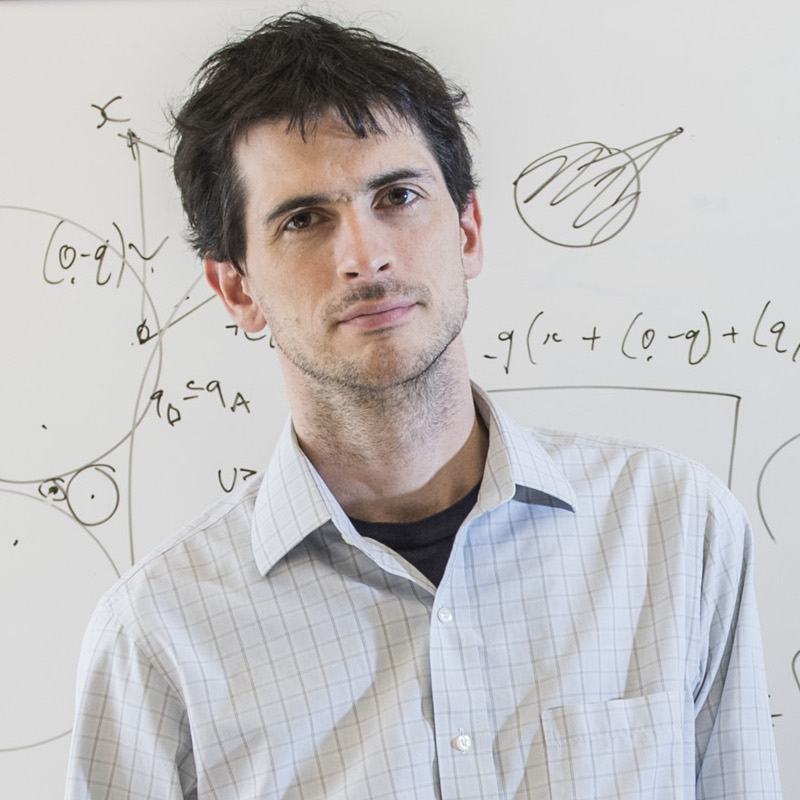
Wesley Pegden is a Professor in the Department of Mathematical Sciences at Carnegie Mellon University, affiliated with the Mellon College of Science. He holds a Ph.D. from Rutgers University. His research focuses on Discrete Mathematics, including probabilistic combinatorics, combinatorial game theory, graph theory, and discrete geometry. A central theme of his work is the Abelian sandpile model, where he has explored fractal patterns and connections to Apollonian circle packings. Collaborations with Lionel Levine and Charles Smart have advanced understanding of the sandpile's geometric properties through novel constructions of integer superharmonic functions. His work extends to applications in network science, epidemiological modeling, and statistical sampling biases (e.g., analyzing the Bangladesh mask trial). Notably, he contributed to studies on gerrymandering and congressional districting, including an expert analysis of Pennsylvania's district map. Awards include the Sloan Research Fellowship. Research Highlights: Abelian sandpile fractal geometry, algorithmic local lemma extensions, and random graph dynamics. Key Collaborations: Lionel Levine, Charles Smart, Alan Frieze.
Yannic Maus is a Professor at Graz University of Technology, affiliated with the Institute of Algorithms and Theory and the Institute of Software Engineering and Artificial Intelligence. His research focuses on distributed computing, graph algorithms, and theoretical computer science. He holds a PhD and multiple bachelor’s and master’s degrees in Computer Science. His work emphasizes distributed graph coloring, locality in algorithms, and massively parallel computing. He has contributed to foundational results in distributed algorithms, including optimal edge coloring and coloring hyperbolic random graphs. His research bridges theoretical insights with practical distributed systems challenges. Education: PhD in Natural Sciences (Dr.rer.nat.), B.Sc. and M.Sc. in Computer Science Key research interests include distributed algorithms for graphs, Lovász Local Lemma applications, and algorithmic efficiency in dynamic networks. His publications explore topics like ruling sets in trees, exponential speedups in MPC models, and adaptive coloring techniques for sparse graphs. He has also investigated the algorithmic small-world phenomenon and connectivity in forests using deterministic approaches. Yannic Maus’s work often addresses theoretical lower bounds and upper limits in distributed computing, with applications to real-world networked systems. His contributions span conferences like DISC and SoCG, focusing on both foundational problems and their algorithmic solutions.
Aravind Srinivasan is a Professor of Computer Science at the University of Maryland, College Park, USA. He holds tenure and has held academic positions at the National University of Singapore and Bell Labs. He completed his B.Tech at IIT Madras and his Ph.D. at Cornell University, with postdoctoral research at the Institute for Advanced Study and DIMACS. His research focuses on randomized algorithms, networking, social networks, combinatorial optimization, and their applications to public health, machine learning, and energy systems. He has published over 115 papers in top journals like Nature and the Journal of the ACM, and his work has received significant recognition, including 1,551 citations for his 2004 Nature paper on disease modeling. Education: B.Tech, Indian Institute of Technology Madras Ph.D., Cornell University Awarded Fellowships from ACM, AAAS, IEEE, and EATCS, he also serves as Editor-in-Chief of the ACM Transactions on Algorithms. His students have secured roles in academia, industry, and government, reflecting his impactful mentorship. His contributions span theoretical computer science and applied domains, with notable work in probabilistic methods, network science, and interdisciplinary applications.
Gábor Tardos is a Hungarian mathematician and computer scientist with a career spanning esteemed institutions such as the Alfréd Rényi Institute of Mathematics (since 1991) and Simon Fraser University (2005–2013). He currently holds a professorship at Central European University and leads the Lendület cryptography research group at Rényi Institute. His work bridges discrete mathematics, computer science, and complexity theory. Key fields of interest: Discrete and computational geometry Cryptography Extremal combinatorics Complexity theory Major scientific contributions include probabilistic fingerprinting codes, advancements in the Lovász local lemma, and combinatorial geometry breakthroughs. His awards include the 2020 Gödel Prize and Lendület Grant. He serves as an editor for journals such as Order and Combinatorica .