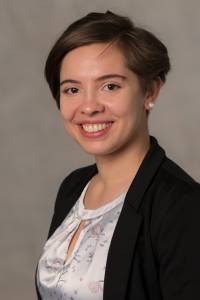
Dr. Lukas Pflug is a researcher at the Department of Mathematics, School of Engineering, Friedrich-Alexander University Erlangen-Nürnberg (FAU). His work spans applied mathematics, chemical engineering, and materials science with a focus on nonlocal conservation laws, topology optimization, and nanoparticle synthesis. Primary affiliation: FAU Erlangen-Nürnberg Research themes: Nonlocal PDEs, Robust Optimization, Plasmonics Key contributions include: Developing mathematical frameworks for nonlocal conservation laws and their singular limit problems Advancing topology optimization techniques for photonic crystals and composite materials Pioneering simulation-driven approaches in nanoparticle synthesis and characterization His methodology integrates theoretical analysis with computational implementation, producing 15+ peer-reviewed publications in high-impact journals like Advanced Optical Materials and SIAM Journal on Applied Mathematics between 2023-2025.
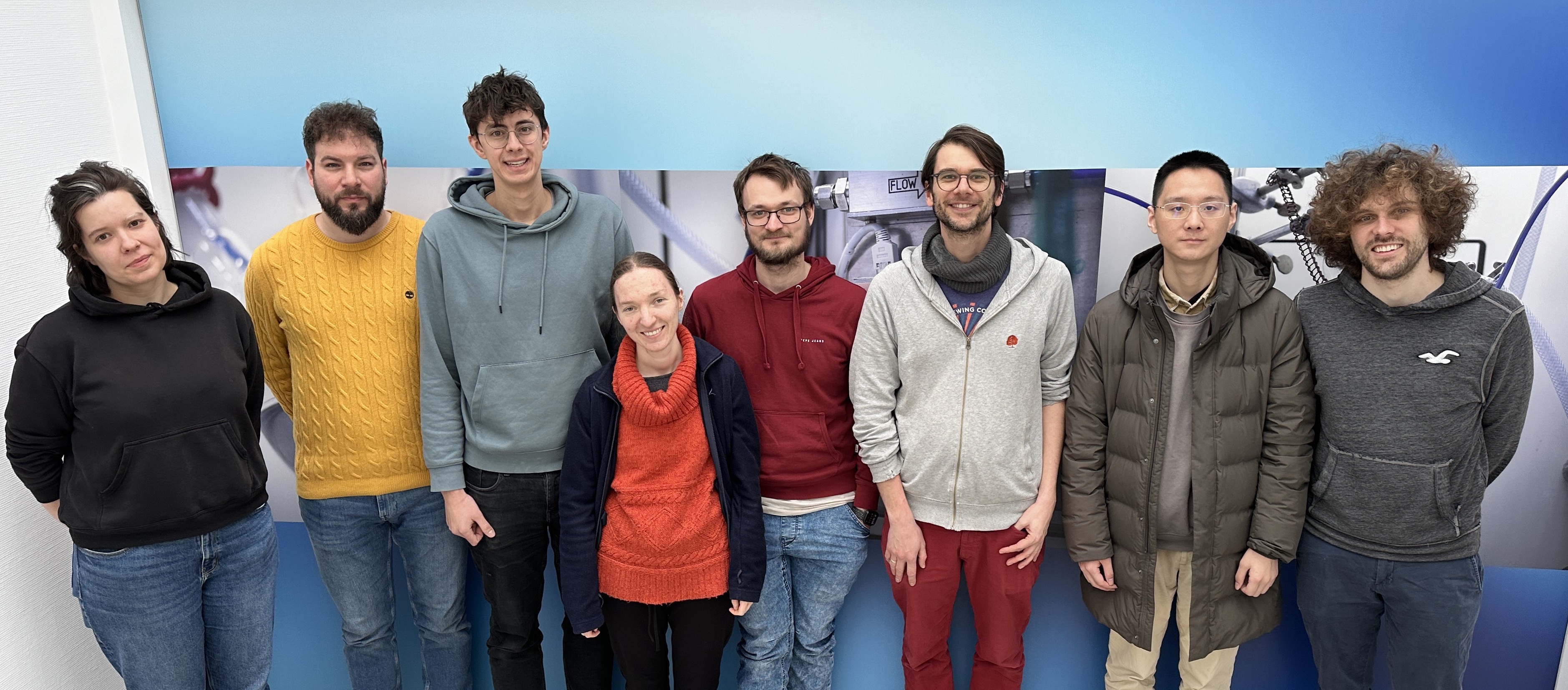
Martin Siebenborn is a Junior Professor (W1) for Optimization and Approximation at the Department of Mathematics, University of Hamburg. His research focuses on shape optimization with applications in fluid dynamics, structural mechanics, and partial differential equations (PDEs), emphasizing scalable high-performance algorithms and multigrid methods. Education: PhD in Mathematics (2014, Universität Trier), Diploma in Mathematics (2010, Universität Trier). His research integrates algorithmic scalability for PDE-constrained optimization, leveraging multigrid preconditioners and nonlinear extension operators. Recent projects include simulation-based design optimization under uncertainties and scalable shape optimization for fluid dynamics. Onyshkevych, Pinzon Escobar, and Wyschka are part of his research team. He has developed open-source software tools like MinFEM, MGSS, and MultigridShapeOpt for teaching and high-dimensional data analysis.
Christin Münch is a Scientific Associate (Researcher) at the University of Duisburg-Essen, affiliated with the Mercator School of Management. She works in the research group of Prof. Kimms, focusing on logistics and operations research. Education: Master of Science (M.Sc.) Her research interests include Operations Research, Logistics, Supply Chain Management, Mathematical Optimization, Computational Geometry, and Drone Logistics. She applies advanced computational methods to optimize logistics systems, with particular emphasis on drone-based delivery and energy-efficient routing. Recent publications reveal a focus on integrating computational geometry with mathematical programming for logistics applications and developing collision-free trajectory planning for drones considering energy consumption. Her work demonstrates interdisciplinary collaboration in solving real-world logistics challenges through algorithmic innovation. Scientific Awards: No scientific awards mentioned. Advising and Grants: No information on students advised or research grants is provided in the text. Labs and Teams: She is part of the logistics research group under Prof. Kimms at the Mercator School of Management, contributing to the Master's program in SCM and Logistics and advancing projects in supply chain optimization.
Clark Barrett is a Professor in the Department of Computer Science at Stanford University, where he conducts research in formal methods, automated reasoning, and verification. He is affiliated with several research centers including the Stanford Center for Automated Reasoning, Stanford Center for AI Safety, Stanford Agile Hardware Project, and Stanford Center for Blockchain Research. His research focuses on developing formal methods and tools for verifying complex systems, with particular emphasis on satisfiability modulo theories (SMT), verification of neural networks, hardware design verification, and security. His work bridges theoretical foundations with practical applications across multiple domains. Over the past decade, Barrett's research has evolved from foundational work in SMT solving to increasingly diverse applications including neural network verification, hardware verification, and AI safety. His recent publications demonstrate a strong focus on practical verification techniques for real-world systems, particularly in the areas of hardware design, neural networks, and programming languages. The trend shows an expansion from core verification techniques to broader applications in AI safety and secure systems design. 2021 CAV (Computer Aided Verification) Award Barrett leads several major research initiatives and collaborates extensively with industry partners. His work on the Marabou neural network verification framework, SMT-LIB standard, and Symbolic QED verification methodology have had significant impact in both academic and industrial settings. He has supervised numerous PhD students and postdoctoral researchers who have gone on to successful careers in academia and industry. He is a key member of the Stanford Center for Automated Reasoning, which develops foundational technologies for automated reasoning, and the Stanford Center for AI Safety, where he focuses on formal methods for ensuring the safety and reliability of AI systems. His work on the Stanford Agile Hardware Project aims to revolutionize hardware design through formal methods and verification techniques.
Prof. Dr. Dr. h.c. Peter Maaß is a leading academic at the Center for Industrial Mathematics (ZeTeM) at the University of Bremen, Germany. His work bridges Inverse Problems , Machine Learning , and Computational Engineering , with a focus on applications in life sciences and industrial systems . Research Interests: A pioneer in inverse problems and imaging, Maaß’s research spans Signal and image analysis in life sciences Deep learning for geometry generation Hybrid data-driven and model-based simulations Parameter identification in differential equations Recent Publications highlight trends in Deep Learning , Medical Imaging , and Scientific Computing , with subtopics including GAN-based inversion , Neural Network Regularization , and Multiscale Approximation . His work often integrates domain-specific knowledge with modern AI techniques. Scientific Honors: Dr. h.c. (honorary doctorate) Advising and Grants: He has supervised numerous PhD theses on topics like Regularization Theory , 3D Image Analysis , and Invertible Neural Networks . His projects include EU-ROMSOC , AGENS , and DIAMANT , funded by agencies such as DFG , BMBF , and EU . Labs and Collaborations: Leads the Working Group Industrial Mathematics and contributes to ZeTeM ’s interdisciplinary research, including Graduate School π³ and collaborations with institutions like University of Melbourne and Clemson University .
Luitpold Babel is a Professor of Mathematics and Computer Science at the Faculty of Business Administration, University of the Federal Armed Forces Munich. He has been serving in this position since 2007 and continues to be actively involved in teaching and research as evidenced by his Spring Term 2025 course offerings including Fundamentals of Computer Science, Scientific Computing with Matlab, and Engineering Mathematics tutorials. His educational background includes: 1982-1987: Studied mathematics at the Technical University of Munich 1987: Diploma (with distinction) 1990: Doctorate (with distinction) 1997: Habilitation Professor Babel's research has evolved significantly over his career, beginning with theoretical work in discrete mathematics and graph theory before transitioning to applied defense technology research. His current focus spans operations research applications in military technology, particularly UAV route planning, missile guidance systems, and logistics optimization. He has developed expertise in translating complex mathematical concepts into practical engineering solutions for defense applications, with particular emphasis on kinematic constraints in path planning and risk assessment in navigation. An analysis of his publication trends reveals a clear shift from pure graph theory (1990-2005) toward increasingly applied research in aerospace engineering and defense technology (2010-present). His recent work demonstrates sophisticated integration of mathematical optimization with real-world constraints in military applications, with growing emphasis on cooperative systems, real-time replanning, and decentralized decision-making for missile and UAV fleets. His contributions have been recognized with: Teaching Award of the University of the Bundeswehr Munich (2015), awarded by the Student Convention Study Award of the German Society for Defense Technology eV Professor Babel has supervised over 30 master's and bachelor's theses, primarily focusing on defense-related applications of mathematics and computer science. His research has been supported by substantial external funding from the Federal Ministry of Defense and through multiple industry partnerships with major defense contractors including MBDA Deutschland GmbH and RAM-System GmbH. Current projects include Decentralized Flight Path Planning (2023-2025) and Studies on Technical-Logistical Tasks (2021-2024), demonstrating his continued active engagement in cutting-edge defense research.
Antonia Kalb is a researcher at Chair 11: Algorithm Engineering within the Department of Computer Science at Technical University of Dortmund. She works under the supervision of Prof. Maike Buchin and Dr. Bernd Zey in the field of computational geometry and algorithm design. Her research focuses on: Algorithms Graph Theory Computational Geometry Matching Problems Property Testing Sublinear Algorithms Antonia has made significant contributions to geometric algorithms, particularly in graph augmentation techniques with maximal matchings. Her research bridges theoretical computer science with practical applications in discrete geometry and optimization problems. She has taught exercises for 'Data Structures, Algorithms and Programming 2' during summer semesters 2019 and 2022, demonstrating her commitment to computer science education at the undergraduate level.
Prof. Johannes T. Margraf is a Professor and Chair of Physical Chemistry V: Theory and Machine Learning at the University of Bayreuth. His research group specializes in applying machine learning to chemical phenomena, including predicting properties of molecules and materials, understanding complex reaction networks, and developing data-efficient models that incorporate physical principles like size-extensivity and accurate descriptions of long-range interactions. The group also focuses on electronic structure theory, particularly bridging wavefunction and density functional methods. Margraf's research interests center on machine learning applications in chemistry and materials science, including non-local machine learning-based density functional theory, chemical reaction network analysis, and the development of physics-informed ML models. His work aims to achieve accurate chemical simulations at unprecedented scales for materials discovery and optimization. Analysis of recent publications shows a strong focus on machine learning potentials for materials simulation, density functional theory advancements, catalytic reaction networks, and computational spectroscopy. His research consistently integrates machine learning with fundamental physics principles to solve challenging problems in computational chemistry and materials science. Margraf leads a research team including postdoctoral researchers (Dr. Maciej Baradyn, Dr. Hyunwook Jung, Dr. Karlo Sovi´c) and PhD students (Nils Gönnheimer, David Greten, Konstantin Jakob, Sachin Rangaswamy, Robert Strothmann, Martin Vondrák). The group actively organizes scientific workshops and collaborates with institutions like the Fritz Haber Institute in Berlin.
Antonio Orvieto is a Professor and Principal Researcher at the Max Planck Institute for Intelligent Systems and ELLIS Institute Tübingen, where he leads the Deep Models and Optimization research group. He is also a lecturer at the University of Tübingen and faculty for the CLS, ELLIS, and IMPRS-IS PhD Programs. His research focuses on improving the efficiency of deep learning technologies through theoretical understanding of optimization dynamics and innovative neural network architectures. Dr. Orvieto earned his PhD from ETH Zürich under the supervision of Prof. Dr. Thomas Hofmann and Dr. Aurelien Lucchi. Prior to his PhD, he obtained his master's degree in Robotics, Systems, and Control from ETH. His educational background also includes undergraduate studies at Universita' degli studi di Padova in Italy. During his academic journey, he gained research experience at DeepMind (UK), Meta (US), MILA (CA), INRIA (FR), and HILTI (LI). Dr. Orvieto's research spans two main areas: understanding the intricacies of large-scale optimization dynamics and designing innovative architectures and powerful optimizers capable of handling complex data. His work particularly focuses on decoding patterns in sequential data, with applications in biology, neuroscience, natural language processing, and music generation. His theoretical approach to deep learning has led to significant contributions in understanding recurrent neural networks, transformers, and optimization methods. His recent publications reveal a strong focus on sequence modeling, optimization theory, and the theoretical foundations of deep learning, with particular emphasis on improving training efficiency and model performance. Schmidt Sciences AI2050 Early Career Fellow Dr. Orvieto actively mentors PhD students and leads a vibrant research group at the Max Planck Institute for Intelligent Systems. His Deep Models and Optimization group includes PhD students Destiny Okpekpe, Felix Sarnthein, Diganta Misra, Sajad Movahedi, and Wenjie Fan, among others. He is deeply involved in doctoral education as faculty for multiple PhD programs including CLS, ELLIS, and IMPRS-IS. His teaching includes the course "Nonconvex Optimization for Deep Learning" at the University of Tübingen. The Deep Models and Optimization research group investigates the interplay between optimizers and architectures in deep learning, with a focus on developing new networks for long-range reasoning. The group's mission is to design new optimizers and neural networks to accelerate technology and scientific discovery, with a strong theoretical foundation in optimization theory. They strongly believe that deep learning will revolutionize science and technology, and they aim to make powerful deep learning solutions accessible to scientists and engineers regardless of resource limitations.
Manuela Zude-Sasse is a Research Professor at the Leibniz Institute for Agricultural Engineering and Bioeconomy (ATB) in Potsdam, Germany, and former Professor at Beuth University of Applied Sciences Berlin (2009–2017). As Working Group Leader for Precision Horticulture, she focuses on spectro-optical measurement methods (LiDAR, hyperspectral analysis) for fruit quality assessment, canopy modeling, and data science applications in bioeconomy. M.Sc. in Chemistry/International Agronomy (1996, TU Berlin) Ph.D. in Horticulture summa cum laude (1999, TU Berlin) Habilitation in Applied Plant Physiology (2004, Humboldt University) Her research spans Precision Fruit Production , Plant Phenotyping , and 3D Sensor Integration , with projects like CrackSense (fruit cracking prediction) and horDIGrow (resource-efficient horticulture). She employs LiDAR, hyperspectral imaging, and time-resolved fluorescence to analyze temperate and tropical fruits. Recent publications in Plant Phenomics and Horticulturae demonstrate her work on spatial chlorophyll estimation via LiDAR and fruit water stress indices. Her studies in the Journal of Food Engineering (2024) and Postharvest Biology and Technology (2023) highlight machine learning applications for ripeness detection and 3D canopy analysis. Technology Transfer Award (State of Brandenburg, 2003) Silver Medal for Innovation (Agritechnica, 2017) She leads the SMART Farming Technology Research Center (SFTRC) collaboration in Malaysia and serves on editorial boards for Plant Phenomics , International Agrophysics , and Biosystems Engineering . Her 3D point cloud methodologies enable non-contact fruit biomechanics and nutrient management studies.
Prof. Dr. Michael Jung is a Professor at the Faculty of Computer Science/Mathematics of the Dresden University of Applied Sciences (HTW Dresden). He has held academic positions since the early 2000s, teaching courses such as "Mathematics 2" for Geomatics programs, "Scientific Computing," "Numerical Mathematics," and "Applied Computer Graphics." His research focuses on the finite element method , multilevel algorithms , and parallel computing for solving large-scale systems in solid mechanics, magnetic fields, and biological flows. Current Roles: Faculty member at HTW Dresden, teaching in undergraduate and graduate programs. Research Areas: Finite element theory, numerical solutions for partial differential equations, parallel implementation of multilevel methods. Teaching History: Includes TU Dresden, University of Kassel, Johannes Kepler University Linz, and TU Chemnitz. Textbooks Authored: "Finite Element Method for Engineers" (2001), "Mathematical Foundations for Natural and Engineering Sciences" (2021), and "Plane Trigonometry & Analytical Geometry" (2024). Contact: Room Z463, Tel. +49 351 462 3421, email michael.jung@htw-dresden.de .
Lasath Siriwardena is a computational designer and researcher at the University of Stuttgart's Institute for Computational Design and Construction (ICD), affiliated with the Cluster of Excellence IntCDC. His work focuses on agent-based modeling for architectural design and construction. Bachelor of Engineering Honours (Civil) - University of Sydney Bachelor of Design in Architecture - University of Sydney Master of Science in Integrative Technologies and Architectural Design Research (ITECH) - University of Stuttgart Research interests center on agent-based computational design , robotic timber construction , and collective construction systems . His projects integrate multi-robot coordination with material-specific design constraints for sustainable architecture. Scientific contributions include agent-based frameworks for timber structures and robotic fabrication systems. Publications demonstrate interdisciplinary collaboration across computational design , robotics , and sustainable construction . IntCDC Master’s Thesis Grant 2020 Dr. Artur-Fischer-Stiftung Award 2021 Teaching involves workshops at DigitalFutures Shanghai, AAG Stuttgart, and IAAC Barcelona. He supervises ITECH Master's theses on topics like mixed reality reinforcement learning for robotic construction.
Prof. Dr. Christof Hättig is a leading theoretical chemist at the Ruhr University Bochum , heading the Quantum Chemistry Group within the Faculty of Chemistry and Biochemistry . His research focuses on quantum chemical methods for excited states, solvation effects, and molecular interactions. Key research areas include: Electronic structure theory for excited states Solvation modeling in photochemistry Local correlation methods for large systems Reaction mechanisms in heterogeneous catalysis Nonadiabatic dynamics and charge transfer Development of efficient quantum chemistry algorithms Recent publications highlight his group's work on coupled cluster methods (CC2, ADC(2)), solvation models (COSMO, EC-RISM), and excited-state dynamics in complex systems. Collaborations span institutions in Germany, Switzerland, and Denmark. His methodological contributions enable accurate computational spectroscopy and catalytic reaction modeling . The group employs tools like TURBOMOLE and COSMOLogic for simulations, with applications in biochar combustion , photophysics , and environmental chemistry .
Dr. Fabian Höflinger serves as a Group Leader and Researcher at the University of Freiburg's Faculty of Engineering, specifically within the Institute of Microsystems Engineering (IMTEK) under the Electrical Measurement and Testing department. He has been a research associate at the University of Freiburg since April 2010 and has led a research group focused on indoor localization systems since 2011. Dr. Höflinger completed a dual degree program in electrical engineering at DHBW Ravensburg in 2005, followed by a master's degree at Mannheim University of Applied Sciences. He earned his doctorate in 2014 with a dissertation on 'Localization systems for determining the position of people and objects indoors.' Prior to his academic career at Freiburg, he worked as a development engineer from 2007 to 2010 and gained industry experience at Junghans Feinwerktechnik during his studies, where he developed components for telemetry systems. His research primarily focuses on indoor localization technologies, with particular expertise in acoustic signal processing, positioning systems, and embedded measurement technologies. Dr. Höflinger's work spans both theoretical development and practical implementation of localization systems, with applications ranging from industrial plant supervision to respiratory monitoring. His recent publications demonstrate a strong emphasis on direction-of-arrival estimation, sparse acoustic array geometries, and Markov modeling for system safety assessment. The research trajectory shows increasing sophistication in localization algorithms while expanding into adjacent fields such as autonomous vehicle safety and biomedical sensor applications. As a group leader, Dr. Höflinger oversees research activities in indoor localization and has built a significant body of work with over 80 publications spanning more than a decade. His research group develops innovative solutions for challenging environments including through-metal communication, respiratory monitoring via body movements, and robust positioning in mixed line-of-sight and non-line-of-sight conditions. The team maintains strong industry connections and focuses on practical implementations of theoretical concepts in real-world scenarios.
Daniel Tenbrinck is an Academic Councilor and Acting Professor (W3) at the Department of Data Science, Faculty of Natural Sciences, Friedrich-Alexander-Universität Erlangen-Nürnberg (FAU Erlangen-Nürnberg). His career spans roles at the University of Münster, ENSICAEN (France), and FAU Erlangen-Nürnberg. He holds a PhD in Computer Science (2013) from WWU Münster. Research Focus: Data Science, Machine Learning, Biomedical Imaging, Variational Methods, Graph Theory, and Numerical Analysis. Recent Publications: Explore hypergraph p-Laplacians, Fourier neural operators for image classification, and Bregman learning frameworks for sparse networks. Awards: Received the 2022 Teaching Award from FAU's Faculty of Natural Sciences and a 2021 performance bonus for outstanding contributions. Secured significant third-party funding, including a €1.98M BMBF grant for "COMFORT" (2024) and a €915k Bavarian Digitalization grant (2023). Teaching: Offers courses in Numerics, Mathematical Image Processing, Inverse Problems, and Data Science seminars. Actively involved in academic program development through grants like the 2023 Innovation Fund for Teaching.