Cicek Cavdar is an Associate Professor at the School of Electrical Engineering and Computer Science (EECS) at KTH Royal Institute of Technology , Sweden. She leads the Intelligent Network Systems research group and specializes in Telecommunication Networks , with a focus on Beyond 5G/6G Mobile Networks , Energy Efficiency , and AI-Assisted Network Management . PhD in Computer Science (2009) from University of California, Davis and Istanbul Technical University Her research spans Cell-Free Massive MIMO , Reconfigurable Intelligent Surfaces (RIS) , UAV Communication Systems , and Green Network Technologies . She actively contributes to 6G Network Architecture and Non-Terrestrial Networks , including satellite and aerial systems. Recent publications highlight AI-driven network optimization for handover management, energy-aware resource allocation , and multi-agent reinforcement learning in complex communication environments. She teaches advanced courses in Communication Systems , Machine Learning , and Software Engineering at KTH.
Kåre Synnes is a Professor in Pervasive and Mobile Computing at Luleå University of Technology, where he is affiliated with the Department of Computer Science, Electrical and Space Engineering. He is an active researcher and educator, recognized as an "Excellent lärare" (Excellent Teacher) and maintains his office in Luleå at location A3305a. Professor Synnes conducts research in pervasive computing and multimedia communication, with significant applications in eHealth. His work bridges theoretical computer science with practical implementations in distributed systems. He is also an affiliated researcher at the Centre for Distance-spanning Technology (CDT), focusing on technologies that enable communication across geographical boundaries. His recent publications demonstrate a clear trajectory toward sustainable computing solutions, with emphasis on circular economy applications, supply chain management, and environmental impact assessment. His research integrates computer science with economic and sustainability principles, showing how digital technologies can address contemporary environmental challenges through innovative auction systems, behavior analytics, and resource management frameworks. IST Prize winner as co-founder of Marratech AB Synnes has been deeply involved in European research projects since 1995, including multiple Framework Programme projects (FP4 through FP7). His work as an expert/reviewer for European projects since 2009 demonstrates his standing in the research community. His entrepreneurial success with Marratech AB, which was acquired by Google to form the basis for Google+ Hangouts, shows his ability to translate research into impactful commercial applications. Professor Synnes maintains strong connections with industry through his European project work and his entrepreneurial experience. His research group likely focuses on pervasive computing applications with real-world implementations, particularly in eHealth contexts, though specific lab details aren't provided in the available information.
Henrik Boström is a Professor of Computer Science specializing in Data Science Systems at the Division of Software and Computer Systems, KTH Royal Institute of Technology. His research focuses on trustworthy machine learning , with emphasis on conformal prediction (for confidence-calibrated predictions) and explainable AI . He is the developer of Python packages crepes (conformal classifiers/regressors) and xrf (explainable random forests). His primary research domains include: Developing robust methods for uncertainty quantification in predictive models Creating interpretable machine learning frameworks Optimizing ensemble techniques for high-dimensional data Applying ML to healthcare informatics and industrial diagnostics Analysis of his recent publications reveals strong emphasis on: (1) advancing conformal prediction theory for trustworthy AI, (2) enhancing interpretability of complex models like random forests and GNNs, and (3) developing efficient algorithms for uncertainty-aware learning in domains including healthcare, graph data, and high-dimensional regression. He serves as examiner for multiple degree projects and teaches courses including Programming for Data Science (ID2214) and Research Methodology and Scientific Writing (II2202) . He leads development of open-source tools for conformal prediction and model interpretation.
Matteo Magnani is a Professor in the Division of Computing Science at the Department of Information Technology, Uppsala University. He leads the Uppsala University Information Laboratory and is a founding member of the Uppsala University Computational Social Science Lab. His research spans network science, artificial intelligence, data science, and computational social science, with a focus on social data mining and multilayer networks. PhD in Computer Science, University of Bologna, 2006 Graduated with honours in Information Sciences, University of Bologna, 2002 Studies in Computer Science at University of Marne la Vallée and Imperial College London Matteo Magnani's research interests include social network analysis, multilayer and probabilistic networks, community detection, visual analytics, and the application of AI to digital media and climate communication. His work bridges computer science and social sciences, particularly in analyzing online discourse and digital intermediaries. He has contributed significantly to the understanding of network structures, uncertainty in networks, and the ethical dimensions of algorithmic analysis. His recent publications highlight trends in fairness in community detection, visual saliency in network layouts, emotional reactions to climate visuals online, and deep learning applications in social media. Topics frequently involve YouTube, Twitter, and online public debates, using advanced network and machine learning methods. Rotary Prize for best student of the Science Faculty Best Paper Award Funniest Presentation Award Best Poster Award Pedagogical Prize from UTN Distinguished University Teacher (Sweden) Docent title (Sweden) Magnani has supervised numerous students and collaborated widely, particularly with Luca Rossi, Alexandra Segerberg, and Davide Vega. He has secured funding from major sources including VR, H2020, STINT, and MIUR. He leads active research labs focused on information systems and computational social science, fostering interdisciplinary collaboration and innovation in network-based research.
Magnus Boman is a Professor of AI and Health at the Department of Medicine, Solna, Karolinska Institutet (KI), where he leads the AI@KI initiative to support researchers in AI integration. He is affiliated with the Chronic Inflammatory Disease Epidemiology research group under Johan Askling. His research focuses on AI applications in precision medicine, multimodal prediction, ethical norms in AI systems, energy-efficient computing, and quantum sensor data interpretation. Research Interests: Artificial Intelligence in healthcare and precision medicine Multimodal data analysis for disease prediction and treatment Machine learning for clinical decision support systems Ethical and societal implications of AI Grants: Swedish Research Council: Improving breast cancer histology image classification (2024-2026) Scalable Federated Learning (2022-2025) Ai in sustainable cities (VINNOVA, 2019) Advising & Students: Supervised over 50 PhD and Master's students across KI, KTH, and Stockholm University, focusing on AI applications in healthcare, machine learning, and computational epidemiology. Notable projects include predictive modeling for mental health outcomes and variant filtering in genetic data. Labs & Teams: Leads AI@KI, fostering AI adoption in medical research. Collaborates with the Johan Askling group on epidemiology and chronic disease studies.
Anna Gautier is an Assistant Professor in the Department of Computer Science at Chalmers University of Technology, affiliated with the Division of Data Science and AI. Previously, she was a Digital Futures Postdoctoral Fellow at KTH Royal Institute of Technology (2023–2025), focusing on mechanism design for multi-robot systems. Her research emphasizes planning under uncertainty, multi-agent systems, and human-robot interaction. She holds a PhD from the University of Oxford (2023), an MSc from the London School of Economics, and dual undergraduate degrees from Washington University in St. Louis. Education Background: PhD in Computer Science, University of Oxford (2023) MSc in Applied Mathematics, London School of Economics BA in Mathematics and BS in Computer Science, Washington University in St. Louis Research Interests: Dr. Gautier explores planning algorithms for multi-agent systems, particularly in uncertain environments. She designs mechanisms to coordinate robots and humans, leveraging game theory and formal methods. Her work addresses challenges like resource allocation, risk-aware decision-making, and trust in autonomous systems. Recent projects include contingency planning for autonomous vehicles and auction-based resource distribution. Professional Activities: She co-chairs the ECAI 2025 Demonstration Track and teaches the course Safe Robot Planning and Control at KTH. Her projects include collaborations with WASP-Nest (PerCorSo) and TECoSA on trustworthy autonomy. She actively publishes in top venues like AAMAS and AAAI. Labs and Teams: Affiliated with Chalmers' Data Science and AI division, she leads research in multi-agent systems and human-AI collaboration.
Panagiotis Papapetrou is a Professor of Data Science and Deputy Head of Department at the Department of Computer and Systems Science , Stockholm University (since 2017). He also serves as Head of the Data Science Research Group and holds an Adjunct Professor position at Aalto University (Finland). As a Board Member of the Swedish Association for Artificial Intelligence (SAIS) , he contributes to shaping AI research directions in Sweden. Research Pillars: Algorithmic data mining, interpretable machine learning, time series classification, and health informatics Key Projects: AI for societal fairness, digital twins for smart buildings, EXTREMUM for explainable medical AI, and e-learning personalization Teaching Legacy: Developed courses in Data Mining (HT2013-2022), Machine Learning (VT2022-2024), and Health Informatics (VT2018-2021) His work focuses on interpretable AI for healthcare applications, particularly through counterfactual explanations for time series classification and forecasting. This includes developing methods like Glacier for constrained counterfactuals and Ijuice for k-justified explanations. His research also explores multimodal clustering of sepsis patient records and federated learning approaches for ICU mortality prediction. Recent scientific contributions include: CounterFair (2024): Group fairness analysis via counterfactual burden metrics M-ClustEHR (2024): Multimodal clustering for electronic health records COMET (2024): Constraint-based glucose forecasting explanations Temporal pattern mining (2024-2025): Enhanced forecasting models through decomposition Z-Time (2024): Interpretable multivariate time series classification His editorial leadership includes: Action Editor at Machine Learning Journal (since 2024) Action Editor at Data Mining and Knowledge Discovery (since 2018) Guest Editorial Board for ECML/PKDD Journal Track (2014-2019)
Eva Erman is Professor of Political Science at Stockholm University and Deputy Head of the Department of Political Science. She serves as Chief Editor of Ethics & Global Politics and has held visiting scholar positions at institutions including the University of Melbourne, London School of Economics, and George Mason University. Her research bridges political philosophy, global democracy, and the ethical implications of artificial intelligence governance. Her scholarly work emphasizes meta-theoretical and methodological questions in political theory, focusing on feasibility, epistemic norms, and the interplay between moral and political legitimacy. She explores the democratization of global governance structures and the role of civil society actors in transnational decision-making processes. Key article themes since 2025 include algorithmic fairness, moral norms in AI governance, and democratic challenges in transnational AI frameworks 2024 contributions analyze legitimacy, behaviorism in political realism, and function-sensitive approaches to global governance 2023 research expands on empirical and normative AI governance, political normativity definitions, and behavioral theory critiques Erman's academic leadership extends to organizing international workshops and refereeing for top journals like Journal of Philosophy , American Political Science Review , and Political Studies . Her projects address critical intersections of technology, democracy, and justice in the 21st century.
Per Ahlgren is a Researcher in the Department of Statistics at Uppsala University, Sweden, specializing in bibliometric methodologies for research evaluation. His work focuses on developing and validating bibliometric indicators, citation analysis techniques, and science mapping approaches. Contact details include email (per.ahlgren@uu.se) and mobile phone (073-312 87 55), with office location at Ekonomikum on Kyrkogårdsgatan 10 in Uppsala. Ahlgren's research centers on bibliometric indicators, bibliometric methods, citation analysis, and science mapping. He has pioneered methodologies for citation normalization in publication-level networks, evaluation of bibliographic coupling and co-citation techniques, and algorithmic approaches to publication classification. His work frequently addresses challenges in research evaluation fairness, including the impact of ethnic diversity on scientific impact and the development of robust indicators for institutional monitoring. Analysis of his 2019-2024 publications reveals consistent methodological innovation in bibliometrics, with strong emphasis on citation normalization techniques, clustering algorithms for publication networks, and application of bibliometric methods to domain-specific research roadmaps (e.g., BATTERY 2030+). His annual Uppsala University monitoring reports demonstrate practical implementation of these methods for institutional research assessment, while his journal publications in Scientometrics and JASIST establish theoretical foundations. No scientific awards were mentioned in the available information. No details were provided regarding student supervision, research grants, or laboratory affiliations. His collaborative work appears primarily through co-authorship on bibliometric reports and methodological papers, but specific team structures or funding sources remain undocumented.
Bobby Lee Townsend Sturm JR is an Associate Professor at KTH Royal Institute of Technology, leading the MUSAiC project (ERC-2019-COG). He holds a PhD in Electrical and Computer Engineering from UC Santa Barbara (2009), followed by postdoctoral research at LAM, Paris 6, and academic roles at Aalborg University and Queen Mary University of London. His research focuses on AI ethics in music, generative AI for music, and folk music preservation. Current roles at KTH include teaching and supervising in Machine Learning, Music Informatics, and AI Ethics. He has pioneered AI music generation challenges (e.g., 2020 Double Jigs Challenge) and investigates societal impacts of AI on traditional music cultures. His work bridges technical innovation with cultural and ethical considerations, addressing issues like data colonialism, algorithmic bias, and human-AI collaboration in creative contexts. Education: PhD (UCSB, 2009), Postdoc (Paris 6), Academic appointments at Aalborg University (2010–2014) and Queen Mary University (2014–2018) Key Projects: MUSAiC (ERC), Virtual Session System for Irish Music, Traditional Music Dataset Analysis Teaching: Courses in Machine Learning, Music Acoustics, and ICT Innovation Publications span peer-reviewed journals and conferences, emphasizing ethical AI, music generation, and interdisciplinary research in MIR (Music Information Retrieval). He actively collaborates with musicians, anthropologists, and technologists to ensure culturally informed AI development.
Ericka Johnson is a Professor and Deputy Prefect at Linköping University, working within Gender Studies in the Department of Thematic Studies. She is affiliated with the Center for Medical Humanities and Bioethics (CMBS), Bodies Hub, and the P6: Body, Knowledge, Subjectivity research collective. Her work bridges Science & Technology Studies, medical humanities, and gender studies, with a focus on how data representation intersects with AI systems and how technologies 'refract' invisible discourses to make them visible. Johnson's research program investigates how the world becomes data, exploring connections between ontologies, epistemologies, and AI. She employs feminist science studies frameworks to examine medical technologies and material-discursive practices around the body. Her metaphor of refraction—comparing how technologies reveal hidden discourses to how prisms refract light into visible spectra—has become influential in feminist technoscience research. She is particularly known for identifying 'intersectional hallucinations' in synthetic medical data, where AI systems generate data that misrepresents complex, overlapping identities. Her major projects include 'Social complexity and fairness in synthetic medical data' (funded by WASP-HS and Vinnova), which examines how machine learning-generated data can overrepresent 'standard' patients while underrepresenting minorities, and 'The Constant Torment' project exploring prostate anxiety and its relationship to masculinity, resulting in her book 'A Cultural Biography of the Prostate.' Her recent publications span critical data studies, human-robot interaction, and the sociotechnical dimensions of AI, consistently examining how technologies shape and are shaped by social, cultural, and gendered contexts. As a supervisor, Johnson mentors doctoral students Isabel García Velázquez, Alexandra Gribble, and Dominika Lisy, as well as postdoctoral researcher Maria Arnelid. Her research is supported by major grants from WASP-HS (NetX) and Vinnova, focusing on fair and representative synthetic data, and she participates in the Wallenberg Autonomous Systems Program (WASP) Humanities and Society initiative. Johnson is actively involved in interdisciplinary research communities including the Center for Medical Humanities and Bioethics, Bodies Hub (researching bodies, identity, and gender), and the P6 research collective. These frameworks support her collaborative work at technology's intersection with gender, society, and healthcare, with practical implications for developing more equitable AI systems in medical contexts.
Damir Isovic is an Associate Professor and Vice-Chancellor for Internationalization at Mälardalen University's Academy of Innovation, Design and Technology. Previously, he served as Dean of the School of Innovation, Design and Engineering. His roles include leadership in academic administration and participation in national boards. He holds a PhD and has extensive international teaching experience. Research focuses on real-time systems, embedded systems design, and scheduling algorithms. Notable contributions include seminal work in real-time scheduling recognized by the IEEE Technical Community on Real-Time Systems. He has organized major conferences and delivered keynotes globally. His publications emphasize hybrid scheduling approaches, real-time operating systems (RTOS), media processing in resource-constrained systems, and MPEG standards. Recent work integrates memetic algorithms with fuzzy controllers and explores multi-core scheduling fairness. His research bridges theoretical scheduling models with practical embedded system implementations. No scientific awards explicitly listed in the text. Advising activities include supervising PhD students, though specific names are not provided. Lab affiliations include the Division of Networked and Embedded Systems, where he develops frameworks like GENESIS for embedded system engineering. His work emphasizes cross-disciplinary collaboration and industry partnerships in education and technology development.
Sarah Gillet is a Postdoctoral Researcher at the Division of Robotics, Perception, and Learning at KTH Royal Institute of Technology, where she focuses on developing social robot behaviors to foster collaboration and inclusion in human groups. Her research addresses challenges like in-group favoritism through computational approaches to shape group interactions. She holds a Doctoral Thesis (2024) titled Computational Approaches to Interaction-Shaping Robotics . Her work emphasizes group dynamics , robot-mediated inclusion , and pedagogical robotics , particularly in children and adolescent populations. Key areas include gaze behavior analysis, equitable participation promotion, and social robot roles such as mediators in educational settings. Dr. Gillet teaches the Social Robotics (DD2413) course and supervises master theses. Her recent publications explore robot gaze behaviors for participation balance, socially appropriate listening, and influence prediction models like RoSI. She actively participates in conferences like ACM/IEEE HRI and IEEE RO-MAN. Her research integrates computational methods with social science insights to design robots that actively improve human group interactions, with applications in education, collaboration, and bias mitigation.
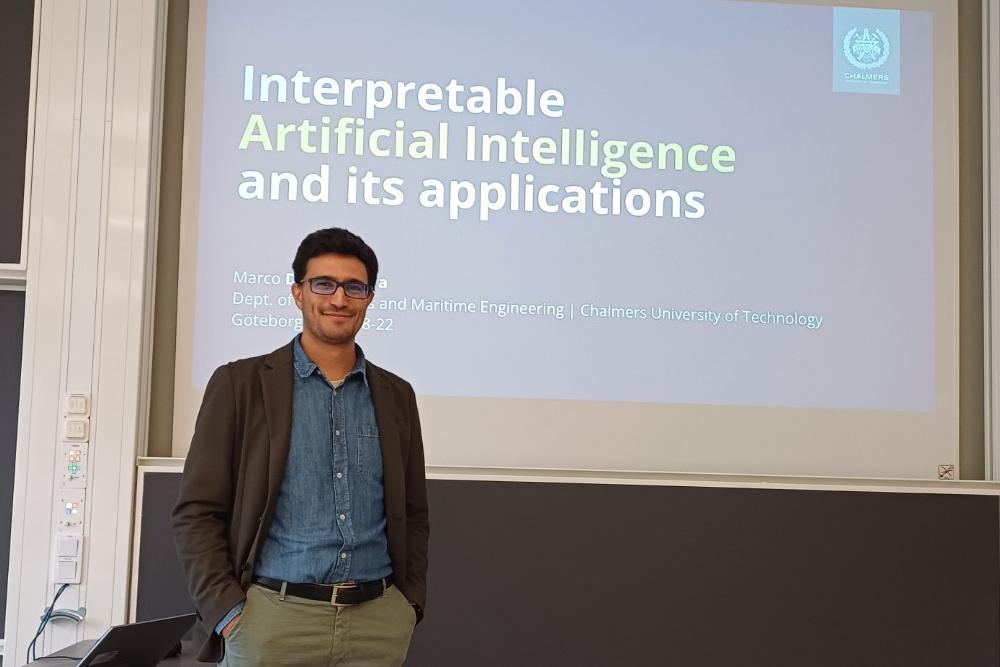
Marco L. Della Vedova is a Senior Lecturer in Applied Artificial Intelligence at Chalmers University of Technology, Sweden. He works in the Vehicle Engineering and Autonomous Systems division within the Department of Mechanics and Maritime Sciences, as part of Prof. Mattias Wahde's research group. Since 2025, he has served as Director of the Data Science and AI master's programme (MPDSC) at Chalmers, where he teaches courses including Introduction to Artificial Intelligence and Digitalization in Sports. Dr. Della Vedova earned his academic foundation at the University of Pavia, Italy, where he completed his BSc (2006), MSc (2009), and PhD (2013) in Computer Engineering. His doctoral research focused on "Real-Time Physical Systems and Electric Load Scheduling" under Prof. Tullio Facchinetti. During his PhD studies, he spent a year at U.C. Berkeley hosted by Prof. Francesco Borrelli at the Model Based Predictive and Distributed Control Lab. His research spans multiple AI domains with a strong emphasis on interpretability. Dr. Della Vedova develops interpretable methods for conversational AI, naturalness evaluation of forests using canopy height models, and geospatial applications. His work bridges theoretical AI with practical societal benefits, particularly in environmental monitoring, transportation systems, and orienteering. He has previously contributed to cloud computing, hate speech detection, and cyber-physical energy systems, demonstrating his interdisciplinary approach to AI research. Dr. Della Vedova's publication record reveals a consistent trajectory of impactful research across multiple domains of artificial intelligence. His recent work shows a strong focus on interpretability in AI systems, with significant contributions to natural language processing, geospatial analysis, and causal inference. The research demonstrates both theoretical depth and practical applications, particularly in environmental monitoring and social media analysis. His methodology often combines traditional machine learning approaches with novel interpretability techniques, creating bridges between complex AI systems and human understanding. Dr. Della Vedova has received several prestigious recognitions for his work: Best PhD thesis award from the Order of the Engineers of Bergamo (2013) Italian champion of Il Cervellone (2012) Top Italian performer in IEEEXtreme 6.0 programming competition (148th overall globally, 2012) Premio Arturo Schena award from Fondazione Credito Valtellinese (2010) With over 50 students supervised through bachelor's and master's theses, Dr. Della Vedova has established himself as a dedicated mentor in the AI community. His current PhD students include Minerva Suvanto working on interpretable NLP and Vivien Lacorre developing AI for railway infrastructure inspection. His supervision spans diverse topics from forest naturalness evaluation to hate speech detection and transportation optimization. Beyond formal supervision, he actively contributes to educational initiatives including serving as Director of Chalmers' Data Science and AI master's program and developing innovative teaching methods that connect theoretical concepts with real-world applications. Dr. Della Vedova is deeply embedded in both academic and professional communities. He leads the Applied Artificial Intelligence research group at Chalmers while maintaining strong connections with European research networks through projects like the ERASMUS+ EUrienteering initiative. His interdisciplinary approach is reflected in collaborations across computer science, environmental science, and social sciences. Notably, he applies his AI expertise to orienteering both as a researcher developing localization methods and as a licensed Event Advisor for the International Orienteering Federation, demonstrating how his professional and personal interests converge in innovative ways.
Fredrik Heintz is a professor at Linköping University's Department of Computer and Information Science within the Faculty of Science & Engineering. His research bridges artificial intelligence, education, and healthcare, focusing on AI literacy, synthetic data generation, and autonomous systems. Key affiliations: Linköping University (Faculty of Science & Engineering, Department of Computer and Information Science) Research Interests: Heintz's work spans multiple domains: Developing frameworks for AI literacy in K-12 education Creating fair synthetic healthcare data using GANs and bias-transforming techniques Advancing autonomous 3D exploration algorithms for dynamic environments Benchmarking tools for fairness, utility, and explainability in AI models Stream reasoning for real-time data analytics and knowledge extraction Evaluating ethical implications of AI in teacher education Scientific Contributions: His publications highlight collaborations with international researchers and significant grants from the Swedish Research Council, Knut and Alice Wallenberg Foundation, and VINNOVA. Notable projects include TransFusion for time-series generation, Bt-GAN for fair healthcare data, and DAEP for dynamic exploration planning. Funded by Wallenberg AI, Autonomous Systems and Software Program (WASP) ELLIIT Excellence Center at Linköping-Lund Mistra Geopolitics research program