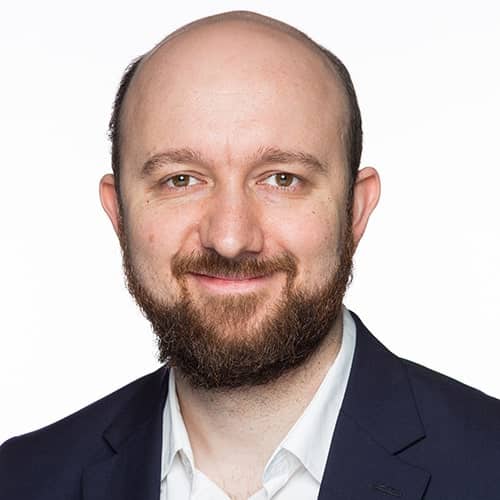
Martin Aumüller is a Lecturer in Theoretical Computer Science Algorithms at the IT University of Copenhagen . He serves as Head of Education and Master of Software Design , focusing on algorithm engineering, differential privacy, and similarity search. Research interests include: Algorithm engineering for high-dimensional data Locality-sensitive hashing and nearest neighbor search Privacy-preserving machine learning Fairness in approximate search algorithms Benchmarking and evaluation of similarity search tools Publications trends highlight his work on approximate nearest neighbor search , privacy-preserving techniques , clustering algorithms , and scalable outlier detection in high-dimensional spaces. His recent projects (2024-2025) focus on fairness, differential privacy, and efficient indexing. Grants and projects : DIREC (2020-2025): Digital Research Centre Denmark (Innovation Fund Denmark) DIREC: Bias and Benefit of Approximate Nearest Neighbor Search (2022-2025): Principal Investigator (Innovation Fund Denmark) BARC (2017-2024): Basic Algorithms Research Copenhagen (Villum Fonden) SSS (2014-2019): Scalable Similarity Search (European Commission)
Tuukka Ruotsalo serves as Associate Professor in the Machine Learning Section at the Department of Computer Science, University of Copenhagen. His research bridges human cognition with computational systems through brain-computer interfaces and physiological computing. As Academy Research Fellow at University of Helsinki (2019-2024), he maintained dual institutional affiliations while leading cutting-edge work in neuro-linguistic modeling and affective relevance. His research focuses on brain-computer interfaces for information retrieval , where he pioneers methods to decode cognitive states from neural signals to improve search systems. Key areas include affective relevance modeling that integrates emotional states into search algorithms, and neuro-linguistic reconstruction that translates brain activity into language. His work on fairness-relevance tradeoffs in recommender systems established Pareto frontier evaluation frameworks now widely adopted in ethical AI research. Recent publications demonstrate how physiological signals like EEG and galvanic skin response can create more adaptive human-information interaction systems. Ruotsalo's scientific recognition includes the prestigious Academy Research Fellow position. His publications in IEEE Transactions on Human-Machine Systems , Journal of the Association for Information Science and Technology , and Communications Biology reveal growing interdisciplinary impact. His advising spans cognitive neuroscience and machine learning students, with notable collaborations across the SCIENCE AI Centre. Current projects include the TreeSense initiative for remote sensing of global tree resources and development of quantum-inspired neural architectures. His lab leverages the department's powerful compute cluster for large-scale physiological data analysis.
Arijit Khan is an Associate Professor in the Department of Computer Science at Aalborg University, Denmark. He leads the Data Engineering, Science and Systems group and is affiliated with the Technical Faculty of IT and Design. His research focuses on Graph Neural Networks , Blockchain , Data Management , and AI interpretability . He is the Principal Investigator (PI) of a major project on Data Management, Fundamental Algorithms, and Machine Learning for Emerging Problems in Large Networks (2022–2027). Research Interests : Graph Data Management & Machine Learning Blockchain Transaction Analysis Large Language Model + Knowledge Graph Synergies Healthcare AI (e.g., ICU glucose prediction) Explainable AI for Graph Neural Networks Research Trends : His publications emphasize neuro-symbolic systems , uncertain graph analysis , and AI-driven blockchain insights . Recent work bridges large language models with knowledge graphs and explores GPU performance optimization via shader code analysis. Awards & Grants : No explicit awards listed, but his active research grants include a 5-year project on large network analysis with interdisciplinary applications in life and health sciences. Funding emphasizes algorithmic innovation and data science integration. Labs/Teams : Head of the Data Engineering, Science and Systems research group, focusing on AI for societal impact ('AI for the People') and scalable graph data systems. Collaborations span blockchain analytics, healthcare informatics, and GPU architecture design.
Andreas Bjerre-Nielsen is an Associate Professor at the Department of Economics and Copenhagen Center for Social Data Science (SODAS) within the Faculty of Social Sciences at the University of Copenhagen. His work bridges economics and data science to analyze education-related behavior and policies. Research Focus: School choice, digital technology in education, predictive analytics for interventions, and social network effects. Methodology: Combines econometrics with machine learning techniques to evaluate policy impacts. Research Trends: Recent publications emphasize algorithmic fairness in college admissions, socioeconomic impacts of school boundary policies, and behavioral insights from large-scale datasets. His 2025 Scientific Reports study reveals nation-scale social network dynamics. Awards and Grants: Tietgen Prize (2021) for young social science researchers 2024: Independent Research Fund Denmark grant for 'Coded Clues' project 2023: Major grant for school choice research Collaborations: Works with Danish Ministry of Children and Education through UDDanKvant unit, and collaborates with multidisciplinary researchers including Sune Lehmann and David Dreyer Lassen.
Sophia Natasha Wilson is a Research Fellow in the Department of Computer Science (DIKU) at the University of Copenhagen, specializing in machine learning applications across interdisciplinary domains. She is affiliated with the SCIENCE AI Centre and holds a cross-departmental position at the Niels Bohr Institute . Her research bridges theoretical machine learning with practical implementations in healthcare, quantum computing, and environmental sustainability. University of Copenhagen Department of Computer Science (DIKU) Niels Bohr Institute SCIENCE AI Centre Her research focuses include: Quantum-enhanced machine learning algorithms Explainable AI for healthcare applications Environmental sustainability in computing Emotion-aware language models Quantum computing hardware optimization Public health risk modeling Her recent publications demonstrate cross-disciplinary work in quantum machine learning (hybrid optical processors, qubit stabilization), health informatics (hypothyroidism analysis, nursing values evaluation), and ethical AI (sustainable AI, fairness in recommender systems). Technical work also appears in non-Euclidean generative models and real-time adaptive systems . Current projects include quantum dot array simulation (QDarts platform) and federated learning for personalized medicine . She contributes to the TreeSense center for remote sensing of global tree resources and works on climate-aware AI frameworks.
Ilias Chalkidis is an Assistant Professor specializing in Natural Language Processing at the Department of Computer Science, University of Copenhagen. He is actively affiliated with the Natural Language Processing research section, contributing to both theoretical and applied advancements in the field. His research spans multiple high-impact domains with particular emphasis on: Legal natural language processing and multilingual legal reasoning Large language model applications in political and social contexts Fairness-explainability trade-offs in AI systems Innovative representation learning techniques for textual data Analysis of his recent publications reveals a strong focus on bridging legal informatics with cutting-edge NLP methodologies. His work on multilingual legal corpora (including the 689GB MultiLegalPile dataset) and legal decision influence prediction demonstrates practical applications for judicial systems. Simultaneously, his investigations into LLMs as voting assistants and European political spectrum analysis showcase innovative intersections between computational social science and language technology. His technical contributions to contrastive learning and hyperbolic embeddings provide foundational advances for document representation. Chalkidis actively participates in the research community through workshop organization (Natural Legal Language Processing Workshop 2023-2024) and conference presentations. His research has been published in top-tier venues including ACL, EMNLP, and ECAI, with significant citations reflecting community impact. While specific advising relationships aren't documented in the provided materials, his collaborative work patterns suggest active mentorship within the NLP research ecosystem.
Ben Wagner is a leading academic in digital rights and technology governance, holding multiple prestigious positions: University Professor of Human Rights & Technology at IT:U, Director of the AI Futures Lab on Rights and Justice at TU Delft, and Professor of Media, Technology and Society at Inholland University of Applied Sciences. He leads the Digital Rights Research Team (DRRT) and co-founded the Sustainable Media Lab (SML) in The Hague, contributing to bridging research and education. He is also a visiting researcher at Oxford University's Human Centred Computing Group and serves on the advisory board of the journal Patterns . Inholland University of Applied Sciences – Professor, Media, Technology & Society (since 2021) TU Delft – Director, AI Futures Lab on Rights and Justice IT:U – University Professor, Human Rights & Technology European University Viadrina – Founding Director, Center for Internet & Human Rights Vienna University of Economics – Director, Sustainable Computing Lab ENISA – Advisory Group Member Ben Wagner earned his PhD in Political and Social Sciences from the European University Institute in Florence in 2013, with a dissertation on freedom of expression and online content regulation. He has held research positions at Cambridge University, University of Pennsylvania, Technical University of Berlin, and European University Viadrina. His research centers on digital rights, AI governance, freedom of expression online, and the societal impact of technology. He investigates how digital infrastructures shape human rights and advocates for sustainable, accountable systems. His work spans legal, technical, and social dimensions, focusing on public sector data practices, content moderation, ethical AI, and digital inclusion. He actively promotes citizen control over technological change and interdisciplinary collaboration. The recent publications reflect a strong focus on the ethical and governance challenges of AI and data science, digital rights frameworks, and platform accountability. Themes include the gap between policy and practice in public data use, global AI ethics, content governance on social media, and co-designing digital rights labels. His work emphasizes systemic accountability, hybrid digital-physical spaces, and embedding rights into technological design. Ben Wagner is an expert advisor to the European Parliament, European Commission, OSCE, Council of Europe, and UNESCO. He is a member of the policy advisory board for ECHOES (European Cloud for Heritage OpEn Science) and contributes to high-impact publications and international discourse. His research is widely covered in global media including CNN, The Guardian, Bloomberg TV, Der Spiegel, ORF, and SWR2. He advises on and contributes to major research initiatives such as ReSocial and fabricated. He is involved in developing a new Master’s program in Data-Driven Business at Inholland and leads efforts to integrate digital rights into education and innovation. His inaugural lecture, 'The Ground Beneath our Feet,' highlights the instability of digital infrastructures and the urgent need to embed digital rights at their core. Ben co-founded the Digital Rights Research Team and the Sustainable Media Lab at Inholland, fostering collaboration across faculties and sectors. These labs focus on creating a digitally responsible society through interdisciplinary research in design, policy, and technology. The AI Futures Lab at TU Delft explores justice-oriented futures for AI, while his work at IT:U advances human rights in digital contexts.
Kasper Lippert-Rasmussen is a Professor in the Department of Political Science at Aarhus University. His research focuses on discrimination, experimental methods in political philosophy, ethics of blame, relational egalitarianism, intergenerational justice, procreative justice, and collective paternalism. He teaches political theory and the theory of social science. Recent activities include organizing workshops on topics like poverty discrimination, equality, and moral standing in international conferences across Norway, Berkeley, and Greece. His work combines theoretical analysis with empirical approaches, particularly examining how experimental philosophy can inform ethical debates. He has contributed to discussions on algorithmic fairness, healthcare ethics, democratic theory, and the ethics of vaccination policies. Lippert-Rasmussen frequently participates in interdisciplinary dialogues, blending philosophy with social science methodologies to address contemporary moral challenges. His publications explore themes such as the moral implications of algorithmic discrimination, standing in blame contexts, and the theoretical foundations of egalitarian justice. He has collaborated with institutions globally and maintains active engagement in academic networks through conferences and workshops.
Line Katrine Harder Clemmensen is a Professor at the Department of Mathematical Sciences, University of Copenhagen. She specializes in statistical modeling, machine learning, and AI, with emphasis on low resource domains, explainability, and fairness in health/life science applications. She co-founded Interhuman AI as Chief Scientific Officer and maintains an active research program across multiple disciplines. Statistical Modeling Machine Learning Explainable AI Fairness in AI Health/Life Science Applications Her recent publications (2024-2025) span computational biology, neuroscience, environmental science, and emotion recognition. Notable collaborations include interdisciplinary work in pediatric OCD analysis, fungal microbiome prediction, and facial emotion recognition systems. She actively explores fairness and scalability in AI models. Dr. Clemmensen holds 60 publications with significant impact across computational biology (40+ citations), neuroscience (68+ readers), and machine learning (20+ Scopus citations). She has been referenced in news outlets, blogged, and discussed across multiple social platforms.
Ingemar Johansson Cox serves as a Professor within the Machine Learning section at the Department of Computer Science, University of Copenhagen. His research bridges theoretical machine learning foundations with practical applications across medical data analysis, information retrieval, remote sensing, and sustainability initiatives. His research portfolio emphasizes machine learning applications in high-impact domains, particularly medical data analysis (e.g., early detection of gynecological malignancy using online search activity) and sustainability (e.g., reducing AI's carbon footprint). The Machine Learning section actively contributes to the university's SCIENCE AI Centre, focusing on both algorithmic innovation and real-world problem-solving in biological modeling and environmental monitoring. Recent publication trends reveal expanding work in quantum computing applications for biomolecular modeling, sustainable AI frameworks, and cross-cultural NLP systems. His 2024-2025 output demonstrates strong interdisciplinary collaboration, especially in medical informatics and climate-related AI research. Professor Cox operates within the Department of Computer Science's robust research ecosystem, which includes dedicated compute clusters and specialized initiatives like TreeSense for global tree resource monitoring through remote sensing and deep learning. The department's infrastructure supports large-scale machine learning projects requiring significant computational resources.
Toine Bogers is a Part-Time Lecturer at Aalborg University , affiliated with the Department of Communication and Psychology within the Faculty of Social Sciences and Humanities . He is a core member of the AI for the People research group. His work focuses on Recommender Systems , Information Retrieval , and Social Media Analysis , with particular emphasis on applications in talent search, leisure information needs, and multistakeholder evaluation. Research Interests: Recommender systems, information seeking behavior, collaborative filtering, human resources algorithms, and ethical evaluation frameworks. His work bridges technical innovation with societal impact, often addressing challenges in job matching, cultural heritage retrieval, and user-centric design. Awards: Best Paper Award at CHIIR 2021 Outstanding PC Member (2020) Best Reviewer (2020, 2018, and multiple years) Grants & Projects: PI of JobMatch (2020–2023): Developing job recommendation systems for unemployed individuals Co-PI of Flipping Information Studies (2017–2019): Integrating video lectures into problem-based learning Organized workshops at RecSys on topics like Recommender Systems in HR and ComplexEnvironments Labs/Teams: He leads research in the AI for the People group, emphasizing human-centered AI applications in recruitment, cultural heritage, and social media analysis.
Thomas Søbirk Petersen is a Professor of Ethics at the School of Communication and Humanities, Roskilde University. His research spans multiple domains in applied ethics, political philosophy, and legal philosophy, with a focus on medical ethics, neuroethics, sports ethics, business ethics , and criminal justice ethics . He holds a Dr. phil. (2021) and PhD (2001) in Philosophy from Roskilde and Copenhagen Universities, respectively. Key Affiliations: Member, Research Group for Criminal Justice Ethics Member, Danish Council on Animal Ethics (since August 2013) Former member, Danish Council of Ethics (2017-2019) Petersen's work bridges theoretical and practical ethics. He specializes in: Philosophy of Law: Criminalization theory, theories of punishment Political Theory: Egalitarianism, libertarianism Theories of Well-Being: Hedonism His recent publications (2025-2026) focus on ethical dilemmas in sports (doping, fairness, neuro-enhancement), AI applications in crime prevention, and reproductive rights with particular attention to surrogacy and assisted reproduction. Petersen has received the Research Communication Award (2013) from the Danish Ministry of Science, Innovation and Higher Education. He leads the Center for Criminal Justice and Artificial Intelligence (CenCAI) (2025-2030) and contributes to projects on: Situational Crime Prevention and Ethics (SITE) Ethics, Crime Prevention and the City International Network for Neuroethics (INNETT)
Jonas Vinther is a Research Fellow at the Department of Computer Science , University of Copenhagen, specializing in Machine Learning and its intersections with quantum computing, medical data analysis, and sustainability. He is also an external PhD student in the Quantum Information Science & Technology program at the Niels Bohr Institute. Email: jonas.vinther@nbi.ku.dk , jonas.vinther@di.ku.dk Location: Universitetsparken 1, 2100 København Ø His research spans quantum machine learning , AI ethics , medical imaging , and environmentally sustainable AI , with recent publications on topics ranging from quantum neural networks to fairness in recommender systems . He contributes to the SCIENCE AI Centre and collaborates on initiatives like TreeSense for global tree resource monitoring.
Sarah Frances Homewood is an Assistant Professor (Tenure Track) in the Department of Computer Science at the University of Copenhagen, affiliated with the Human-Centred Computing research section. Her research focuses on the intersection of human-computer interaction and artificial intelligence, with applications in healthcare, natural language processing, and interpretable machine learning. Her diverse research interests span Human-Computer Interaction, Machine Learning, Natural Language Processing, and Artificial Intelligence. Recent investigations include interpretability of large language models, clinical NLP applications, fairness in recommender systems, and quantum natural language processing. Analysis of her recent publications reveals strong emphasis on NLP interpretability techniques, healthcare applications of AI, and theoretical foundations of machine learning. Her work frequently bridges fundamental computer science with practical applications in medicine and human-centered systems. Emerging research directions include quantum NLP and protein sequence modeling. Dr. Homewood's research contributes to the Machine Learning Section's focus on both theoretical foundations and applied domains including medical data analysis and information retrieval.
Markus Strohmaier is Professor and Chair of Data Science in the Economic and Social Sciences at the University of Mannheim, with affiliations as Scientific Coordinator at GESIS – Leibniz Institute for the Social Sciences and External Faculty Member at the Complexity Science Hub Vienna. His interdisciplinary work bridges computer science, economics, and the social sciences. University of Mannheim – Chair for Data Science in the Economic and Social Sciences GESIS – Scientific Coordinator for Digital Behavioral Data Complexity Science Hub Vienna – External Faculty Former Professor at RWTH Aachen University and University of Koblenz-Landau Previous Post-Doc and Visiting Roles at Stanford University, Xerox PARC, University of Toronto, and Graz University of Technology His research focuses on computational social science , algorithmic fairness , network science , and the modeling of human behavior using machine learning and large-scale data. He develops methods to analyze textual, relational, and emerging data types to understand socioeconomic systems and digital societies. The recent articles reflect a strong trend in studying inequality in algorithmic systems , governance in decentralized organizations (DAOs) , and psychological profiling of AI . His work spans high-impact journals like Nature and Scientific Reports , emphasizing fairness, transparency, and societal impact of data-driven technologies. Notable scientific contributions include: Editor-in-Chief of EPJ Data Science (2018–2022) Founding co-chair of the Computational Social Science section of the German Informatics Society He advises students and leads research projects on algorithmic fairness, digital governance, and behavioral modeling. His team engages in both fundamental methodological development and applied studies in real-world digital platforms. He has been involved in significant grants and collaborative initiatives around digital behavioral data and computational social science infrastructure. His lab and projects include the Algorithmic Fairness initiative and the interactive visualization tool Planets of Disparity , which explores how algorithms behave on different network structures. These efforts aim to enhance public understanding and technical scrutiny of algorithmic systems.