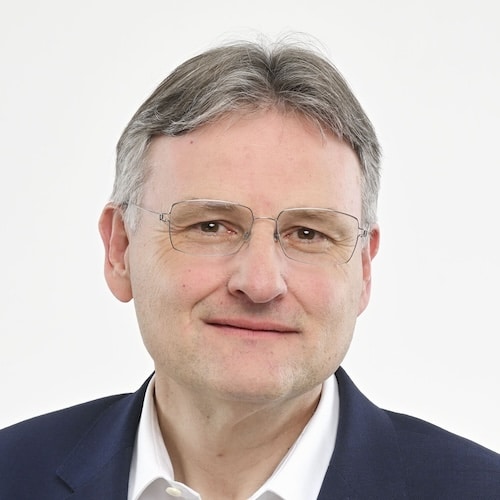
Diego F. Aranha is an Associate Professor in the Department of Computer Science at Aarhus University . His research focuses on cryptographic systems, cybersecurity, and privacy-preserving technologies with applications in voting systems, post-quantum cryptography, and secure computation. He has contributed extensively to homomorphic encryption, secure multiparty computation (MPC), and cryptanalysis of cryptographic implementations. Key projects include: MPCC (2025-2028) : Multi-Party Computation in the Confidential Cloud SCI (2024-2027) : Secure Computation Infrastructures for the Retail Industry RENAIS (2021-2026) : Residue Number Systems for Cryptography His work emphasizes practical efficiency and formal verification of cryptographic protocols. Recent publications highlight advancements in lattice-based cryptography, secure voting schemes, and mitigating side-channel vulnerabilities in post-quantum algorithms. He actively collaborates on open-source cryptographic libraries and standards, with a focus on bridging theoretical security and real-world implementation challenges.
Mogens Fosgerau is a Professor in the Department of Technology, Management and Economics at the Technical University of Denmark (DTU), where he conducts research in transport policy and transportation science. His work spans econometrics, travel behavior modeling, and transport economics, contributing to sustainable urban mobility and policy design. Institution: Technical University of Denmark Department: Department of Technology, Management and Economics Email: mogens.fosgerau@econ.ku.dk ORCID: https://orcid.org/0000-0002-6452-5215 His research focuses on discrete choice modeling, travel time valuation, scheduling preferences, and congestion pricing. He develops theoretical and empirical models to understand how individuals make travel decisions under uncertainty and how these behaviors affect urban transport systems. His work integrates economic theory with data-driven methods, often using large-scale datasets and advanced econometric techniques. The recent trend in his publications highlights innovations in perturbed utility models for route choice, stochastic traffic assignment, and the analysis of induced demand for cycling. His research bridges transportation science, behavioral economics, and operations research, with applications in urban planning and policy evaluation. Scientific awards received include: The International Choice Modeling Conference (ICMC) award for Most Innovative Application (2022) Best Overall Paper Award, ITEA Conference (2015) Best Paper Awards from BIVEC-GIVET (2007), Kuhmo-Nectar (2008) Hedorfs Fonds Pris for Transportforskning (2011) Mogens Fosgerau has supervised PhD students such as Fentie Abegaz and has been involved in multiple externally funded research projects, including URBAN (Innovation Fund Denmark), IRUC (Danish Council for Strategic Research), and Horizon 2020 initiatives. He has also served on review panels, including for the Norwegian Research Council, and contributed to peer review and editorial duties. He is actively engaged in research networks and has presented his work at international conferences. His projects often involve interdisciplinary collaboration with researchers in economics, engineering, and urban planning.
Andreas Kugi is the Scientific Director at the AIT Austrian Institute of Technology and a full professor of Complex Dynamical Systems at TU Wien (Vienna University of Technology) in the Faculty of Electrical Engineering and Information Technology, Institute of Automation and Control. He has held significant academic and leadership roles across Europe, including professorships at Saarland University and offers from TU Dresden and KIT. His research focuses on the modeling, control, and optimization of complex dynamical systems , with strong applications in mechatronics, robotics, and industrial automation . He has led major research centers such as the Christian Doppler Laboratory for Model-Based Process Control in the Steel Industry and the Center for Vision, Automation & Control at AIT. His work bridges theoretical control design and real-world industrial implementation. The recent publications reflect a consistent focus on nonlinear, hybrid, and distributed parameter systems , with applications in robotics, manufacturing, energy, and process industries. His research integrates advanced control theory with practical engineering challenges, emphasizing real-time optimization, robustness, and system efficiency. Scientific Awards: Mechatronic Systems Outstanding Investigator Award (IFAC, 2022) Goldene Stefan-Ehrenmedaille (OVE, 2023) 16 best paper awards Andreas Kugi has supervised over 50 completed PhD dissertations and has been deeply involved in research leadership, including serving as Editor-in-Chief of Control Engineering Practice (2010–2017) and Vice President of the OVE Austrian Electrotechnical Association (2017–2023). He has secured and led numerous research grants, particularly through industrial collaborations in automation and process control. He leads and contributes to major research initiatives, including the Center for Vision, Automation & Control at AIT and the Christian Doppler Laboratory , fostering interdisciplinary teams focused on industrial digitalization and smart systems.
Claus Bossen is a Professor at the Department of Digital Design and Information Studies within Aarhus University's School of Communication and Culture. His research bridges participatory design, healthcare digitization, and data work. Primary Affiliation: School of Communication and Culture, Department of Digital Design and Information Studies Research Focus: Data-driven healthcare, information infrastructures, and participatory design Email: clausbossen@cc.au.dk Research Interests span critical areas in healthcare digitization, including: Emergence of data work professions Human-AI collaboration in clinical documentation Design of healthcare information systems Infrastructure governance and quality improvement Digitization's impact on non-clinical staff Participatory design scaling mechanisms Recent Publications (2024-2025) show a trajectory toward: Global-local data integration challenges Professional adaptation in data-intensive settings Digitization's soco-technical implications Empowerment through data work practices Emergency healthcare system analysis Human-AI collaboration frameworks Current Projects include: LIVSTEGN: Monitoring technologies for safe dementia care Making Data Work Visible: Professional changes in healthcare Acute healthcare treatment pathways
Krist V. Gernaey is Professor in Industrial Fermentation Technology at the Technical University of Denmark's Department of Chemical and Biochemical Engineering. His research develops computational tools for bioprocess optimization across pharmaceutical, food, and chemical sectors. Research specializes in mechanistic modeling of fermentation processes, process analytical technology (PAT) implementation, and continuous production system design. Current investigations focus on uncertainty analysis methods, data-driven modeling, and novel bioreactor characterization from micro to production scale. Publications demonstrate applications in vaccine manufacturing, wastewater treatment, chromatography simulation, and sustainable chemical engineering. Recent work advances regulatory frameworks for in silico bioprocess models and AI integration in engineering education. Research collaborations span academic institutions and industry partners across Europe. Professional activities include conference organization and editorial responsibilities for chemical engineering journals.
Yan Kyaw Tun is a Tenure Track Assistant Professor in the Department of Electronic Systems at Aalborg University's Technical Faculty of IT and Design, located in Copenhagen, Denmark. His research lies at the intersection of wireless communications, edge computing, and artificial intelligence, with a strong focus on next-generation networks (5G/6G), UAV-assisted systems, and intelligent resource management. His educational background includes a Ph.D. in Computer Engineering from Kyung Hee University, South Korea, where he was awarded the Best Ph.D. Thesis Award in 2021, and a Bachelor of Engineering in Marine Electrical Systems and Electronic Engineering from Myanmar Maritime University. Dr. Tun's research interests span Edge Computing , Multi-Access Edge Computing (MEC) , Resource Allocation , Unmanned Aerial Vehicles (UAVs) , Reinforcement Learning , Energy Efficiency , and Integrated Sensing and Communication (ISAC) . His work leverages AI and optimization techniques to enhance the performance of wireless networks, particularly in space-air-ground integrated systems and satellite-HAP environments. The recent publications highlight a clear trend toward intelligent and sustainable networking: the integration of STAR-RIS (Simultaneously Transmitting and Reflecting Reconfigurable Intelligent Surfaces), Federated Learning for satellite-HAP systems, and AI-driven optimization for UAV trajectories and beamforming. These works are published in high-impact venues such as IEEE Transactions on Mobile Computing and IEEE ICC , showcasing his leadership in cutting-edge communication technologies. His scientific accolades include: IEEE ComSoc Outstanding Young Researcher Award for EMEA Region (2024) Best Ph.D. Thesis Award (2021) Student Best Paper Award at APNOMS 2019 Korea Network Operation and Management Conference Award (2020) Korea Computer Congress 2018 Award Dr. Tun is actively engaged in the academic community as an advisor and grant participant. Though no direct advisees are listed, his involvement in large collaborative projects—evidenced by co-authorship with senior researchers like Prof. Choong Seon Hong—indicates mentorship and team leadership. He has served on the editorial boards of IEEE Internet of Things Journal , IEEE Open Journal of the Communications Society , and IEEE Network , and has secured research support through participation in IEEE-organized workshops and special issues. He is a key organizer of upcoming workshops, including the 'Sustainable AI for Next-Generation Wireless Communications and Networking' at IEEE GLOBECOM 2025 and the 'Digital Twin Networks' workshop at IEEE/CIC International Communications in China 2025, reflecting his role in shaping future research directions in intelligent and green networking.
Jeppe Revall Frisvad is an Associate Professor in the Department of Applied Mathematics and Computer Science at the Technical University of Denmark (DTU), within the Visual Computing group. His work bridges computer graphics, material science, and applied optics, focusing on realistic rendering and material appearance modeling. Ph.D. in Computer Graphics, DTU Informatics (2008) M.Sc. in Engineering (Applied Mathematics), DTU (2004) Education in University Teaching, LearningLab DTU (2008–2009) His research centers on computing material appearance from physical and chemical properties, developing faster and more accurate physically based rendering methods. Key areas include light scattering, bidirectional reflectance distribution functions (BRDF), anisotropy, and translucency modeling. Applications span computer games, movies, digital prototyping, architectural visualization, and training simulators. His recent publications (2024–2025) reflect a strong trend in digitizing material appearance, especially for 3D printing and food science, using spectrophotometry and optical validation. The work combines computer graphics with interdisciplinary applications in food structure and biological imaging, emphasizing measurement, modeling, and simulation. Scientific Awards: Research travel prize from AEG Elektronfonden (2006) IGDA scholarship for GDCE 2005 DTU Ph.D. scholarship (2004) He actively supervises Ph.D. students and leads multiple research projects, including those on organ-on-chip imaging, cheese quality analysis, and optical modeling of teeth. He collaborates across disciplines and institutions, with external research stays at UC San Diego and the University of Otago. He is involved in projects integrating AI with 3D imaging and material digitization. Jeppe is a key member of the Visual Computing research environment at DTU, contributing to both fundamental rendering algorithms and practical applications in industry and science.
Carsten Baum is an Associate Professor at the Department of Applied Mathematics and Computer Science, Technical University of Denmark, working within the Cybersecurity Engineering Center for Quantum Technologies. His research focuses on cryptography, particularly post-quantum security, secure multi-party computation, and quantum-resistant protocols. Primary Affiliation: Technical University of Denmark (DTU) Academic Rank: Associate Professor Research Centers: Cybersecurity Engineering Center for Quantum Technologies Research Interests: Carsten Baum specializes in cryptographic protocols, including zero-knowledge proofs, multi-signatures, and oblivious computation. His work addresses quantum computing threats to classical cryptography and develops resilient post-quantum solutions. Key areas include: Secure multi-party computation (MPC) Post-quantum key agreement Quantum computing's impact on cryptographic security Privacy-preserving technologies Hash function security analysis (e.g., SHA-3) Time-based cryptographic primitives Advising and Projects: As a main or co-supervisor, Baum mentors multiple PhD candidates in post-quantum cryptography and secure protocols. His projects include proactive post-quantum cryptography, quantum key agreement, and long-term security frameworks, reflecting collaborations with institutions across Europe and Asia. Recent Activities: Baum actively organizes and participates in Nordic cryptography workshops, including NordiCrypt Spring 2024 and 2023, fostering academic exchange in cryptographic research.
Mauricio Bustamante is an Assistant Professor at the Niels Bohr Institute , University of Copenhagen, specializing in theoretical high-energy astrophysics, astroparticle physics, and neutrino phenomenology. His research bridges cosmic phenomena with fundamental particle physics, focusing on ultra-high-energy neutrinos, cosmic rays, gamma-ray bursts, and new physics beyond the Standard Model. PhD in Physics (2012-2014) M.Sc. in Physics (2007-2010) B.Sc. in Physics (2001-2006) His work explores neutrino oscillations, self-interactions, and decay in extreme astrophysical environments. He contributes to major international collaborations like GRAND (Giant Radio Array for Neutrino Detection) and IceCube-Gen2, developing simulation pipelines and forecasting detection methods for EeV-scale neutrinos. Recent publications highlight energy-dependent flavor transitions, Lorentz invariance testing, and constraints on long-range neutrino interactions via DUNE and T2HK experiments. He actively participates in peer review for journals such as Physical Review D , Physical Review Letters , and Astrophysical Journal , and has attended conferences like TeV Particle Astrophysics (2017). His research emphasizes detector design, cosmic ray reconstruction via graph neural networks, and multi-messenger astronomy.
Andreas Bjerre-Nielsen is an Associate Professor at the Department of Economics and Copenhagen Center for Social Data Science (SODAS) within the Faculty of Social Sciences at the University of Copenhagen. His work bridges economics and data science to analyze education-related behavior and policies. Research Focus: School choice, digital technology in education, predictive analytics for interventions, and social network effects. Methodology: Combines econometrics with machine learning techniques to evaluate policy impacts. Research Trends: Recent publications emphasize algorithmic fairness in college admissions, socioeconomic impacts of school boundary policies, and behavioral insights from large-scale datasets. His 2025 Scientific Reports study reveals nation-scale social network dynamics. Awards and Grants: Tietgen Prize (2021) for young social science researchers 2024: Independent Research Fund Denmark grant for 'Coded Clues' project 2023: Major grant for school choice research Collaborations: Works with Danish Ministry of Children and Education through UDDanKvant unit, and collaborates with multidisciplinary researchers including Sune Lehmann and David Dreyer Lassen.
Jonathan Voersaa Wenshøj is an academic researcher at the Department of Computer Science, University of Copenhagen. He contributes to the Machine Learning section's activities spanning theoretical foundations and applications in diverse domains like information retrieval, medical data analysis, remote sensing, sustainability, and biological modeling. The section participates in the SCIENCE AI Centre and collaborates with initiatives like TreeSense for global tree resource analysis. His research intersects machine learning with quantum computing, medical informatics, and sustainability. Recent publications highlight applications in environmental monitoring, healthcare diagnostics, and energy-efficient AI systems. The department provides advanced compute resources including a powerful cluster for intensive machine learning tasks. This researcher's work appears in diverse machine learning domains, with recent publications addressing quantum-inspired architectures, explainable AI in medical imaging, and sustainable computing practices. The section actively hosts events including seminars, conferences, and PhD defences related to machine learning advancements.
Stefan Oehmcke is an Assistant Professor at the Machine Learning Section of the Department of Computer Science , University of Copenhagen. His research focuses on applying machine learning techniques to environmental and geospatial analysis, particularly in forest ecology, tree monitoring, and climate impact studies. Research Trends: His recent publications emphasize deep learning for LiDAR data processing, multi-modal geospatial representation, and sustainable AI practices. Key Collaborations: Frequently collaborates with researchers in environmental science, remote sensing, and climate change (e.g., Martin Brandt, Christian Igel). Applications: Develops tools for forest biomass estimation, tree mortality mapping, and urban safety analysis using satellite imagery. While no specific educational background or scientific awards are mentioned in the provided texts, Oehmcke's work demonstrates technical innovation in AI explainability and environmental monitoring, with significant contributions to journals like Remote Sensing of Environment and Nature Communications .
Peter Behrensdorff Poulsen serves as Solar Photovoltaic Systems Group Leader at the Department of Electrical and Photonics Engineering, Technical University of Denmark (DTU). His work spans photovoltaic research, solar-powered lighting systems, and drone-based inspection technologies within DTU's College of Engineering. His research focuses on Solar Cell Engineering , Photovoltaic Modules , and Drone Applications for renewable energy systems. Key areas include bifacial photovoltaics, electroluminescence imaging diagnostics, building-integrated photovoltaics, and ultra-efficient solar-powered lighting solutions. His work significantly contributes to UN Sustainable Development Goals related to affordable clean energy and sustainable cities. Recent publications reveal strong trends in AI-driven PV diagnostics , bifacial module performance in northern climates, and dark-sky compatible lighting systems . His research bridges fundamental photovoltaic science with practical applications in urban infrastructure and environmental sustainability. Best Poster Award at 44th IEEE Photovoltaic Specialists Conference Best Poster Award at 48th IEEE Photovoltaic Specialists Conference Characterizing the Performance of Daylight Filters for Electroluminescence Imaging Poster Award at 35th European Photovoltaic Solar Energy Conference Poster Prize at Sustain 2017 Poulsen leads multiple research grants including the Ultra-efficient Dark Sky-compatible Solar-powered Outdoor Lighting project (2024-2026) and previously managed the DronEL project (2017-2019) for drone-based PV inspection. His work connects photovoltaic engineering with practical lighting applications through the Lighting Color and Radiation Laboratory. He actively collaborates with industry partners on building-integrated photovoltaics and solar-powered infrastructure solutions, with notable projects including the Plateau Sun Hub public charging stations and Black Si BIPV panel development.
Asmus Skar Christiansen is an Associate Professor in Pavement Engineering at the Department of Environmental and Resource Engineering, Technical University of Denmark (DTU Sustain). He serves as Head of Study for the Nordic Master in Cold Climate Engineering programme and lectures on pavement engineering, Arctic road construction, and foundation design. His academic career at DTU spans from Postdoc researcher (2017-2019) to Assistant Professor (2020-2023) and current Associate Professor position since 2023. His research centers on pavement technology and geotechnics with specialization in: Development of advanced testing and modeling techniques for pavements Integration of modern sensing technologies in civil infrastructure Computational mechanics for soil-structure interaction Sustainable materials for cold climate engineering Recent work demonstrates a clear shift toward IoT-enabled monitoring systems and data-driven pavement assessment, with 80% of 2023-2025 publications focusing on sensor integration and machine learning applications. Notable scientific contributions include: Creation of open-source datasets (LiRA-CD, RIVA) for road condition modeling Development of thermomechanical models for heated pavements Innovations in waste soil reuse for infrastructure He actively supervises PhD candidates across multiple projects including GREENPIPE (self-sensing pipe systems) and urban pavement analysis, while maintaining industry consultancy through COWI A/S collaborations. Christiansen also contributes to sustainable infrastructure through DTU's alignment with UN SDG 9 (Industry, Innovation, and Infrastructure) and SDG 11 (Sustainable Cities).
Kasper Green Larsen is a Professor in the Department of Computer Science at Aarhus University. His research focuses on theoretical computer science, machine learning, algorithms, and data structures. He has made significant contributions to boosting algorithms, PAC learning theory, and computational geometry. His work often bridges algorithm design with complexity theory, addressing challenges in optimization, memory efficiency, and lower bounds analysis. Key research areas include: Algorithmic Learning Theory (e.g., boosting, bagging, and PAC learners) Data Structure Design (e.g., invertible Bloom tables, succinct representations) Computational Complexity (e.g., lower bounds for dynamic and oblivious algorithms) Geometric Algorithms (e.g., hierarchical searching, range queries) Recent publications emphasize foundational advancements in learning theory (e.g., optimal weak-to-strong learning) and data efficiency (e.g., memory-reduced Bloom filters). His work frequently appears in top conferences like IJCAI, ICALP, and SODA, reflecting rigorous theoretical contributions with practical implications.