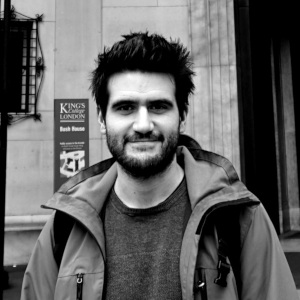
Artem Barger is a researcher specializing in blockchain technology, distributed systems, and database optimization. With affiliations primarily in blockchain development and academic research, he has contributed extensively to Hyperledger Fabric enhancements and decentralized information systems. Research Interests Optimizing state databases for blockchain platforms Byzantine Fault Tolerance in distributed networks Permissioned blockchain architectures Tokenization of real-world assets AI applications in soft skills evaluation Recent Publications Barger's work focuses on improving blockchain scalability and security through techniques like certification blocks, Patricia Merkle tries, and verifiable randomness. He has also explored tokenization applications in charity and energy sectors.
Jatinder Singh is a Professor at the RC Trust and Principal Research Associate (equivalent to Research Professor) at the Department of Computer Science & Technology, University of Cambridge. He is primarily affiliated with the University of Duisburg-Essen, Germany, where he leads the Compliant and Accountable Systems research group within the Law department. His work operates at the critical intersection of computer science, legal frameworks, and societal impact, focusing on practical implementations that align technology with regulatory requirements while addressing user and community concerns. Research interests center on accountability mechanisms for AI systems, responsible development practices, data governance, and privacy/security in emerging technologies. He examines governance, agency, trustworthiness, and transparency gaps in algorithmic systems through interdisciplinary socio-technical lenses. Current work addresses bias in LLMs, stakeholder participation frameworks, and human rights implications in domains like healthcare, maritime enforcement, and consumer IoT, emphasizing contextual awareness and real-world applicability. His 15 most recent publications (2025-2024) reveal dominant trends in AI transparency, fairness proxy development, and legal-compliance engineering. Key focus areas include stakeholder involvement in AI governance, bias mitigation in language models, data justice applications for vulnerable populations, and operationalizing human-centered AI in clinical settings. The work consistently bridges technical implementation with regulatory frameworks like the EU Cyber Resilience Act and GDPR. Scientific Awards: No awards or fellowships were mentioned in the provided text. Advising and Grants: The text does not specify PhD/Master's students or grant details. As leader of an active research group publishing high-impact work on EU regulations and human rights, he likely directs funded projects and mentors early-career researchers, though concrete evidence is absent in the source material. His position suggests involvement in interdisciplinary grant consortia addressing socio-technical challenges. Labs and Teams: Singh leads the Compliant and Accountable Systems research group at University of Duisburg-Essen, which collaborates across university-wide clusters including Artificial Intelligence and Society, Human-AI Interaction, Trustworthy Human Language Technologies, and Verification of Machine Learning. The group develops frameworks for legal compliance in AI, focusing on demonstrable accountability through tools for transparency, bias auditing, and stakeholder engagement in real-world deployments.
Martim Brandão is a Lecturer (Assistant Professor) in Robotics and Autonomous Systems at King’s College London, where he leads the Responsible Robotics and AI (RRAI) Lab and serves as Co-Director of the UKRI Centre for Doctoral Training in Safe and Trusted AI. His research focuses on ethical, explainable, and safe AI and robotics, with applications in human-robot interaction, motion planning, fairness, and societal impact. His research interests include: Explainable AI and Motion Planning Fairness and Bias in AI Systems Human-Robot Interaction and Social Robotics Adversarial Robustness in Robotics Value Alignment and Ethical AI Inclusive and Participatory Robotics Design His recent publications (2023–2025) reflect a strong trend toward socially responsible robotics, focusing on fairness in navigation, explainability of planning failures, worker-centered agricultural robotics, environmental justice in drone delivery, and the dangers of bias in drowsiness detection and LLM-driven robots. His work emphasizes user understanding, societal impact, and ethical safeguards in autonomous systems. He has advised and collaborated with numerous students and researchers across diverse topics in robotics and AI. He is actively involved in shaping responsible robotics through: Leadership in the RRAI Lab Co-directing a national CDT in Safe and Trusted AI Developing fairness-aware algorithms Advocating for inclusive and ethical design practices His lab and research group focus on: Responsible Robotics and AI Explainability in Multi-Agent Planning Fairness in Coverage and Navigation Human-Centered Evaluation of AI Systems
Prof. Maria Bielikova is a Full Professor and former Dean of the Faculty of Informatics and Information Technologies (FIIT STU), now leading research at the Kempelen Institute of Intelligent Technologies (KInIT). Her work focuses on AI ethics, user modeling, and combating disinformation. She has held leadership roles in EU initiatives like the High-Level Expert Group on AI and chairs Slovakia's Permanent Committee for AI Ethics. Education: BSc/PhD in Electronic Computers from Slovak University of Technology Over 30 years at STU, including 15 years as Full Professor and 5 years as Dean Research interests span personalized systems, trustworthy AI, and low-resource machine learning. Authored/co-authored over 280 publications with 4,500+ citations (h-index 30). Secured EU funding for projects like vera.ai and VIGILANT. Supervised 90+ bachelor, 70+ master, and numerous doctoral students. Recognized with national/international awards including Slovakia IT Personality 2016 and Ľudovít Štúr Order 2024. Key contributions include founding the Slovak.AI research center, establishing the PeWe research group, and leading the User eXperience and Interaction Research Centre. Her work bridges academia-industry collaboration through KInIT's international projects with 69+ global partners.
Sebastián Ferrada is an Assistant Professor at the Data & Artificial Intelligence Initiative of Universidad de Chile. He also serves as Young Researcher at the Institute for Foundational Research on Data (IMFD) and Collaborating Researcher at the National Center for Artificial Intelligence Research (CENIA). His research focuses on Knowledge Graphs, with special emphasis on extraction, management, and applications for querying, browsing, and AI systems. His academic background includes: PhD in Computer Science (2021), Universidad de Chile MSc in Computer Science (2017), Universidad de Chile BEng in Computer Science (2017), Universidad de Chile Sebastián's research explores several key areas: Multimedia Databases with applications to Wikimedia Commons images Graph Databases and Knowledge Graphs construction Federated Data Management across heterogeneous RDF sources SPARQL query extensions for similarity-based operations Graph data management and compression techniques His recent publications demonstrate strong trends in knowledge graph construction, similarity-based querying, and efficient graph data management. These works combine theoretical advancements with practical implementations in real-world systems like IMGpedia and MillenniumDB. Scientific achievements include: Best Paper Award at CoopIS 2023 Best Demonstration Award runner-up at SIGMOD/PODS 2024 Best Student Paper (Resources Track) and Best Poster at ISWC 2017 First prize in CLEI 2017 for his Master's thesis Sebastián currently leads the Fondecyt project on graph data management and contributes to the U-Inicia project on AI processes in graph databases. He serves on the editorial board of Transactions on Graph Data and Knowledge.
Prof. Georg Neugebauer is a Professor at RWTH Aachen University, specializing in cybersecurity, privacy-preserving protocols, and secure multi-party computation. His research focuses on developing frameworks for secure data reconciliation, enhancing information security management systems, and addressing cybersecurity challenges in AI, industrial systems, and smart environments. Research Interests: Secure Multi-Party Computation (MPC) Privacy-Preserving Systems Cybersecurity Education & Training Artificial Intelligence in Security Management Industrial IoT and Operational Technology (OT) Security Digital Forensics and Incident Response Recent work highlights a shift towards cybersecurity education initiatives (e.g., CampusQuest ), AI-driven security solutions, and addressing vulnerabilities in public AI tools. His frameworks like SMC-MuSe have advanced MPC applications for multi-set operations. His publications span conferences such as ARES, ICISSP, and AHFE, addressing topics from smart building protocol security to forensic triage tools. Collaboration with researchers like Schuba, Höner, and Meyer marks his interdisciplinary approach to solving real-world security challenges.
Hannah Keller is a researcher in the field of cryptography and privacy-preserving technologies. Her work focuses on secure multi-party computation (MPC), differential privacy, and post-quantum cryptography. She has collaborated with institutions on topics such as privacy-preserving aggregation, secure noise sampling, and cryptographic protocols. Notable contributions include research on lattice-based cryptography in PQCrypto 2025 and differential privacy in distributed systems. Her publications address challenges in balancing privacy with computational efficiency in machine learning and data analysis.
Anne Helmond is an Associate Professor of Media, Data and Society at Utrecht University , specializing in the platformization , algorithmization , and datafication of the web. She is a key contributor to the focus area Governing the Digital Society , where she develops digital methods for analyzing mobile data flows and app store infrastructures . Her work combines empirical and historical perspectives, emphasizing the material and programmable data infrastructures of platforms.
Jaime Delgado is a prominent researcher with over three decades of contributions to digital rights management, healthcare information systems, and security and privacy in eHealth. With an extensive publication record spanning from 1994 to 2025, Delgado has established themselves as a leading expert at the intersection of computer science and healthcare, developing practical frameworks that enhance security, privacy, and interoperability in medical systems. Delgado's research spans multiple critical domains: Digital Rights Management and Multimedia Content Security Healthcare Information Systems and eHealth Applications Security and Privacy in Medical Data Management Ontologies and Semantic Web Technologies for Healthcare Genomic Information Systems and FAIR Data Principles Trustworthy Media Systems and Provenance Tracking Analysis of recent publications (2021-2025) reveals a strategic shift toward healthcare applications, particularly focusing on security requirements for Internet of Medical Things (IoMT), privacy-enhancing techniques for medical data, and genomic information systems. Delgado's work demonstrates consistent development of practical architectures addressing real-world security challenges in healthcare settings, with increasing collaboration with medical professionals and participation in European health informatics initiatives like the MedSecurance Project. Delgado has received recognition for contributions to standardization efforts, particularly in developing frameworks for media trustworthiness and international standards for assessing trust in digital media. Their work on the JPEG Privacy and Security framework has significantly influenced industry practices. Through extensive collaboration with researchers like Silvia Llorente (43 joint publications), Eva Rodríguez (29 publications), and Rubén Tous (26 publications), Delgado has built a strong research network across European institutions. Their work consistently combines theoretical framework development with practical implementation considerations, addressing the critical balance between security requirements and clinical workflow usability. Delgado's laboratory work centers on developing secure frameworks for medical data management, with recent emphasis on genomic information systems, provenance tracking in eHealth, and security requirements for medical IoT devices. Their research group actively participates in European health informatics initiatives and contributes to international standards development, maintaining exceptional productivity with 4-7 publications annually in recent years.
Abhradeep Thakurta is a researcher at Pennsylvania State University (College of Engineering, Computer Science and Engineering Department) and Microsoft Research Silicon Valley, focusing on Differential Privacy and Machine Learning . His work explores privacy-preserving techniques in optimization, model training, and data analysis. Key affiliations: Pennsylvania State University (College of Engineering), Microsoft Research Silicon Valley Academic rank: Researcher His research spans Differential Privacy in Stochastic Optimization , Convex Optimization , and Deep Learning . He investigates methods to enhance privacy guarantees while maintaining model accuracy and efficiency, particularly through matrix factorization, adaptive clipping, and noise correlation. Recent publications (2023–2025) highlight advancements in privacy amplification , checkpoint reuse , and secure model training . Collaborations include top researchers from institutions like Google, Stanford, and MIT.
Professor Heinrich Kuhn serves as Professor of Business Administration, Supply Chain Management & Operations at the Ingolstadt School of Management, Catholic University of Eichstätt-Ingolstadt. His extensive research focuses on planning and control of production systems, flexible production planning, JIT and flow production systems analysis, maintenance, and queueing theory. With a prolific publication record spanning decades, he has established himself as a leading scholar in operations research and supply chain management. His research interests encompass Supply Chain Management, Operations Research, Production Planning, Retail Logistics, Queueing Theory, and Inventory Management. Professor Kuhn has developed innovative approaches for optimizing retail fulfillment processes, managing assortment planning, improving inventory accuracy, and addressing complex production planning challenges. His work bridges theoretical operations research with practical applications in retail and manufacturing industries, with particular emphasis on omnichannel retailing, grocery operations, and sustainable logistics solutions. His research demonstrates consistent evolution from foundational production planning systems to addressing contemporary challenges in digitalized retail environments. Professor Kuhn's recent publications (2021-2024) reveal a strong focus on retail logistics challenges, particularly in grocery retailing during the pandemic, drone delivery systems, vehicle routing optimization, and inventory management. His research shows a clear progression toward addressing digital transformation in retail, sustainable practices, and the integration of physical and online retail channels. The work demonstrates sophisticated methodological approaches including advanced optimization algorithms, simulation modeling, and empirical analysis of retail operations. Throughout his career, Professor Kuhn has maintained extensive collaborations with researchers including A. Holzapfel, A. Hübner, M. Sternbeck, and others. His research provides valuable decision support tools for retail operations, supply chain design, and production planning, with practical applications across multiple industries. His work continues to influence both academic discourse and industry practices in supply chain management and operations research.
Patrik Hummel is an Assistant Professor at Eindhoven University of Technology, focusing on the intersection of Artificial Intelligence Ethics , Health Data Governance , and Digital Sovereignty . His work bridges technical and normative challenges in medical AI applications.
Damien Garreau is Professor for the Theory of Machine Learning at Julius-Maximilians-Universität Würzburg , Germany. Until March 2024 he served as Associate Professor in the Probability and Statistics team of the J. A. Dieudonné laboratory at Université Côte d'Azur and was a member of the Inria Maasai team in Sophia-Antipolis. Earlier positions include post-doctoral research at the Max Planck Institute for Intelligent Systems in Tübingen and PhD studies in the Inria Sierra team in Paris. Education & Career Path PhD, Inria Sierra team, Paris – advisors Sylvain Arlot & Gérard Biau Post-doc, Max Planck Institute for Intelligent Systems, Tübingen – mentor Ulrike von Luxburg Associate Professor, Université Côte d’Azur / Inria Maasai (until March 2024) Professor for Theory of Machine Learning, Julius-Maximilians-Universität Würzburg (since 2024) Research Focus Garreau’s research centers on trustworthy machine learning . He investigates how to explain, audit, and robustify modern AI systems, with particular emphasis on post-hoc interpretability , statistical guarantees of explanation methods, fairness , and causality . Representative contributions include theoretical analyses of LIME and Anchors, novel explanation methods such as SMACE and GLEAMS, and practical tools for vision and NLP that remain faithful under adversarial or out-of-distribution settings. Across computer vision, natural-language processing, and healthcare applications, his work bridges rigorous theory with impactful algorithms, advancing the societal goal of deploying AI systems whose decisions can be trusted and understood by humans. Scientific Awards & Recognition Best Paper Award , ECML 2024 Area Chair , ICML 2025 ANR JCJC Grant NIM-ML (2021–2025) Université franco-allemande support for Winter School on Causality and Explainable AI Advising, Grants & Collaborative Projects Garreau has successfully supervised or co-supervised a growing cohort of doctoral and master’s students, including Gianluigi Lopardo, Kensuke Mitsuzawa, Martin Charachon, Jonas Wacker, Samuel, Antonio, Magamed, Arthur Assad, Charbel Yahchouchi, and Mariana Chaves. He is the PI of the ANR JCJC project NIM-ML , whose goal is to develop next-generation interpretability methods endowed with statistical guarantees. He co-organizes the annual Winter School on Causality and Explainable AI , fostering Franco-German academic exchange. Labs & Teams Since 2024 he leads the Professorship for the Theory of Machine Learning at Julius-Maximilians-Universität Würzburg. Previously he was a core member of the Maasai Inria team on the Sophia-Antipolis campus, and an active collaborator of the J. A. Dieudonné mathematics laboratory. He maintains strong ties with the TML group at the Max Planck Institute for Intelligent Systems and regularly hosts joint visitors and workshops.
Prof. Dr. Martin Matzner is a Professor at Friedrich-Alexander University Erlangen-Nürnberg, holding the Chair of Digital Industrial Service Systems. He studied Business Informatics at the University of Münster and Turku School of Economics, earned his doctorate in 2012 for work on service networks, and received a teaching license in Business Informatics in 2016. His research focuses on IT-supported services, business process management, and design-oriented business informatics research, with significant contributions to digital transformation and smart service systems. Current affiliation: Friedrich-Alexander University Erlangen-Nürnberg Previous roles: University of Münster (2007-2017) Key research areas: Business Process Management, Process Mining, Smart Service Systems, Predictive Analytics His recent publications emphasize predictive process monitoring using machine learning, transfer learning for cross-domain applications, explainable AI in business processes, and platform ecosystem governance . He has pioneered methods for adaptive AI control in manufacturing and context-aware process analytics , with applications spanning logistics, healthcare (ICU admission prediction), and human resources. His work bridges technical process mining with sociotechnical perspectives , particularly in algorithm adoption and ethical implications. Prof. Matzner's research has produced 15+ recent publications (2025-2024) in journals like International Journal of Production Research , Computers in Industry , and conferences including ECIS and ICIS. Topics demonstrate a progression from process efficiency optimization to human-AI collaboration and regulated AI risk assessment . His methodological toolkit spans LSTM networks , graph-based neural models , and LRP explanation techniques .
Xavier Devroey is an Assistant Professor of Software Engineering at the University of Namur in Belgium. He co-leads the SNAIL Team with Benoît Vanderose, focusing on innovative approaches to software testing and automation. His work bridges academic research with practical applications in the software engineering community. His educational background includes a Ph.D. and Master's in Computer Science from the University of Namur, plus a Bachelor's in Analyst Programming from Haute Ecole de Bruxelles, Belgium. This comprehensive academic training informs his research and teaching approach. Devroey's research interests center on Software Testing , with particular emphasis on Search-Based Software Engineering and Software Variability . His specific focus areas include: Search-Based Testing and Fuzzing Model-Based Testing Mutation Testing Variability Modeling Software Product Line Testing Test suite augmentation DevOps integration These interests reflect his commitment to advancing automated approaches for test case design, generation, selection, and prioritization. His recent publication portfolio (2019-2025) demonstrates consistent contributions to software testing research, with particular focus on crash reproduction, API testing, and innovative approaches to test automation. The articles reveal a strong emphasis on practical applications of search-based techniques across various testing domains. Devroey maintains active engagement with the academic community through conference participation, having served on program committees for major software engineering conferences including ASE, ICSE, ISSTA, and ICST across multiple years (2019-2025). He also contributes to educational aspects of software engineering, with publications examining testing education approaches and tools for programming exercise assessment. His personal website (xdevroey.be) and GitHub profile demonstrate his commitment to open academic practices and community engagement.