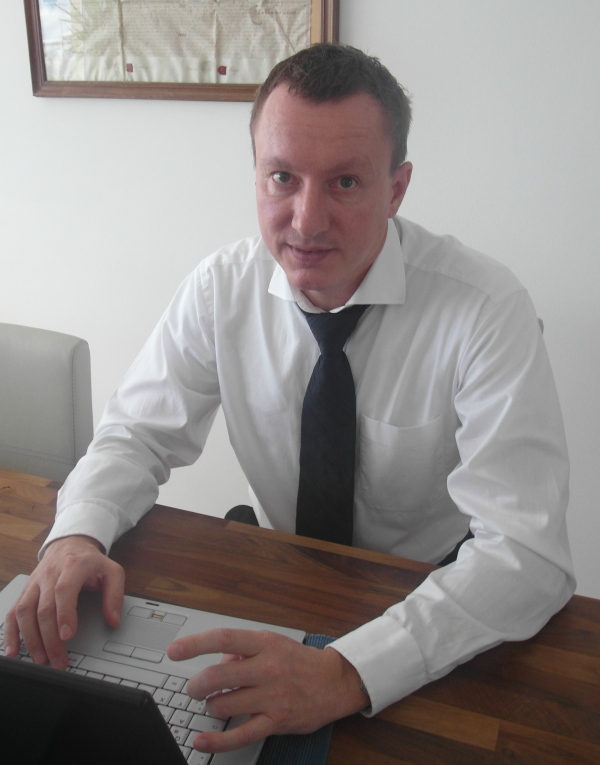
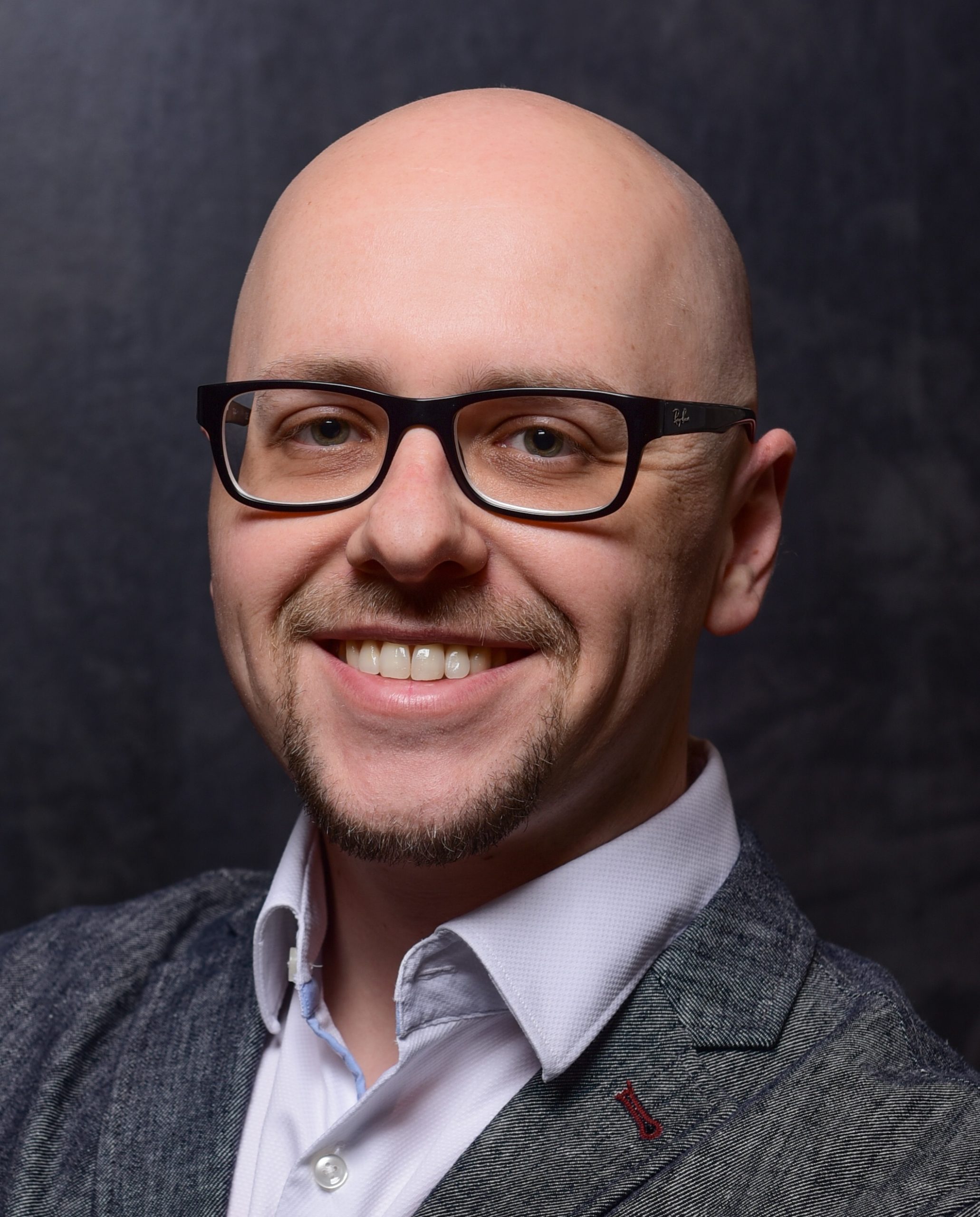
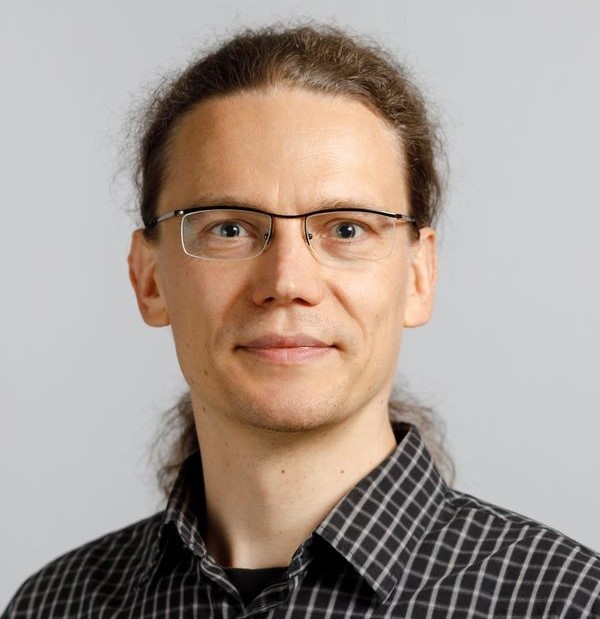
Prof. Dr. Martin Kronbichler is a faculty member at the Faculty of Mathematics , Ruhr University Bochum , leading the Numerics group. His research focuses on higher-order finite element methods, multigrid techniques, and high-performance computing for complex fluid and solid mechanics problems. Key Research Areas: Higher-order finite element methods, iterative solvers, multigrid algorithms, exascale mathematical software, and computational fluid dynamics. Notable Projects: EU-funded dealii-X (exascale digital twins), BMBF PDExa (optimized PDE solvers for exascale), and DFG grants for cut-discontinuous Galerkin methods and geometric multigrid. Publications Trends: Recent works emphasize matrix-free operators for hyperelasticity, diffuse-interface models for additive manufacturing, and multigrid smoothers for higher-order elements. Scientific Awards: Recipient of the Humboldt Research Award for his contributions to numerical methods and HPC. Team: Collaborates with researchers like Dr. Shubham Kumar Goswami, Dr. Richard Schussnig, and Natalia Nebulishvili.
Prof. Dr.-Ing. Richard Membarth is a Research Professor for System-on-a-Chip and AI at the Edge Computing at Technische Hochschule Ingolstadt (THI). He is affiliated with the Hardware-Software Co-Design group and holds a secondary position at the German Research Center for Artificial Intelligence (DFKI) Saarbrücken. Co-creator of DSL frameworks like AnyDSL and Hipacc Key contributor to MetaDL (AI metaprogramming) and PRIME (predictive rendering) His research bridges GPU computing , domain-specific languages , and compiler technology , with recent work on Vulkan SPIR-V compilation and device-driven SpMV algorithms . Notable awards include the HiPEAC Paper Award (2018) and multiple Best Paper Awards for his compiler frameworks.
Lars Grasedyck is a Professor of Numerical Analysis at RWTH Aachen University. His research focuses on hierarchical matrices, tensor approximation, and numerical methods for partial differential equations and matrix equations. He has contributed to applications in biomedical engineering, particularly EEG/MEG inverse problems, and is involved in software development (HLIB, HLIB-pro). Education: Diploma and Ph.D. in Mathematics at Christian-Albrechts-Universität zu Kiel (1998, 2001), Postdoctoral work at Max Planck Institute, Leipzig (2002-2010). Research: Specializes in high-dimensional numerical methods, low-rank matrices, and tensors with applications in PDEs, uncertainty quantification, and biomedical modeling. Projects: Leads DFG-funded initiatives on adaptive tensor networks for parametric PDEs and tumor progression modeling. Advising: Supervises doctoral students including Thong Le, Maren Klever, and Dieter Moser. Software: Developed HLib and HLib-pro for hierarchical matrix computations. Conferences: Active in GAMM Fachausschuss Numerische Analysis, organizing workshops and symposia globally.
Oliver G. Ernst is a Professor of Numerical Analysis at Technische Universität Chemnitz . His research focuses on Numerical Analysis , Uncertainty Quantification , and Inverse Problems , with applications in Thermo-Hydro-Mechanical (THM) processes , Electromagnetics , and Stochastic Partial Differential Equations . He is associated with the Numerical Analysis group at TU Chemnitz. Key Research Areas : Efficient numerical methods for PDEs Krylov subspace techniques Stochastic finite element methods Multi-physics modeling Geoscientific applications Recent Publications (2025-2010): THM simulations under uncertainty Neural network PDE solvers Bayesian inversion frameworks Rational Krylov algorithms Deflated restarting strategies Collaborations : TU Bergakademie Freiberg University of Manchester Technical University of Munich University of Maryland University of Geneva Software Development : Contributor to OpenGeoSys platform Developer of FEMALY MATLAB library Academic Recognition : h-index 32, i10-index 66, with over 4423 citations since 2020.
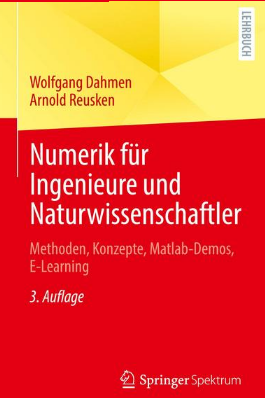
Prof. Dr. Arnold Reusken is a full Professor of Numerical Mathematics at RWTH Aachen University, affiliated with the Institute for Geometry and Practical Mathematics (IGPM). He has held the Chair for Numerical Mathematics since 1997 and maintains an active research and academic profile in computational mathematics. Education: Ph.D. in Mathematics, University of Utrecht (1988) M.Sc. in Mathematics, University of Utrecht (1984) His research focuses on the development and analysis of numerical methods for partial differential equations, with particular emphasis on finite element methods, multigrid solvers, and computational techniques for two-phase incompressible flows and PDEs on surfaces. His work bridges theoretical numerical analysis and practical scientific computing applications in fluid dynamics and interfacial phenomena. He has made significant contributions to trace finite element methods, surface Stokes equations, and unfitted discretizations. The recent publication trend shows sustained activity in numerical methods for evolving surfaces, surface fluid dynamics, and preconditioning techniques. His work often involves rigorous error and stability analysis, demonstrating a strong theoretical foundation. Editorial Roles: Associate Editor, Journal of Numerical Mathematics (2015–present) Associate Editor, IMA Journal of Numerical Analysis (2020–present) Former Associate Editor, SIAM Journal on Numerical Analysis (2016–2021) Former Associate Editor, SIAM Journal on Scientific Computing (2002–2008) Former Associate Editor, Computing & Visualization in Science (2010–2021) Member of Advisory Board, Computing (1997–2009) Prof. Reusken has advised numerous students and researchers, though specific names are not listed in the provided text. He has been involved in collaborative research projects and has secured funding for work in numerical simulation and computational fluid dynamics. He co-authored the influential textbook Numerik für Ingenieure und Naturwissenschaftler , now in its third edition, and has contributed to other key publications in the field. He leads a research group at IGPM focused on numerical methods for interface and surface problems, contributing to both fundamental algorithm development and practical implementation in scientific computing. His team works on cutting-edge methods for simulating complex fluid systems with moving boundaries and topological changes.
Univ.-Prof. Dr.-Ing. Alexander Popp is a Full Professor of Computer-Based Simulation at the University of the Bundeswehr Munich, Germany, where he also serves as Vice Dean of the Department of Civil Engineering and Environmental Sciences. Additionally, he is the Vice Director of the DLR Institute for the Protection of Terrestrial Infrastructures in Sankt Augustin, Germany. His academic career spans prestigious institutions including TU Munich, Columbia University, and The University of Tokyo, demonstrating his international recognition in computational mechanics. Professor Popp's research spans the entire field of computational mechanics and numerical analysis, with a particular focus on computational contact dynamics, solid and structural dynamics, and multiphysics problems. His work encompasses fluid-structure interaction, non-conforming discretization methods, tribology, and computational plasticity. More recently, he has expanded his research into digital twins for critical infrastructure protection and biomedical applications, particularly in cardiovascular mechanics and stent graft modeling for endovascular repair. His group develops advanced finite element formulations for beams and shells, isogeometric analysis, and integrates machine learning techniques with traditional computational methods. Professor Popp has received numerous prestigious awards including the O.C. Zienkiewicz Award for Young Scientists from ECCOMAS (2018), the Top Teaching Trophy of the Munich School of Engineering (2018), and the ZD.B Junior Research Group Award (2017). His research is supported by significant funding from the Deutsche Forschungsgemeinschaft (DFG), the German Federal Ministry of Education and Research, and industry partners. He leads several major research projects including "AutoStent - An autonomous design assistant for aneurysm repair" and "Combination of data- and physics-based methods for hybrid digital twins" through the dtec.bw research center. As a leader in the computational mechanics community, Professor Popp serves on multiple editorial boards including Scientific Reports (Springer Nature) and Advanced Modeling and Simulation in Engineering Sciences. He is an Associate Editor for the Journal of Theoretical, Computational and Applied Mechanics and will serve as Co-Chairman for the 17th World Congress on Computational Mechanics (WCCM) and ECCOMAS Congress in 2026. His laboratory, the Institute for Mechanics of Components and Systems (IMCS), focuses on bridging fundamental research with real-world applications in civil engineering, infrastructure protection, and biomedical engineering.
Gerhard Starke is a Professor of Numerical Mathematics at the Faculty of Mathematics, University of Duisburg-Essen. He leads the Numerical Mathematics workgroup, focusing on the development and analysis of finite element methods for solving complex mathematical and mechanical problems. His research spans multiple areas of computational mathematics with applications in solid mechanics and optimization. Professor Starke's research interests center around numerical analysis of finite element methods , reconstruction-based a posteriori error estimators , and mixed finite element methods . His work has significant applications in shape optimization , solid mechanics , hyperelasticity , plasticity , and frictional contact problems . His research combines theoretical mathematical analysis with practical computational approaches to solve challenging engineering problems. Analysis of Professor Starke's recent publications (2017-2025) reveals a strong focus on stress-based methods, shape optimization, and advanced finite element formulations. His work demonstrates a consistent progression from fundamental numerical analysis to increasingly complex applications in solid mechanics. Key trends include the development of constrained first-order system least mean approximation for shape optimization, superconvergent DPG approximations in linear elasticity, and stress-based methods for variational inequalities in contact mechanics. Professor Starke has secured significant third-party funding for his research, including current projects funded by the German Research Foundation (DFG) within Priority Programs 1748 and 1962. These projects focus on stress approximation in hyperelastic material models and stress-based methods for variational inequalities in solid mechanics. His research collaborations span multiple institutions including Humboldt University Berlin, University of Duisburg-Essen's Institute of Mechanics, and international partners in Switzerland. Head of Numerical Mathematics workgroup at University of Duisburg-Essen Principal investigator for multiple DFG-funded projects since 1999 Supervisor for numerous doctoral students including Laura Hetzel, Henrik Schneider, and Kemal Suntay Extensive international collaborations with researchers across Europe The Numerical Mathematics workgroup led by Professor Starke maintains active collaborations with mechanics researchers at the University of Duisburg-Essen and international institutions. The group has participated in significant research initiatives including the DFG Research Training Group 615 and multiple Priority Programs. Current work focuses on applying advanced numerical methods to challenging problems in computational solid mechanics and shape optimization.
Ming Zhou is a Senior Lecturer at the Institute of Mathematics, University of Rostock, Germany. His research focuses on numerical linear algebra, eigenvalue problems, and adaptive finite elements. He is known for contributions to convergence theory of preconditioned eigensolvers and iterative methods. Zhou co-developed the AMP Eigensolver, a software tool for solving elliptic partial differential operator eigenvalue problems in 2D domains. His work emphasizes robust bounds for Ritz values, block preconditioned gradient methods, and restarted Krylov subspace iterations. Collaborations with researchers like K. Neymeyr and A.V. Knyazev have produced influential studies in numerical analysis. Zhou’s recent publications (2023–2024) address cluster-robust estimates and angle-free Ritz value bounds, advancing eigensolver algorithms. He is based at the Institute of Mathematics in Rostock, with office 332. His email is ming.zhou@uni-rostock.de . Office hours are by appointment.
Prof. Dr. Johannes Kraus is a faculty member at the University of Duisburg-Essen , affiliated with the Faculty of Mathematics . His research focuses on advanced numerical methods for partial differential equations and their applications across multiple disciplines. University: University of Duisburg-Essen Faculty: Faculty of Mathematics Contact: Thea-Leymann-Str. 9, 45127 Essen, Germany Dr. Kraus specializes in numerical solution of partial differential equations , discretization techniques (including finite element and isogeometric analysis), numerical linear algebra , and subspace correction methods like domain decomposition and multigrid. His work extends to high-performance computing and machine learning applications in medicine, engineering, and sciences. Recent publications highlight collaborations on nonlinear poroelasticity , space-time finite element methods , and preconditioning techniques for complex systems. Articles span domains such as biomechanics , biomolecular electrostatics , and multiscale modeling , demonstrating interdisciplinary impact. Teaching responsibilities include Numerical Mathematics II (Summer 2025) and Numerical Mathematics I , with seminars on multiphysics finite element software . He leads the Numerical Mathematics group and has secured third-party funding from DFG and FWF grants.
Dr. Hussam Al Daas is a Postdoctoral Research Fellow at the Max Planck Institute for Dynamics of Complex Technical Systems since January 2019, specializing in numerical algorithms for large-scale scientific computing. His work bridges theoretical numerical analysis and high-performance implementation. Education: PhD in Applied Mathematics, Inria-Paris and Sorbonne University (2015-2018), funded by TOTAL Master in Fundamental and Applied Mathematics, Paris-Sud University (2012-2014) His research centers on developing communication-avoiding algorithms for sparse linear systems and tensor computations, with emphasis on robust preconditioners (algebraic two-level Schwarz, domain decomposition), Krylov subspace methods, and low-rank approximations. He addresses critical challenges in parallel scalability through rigorous complexity analysis and memory-efficient implementations, particularly for distributed-memory architectures. Analysis of his 2022-2025 publications reveals three dominant trends: (1) Algebraic multilevel preconditioners achieving robustness for ill-conditioned sparse systems, (2) Theoretical communication lower bounds with optimal algorithm design for tensor/matrix operations, and (3) Novel extensions of Krylov methods for sequences of shifted systems and tensor train decompositions. These contributions target reservoir simulation, PDE-constrained optimization, and high-dimensional data problems. Funded by TOTAL during his PhD and currently by the Max Planck Society, his work shows no evidence of student advisement or external grant leadership. He contributes to the Computational Methods in Systems and Control Theory group, focusing on scalable solvers for complex dynamical systems through collaborative software development and algorithmic innovation.
Michael Gee is a Professor at Technische Universität München (TUM), specializing in Mechanics on High-Performance Computers. His research focuses on computational biomechanics, fluid-structure interaction, and patient-specific modeling of cardiovascular systems, particularly abdominal aortic aneurysms (AAAs). He employs advanced numerical methods like algebraic multigrid and mortar contact formulations to address complex biomechanical challenges. Recent work highlights include the development of digital twin technologies for endovascular repair, integration of artificial intelligence in vascular diagnostics, and multiscale modeling of atherosclerosis. His publications emphasize high-performance computing applications in cardiovascular disease modeling, medical device simulation, and rupture risk assessment. Institution: Technische Universität München Department: Mechanics on High-Performance Computers Contact: gee@tum.de
Dr. Andreas Nuessing is a researcher at the Institute for Analysis and Numerics within the Department of Mathematics and Computer Science at the University of Münster, Germany. His work focuses on numerical methods, particularly unfitted discontinuous Galerkin methods and algebraic multigrid techniques, applied to biomedical problems such as the EEG forward problem and brain stimulation (TDCS). Education: Dr. rer. nat. in Mathematics, supervised by Prof. Dr. Christian Engwer and Prof. Dr. rer. nat. Carsten Wolters. Research Areas include: Development of numerical methods for solving PDEs in brain research Efficient implementations of discontinuous Galerkin methods Applications in biomedical engineering and neuroscience Scientific Contributions : 2015: Best poster award at BACI2015 conference Key projects: Efficient solvers for DG discretizations of saddle point problems (2012–2013), German Academic Exchange Service collaborations
Stephen L. Olivier is a prominent researcher in high-performance computing at Sandia National Laboratories, with a distinguished publication record spanning nearly two decades. His work focuses on parallel programming models, performance optimization, and energy-efficient computing across diverse architectures including CPUs, GPUs, and FPGAs. Olivier has made significant contributions to OpenMP standards and Kokkos programming model development, collaborating extensively with Department of Energy national laboratories and international research teams. Olivier's research interests center on task parallelism, memory management in distributed systems, and performance portability across heterogeneous architectures. His work addresses critical challenges in exascale computing, including efficient task scheduling for unbalanced workloads, power management in large-scale systems, and optimization of communication patterns. More recently, he has expanded his research into medical imaging applications, applying high-performance computing techniques to tuberculosis detection in rural healthcare settings. Analysis of Olivier's recent publications (2021-2024) reveals a strong focus on practical performance engineering for next-generation computing platforms. His work spans traditional HPC domains while increasingly incorporating data science applications and medical imaging analysis. The research demonstrates consistent innovation in parallel programming models, particularly around OpenMP tasking and Kokkos abstractions, with growing emphasis on energy efficiency and hardware-specific optimizations for emerging architectures. Olivier has maintained a prolific research output with numerous publications in top-tier conferences including SC, IPDPS, and IWOMP. His collaborative work extends across multiple Department of Energy laboratories and international institutions, reflecting the interdisciplinary nature of modern high-performance computing research. While specific grant information isn't detailed in the publication record, his work on DOE systems suggests significant involvement in national supercomputing initiatives.
Dr. Sebastian Kuckuk is a researcher and head of training at the Erlangen National High Performance Computing Center (NHR@FAU), Friedrich-Alexander-Universität Erlangen-Nürnberg. He is affiliated with the Department of Computer Science and contributes to the Chair of System Simulation. His work bridges research, training, and software development in high-performance computing. Education: PhD in Computer Science, Friedrich-Alexander-Universität Erlangen-Nürnberg (2019) His research focuses on enhancing performance portability and programmer productivity using domain-specific languages, code generation, automatic parallelization, and GPU programming. These techniques are applied to develop massively parallel numerical solvers for computational fluid dynamics, particularly for the shallow water equations. He is a core developer of the ExaStencils framework, which enables automated generation of efficient multigrid solvers for structured and patch-structured grids. Analysis of his recent publications (2020–2025) reveals a consistent focus on code generation, GPU acceleration, and solver optimization for fluid dynamics problems. Key themes include heterogeneous computing, block-structured grids, and adaptive methods. His work integrates advanced compiler techniques with numerical mathematics to improve scalability and performance on modern HPC architectures. Scientific Recognition: NVIDIA Deep Learning Institute (DLI) University Ambassador Certified Instructor for DLI courses in GPU programming and CUDA He actively contributes to teaching and training through courses such as Programming Techniques for Supercomputers and High-End Simulation in Practice . He conducts workshops and tutorials on GPU programming and performance optimization. While no formal students are listed, his mentoring role is evident through collaborative research and training activities. He has no recorded grants in the provided text, but his involvement in NHR and KONWIHR projects indicates active participation in funded HPC initiatives. Laboratories and Projects: Lead developer of ExaStencils , a code generation framework for multigrid solvers Contributor to GHODDESS , a module for higher-order discretizations in shallow water modeling Active in NHR@FAU and KONWIHR projects focused on GPU computing and performance optimization
Robert Strzodka is a full professor at Heidelberg University, holding the chair on Application Specific Computing since 2015. He is renowned for pioneering work in GPU-based scientific computing, focusing on optimizing interactions between mathematics, algorithms, and parallel hardware architectures. Current affiliation: Institute of Computer Engineering (ZITI), Heidelberg University Prior roles: NVIDIA (AmgX group), Max Planck Institute (Integrative Scientific Computing), Stanford University (visiting assistant professor) PhD: Numerical mathematics from University of Duisburg-Essen (2004) His research spans parallel algorithms (GPUs, FPGAs), numerical methods (AMG, Krylov, preconditioners), and graph algorithms (partitioning, MST). Publications emphasize GPU acceleration , cache optimization , and mixed precision computing across domains like astrophysics, fluid dynamics, and finite element methods. The 15 most recent articles (2024-2008) demonstrate consistent innovation in parallel computing , GPU algorithms , and numerical methods . Key subfields include stochastic modeling , tridiagonal solvers , level set visualization , and cache-aware algorithms .