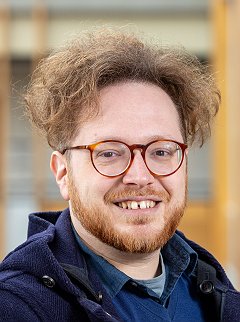
Hampus Nyström is a Researcher at KTH Royal Institute of Technology , focusing on the study of the 'pedestal' region in fusion plasmas. His work involves experimental data analysis, simulations using optimized MHD stability codes, and modifying modeling frameworks to incorporate additional physics. Teaching and supervision roles include: Course: ED1110 Vector Analysis (Assistant Teacher, second-year Electrical Engineering students) Supervision of Master’s theses related to fusion plasma pedestals Assistant roles in Algebra and Geometry (IX1303) and Engineering Science (ED1100) His research contributes to advancements in nuclear fusion technology and plasma stability analysis.
Dr. Thomas Bendokat is a researcher at the Max Planck Institute for Dynamics of Complex Technical Systems in Magdeburg, Germany. He specializes in computational methods for systems and control theory, with a focus on geometric approaches to dynamical systems and manifold structures. Research Interests: Hamiltonian systems, symplectic geometry, Grassmann and Stiefel manifolds, model reduction, geometric optimization, and data-driven identification of nonlinear systems. Contact: Email: bendokat@mpi-magdeburg.mpg.de His work bridges theoretical mathematics with practical applications in gas network modeling, computer vision, and structure-preserving computational methods. He has contributed to open-source software like phgasnets for port-Hamiltonian system simulations.
Morten Øygarden is a Postdoctoral Fellow in the Department of Cryptography at Simula UiB, a joint research initiative between Simula Research Laboratory and the University of Bergen. His work bridges theoretical cryptography and practical security analysis within Norway's premier cryptographic research environment. His educational background culminates in a 2021 PhD from the University of Bergen with the thesis "Algebraic Cryptanalysis of Cryptographic Schemes with Extension Field Structure", establishing his expertise in algebraic methods for cryptanalysis. Øygarden's research focuses on Algebraic Cryptanalysis , Post-Quantum Cryptography , and Symmetric Cryptography , specializing in vulnerabilities of multivariate systems, code-based schemes, and ring-based primitives. He develops novel Gröbner basis techniques to break cryptographic assumptions underlying quantum-resistant candidates, with direct implications for NIST standardization processes. Analysis of his 2020-2024 publications reveals consistent innovation in algebraic attack methodologies, particularly against arithmetization-oriented primitives for zero-knowledge proofs and MPC-friendly ciphers. His work demonstrates exceptional depth in exploiting mathematical structures of symmetric primitives while advancing post-quantum security evaluations of multivariate and code-based systems. His publication record in top venues including CRYPTO, EUROCRYPT, and the Journal of Cryptology reflects significant contributions to cryptographic science, though specific awards or grant details are not documented in available sources.
Gilbert Bernstein is an Assistant Professor in the Computer Science & Engineering department within the College of Engineering at the University of Washington. His research bridges computer graphics and programming languages, with a focus on high-performance domain-specific languages. Previously, he was a post-doctoral scholar at UC Berkeley and MIT working with Jonathan Ragan-Kelley, and received his PhD from Stanford University under Pat Hanrahan. His research interests span Computer Graphics, Programming Languages, High-Performance DSLs, Physical Simulation, Geometry & Topology, Differentiable Programming, Hardware DSLs, Tools for Artists, Fabrication, and Human-Computer Interaction. Bernstein develops languages and compilers that enable efficient computation for creative applications, physical simulations, and graphics rendering systems. His recent publications reveal strong trends in differentiable programming for graphics applications, domain-specific languages for hardware acceleration, and computational approaches to traditional crafts like quilting and knitting. His work consistently combines formal language theory with practical applications in graphics and fabrication. Bernstein actively mentors students across multiple institutions including current advisees Felix Hahnlein (UW Postdoc), Ryan Zambrotta (UW PhD), Haoran Peng (UW PhD), and previous students including Alex Reinking (UC Berkeley PhD 2022, now at Qualcomm) and MacKenzie Leake (Stanford PhD 2021, now at Adobe Research). His lab works on diverse projects including debugging CAD programs, compilers for finite element methods, semantics for knitting machines, algebraic scheduling of tensor programs, and exocompilers for hardware accelerators. Bernstein also collaborates on DSLs for networking, Counterstrike bots, gradient-based optimization, memory management, hardware design, and garment design tools.
Professor Maya Miteva Stoyanova is a distinguished academic at Sofia University "St. Kliment Ohridski", serving as Dean of the Faculty of Mathematics and Informatics (FMI) and Professor in the Department of Algebra. She earned her M.Sc. in 1992 and Ph.D. in 2009 from the same institution, with a career progression from Assistant Professor (1999) to her current position as Professor (since 2021). Her research focuses on Coding Theory, particularly spherical codes and designs, orthogonal arrays, and energy minimization of combinatorial configurations in polynomial metric spaces. She also contributes significantly to Algebra, Combinatorics, and Number Theory. Her work bridges theoretical mathematics with practical applications in information theory and discrete geometry. Professor Stoyanova's recent publications (2018-2023) demonstrate a consistent research trajectory in spherical codes, orthogonal arrays, and energy bounds, primarily through collaborations with prominent mathematicians like Peter Boyvalenkov, Peter Dragnev, Douglas Hardin, and Edward Saff. Her work appears in high-impact journals such as Journal of Mathematical Analysis and Applications, IEEE Transactions on Information Theory, and Designs, Codes and Cryptography. She has successfully supervised doctoral students including Tanya Todorova Marinova and Tedis Arben Ramaj, whose research continued her work on orthogonal arrays and combinatorial configurations. Her academic leadership is evident through her role as Head of the Department of Algebra (2016-2020) and her current position as Dean of FMI. Professor Stoyanova maintains an active research profile with numerous publications in top-tier mathematics journals, reflecting her significant contributions to discrete mathematics and coding theory. Her work on distance distributions, energy bounds, and spherical designs represents cutting-edge research in combinatorial geometry.
Dr. Angelynn R. Álvarez is a tenure-track Assistant Professor of Mathematics in the Department of Mathematics, College of Arts & Sciences at Embry-Riddle Aeronautical University (ERAU) in Prescott, Arizona. She holds significant service roles as Archivist of ERAU's Faculty Senate, Faculty Fellow for the Center for Teaching & Learning Excellence, and Secretary of the Mathematical Association of America (MAA) Southwestern Section. Her academic foundation includes: Ph.D. in Mathematics, University of Houston M.S. in Mathematics, University of Houston B.A. in Mathematics (Spanish concentration), University of Houston Dr. Alvarez's research bridges theoretical and applied mathematics with dual emphases: (1) Coding Theory advancements in locally recoverable codes and algebraic constructions for data storage systems, and (2) Differential Geometry investigations of holomorphic sectional curvature. Her parallel work in Mathematics Education develops inclusive pedagogical frameworks, particularly through Students-as-Partners initiatives and diversity-focused mentorship training. This interdisciplinary approach connects pure mathematics with engineering applications and educational innovation. Her recognition includes: ERAU 2025 Teacher of the Year Award AMS-Simons Research Enhancement Grant (PI, 2023-2026) Consecutive MAA Tensor Grants for Women in Mathematics (2022-2025) ERAU FIRST Grant for research innovation (2023-2024) Innovative Teaching Grant from ERAU's Center for Teaching Excellence (2023) As an educator, Dr. Alvarez teaches the full undergraduate mathematics curriculum while mentoring through independent studies and PCMI workshops. Her research is supported by active AMS-Simons and ERAU grants, while her educational initiatives leverage MAA funding. She co-directed the Arizona Women's Symposium (2022-2024) and maintains leadership in AMS, MAA, and AWM to advance inclusive practices in mathematical communities. Dr. Alvarez's 2025-2026 research agenda features collaborations at AIM, ICERM, and Pomona College, alongside invited presentations at major conferences including the Mathematical Congress of the Americas, demonstrating sustained contributions to both research frontiers and educational transformation.
Maxim Evgenievich Beketov is a Research Fellow at the Faculty of Computer Science of the National Research University Higher School of Economics (HSE), where he has been working since 2020. He is affiliated with the Institute of Artificial Intelligence and Digital Sciences and the International Laboratory of Stochastic Algorithms and Multidimensional Data Analysis, contributing to cutting-edge research in computational methods and artificial intelligence. His educational background includes: Master's degree (2017) in Applied Mathematics and Physics from Moscow Institute of Physics and Technology Bachelor's degree (2015) in Applied Mathematics and Physics from Moscow Institute of Physics and Technology Beketov's research spans multiple interdisciplinary fields with a strong mathematical foundation. His primary interests include topological data analysis, machine learning, mathematical and Bayesian statistics, differential geometry, and computational neuroscience. He applies these methods to problems in dimensionality reduction, variety assessment, and graph neural networks. His work bridges theoretical mathematics with practical applications in artificial intelligence and neuroscience, particularly in understanding cognitive processes through topological approaches. An analysis of his recent publications reveals a strong focus on topological methods in machine learning, with increasing emphasis on applications to neuroscience and cognitive mapping. His work demonstrates a progression from theoretical mathematical foundations toward practical implementations in spiking neural networks, traffic control systems, and music information retrieval. The interdisciplinary nature of his research connects computer science, mathematics, and neuroscience through topological approaches. His scientific achievements include: High Professional Potential Group (HSE Personnel Reserve), Category: New Researchers (2025) Beketov has been actively involved in academic teaching, offering courses including Introduction to Discrete Differential Geometry and Mathematical Analysis. His research is supported through the HSE University Basic Research Program, as acknowledged in his publications. He collaborates with researchers across multiple institutions, as evidenced by his co-authorship on papers with numerous collaborators. He is a core member of the International Laboratory of Stochastic Algorithms and Multidimensional Data Analysis, where he contributes to projects involving topological data analysis, machine learning, and computational neuroscience. His work in the laboratory focuses on developing advanced mathematical methods for analyzing complex data structures, with applications ranging from cognitive neuroscience to transportation systems.
Vasilisa Shramchenko serves as Full Professor and Associate Director of Graduate Studies and Research in the Department of Mathematics at the University of Sherbrooke. Her work bridges advanced algebraic geometry with mathematical physics, focusing on structural frameworks governing complex systems. Educational background: Master of Science in Mathematics, St. Petersburg State University (2000) Ph.D. in Mathematics, Concordia University (2005) Her research program integrates Frobenius manifolds, integrable systems, and Riemann surface theory through the lens of isomonodromic deformations and Riemann-Hilbert problems. Key contributions include foundational work on Hurwitz spaces, Painlevé equations, and Eynard-Orantin topological recursion, revealing deep connections between algebraic curves, moduli spaces, and differential equations. This interdisciplinary approach extends to combinatorial enumeration and quantum field theory applications. Publication trends indicate sustained focus on algebro-geometric methods for solving nonlinear systems, with recent work emphasizing cluster algebras and superelliptic curve structures. Her output consistently appears in high-impact journals spanning mathematical physics and pure mathematics. Scientific recognition: No awards explicitly documented in source material Administrative leadership in graduate studies complements her research role, though specific grant funding or advisee information remains unreported. She actively contributes to the Algebraic and Geometric Structures Research Team and the Sherbrooke Mathematics Circle, fostering collaborative exploration of mathematical frontiers.
Jérémy Le Borgne is an Assistant Professor in the Department of Mathematics at ENS Rennes, where he has held faculty positions since 2012. He is a core member of IRMAR's Geometry and Effective Algebra Team, contributing to France's national mathematics research infrastructure through this CNRS-affiliated institute. His dual role encompasses advanced teaching from undergraduate to Agrégation levels and active research at the intersection of algebra, geometry, and computation. His educational foundation includes: ENS Cachan - Antenne de Bretagne (2005-2009) PhD in Mathematics, University of Rennes 1 (2009-2012), supervised by Xavier Caruso and David Lubicz Le Borgne's research pioneers computational approaches to arithmetic geometry, with seminal work on Ore polynomials enabling breakthroughs in Gabidulin code construction for error correction. His investigations into p-adic Galois representations bridge number theory and algorithm design, while recent studies of Hall bases for free Lie algebras reveal deep combinatorial structures applicable to differential equations. This tripartite focus creates synergies between theoretical mathematics and practical computation. Analysis of his 2010-2023 publications reveals consistent progression from foundational number theory (Ax-Sen-Tate theorem optimization) toward increasingly computational work, with 2022-2023 papers emphasizing algorithmic Lie algebra structures and nonlinear system expansions. His research demonstrates strong continuity in non-commutative algebra applications while expanding into new combinatorial territories. No formal awards are documented in public materials, though his publication record in high-impact journals like Journal of Algebra and Comptes Rendus Mathématique indicates peer recognition. His teaching portfolio spans advanced algebra courses and Agrégation preparation, with documented outreach including Lebesgue lectures and Olympiad training. As a research supervisor, Le Borgne integrates students through IRMAR's collaborative environment, though specific advisee counts aren't public. His Geometry and Effective Algebra Team provides infrastructure for computational mathematics projects, with recent work suggesting active funding for skew polynomial and Lie algebra research. The lab maintains close ties with University of Rennes 1's mathematics department, facilitating resource sharing across Rennes' academic ecosystem.