Yiguang Ju is the Robert Porter Patterson Professor of Mechanical and Aerospace Engineering at Princeton University, affiliated with the HMEI Grand Challenges Program. His research focuses on plasma-assisted combustion, alternative fuels, and nano-material synthesis via flame processes. He investigates energy-efficient systems for microscale energy conversion, catalytic reactions, and low-temperature plasma chemistry. Research interests include non-equilibrium plasma dynamics, ammonia synthesis, and high-pressure oxidation kinetics. He develops advanced diagnostics like hybrid laser spectroscopy and machine learning models to study reaction mechanisms. Recent work explores plasma-enhanced combustion for hydrogen and alternative fuels, with applications in energy storage and emission reduction. His studies address challenges in plasma-chemistry interactions, material synthesis, and high-pressure combustion systems. His articles highlight innovations in plasma catalysis, combustion kinetics, and atmospheric chemistry. Collaborative projects include plasma-based material recycling and supercritical-pressure reactor analysis. He leads initiatives in clean energy technologies and sustainable chemical processes.
Dr. Paul Poodt is Associate Professor in Applied Physics at Eindhoven University of Technology, specializing in advanced thin film deposition techniques. His research advances plasma-enhanced and atmospheric-pressure atomic layer deposition for solar cells and electronic devices. Work focuses on conformal coating processes, surface passivation, and novel precursor chemistries. Recent innovations enable nanoscale material control on complex 3D structures for energy applications. Publications in high-impact journals demonstrate breakthroughs in deposition speed and material performance. Collaborations include industry partnerships for semiconductor manufacturing improvements.
Samarpita Roy is an Assistant Professor at TU Delft's Faculty of Applied Sciences, leading the Environmental Biotechnology department's Samarpita Roy Group. Her research focuses on microbial ecology in engineered bioprocesses, integrating metagenomics and quantitative physiology to study microbial metabolisms and community interactions. Key projects include exploring phototrophic and polyphosphate-accumulating organisms in wastewater treatment for nutrient/resource recovery. She actively seeks industrial collaborations and is hiring PhD candidates in metagenomics/microbial ecology. Research emphasizes understanding microbial community dynamics under fluctuating conditions, developing sequencing/data analysis workflows, and applying findings to enhance bioprocess efficiency. Her work aims to advance circular bioeconomy solutions through innovative biotechnology approaches.
Mohammadreza Karamad is an Assistant Professor in the School of Sustainable Energy Engineering at Simon Fraser University (SFU), with a joint appointment in the Sustainable Energy Engineering department. His research focuses on computational materials discovery, leveraging quantum-mechanical methods (e.g., DFT) and machine learning (ML) to design advanced energy materials for clean technologies like hydrogen storage and catalysis. He holds a Ph.D. from the Technical University of Denmark (DTU) and completed postdoctoral research at Stanford University. His academic background includes leadership roles in the CMD Lab (Computational Materials Discovery), where he explores novel materials for electrochemical energy conversion processes. Key research areas include electrochemistry, heterogeneous catalysis, and material science, with a particular emphasis on CO2 reduction, ammonia synthesis, and sustainable energy storage solutions. Dr. Karamad collaborates with industry and academic partners to advance materials discovery through high-throughput computational screening and AI-driven approaches. He actively seeks motivated students (undergraduate and graduate) to join his research program, focusing on developing next-generation energy materials. His lab is located in room B8220, and he can be reached at mkaramad@sfu.ca. Notable technical contributions include pioneering work on transition metal nitrides for CO2 reduction, single-atom catalysts for ammonia synthesis, and machine learning frameworks for predicting material properties. His research bridges fundamental theory with practical applications, addressing global challenges in sustainable energy and environmental technology.
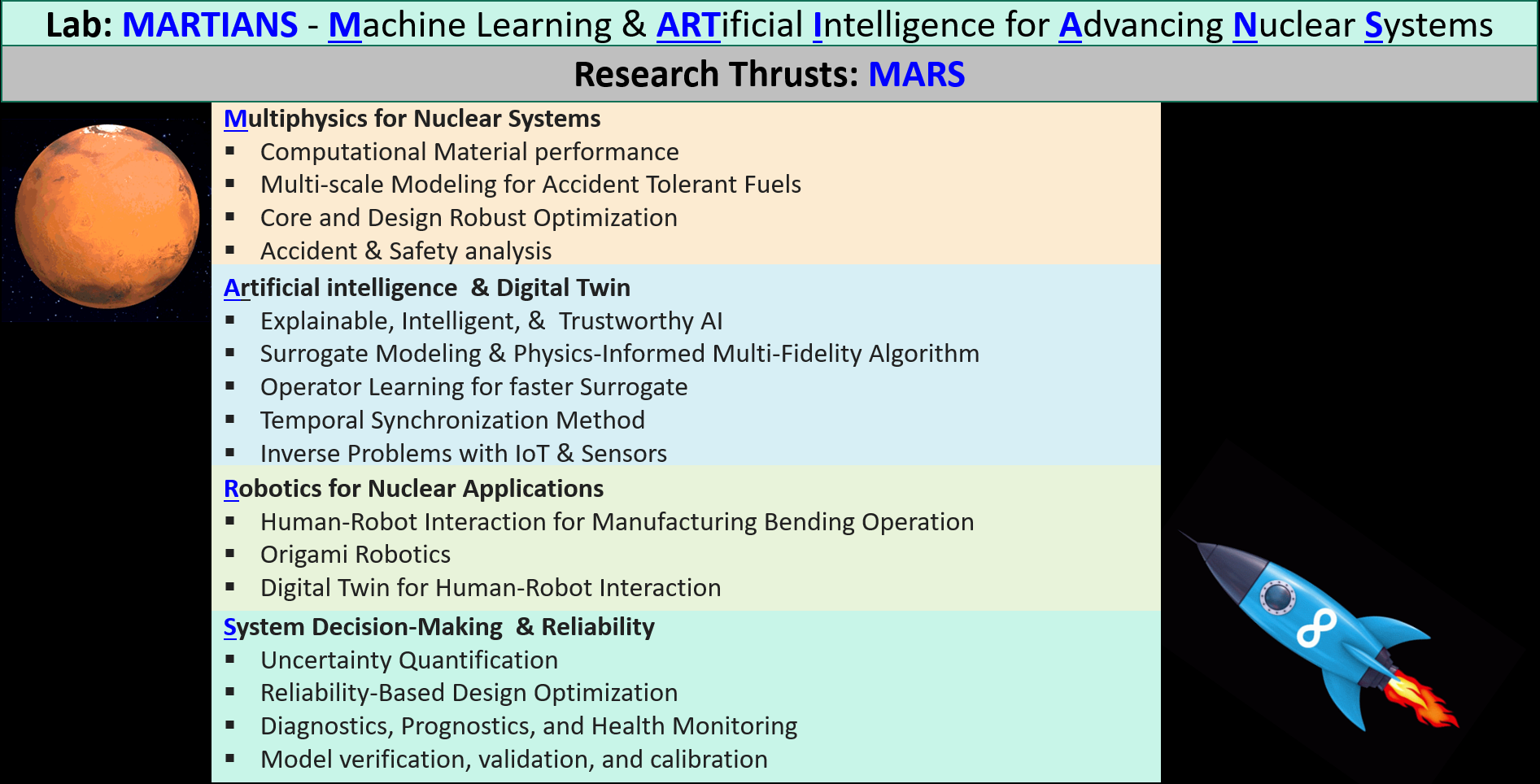
Syed Bahauddin Alam is an Assistant Professor at the University of Illinois Urbana-Champaign (UIUC) in the Nuclear, Plasma & Radiological Engineering department. He holds appointments in the Grainger College of Engineering and the National Center for Supercomputing Applications (NCSA). His research focuses on AI-driven digital twins, uncertainty quantification, and cybersecurity for nuclear systems. Education: B.Sc. in Electrical and Electronics Engineering, Bangladesh University of Engineering and Technology (BUET), 2011 MPhil in Nuclear Energy, University of Cambridge, 2013 PhD in Nuclear Engineering, University of Cambridge, 2018 Research Interests: AI and Digital Twins for Nuclear Energy Multiscale Modeling with Uncertainty Quantification Cybersecurity for Nuclear Systems Sensors and Instrumentation for Reactor Monitoring His work emphasizes explainable AI (XAI), physics-informed machine learning, and robust design optimization. Key contributions include AI-powered digital twins for nuclear systems, which received global media coverage and top 5% Altmetric scores. Awards & Honors: 2025 Dean’s Award for Excellence in Research (UIUC) 2024 Illinois Innovation Award Finalist 2022-2021 Outstanding Teaching Award (Missouri S&T) 2017 Cambridge Philosophical Society Research Studentship Award Grants & Funding: $700,000 U.S. Nuclear Regulatory Commission (NRC) Distinguished Faculty Development Award (2024) $2 million DOE grant for nuclear fuel storage solutions (2023) $500,000 NRC R&D Grant (2024) Labs & Teams: Leads the MARTIANS Lab (Machine Learning and ARTificial Intelligence for Advancing Nuclear Systems), focusing on hybrid data-physics-driven AI and explainable machine learning for nuclear engineering challenges.
Pedro Fardim is a Professor at the KU Leuven , affiliated with the Faculty of Engineering Sciences, Department of Chemical Engineering , and leads the Chemical and Biochemical Reactor Technology and Safety (CREaS) division. He also serves as President of EPNOE (European Polysaccharide Network of Excellence) and is a member of multiple institutes including KU Leuven Brain Institute (LBI) , Institute for Single Cell Omics (LISCO) , and Institute for Micro- and Nano-scale Integration (LIMNI) . PhD in Chemistry, State University of Campinas (UNICAMP), Brazil Habilitation in Chemical Engineering, Åbo Akademi University, Finland Pedro’s research focuses on topochemical engineering —mimicking natural bioassembly processes in trees and microorganisms to create sustainable materials and biofabrication technologies . His work spans drug delivery , regenerative medicine , biopolymer engineering , and green chemistry , with applications in pharmaceuticals , cosmetics , and energy . Recent projects include hydrogels for wearable sensors , biohybrid materials for bone tissue engineering , and lignin valorization using hydrotropic solvents. His scientific awards include Fellowships from the Royal Society of Chemistry and the International Academy of Wood Science , along with membership in the American Chemical Society . He teaches Chemical Engineering for Human Health , Biochemical Process Engineering , and Biopolymer-based Sustainable Technologies .
Oliver Schmitz is a Professor in the Department of Nuclear Engineering & Engineering Physics at the University of Wisconsin-Madison, where he leads research in plasma edge physics for magnetic confinement fusion and next-generation particle accelerators. His work bridges experimental plasma science, computational modeling, and diagnostic development with applications in both tokamaks and stellarators. Education: PhD (2006), Heinrich-Heine-Universität Diploma (2003), Rheinische Friedrich-Wilhelms-Universität Professor Schmitz's research focuses on 3D plasma edge transport phenomena, plasma-wall interactions, and helicon plasma generation for wakefield accelerators. His group employs advanced computational tools like EMC3-EIRENE for 3D plasma edge modeling and develops active spectroscopic diagnostics to measure plasma parameters through atomic emission analysis. Key themes include resonant magnetic perturbation effects in tokamaks, inherent 3D physics in stellarators, and high-density plasma sustainment for accelerator applications. He actively develops atomic models to interpret spectroscopic data and operates helicon plasma test stands for fundamental process studies. Recent publications reveal strong emphasis on experimental-computational integration for fusion boundary physics, with significant contributions to ITER divertor solutions, stellarator exhaust optimization, and plasma-facing materials. The work shows growing focus on wakefield accelerator diagnostics through helicon plasma sources and advanced spectroscopy, alongside persistent innovation in 3D modeling of plasma-material interfaces. Scientific Awards: 2020 Thomas and Suzanne Werner Chair Professorship 2018 UW Madison Teaching Academy Fellow 2017 ITER Science Fellowship & Vilas Mid-Career Award 2015 DOE Early Career Award & NSF CAREER Award 2011 Torkil Jensen Award (General Atomics) 2007 Günther-Leibfried-Preis (Jülich) Professor Schmitz directs multiple DOE/NSF-funded research programs including his UW Madison laboratory and AWAKE project contributions at CERN. He mentors graduate students through NE 890/990 thesis research courses and has developed nationally recognized K-12 outreach including the "Plasma Show" for elementary schools and "Plasma Academy" for high-school educators developing AP Physics curriculum modules. His leadership extends to university governance through the Kaufman seminar on academic leadership. His research group operates helicon plasma test stands and computational facilities for EMC3-EIRENE simulations, with current efforts focused on high-density plasma sources for accelerators and resilient divertor solutions for stellarators. The group maintains strong international collaborations with ITER, CERN, and major fusion facilities worldwide.
Mo Jiang is a Researcher in the Department of Chemical & Life Science Engineering at Virginia Commonwealth University's College of Engineering. His research focuses on advanced crystallization processes for energy storage materials and pharmaceutical manufacturing. He specializes in continuous manufacturing techniques such as slug-flow reactors, aiming to improve material uniformity, scalability, and process efficiency. His work bridges chemical engineering principles with practical applications in battery technology and drug substance development. Research Interests: Continuous crystallization and manufacturing systems Slug-flow synthesis of battery cathode materials Process optimization for pharmaceuticals and energy storage Scalable synthesis of uniform microcrystals His recent articles highlight advancements in low-cobalt/cobalt-free lithium-ion battery cathodes, pharmaceutical crystallization methods, and the application of computational fluid dynamics to enhance manufacturing processes. These studies emphasize improving material performance, reducing costs, and achieving sustainable production methods. While no formal academic awards are listed, his prolific publication record demonstrates expertise in interdisciplinary engineering solutions. He collaborates on projects involving process design, real-time monitoring, and the integration of advanced manufacturing technologies.
Jozef Vleugels is a full Professor at KU Leuven's Faculty of Engineering Sciences, where he serves as Department Head of Functional Materials (SIEM) within the Department of Materials Science. He is also Chairman of the Leuven Centre for Materials and serves as contact person for the Functional Materials research unit located at Castle Park Arenberg 44 in Leuven. His research focuses on advanced materials processing, particularly in ceramics, powder metallurgy, and additive manufacturing. Vleugels has extensive expertise in zirconia-based dental biomaterials, nuclear materials, and refractory ceramics. His work integrates traditional ceramic processing techniques with cutting-edge additive manufacturing technologies, including direct ink writing (DIW) and binder jetting for complex geometries. His recent publications demonstrate a strong emphasis on dental applications of zirconia ceramics, laser surface modification techniques, microwave processing, and high-entropy carbide systems. His research group is actively involved in numerous EU and national projects related to additive manufacturing of multi-material components, nuclear applications, and dental biomaterials. Prof. Vleugels teaches several courses including Ceramics and Powder Metallurgy, Advanced Ceramic Materials, and project-based courses in materials science. He supervises numerous doctoral candidates and collaborates extensively with industry partners on applied research projects. He is an active member of multiple research networks including the Materials Science Division, KIEM – KU Leuven Institute for Energy and Society, and Leuven.AM – KU Leuven Institute for Additive Manufacturing. He also serves on various faculty and departmental councils including the Faculty Council of Engineering Sciences and the Departmental Council of Materials Science.
Scott Kemp is an Associate Professor at the Massachusetts Institute of Technology (MIT) within the Department of Nuclear Science and Engineering , where he also directs the Laboratory for Nuclear Security and Policy . His interdisciplinary research bridges physics, political science, and history to address challenges in nuclear security, energy policy, and critical infrastructure protection . Education: B.Sc. in Physics from University of California, Santa Barbara; Ph.D. in Public and International Affairs from Princeton University Research focuses on: Strategic implications of hypersonic and advanced conventional weapons Securing vulnerabilities in energy/water/gas infrastructure Technological tools for nuclear disarmament verification Decarbonization policy frameworks Scientific recognition includes: Fellow of the American Physical Society (2017) Sloan Research Fellowship in Physics (2016) NEC Corporation Award in Computation (2015) Fulbright Fellow (2003) As an academic advisor in MIT's Energy Studies Program , he mentors students in policy-science intersections while serving on the International Policy Lab and President’s Committee for Distinguished Fellowships .
Kyle Doudrick serves as an Associate Professor in the Department of Civil and Environmental Engineering and Earth Sciences at the University of Notre Dame, with his office located in 166 Fitzpatrick Hall of Engineering. His research program bridges environmental engineering and materials science to address critical water quality challenges. Education Ph.D. in Environmental Engineering, Arizona State University (2013) M.S. in Civil Engineering, University of Memphis (2008) B.S. in Civil Engineering, University of Memphis (2006) Research Focus : The Doudrick Lab pioneers physical-chemical treatment technologies targeting emerging contaminants including PFAS, micro/nanoplastics, and oxyanions. His group develops solar-activated photocatalytic systems for water purification and wastewater-to-hydrogen conversion, while investigating fundamental processes in catalytic, adsorptive, thermal, photochemical, and electrochemical treatment. Current work emphasizes understanding contaminant fate in natural and engineered systems through advanced analytical methods. Publication Trends : Recent works (2019-2020) demonstrate a cohesive research trajectory centered on electrochemical and photocatalytic water treatment. Key themes include nanomaterial stability for contaminant degradation, hybrid processes for persistent pollutants like PFOS, and innovative reactor designs such as hydrogel membranes. These publications span environmental engineering, materials chemistry, and sustainable energy conversion, reflecting interdisciplinary approaches to water security challenges. Laboratory Operations : The Doudrick Lab maintains a mission-driven focus on developing cost-effective, scalable solutions that integrate seamlessly with existing water infrastructure. Research activities combine fundamental material science with practical engineering applications, targeting real-world implementation of contaminant removal technologies while advancing scientific understanding of emerging pollutant behavior.
Nancy G. Love is the Borchardt and Glysson Collegiate Professor and JoAnn Silverstein Distinguished University Professor of Environmental Engineering at the University of Michigan, affiliated with the Department of Civil and Environmental Engineering and the African Studies Center. Her research focuses on water infrastructure, public health, and environmental systems, emphasizing interdisciplinary approaches to address challenges in both domestic and global contexts. Education: Ph.D. (1994) in Environmental Systems Engineering from Clemson University; MS (1986) and BS (1984) in Civil Engineering from the University of Illinois. Research interests include water quality, pathogen fate and transport, sustainable resource recovery (e.g., urine-derived fertilizers), and infrastructure resilience in shrinking cities. She leads the Love Research Group, which integrates chemical, biological, and computational methods to develop technologies for contaminant removal, resource recovery, and public health protection. Her work addresses pressing issues like drinking water equity in Detroit, Legionella outbreaks in Flint, and global sanitation in Ethiopia. She advocates for transdisciplinary collaboration and community-informed solutions to environmental challenges. Awards include prestigious professorships at the University of Michigan. She serves on editorial boards (e.g., ACS ES&T Engineering) and contributes to policy initiatives on water infrastructure and environmental justice. Labs/Teams: Love Research Group; Collaborations span academia, industry, and NGOs, including projects on urine diversion, sensor-mediated wastewater treatment, and civic engagement in infrastructure decisions.
Brian S Woodard serves as a Teaching Associate in the Department of Aerospace Engineering at the University of Illinois Urbana-Champaign, teaching undergraduate courses including AE 100 (Intro to Aerospace Engineering), AE 140 (CAD), and ENG 100/101 (Engineering Orientation). Education Doctor of Philosophy, Aerospace Engineering, University of Illinois Urbana-Champaign, 2012 Master of Science, Aerospace Engineering, University of Illinois Urbana-Champaign, 2004 Bachelor of Science, Aerospace Engineering, University of Illinois Urbana-Champaign, 2001 Research Interests His research focuses on High-Energy Lasers , Aerodynamics , and Aircraft Icing , with specialized work in electric discharge-pumped atomic iodine and oxygen-iodine laser systems. He investigates plasma discharge geometries for oxygen singlet delta production and their application in high-power laser development, while also studying aerodynamic effects of aircraft icing for flight safety. Publication Trends Publications from 2008-2011 reveal concentrated expertise in laser physics and plasma engineering, particularly in electric discharge pumping mechanisms for iodine-based laser systems. His work demonstrates consistent innovation in resonator design and discharge configuration to enhance laser efficiency, bridging aerospace engineering principles with advanced optical technologies for potential defense and propulsion applications. Scientific Awards No scientific awards were mentioned in the provided text. Advising and Grants Dr. Woodard mentors students through AE 298 RES (Research Seminar Mentoring and Introduction to Research courses), guiding undergraduate research projects. He has instructed over 20 distinct undergraduate courses spanning aerospace fundamentals, computational design, global engineering experiences, and leadership training, though no research grants are documented in the source material. Labs and Teams His research is conducted within Talbot Laboratory (Room 319K) at the University of Illinois, collaborating with prominent researchers including J.W. Zimmerman, G.F. Benavides, and W.C. Solomon on electric oxygen-iodine laser projects.
Professor Bing-Jie (Bruce) Ni is an Adjunct Professor at the University of Technology Sydney (UTS) within the School of Civil and Environmental Engineering and a full Professor at UNSW Sydney. He is an internationally recognised leader in environmental engineering, wastewater treatment, greenhouse-gas mitigation, microplastics fate, electrocatalysis and sustainable energy systems. Education PhD in Environmental Engineering, University of Science and Technology of China, Hefei (2005–2009) Research Interests Professor Ni’s research integrates process engineering, microbial biotechnology, materials science and mathematical modelling to develop sustainable technologies for high-efficiency pollutant removal, minimal carbon footprint and maximal energy recovery from wastewater. He is a global pioneer in: Modelling and control of nitrous oxide (N₂O) and methane (CH₄) emissions from wastewater systems, Micro- and nano-plastics ecotoxicity and mitigation in anaerobic digestion, Transforming sewage sludge into high-value liquid bio-energy (medium-chain fatty acids and long-chain alcohols), Designing cost-effective electrocatalysts from natural minerals for green hydrogen production and wastewater electrolysis. Research Output & Impact Over the last decade he has published 2 research books, 30 book chapters and >400 refereed journal papers , including 35 in Environmental Science & Technology and 85 in Water Research . His work has influenced global policy: the IPCC adopted his nitrous-oxide-emission model in 2019 to revise national greenhouse-gas inventories for the first time in 13 years. Awards & Recognition ARC Future Fellowship & ARC DECRA Fellowship Clarivate Analytics Highly Cited Researcher (Web of Science) Royal Society of Chemistry Highly Cited Researcher (2020–present) Mendeley Data Top 2 % Cited Researchers worldwide Listed among “Australia’s Most Innovative Engineers” (Engineers Australia, 2018) 50+ additional awards including Scopus Young Researcher Award, South Australian Water Awards, UQ Research Excellence Awards, and Outstanding Doctoral Dissertation Awards. Research Funding & Leadership He has secured ≈ AUD $10 million in competitive funding (six major ARC grants plus >20 government, university and industry projects). He serves as: Lead Guest Editor, Water Research Editorial Advisory Board, Environmental Science & Technology Associate Editor for Journal of Cleaner Production , Environmental Chemistry Letters , Environmental Research , Journal of Environmental Management Editorial Board member for five additional high-impact journals. Teaching & Supervision At UTS he teaches Renewable Energy Technologies , Environmental and Sanitation Engineering , Process Dynamics and Control , and Water and Wastewater Treatment . He is available to supervise Masters and PhD students in environmental biotechnology, process modelling and sustainable energy systems. Laboratory & Commercial Translation He heads active research teams at both UNSW and UTS and is the inventor of >10 granted patents , some of which are currently being commercialised to deliver real-world impacts in greenhouse-gas-neutral wastewater treatment and renewable energy production.
Henrik Rasmus Andersen is a Professor at the Department of Environmental and Resource Engineering, Water Technology & Processes at the Technical University of Denmark (DTU). His research focuses on water treatment processes, particularly the occurrence, transformation, and removal of micropollutants like pharmaceuticals and hormones. Key Research Areas: Chemical analysis, bioassays, ozonation, biofilter optimization, by-product profiling, and advanced oxidation processes. Projects: Leads initiatives like BIZON (ozone technology for fish farms) and Sustainable Industrial Laundry Wastewater Treatment , emphasizing sustainable solutions. Collaborations: Works with institutions such as University of Copenhagen and industry partners on municipal and industrial wastewater challenges. Education: Master of Science in Environmental Chemistry from Copenhagen University (1998).