Lindell Bromham is a Professor at the Research School of Biology , Australian National University, focusing on evolutionary biology, cultural evolution, and interdisciplinary research. Their work spans genomic mutation rates to global linguistic diversity, with notable projects on language endangerment and Galton’s problem in cross-cultural studies. Broad research themes: evolutionary biology, cultural evolution, macroecology, linguistics Key contributions: interdisciplinary funding disparities, language evolution models, parasite-culture interactions Recent articles emphasize language endangerment risk factors, methodological innovations in cross-cultural analysis, and population size effects on language evolution. Awards include Eureka Prize Finalist (2021) and media recognition in Nature and New Scientist . Supervises students in evolutionary and linguistic research.
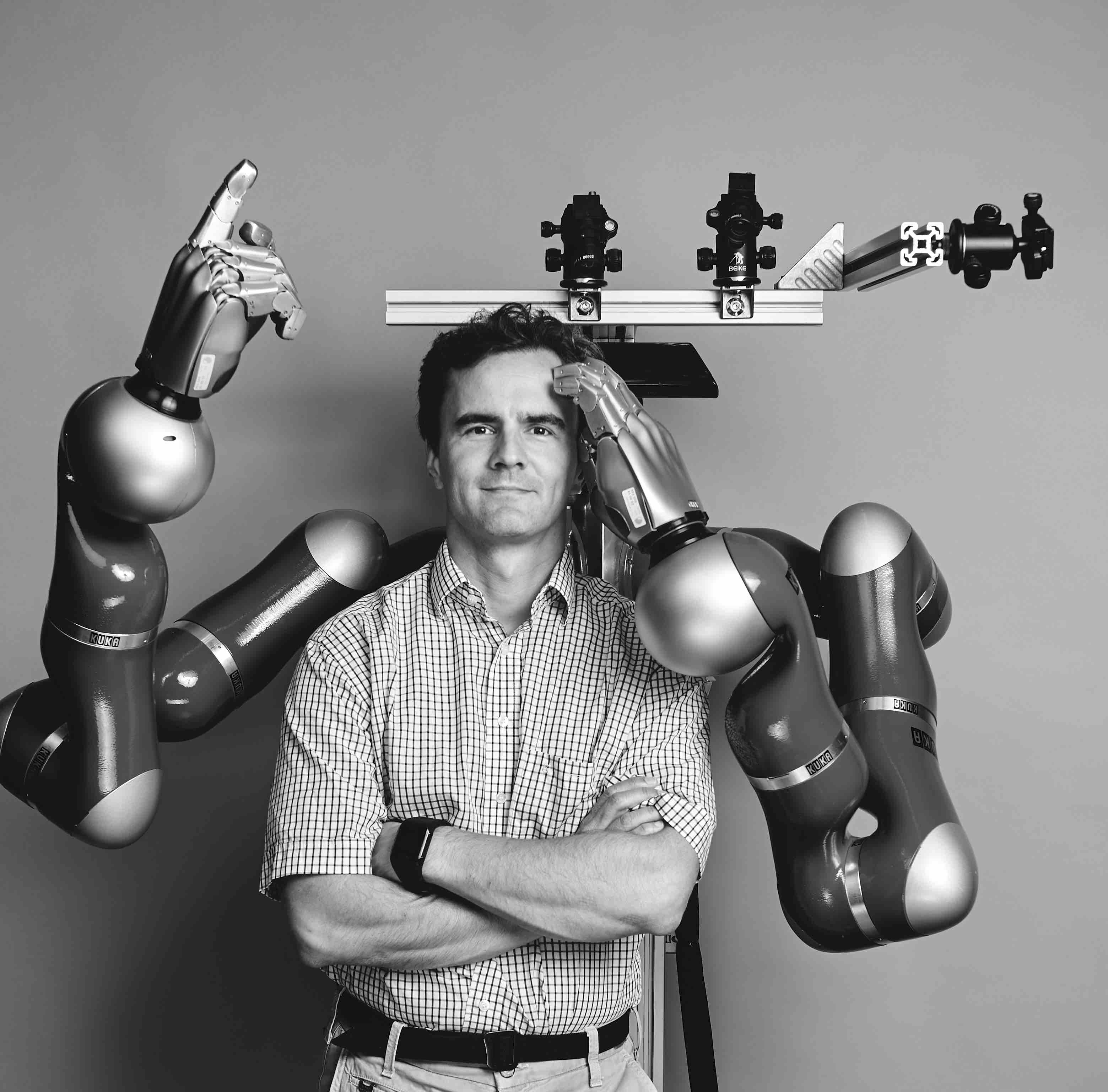
Jan Peters is a full professor (W3) at the Computer Science Department of Technische Universität Darmstadt and serves as the department head of the Systems AI for Robot Learning (SAIROL) at the German Research Center for AI (DFKI) . He is also a founding faculty member of the Hessian Centre for Artificial Intelligence . Peters holds a Ph.D. in Computer Science from the University of Southern California (2007) and dual master’s degrees in Computer Science and Electrical Engineering from USC and TU Munich respectively. Research Themes : Robot Learning, Reinforcement Learning, Imitation Learning, Tactile Sensing, Human-Robot Interaction, and Safe AI. Recent Article Trends : Focus on deep reinforcement learning (Iterated Q-Networks, Adaptive Q-Networks), safe robot foundation models , tactile-enhanced imitation learning , and physics-informed machine learning . Scientific Recognition : Recipient of the Dick Volz Best PhD Thesis Award , ERC Starting Grant , IEEE Fellow , and Amazon Research Award . Leadership : Founder of the IEEE RAS Technical Committee on Robot Learning and editor for journals including Autonomous Robots and IEEE Transactions on Robotics .
Professor Bradley D Eyre is a leading academic at Southern Cross University, serving as a Professor in the Faculty of Science and Engineering and as the Foundation Director of the Centre for Coastal Biogeochemistry (CCB). His work spans the land-ocean continuum, with a focus on carbon and nitrogen biogeochemistry in coastal and estuarine systems under global change pressures. Education: BAppSc(Hons), University of Adelaide PhD, Queensland University of Technology His research centers on ecosystem-scale biogeochemical processes, particularly the impacts of climate change, ocean acidification, and eutrophication on greenhouse gas emissions and carbonate dynamics. He employs multi-scale approaches, from field measurements to global modeling. His recent work highlights how methane and nitrous oxide fluxes alter the climate benefit of blue carbon ecosystems and how ocean acidification drives net dissolution of coral reef sediments. An analysis of his recent publications reveals a strong focus on quantifying greenhouse gas fluxes in aquatic systems, with an emphasis on upscaling methods, geomorphic controls, and climate feedbacks. His work frequently appears in high-impact journals such as Nature , Science , and Nature Climate Change , reflecting broad disciplinary influence in environmental science, biogeochemistry, and climate research. Scientific Awards and Recognitions: Fellow, Association for the Sciences of Limnology and Oceanography (ASLO), since 2018 Member, ARC College of Experts, since 2022 Deputy Chair, 2024 MPCE DECRA Panel Professor Eyre has supervised 32 PhD students to completion and currently mentors 13 more, in addition to 22 early- and mid-career researchers. His research has attracted over $20 million in funding, including 32 ARC grants (>$10 million), 11 ARC Linkage projects (> $7.5 million), and over $3 million in contract research. His collaborations span federal and state agencies, local governments, private sector partners, and multiple universities across Australia and internationally, demonstrating extensive impact on policy and practice. He leads the Centre for Coastal Biogeochemistry, which played a key role in securing SCU’s ERA Rank 5 (well above world standard) in Geochemistry. His team conducts interdisciplinary research on coastal carbon cycling, sediment dynamics, and climate change impacts, contributing significantly to national and global environmental assessments.
Yan Gu is an Associate Professor of Mechanical Engineering at Purdue University, located in West Lafayette, Indiana. He is affiliated with the School of Mechanical Engineering within the College of Engineering. His research focuses on legged locomotion, humanoid and quadrupedal robots, wearable robotics, hybrid dynamical systems, control systems, state estimation, and dynamics. He leads the TRACE Lab and has been recognized with prestigious awards including the NSF CAREER Award (2021) and multiple teaching accolades. Gu holds a Ph.D. from Purdue University (2017) and a B.S. from Zhejiang University, China (2011). His work emphasizes robust control strategies for legged robots in dynamic environments, including adaptive ankle torque control, time-varying foot-placement algorithms, and state estimation techniques for non-inertial surfaces. His recent publications explore multimodal datasets in animal-robot interaction and the stabilization of quadrupedal locomotion on accelerating platforms. His research has been supported through grants such as the NSF CAREER Award, and his contributions span both theoretical advancements in hybrid control systems and practical applications in wearable robotics and exoskeleton design. Gu’s TRACE Lab serves as a hub for innovative robotics research, addressing challenges in robot-environment interaction and dynamic stability.
Matthew R. Jones is an Associate Professor in the Department of Chemistry at Rice University and holds the Gene and Norman Hackerman Junior Chair and Norman Hackerman-Welch Young Investigator titles. He joined Rice in 2017 after postdoctoral research at UC Berkeley under Paul Alivisatos and a PhD at Northwestern University under Chad Mirkin. His research focuses on systems-level nanoparticle assembly, plasmonics, and metamaterials, with applications in energy storage and biomedicine. Jones has pioneered techniques like 4D-STEM for catalytic nanoparticles and developed adaptive materials via strain-controlled synthesis. Education: B.S. in Materials Science and Biomedical Engineering (Carnegie Mellon University), Ph.D. in Chemistry (Northwestern University as an NSF Fellow). Key awards include the Packard Fellowship (2018) and NSF CAREER Award (2022). His lab hosts over 20 graduate students and postdocs, with notable advisees including Bukky, Zhihua Cheng, and Saxton. Research emphasizes interdisciplinary approaches: combining in-situ microscopy, ligand engineering, and computational modeling to control nanoparticle behavior. Recent studies include strain-preserved nanocatalysts (2024) and chiral superlattices (2024). Collaborations span Rice’s Center for Nanoscale Imaging Sciences and the Electrochemical Society. Lab: Jones Research Group Grants: NSF CAREER, Packard Fellowship, Rice Seed Award Publications: Over 50 peer-reviewed articles, including Science Advances (2024) and Nature Communications (2023)
David Hsu is Provost's Chair Professor in the Department of Computer Science at the National University of Singapore (NUS) School of Computing, where he founded and directs the NUS Artificial Intelligence Laboratory (NUSAIL) and leads the Smart Systems Institute. His academic leadership includes chairing major conferences such as Robotics: Science & Systems (2015) and IEEE ICRA (2016), alongside editorial roles in IEEE Transactions on Robotics and the Journal of Artificial Intelligence Research. He earned a B.Sc. in Computer Science & Mathematics from the University of British Columbia and a Ph.D. in Computer Science from Stanford University. His research spans robotics, AI, and computational biology, with recent focus on robot planning under uncertainty and human-robot collaboration. Current work integrates machine learning with decision-theoretic planning to enable robust human-robot co-existence in unstructured environments. Analysis of his 2023-2025 publications reveals dominant trends in deformable object manipulation (e.g., clothes handling via semantic keypoints), open-world navigation using scene graphs, and LLM-driven multi-agent reasoning for complex tasks. Key innovations include perspective-aware visual grounding for human-centric interaction and functional object arrangement through compositional generative models, reflecting a strong emphasis on real-world applicability. His scientific contributions have earned prestigious recognition: IJCAI-JAIR Best Paper Prize (2022) for foundational AI research Robotics: Science & Systems Test of Time Award (2021) IEEE Fellowship (2018) for contributions to robotic planning RSS Best Systems Paper Award (2017) RoboCup Best Paper Award at IROS (2015) Humanitarian Robotics Award at ICRA (2015) As director of the Adaptive Computing Laboratory, Hsu drives research on fundamental computational frameworks for human-robot interaction. The lab's work on uncertainty-aware decision-making has secured significant research funding through grants from Singapore's National Research Foundation and industry partnerships with robotics firms. While specific student names aren't publicized, his leadership in the NUSAIL indicates extensive mentorship of doctoral candidates in AI and robotics.
Panagiota (Nota) Klentrou is a Distinguished Professor and Dean of the Faculty of Applied Health Sciences at Brock University, specializing in Kinesiology. Her research focuses on exercise physiology , bone development , and the health implications of sport training in youth , particularly examining cellular mechanisms linking exercise, diet, and lifelong bone health. Supported by NSERC, CIHR, Osteoporosis Canada, and the International Gymnastics Federation Education: PhD, FCSEP (Fellow of the Canadian Society of Exercise Physiology) Her work spans bone physiology , inflammatory responses to exercise , and sclerostin-mediated tissue cross-talk , with recent studies exploring the impact of obesogenic diets , acute exercise , and nutritional interventions on skeletal growth and adaptation. Key findings include the role of sprint interval training in modulating adipose tissue Wnt signaling and the effects of dairy consumption on bone turnover markers. Scientific Awards & Distinctions Fellow, Canadian Society for Exercise Physiology (CSEP), 2020 Marilyn Rose Graduate Leadership Award, 2017 TVO's Best Lecturer nominee, 2010 Chancellor’s Chair for Research Excellence, Brock University, 2009 Award for Distinguished Research & Creative Activity, Brock University, 2006 Dr. Klentrou actively supervises graduate and undergraduate students in projects related to bone physiology , inflammation , and exercise adaptation , and collaborates with organizations like Osteoporosis Canada and the International Gymnastics Federation.
Gabriela Minigo serves as an Honorary Fellow in Global and Tropical Health and Associate Dean - Learning and Teaching within the Faculty of Health. Her academic profile demonstrates active engagement in malaria immunology research with a recent expansion into circadian rhythm and metabolic health investigations. Dr. Minigo completed her PhD at the University of Melbourne (awarded March 31, 2007) and earned a Master of Clinical Epidemiology from the University of Newcastle (awarded December 8, 2017). Her educational background provides a strong foundation in both basic science and clinical epidemiology. Her primary research focuses on immunological responses to malaria, with particular expertise in T follicular helper cells, dendritic cell function, and regulatory T cells in Plasmodium falciparum and Plasmodium vivax infections. Analysis of her research fingerprint reveals significant contributions to Plasmodium falciparum Immunology and Microbiology (100%), Dendritic Cell Immunology and Microbiology (45%), Regulatory T Cell Immunology and Microbiology (38%), and other related fields. In recent years, she has expanded her research to investigate the relationship between photoperiod, circadian rhythm, and metabolic health, as evidenced by her 2024 publications on these topics. Dr. Minigo's scholarly output shows an evolving research trajectory from fundamental malaria immunology toward interdisciplinary investigations connecting circadian biology with metabolic health. Her recent publications (2022-2024) demonstrate continued strong contributions to malaria immunology while incorporating new dimensions related to light exposure, sleep patterns, and glucose control. She has secured research funding for multiple projects including 'Rainmaker start up- Does exposure to artificial light alter circadian rhythm and glucose control in Australian adults? A pilot study' (2023-2026) where she serves as Co-Investigator, and 'Effect of Extended Photoperiod Exposure on Circadian Rhythm and Glucose Control' (2024-present) where she is Principal Investigator. Previously, she contributed as Chief Investigator C to 'Manipulating T follicular helper cells to improve human malaria vaccines' (2020-2023). As Associate Dean for Learning and Teaching, Dr. Minigo holds significant educational leadership responsibilities within the Faculty of Health. She is registered to supervise postgraduate research, indicating her active role in mentoring graduate students in immunology and tropical medicine research.
Kaiyang Liu is an Assistant Professor at the Department of Computer Science, Memorial University of Newfoundland. He holds a Ph.D. from Central South University (2019) and was a Postdoctoral Fellow at the University of Victoria, Canada. His research focuses on distributed cloud/edge computing, data center networks, and distributed machine learning, emphasizing optimization for data-intensive services. He is an IEEE Senior Member and has received prestigious awards, including the NSERC Discovery Grants and IEEE TCCLD Outstanding Ph.D. Thesis Award. Education: Ph.D. in Information Science and Technology, Central South University (2014–2019) M.Sc. in Information Science and Technology, Central South University (2012–2014) B.Eng. in Information Science and Technology, Central South University (2008–2012) Research Assistant at the University of Victoria (2016–2018) Research Interests: Kaiyang’s work bridges AI and cloud computing, exploring optimization strategies for next-generation systems. Key areas include learning-based congestion control, energy-efficient resource management, and scalable distributed storage solutions. His research has been published in top-tier journals like IEEE Transactions on Parallel and Distributed Systems and conferences such as IEEE ICDCS. Awards & Grants: NSERC Discovery Grants & Discovery Launch Supplement (2024) IEEE TCCLD Outstanding Ph.D. Thesis Award (2020) CSC-UVic Fellowship (2016–2018) Teaching: He teaches courses on Computer Networks, Advanced Computer Networks, and Operating Systems at Memorial University and previously at the University of Victoria. Labs & Teams: His research group focuses on Space Edge Computing, leveraging LEO satellites for resilient, low-latency networks. Ongoing projects include optimizing distributed systems for AI workloads and satellite-based data centers.
John R Anderson is the Richard King Mellon University Professor of Psychology and Computer Science at Carnegie Mellon University (CMU), affiliated with the Department of Psychology within the Dietrich College of Humanities and Social Sciences. His research focuses on understanding higher-level cognition, particularly mathematical problem-solving, through the development of the ACT-R cognitive architecture—a computational framework simulating human cognitive processes. This architecture integrates behavioral, neural, and educational data to model learning and decision-making. Anderson’s work bridges cognitive science, neuroscience, and educational technology. He investigates how brain imaging (e.g., fMRI, EEG) can reveal the temporal dynamics of cognitive processes and improve instructional methods. His research emphasizes analyzing brain activity time courses to uncover underlying mechanisms of problem-solving and skill acquisition. Key Research Themes: Cognitive architectures, neural correlates of learning, computational models of memory, and intelligent tutoring systems. Notable Contributions: Development of the ACT-R architecture, integration of neuroimaging with cognitive modeling, and studies on skill transfer and learning strategies. Anderson’s publications include seminal books like Cognitive Psychology and Its Implications and How Can the Human Mind Occur in the Physical Universe? His work has advanced understanding of associative memory, strategic decision-making, and the application of cognitive models in educational technology. His lab, the ACT-R Research Group, collaborates across disciplines to model complex cognitive tasks and their neural foundations. Current projects analyze real-time brain activity to refine educational interventions and improve human-machine interaction.
LING Chun Kai is an Assistant Professor in the Department of Computer Science at the National University of Singapore (NUS), School of Computing. His research focuses on multiagent systems, computational game theory, and machine learning applications in adversarial real-world domains like cybersecurity and logistics. Educational background includes a PhD in Computer Science (2017-2023) from Carnegie Mellon University and a First Class BEng in Computer Engineering (2015) from NUS. Previously, he was a Postdoctoral Research Scientist at Columbia University. Current research interests span computational game theory, machine learning for multi-agent systems, equilibrium characterization in imperfect information settings, and applications in network security, logistics, and recreational games. Key methodological contributions include scalable algorithms for game solving, differentiable game solvers, and copula-based statistical modeling. Recent publications focus on attacker-defender graph games, language negotiation agents, and modeling games with incomplete information. Collaborations include researchers from Columbia University, Carnegie Mellon, and institutions working on GameSec, AAAI, Neurips, and ICML venues. Scientific Awards: IJCAI 2018 Distinguished Paper Award GameSec 2023 Best Paper Award GameSec 2024 Best Paper Award Singapore Teaching and Academic Research Talent Scheme (2024) Teaching includes courses on AI Planning and Decision Making (CS4246, CS5446) and Advanced Topics in Artificial Intelligence (CS6208).
Mathias Lécuyer is an Assistant Professor in the Computer Science Department at the University of British Columbia (UBC) , part of the Faculty of Science . His research focuses on trustworthy AI systems, with emphasis on privacy (differential privacy), adversarial robustness, and causal machine learning. He leads the Systopia Lab and collaborates with groups such as UBC S&P, TrustML, and CAIDA. Education: PhD in Computer Science from Columbia University (2019), MSc from Columbia University (2013) and École Polytechnique (2011). Research Interests: Ensuring rigorous guarantees for AI systems via differential privacy, robustness against adversarial attacks, and causal inference. His work spans theoretical foundations and practical implementations in areas like privacy-preserving systems, federated learning, and transparent machine learning. Awards: SOSP Distinguished Artifact Honorable Mention (2024), Google Research Award (2022), Bourse Carnot Fellowship (2011), and UBC’s top teaching evaluations (2021). Advising & Service: Supervised over 20 students (PhD, MSc, undergrad) across privacy and machine learning topics. Serves on PCs for top conferences (OSDI, S&P, NeurIPS) and organizes workshops like TrustML @ UBC. Actively mentors high school students in ML research through outreach programs. Labs/Teams: Leads the Systopia Lab at UBC, focusing on AI safety and privacy. Collaborates with MSR, Google, and industry partners on practical system implementations.
Amitai Shenhav is an Associate Professor at the University of California, Berkeley, specializing in Cognitive Neuroscience. His research explores the neural and computational mechanisms underlying motivation, affect, decision-making, and cognitive control, as detailed on the Shenhav Lab website . Ph.D., Harvard University Key research themes include: Explaining motivated behavior through affective gradients Modeling decision-making with mutual inclusivity and value integration Investigating cognitive control allocation under varying motivational contexts Understanding neural dynamics in target-distractor interactions Recent publications (2025–2024) highlight his work on value-based decision-making, effort allocation, and computational models of cognitive control. These studies often bridge behavioral experiments with neural recordings and theoretical frameworks. Scientific contributions include: NSF CAREER Award (2021) for research on motivation in cognition He mentors students and collaborators in his lab, focusing on psychophysiological experiments, computational modeling, and neuroeconomic paradigms. His work intersects with psychology, neuroscience, and artificial intelligence, particularly in attention training applications.
Somil Bansal is an Assistant Professor in the Department of Aeronautics and Astronautics at Stanford University, part of the School of Engineering. Previously, he served as an Assistant Professor in the Electrical and Computer Engineering (ECE) department at the University of Southern California. He holds a B.Tech. from IIT Kanpur, an MS, and a Ph.D. from UC Berkeley’s EECS department. Research Focus: Development of mathematical tools and algorithms for safety-critical autonomous systems, emphasizing learning-enabled systems’ safety. Key Collaborations: Waymo, Skydio, Google, Boeing, NASA AMES/JPL. Awards: NSF CAREER Award, Eli Jury Award, RSS Pioneer Award, and Outstanding Graduate Instructor Award. His research integrates control theory and machine learning to ensure safety in autonomous systems, focusing on safe learning frameworks, anomaly detection, and real-time safety guarantees. He leads the Safe and Intelligent Autonomy (SIA) Lab, which explores applications in robotics, autonomous driving, and aerospace systems. Teaching: Courses include Introduction to Control Design Techniques and Principles of Safety-Critical Autonomy. He advises doctoral students and supervises research projects in his lab.
Wojciech Jarosz is an Associate Professor of Computer Science at Dartmouth College, affiliated with the College of Engineering and Computer Science. His research focuses on computer graphics, particularly light transport simulation, rendering algorithms, and digital fabrication. He co-founded the Visual Computing Lab and previously led the rendering group at Disney Research Zürich. Jarosz holds a Ph.D. and M.S. from UC San Diego and a B.S. from the University of Illinois Urbana-Champaign. His educational background includes studies in computer science and engineering, with a strong emphasis on graphics and rendering. Research interests span light transport simulation, Monte Carlo methods, appearance capture, and fabrication. Notable achievements include the Eurographics Young Researcher Award (2013) and the NSF CAREER Award (2019). Jarosz's work integrates theoretical rigor with practical applications, such as real-time rendering techniques and volumetric light transport. His lab develops tools for artistic authoring, including intuitive metaphors for volumetric lighting in animated films. Recent projects explore wave-optics BSDF models, optical heterodyne rendering, and unifying radiative transfer models. Key awards include the SIGGRAPH 2024 Best Paper Award and Neukom Institute prizes. His teaching includes courses on rendering algorithms, computer graphics, and computational photography. Jarosz collaborates with industry (e.g., Disney, NVIDIA) and advocates for diversity in computer graphics research.