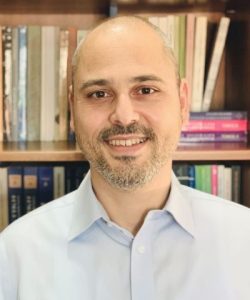
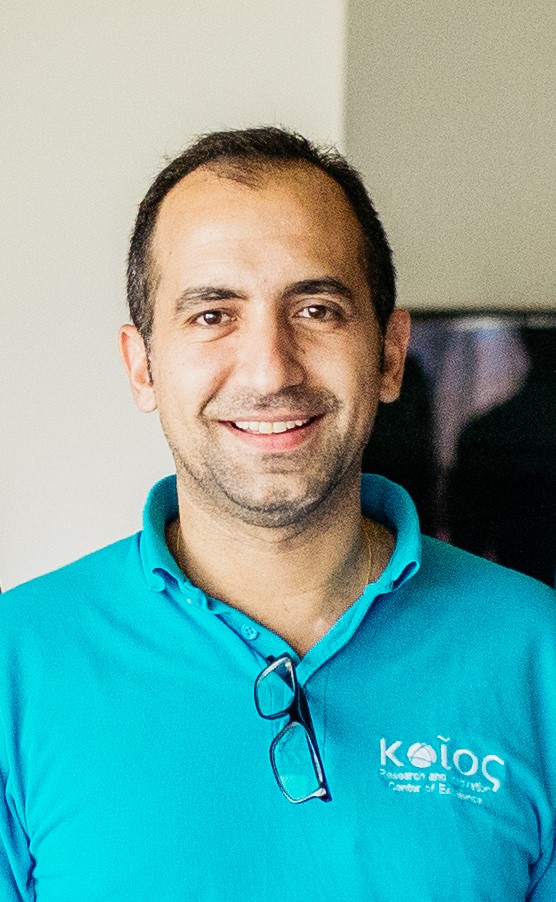
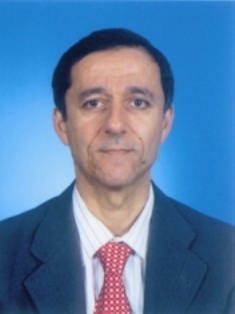
Stelios Timotheou is an Associate Professor at the Department of Electrical and Computer Engineering and faculty member at the KIOS Research and Innovation Center of Excellence, University of Cyprus. He holds a Dipl-Ing from National Technical University of Athens, and MSc/PhD from Imperial College London. His research focuses on developing real-time distributed methodologies using mathematical optimization, machine learning, and computational intelligence to enhance efficiency in critical infrastructure systems. Research interests center on data-driven decision making for urban mobility management, traffic control systems, and energy optimization. Key areas include: Intelligent UAV-based sensing for traffic monitoring Cooperative control algorithms for multi-agent systems Optimization of renewable energy integration Robust infrastructure protection strategies Recent publications demonstrate strong focus on traffic state estimation (76%), energy system optimization (16%), and UAV applications (8%). Awarded the Cyprus Research Award (2017) and ERC Consolidator Grant for URANUS project. Secured multiple research grants focusing on real-time control systems.
Marios Polycarpou is a Professor of Electrical and Computer Engineering and Director of the KIOS Research and Innovation Center of Excellence at the University of Cyprus. He holds honorary positions at Imperial College London and is a member of Academia Europaea. His expertise spans intelligent systems, adaptive control, machine learning, and critical infrastructure. Education: B.A. Computer Science (Rice University, 1987) B.Sc. Electrical Engineering (Rice University, 1987) M.S. Electrical Engineering (University of Southern California, 1989) Ph.D. Electrical Engineering (University of Southern California, 1992) Research Focus: Polycarpou’s work emphasizes fault diagnosis in cyber-physical systems, water distribution networks, and adaptive control. He pioneers digital twin technologies for infrastructure resilience and develops algorithms for real-time anomaly detection and system optimization. Article Trends: His recent publications address adaptive control strategies, cybersecurity in networked systems, and AI-driven solutions for water management. Key themes include distributed control, event-triggered mechanisms, and transformer-based anomaly localization. Awards: 2023 IEEE Frank Rosenblatt Technical Field Award 2016 IEEE Neural Networks Pioneer Award Fellow of IEEE and IFAC Grants & Leadership: He secured prestigious grants including ERC Advanced and Synergy Grants. He led KIOS CoE’s Horizon 2020 projects and served as IEEE Computational Intelligence Society President (2012–2013). Labs & Teams: Directs the KIOS CoE, a hub for AI in critical infrastructure. Collaborates on projects like ERC Water-Futures, focusing on long-term water system transitions and contamination mitigation.
Panayiotis Kolios is an Assistant Professor at the Department of Computer Science, University of Cyprus (UCY). Previously, he served as a Research Assistant Professor at the KIOS Research and Innovation Centre of Excellence (2013–2024) and a Visiting Lecturer at UCY. He holds a BEng and PhD in Telecommunications Engineering from King’s College London (2008 and 2012, respectively). His research focuses on networked intelligent systems, emergency management using AI and UAV technologies, and cyber-physical systems. Education: BEng in Telecommunications Engineering, King’s College London, 2008 PhD in Telecommunications Engineering, King’s College London, 2012 Research Interests: His work centers on autonomous systems, intelligent transportation, and emergency management. Key areas include AI-driven disaster response, UAV-based surveillance, and algorithmic optimization for critical infrastructure. He develops solutions for real-time situational awareness and decision-support in emergencies. Recent work trends show a focus on multi-UAV coordination, disaster management platforms (like AIDERS), and AI applications in emergency response. His team’s 2023 win in the Cooperative Aerial Robots Inspection Challenge highlights advancements in UAV inspection algorithms. Scientific Awards: First Prize in Cooperative Aerial Robots Inspection Challenge (CDC 2023) Grants and Advising: He has secured over €40 million in EU and industrial grants, leading projects like PREDICATE, SWIFTERS, and AIDERS. His team advises on emergency response strategies and has trained first responders through EU-funded programs such as the Exchange of Experts training. Labs and Teams: He leads the Security and Emergency Response Group at KIOS CoE and established the Cyprus Civil Defence Aerial Observation Unit. His team collaborates with institutions like the Cyprus Police and Fire Service to operationalize UAV technologies in disaster scenarios.
Christos Nicolaides is an Assistant Professor at the Department of Business and Public Administration within the School of Economics and Management at the University of Cyprus (UCY), holding a secondary appointment as a Digital Fellow at MIT's Initiative on the Digital Economy. Previously, he spent three years as a James McDonnell Foundation-funded Postdoctoral Fellow at MIT Sloan School of Management. His educational background includes a PhD in Engineering from Massachusetts Institute of Technology (2014), SM from MIT (2011), MSc in Applied Mathematics from Imperial College London (2009), and BSc in Physics from University of Thessaloniki (2008). Nicolaides' research applies mathematical, statistical, and computational tools to large-scale empirical questions in social influence mediated by digital technologies. His work spans Data Science , Machine Learning , Social Networks , and Computational Social Science , with significant contributions to understanding human mobility patterns, disease transmission dynamics, and social contagion effects. His research has established novel methodologies for analyzing complex network structures in mobility data and social interactions. Analysis of his 15 most recent publications reveals a consistent focus on applying network science to real-world problems, particularly in pandemic response (12 publications), human mobility analytics (9 publications), and social contagion dynamics (7 publications). His work demonstrates increasing interdisciplinary integration, combining computer science, epidemiology, and organizational behavior since 2020. Marie S. Curie Fellow Two Highly Cited Papers by Web of Science (2017, 2020) Best Paper Award by Risk Analysis Society (2019) Professor of The Week by Poets & Quants (2020) As principal institutional investigator, Nicolaides has secured over €1 million in research funding from the European Commission, industry partners, Cyprus Innovation and Research Foundation, and Cyprus Ministry of Health. His current teaching includes Social Networks and Entrepreneurship, Introduction to Operations Management, and Quantitative Methods in Management. Media coverage of his work spans major outlets including The New York Times, CNN, Nature, and Science, with significant impact on public health policy discussions during the COVID-19 pandemic.
Angelos Georghiou is an Associate Professor of Operations Management at the Department of Business and Public Administration, University of Cyprus. He previously held academic positions as Assistant Professor at McGill University (2016–2019), Post-Doctoral Researcher at MIT (2012–2013), and Postdoctoral Researcher at ETH Zurich (2013–2016). His work bridges computational methods in stochastic and robust optimization with applications in healthcare, energy systems, and operations management. Ph.D. in Operations Research, Imperial College London (2012) M.Sci. in Mathematics, Imperial College London (2008) His research focuses on stochastic optimization , robust optimization , and decision rules , addressing challenges in healthcare analytics , energy-efficient control systems , and machine learning integration . Recent publications in Management Science and Operations Research highlight his contributions to decision-dependent information discovery and computational frameworks. Key trends in his 15 most recent articles include: Advancing robust optimization techniques for multistage problems Applications in healthcare (psychiatric risk prediction) and energy systems Integration of machine learning with stochastic programming Development of tractable algorithms for complex decision environments Scientific Awards : Esdras-Minville Best Student Paper Award (2023) He serves on editorial boards of Operations Research Letters (Area Editor) and Management Science , and collaborates with institutions like MIT, ETH Zurich, and McGill University. His work with undergraduate students includes a 2021 paper in SIAM Undergraduate Research Online .
Christodoulou Chris is a Professor at the Department of Computer Science, University of Cyprus. He joined in 2005 and holds a Visiting Research Fellowship at Birkbeck College, University of London. His educational background includes a BEng in Electronic Engineering from Queen Mary and Westfield College (1991), a PhD in Neural Networks from King's College London (1997), and a BA in German from Birkbeck College (2008). His research focuses on Computational Neuroscience, Neural Networks, and Machine Learning, with specific interests in neural coding, self-control modeling, computational neuronal modeling, multi-agent reinforcement learning, and practical machine learning applications. Recent publications (2013-2025) demonstrate interdisciplinary approaches combining neuroscience, computer science, and optimization techniques, with emerging emphasis on protein structure prediction and biomedical applications. Scientific awards include: Best Paper Award, ICSR 2015 Best Paper Award, MODELS 2008 Doctoral Symposium He leads the Computational Intelligence and Neuroscience (CIN) research group and has secured funding from European projects (SocioCoast, CYberSafety, TAMIT). He mentors students through Google Summer of Code and collaborates internationally.
Savvas G. Loizou is a faculty member at the Cyprus University of Technology , affiliated with the Department of Mechanical and Materials Science and Engineering . He established the Robotics, Control, and Decision Systems Laboratory (RCDS Laboratory) in 2011. Education: PhD in Mechanical Engineering (2005) and Eng. Diploma (2000) from National Technical University of Athens (NTUA). Postdoctoral Experience: GRASP Laboratory, University of Pennsylvania (2005–2007). His research focuses on control theory for autonomous robotic systems , with applications in underwater, aerial, ground, and micro-robotics . Key areas include multi-agent coordination , human-robot interaction , task planning , and sensor-based navigation . Recent work emphasizes logistics automation , UAV hardware platforms , and bounded control algorithms . Dr. Loizou has contributed to multi-agent formation control , underwater vision systems , and nonlinear model predictive control for electric vehicles. He is active in control system design and navigation transformations for complex environments. His laboratory, RCDS , serves as a hub for research in autonomous systems and decision-making algorithms.
Professor George Giaglis is a prominent academic in the School of Business at the University of Cyprus, serving as Director of the Institute for the Future. He holds a PhD in Information Systems from Brunel University and a BSc (Hons) in Information Systems from the Athens University of Economics and Business. His academic journey includes roles such as Professor, Vice Rector, and Associate Professor at the Athens University of Economics and Business (2002–2017) and prior positions at the University of the Aegean and Brunel University. His research focuses on blockchain technology, IoT, digital currencies, and pervasive information systems. He has contributed to over 200 publications, exploring topics like blockchain integration in marine systems, NFTs, CBDCs, and social network dynamics. His work bridges technology and business, addressing digital transformation challenges and ethical implications of emerging technologies. Giaglis has organized major conferences like Decentralized 2019 and contributed to EU blockchain policy discussions. His research emphasizes practical applications of technology in sectors like healthcare, finance, and urban logistics. Despite prolific output, no specific awards are noted, though his h-index of 25 reflects significant academic impact. His current roles involve advancing the Institute for the Future’s projects, advising on digital innovation strategies, and mentoring researchers in decentralized systems. Ongoing work includes exploring AI-blockchain synergies and regulatory frameworks for digital currencies.
Professor Edna Yamasaki is the Head of the Department of Life and Health Sciences at the University of Nicosia's School of Sciences and Engineering, and serves as Vice Rector for Academic Affairs. Her career spans roles in academia, research, and administrative leadership. She holds a Medicine degree from Federal Fluminense University (Brazil), followed by MSc/PhD in Biophysics (Neurobiology) from Federal University of Rio de Janeiro, and postdoctoral training at institutions including Harvard Medical School (USA) and the University of Cyprus. Her research focuses on nervous system development/degeneration, public health implications of climate change, and biomedical materials. Notable projects include the CYPHEW initiative (identifying Cyprus's heat-related health risks), polymer development for biological applications, and Erasmus+ programs promoting health-enhanced physical activity. She has contributed to environmental hydrodynamic modeling, health information systems evaluation (DIPSA framework), and disaster risk assessments for oil spills. Her work bridges neuroscience, environmental science, and public policy. Recent studies highlight aging populations' health challenges and the impact of extreme weather on mortality and hospital admissions in Cyprus. She actively collaborates on EU-funded projects addressing work safety, healthcare informatics, and climate adaptation. Professional milestones include coordinating interdisciplinary teams across multiple continents and transitioning between laboratory research to institutional leadership roles. Her leadership emphasizes fostering curiosity-driven research while addressing societal health challenges.
George Pallis is a Professor in the Department of Informatics at the University of Cyprus, affiliated with the School of Science. He holds a BSc and PhD from Aristotle University of Thessaloniki. His research focuses on Distributed and Network Computing, Big Data Analytics, and Cloud/Edge/Fog Computing. He leads the Master's Program in Data Science and has secured over €5.5M in research funding from the EU, Cyprus, and industry partners like Google. Education: BSc (2001), PhD (2006) from Aristotle University of Thessaloniki. Research Interests include Internet technologies, large-scale network environments, and cloud computing. He has published over 100 articles in top-tier journals and conferences (e.g., IEEE TKDE, ACM TOIT, WWW, ICDCS) and contributed to international standards (DIN, CEN). His work spans topics like fake news detection, edge computing frameworks, and energy-efficient micro-data centers. Key Achievements: Editor-in-Chief Emeritus of IEEE Internet Computing, recipient of multiple best paper awards, and contributor to projects like RAINBOW (H2020), UNICORN, and ICARUS. His research explores cutting-edge areas such as LLM manipulation, polarization detection, and carbon-aware computing. He has supervised five PhD students and served as General Chair for IEEE/ACM SEC 2024 and IEEE IC2E 2024. His work bridges academia and industry through collaborations on AI, IoT, and sustainable computing.
Dr. Andria Procopiou is a Lecturer in Artificial Intelligence and Cybersecurity at the University of Central Lancashire Cyprus, serving as Course Leader for the MSc Computing program and Deputy Course Leader for the MSc Cybersecurity. She holds a PhD in Computer Science (City, University of London, 2022), an MSc in Human-Computer Interaction (University College London, 2014), and a BSc in Computer Science (University of Surrey, 2013). Her research spans AI applications in sports analytics, cybersecurity for smart cities/IoT, hate speech detection, and metaverse safety. She has led modules in User Experience Design, Penetration Testing, and Cybersecurity. Research interests include AI-driven solutions for sports injury prediction, real-time DDoS detection in IoT networks, and ethical challenges in the metaverse. Her work emphasizes explainable AI (XAI) for transparency in decision-making systems. She has published extensively in journals like Wireless Communications and Mobile Computing and conferences such as IEEE CYBER and the International Conference on Human-Computer Interaction. Education: PhD Computer Science (City University London), MSc HCI (UCL), BSc Computer Science (University of Surrey) Key Roles: Course Leader (MSc Computing), Deputy Course Leader (MSc Cybersecurity) Administrative Contributions: Module leadership in AI, Cybersecurity, and Digital Forensics Her recent publications address critical issues like privacy concerns in smart campuses, gender-based hate speech in virtual spaces, and injury patterns in professional football using data analytics. She collaborates with industry on IoT security solutions and metaverse governance frameworks.
Kristis Alexandrou is a Researcher at the Science and Technology in Archaeology and Culture Research Center (STARC) of The Cyprus Institute. He holds a Master’s degree in Architecture (MA) and a Ph.D. in Architectural Engineering from the University of Cyprus, focusing on hybrid bending-active structural systems. His research emphasizes Structural Design, Computational Methods, and BIM applications in heritage conservation. He contributes to projects like ENI-CBC-MED BEEP, RIF-UrbanPeriscope, and Horizon Infra, advancing BIM interoperability for cultural heritage data management. His professional experience includes architectural design and heritage retrofitting in Cyprus. At STARC’s Virtual Environments Lab (VElab), he develops BIM-based workflows to address data interoperability challenges in arts and humanities. Key projects include 'BIM to BPS interoperability' leadership in the BEEP Project and semantic data integration for Mediterranean heritage sites. His work bridges computational innovation with sustainable heritage preservation.
Prof. Nearchos Paspallis is the Head of the School of Sciences and Professor in Mobile and Distributed Systems at UCLan Cyprus. He holds a PhD in Computer Science from the University of Cyprus (2010) and has extensive academic leadership roles, including Deputy Head of School (2020–2022) and Chair of the Teaching and Learning Enhancement Committee (2018–2023). His teaching responsibilities include leading the BSc (Hons) Computing program and delivering modules on software development, mobile computing, and algorithms. Education: PhD Computer Science (University of Cyprus, 2010), MSc Computer Science (University of California, 2002), BEng/MEng Computer Engineering and Informatics (University of Patras, 2001). His research focuses on software engineering , distributed systems , and mobile computing , with recent work on machine learning applications, context-aware systems, and computer science education. He has pioneered initiatives like Code Cyprus to inspire youth in coding and co-led EU-funded projects such as WIDERa (€4.2M) and MentorME (€296K). Key Awards: Shortlisted for 2024 Outstanding Contribution award, Best Paper (2016), Fulbright Scholarship (2001). Prof. Paspallis has supervised multiple research projects, including a PhD on MMOG backend architectures. His outreach efforts extend to judging hackathons and robotics competitions, emphasizing STEM engagement.
Prof. Dr. Hadi Işık Aybay is a distinguished Professor of Computer Engineering at Eastern Mediterranean University (EMU), North Cyprus. He has held academic roles including Department Chairman of Computer Engineering (1994–2004 and 2013–present) and Director of EMU's Distance Education Institute (2000–2013). He earned his PhD in Electrical and Electronic Engineering from METU (1989) and served as an Assistant/Associate Professor before becoming a full Professor in 2013. His research spans neural networks, distributed systems, and e-learning technologies. Education: PhD, Electrical and Electronic Engineering, Middle East Technical University (1989) M.Sc., Electrical and Electronic Engineering, METU B.Sc., Electrical and Electronic Engineering, METU Research Interests: Prof. Aybay's work focuses on computer engineering innovations, including neural network hardware, distributed multimedia systems, and wireless communication protocols. He pioneered EMUOnline, a blended learning platform, and contributed to science park development in North Cyprus. His research also addresses challenges in video streaming optimization and adaptive resource allocation in cellular networks. Key Achievements: He led over 15 projects, including EU-funded initiatives like 'Deep Farm' (2024–2025). His publications (80+ papers) span IEEE journals and conferences, with 281 Google Scholar citations. Awards include the 1973 National Project Contest First Prize and the 1990 Best Thesis Award (supervised). Grants and advising: Supervised 3 PhD and 28 MSc students. Current projects include AI-driven agriculture (Erasmus+). Grants include EU funding (€1M) and Turkish Republic of Northern Cyprus initiatives. Labs/Teams: Active in the EMU Computer Engineering Department's research groups, focusing on distributed systems and e-learning infrastructure.
MSc. Sinem Alturjman is a Lecturer in the Department of Artificial Intelligence Engineering at Near East University's College of Engineering. Her academic work focuses on the intersection of artificial intelligence, blockchain technology, and internet of things (IoT) systems. Research areas include: Development of AI-powered learning facilitators and educational tools Integration of blockchain for secure IoT architectures Optimization of mobile cloud computing services Application of machine learning in cybersecurity frameworks 6G communication systems with intelligent routing protocols Recent publications demonstrate expertise in: AI-enhanced scheduling mechanisms Decentralized cloud-IoT architectures Reinforcement learning applications Smart healthcare systems with blockchain Energy-aware routing protocols for sensor networks