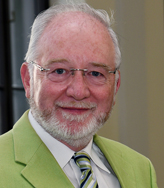
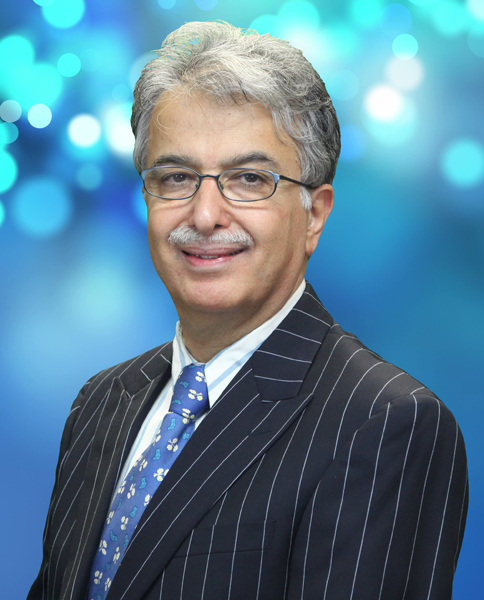
Ulrich Berger is a Professor of Economics at the Department of Economics of WU Vienna University of Economics and Business (WU Vienna). He serves as Editor-in-Chief of the journal Games and is actively involved in promoting science through the Vienna Skeptics Society. His research focuses on game theory, including non-cooperative, evolutionary, behavioral, and experimental variants. He has been recognized with multiple awards, including the WU Best Paper Award and an Outstanding Reviewer Award. His work explores dynamics of cooperation, reputation systems, and strategic behavior in economic contexts. Key research areas include evolutionary stability in reputation games, indirect reciprocity, and cognitive hierarchies in strategic interactions. His publications span peer-reviewed journals like PLoS ONE and Scientific Reports , as well as popular science articles in outlets like derStandard.at . Berger has led research projects on topics such as cognitive hierarchies in minimizer games and has contributed to policy discussions on access pricing in telecommunications. His academic contributions reflect a blend of theoretical rigor and practical engagement, with recent work emphasizing evolutionary mechanisms of deterrence and experimental validation of equilibrium concepts.
Roman Obermaisser is a Professor at the Vienna University of Technology (TU Wien), affiliated with the Cyber-Physical Systems department. His research focuses on real-time systems, system architectures, communication protocols, safety-critical systems, distributed algorithms, and fault-tolerance. He holds a PhD in Computer Science from TU Wien, awarded in 2003 for his work on integrated architectures for control paradigms. His academic contributions span over two decades, with publications in top-tier conferences and journals. Key research themes include time-triggered architectures (TTA), fault containment in embedded systems, and integration of heterogeneous communication protocols like CAN and Ethernet. He has supervised numerous graduate students, contributing to advancements in system-on-chip (SoC) design, transient-resilient architectures, and diagnostic frameworks for real-time systems. Obermaisser’s work emphasizes practical applications in automotive and industrial systems, addressing challenges such as scalability, reliability, and composability. His involvement in projects like GENESYS and DECOS highlights his role in developing cross-domain reference architectures for embedded systems. Recent efforts include evaluating ontology-based reconfiguration and COTS-based Ethernet solutions for safety-critical networks. His articles reflect a focus on real-time communication protocols, fault-tolerant design, and system integration, with applications ranging from automotive networks to smart transducers. Advising over 20 students underscores his commitment to nurturing the next generation of embedded systems researchers.
Endre Süli is Professor of Numerical Analysis at the University of Oxford, where he has maintained a distinguished academic career since 1985. He currently serves as Fellow and Tutor in Mathematics at Worcester College and Supernumerary Fellow at Linacre College. His progression at Oxford includes University Lecturer in Numerical Analysis (1985-1996), Reader in Numerical Analysis (1996-1999), and Professor of Numerical Analysis (1999-present). Süli completed his B.Sc. in Mathematics at the University of Belgrade (1974-1978), followed by an M.Sc. in Mathematics (1978-1980). As a British Council Visiting Student, he studied at Reading University and Oxford University in 1983/84, earned his Ph.D. from the University of Belgrade in 1985, and received his M.A. from Oxford University in the same year. Professor Süli's research centers on numerical analysis of nonlinear partial differential equations with applications across multiple scientific domains. His work spans free-discontinuity problems and computational modeling of fracture; finite element methods; Navier-Stokes-Fokker-Planck systems; adaptive algorithms with a-posteriori error control; implicitly constituted material models; and discontinuous finite element methods. His research bridges theoretical mathematics with practical computational approaches for complex physical phenomena. Recent publications (2024-2025) demonstrate Süli's continued leadership in numerical analysis, with focus areas including fractional calculus, stochastic PDEs, and advanced finite element techniques. His work shows strong interdisciplinary connections between mathematical analysis, fluid dynamics, and materials science, addressing challenging problems in polymeric fluids, porous media, and capillary flow modeling. Professor Süli's distinguished career has been recognized with numerous prestigious honors: Invited Speaker at the International Congress of Mathematicians, Madrid (2006) Fellow of the Institute of Mathematics and its Applications (2007) Foreign Member of the Serbian National Academy of Sciences and Arts (2009) Fellow of the European Academy of Sciences (2010) IMA Service Award (2011) SIAM Fellow (2016) Member of the Academia Europaea (2020) London Mathematical Society Naylor Prize and Lectureship (2021) Fellow of the Royal Society (2021) As an educator, Süli has received the Oxford University Teaching Excellence Award (2009) and the Mathematical Institute Teaching Award (2013). He has supervised numerous PhD students and postdoctoral researchers throughout his career, though specific names aren't documented in the available materials. His research has been supported by various grants enabling work on computational methods for partial differential equations. Süli maintains active service to the mathematical community through editorial boards and professional organizations. Professor Süli is affiliated with the Numerical Analysis research group and the Oxford Centre for Nonlinear PDE at the Mathematical Institute. These research centers provide a collaborative environment for theoretical and applied work on partial differential equations. His research often involves interdisciplinary collaborations with physicists, engineers, and computational scientists to develop and analyze numerical methods for complex physical phenomena.
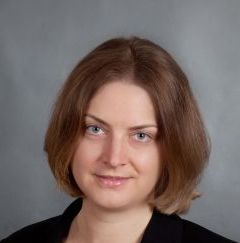
Dr. Quirin Thomas Simon Vogel is a Senior Lecturer at the Department of Statistics, University of Klagenfurt. He previously held postdoctoral positions at the Technical University of Munich, New York University Shanghai, and served as an Interim Professor at Ludwig-Maximilians University of Munich. His research bridges probability theory with statistical mechanics and algorithmic applications. Current role: Senior Lecturer (2025) Previous roles: Postdoc (TUM, NYU Shanghai), Interim Professor (LMU Munich) His research focuses on: Random walks and their geometric/stochastic properties Randomized algorithms with applications in statistical models Quantum-inspired probabilistic systems (e.g. interacting bosonic loop soups) Large deviation theory for complex systems Percolation and phase transitions in particle models The articles reflect trends in probability theory, mathematical physics, and algorithmic applications. Key topics include high-dimensional percolation, Bose gas models, neural network theory, and stochastic geometry. The work combines rigorous mathematical analysis with interdisciplinary applications in physics and computer science. Scientific awards and functions cannot be determined from the provided data, as they describe other researchers. The department's research activities include projects on statistical learning, quantum models, and algorithmic probability, though Vogel's direct involvement in these specific funded projects isn't explicitly stated.
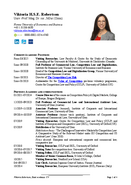
Prof. Viktoria HSE Robertson is a Professor of Corporate Law, Antitrust Law, and Digitalization at Vienna University of Economics and Business (WU Vienna), where she also serves as Head of the Department of Antitrust Law and Digitalization. Her research focuses on European and international antitrust law, digitalization's impact on competition, and comparative legal frameworks. She teaches courses such as *Corporate Law*, *Competition, Antitrust and Intellectual Property Law*, and *Competition Law in the Digital Economy*, emphasizing digital markets and regulatory challenges. Her work bridges antitrust law with digital innovation, addressing topics like algorithmic pricing, data governance, and the role of competition law in safeguarding democracy. Robertson is affiliated with organizations such as the Academic Society for Competition Law and the Women in Competition Law Network Austria. Her recent research includes studies on DMA implementation, computational antitrust, and green transition policies within EU competition frameworks. Robertson holds degrees including Mag. (Austria), MJur (Oxford), and has authored books like *Competition Law’s Innovation Factor: The Relevant Market in Dynamic Contexts in the EU and the US*. Her interdisciplinary approach integrates legal analysis with technological and economic considerations, shaping modern competition law discourse globally.
Brian Horsak is a Professor and Head of the Center for Digital Health and Social Innovation at Fachhochschule Steyr. He holds an endowed professorship in Applied Biomechanics and Rehabilitation Research, focusing on integrating advanced technologies like VR/AR, machine learning, and wearable devices into clinical gait analysis and motor rehabilitation. His roles include leading the Institute of Health Sciences and contributing to the Department of Health Sciences and Media and Digital Technologies. Education: Dr. rer. nat. (2012, University of Vienna), Habilitation in Kinesiology (2020, University of Vienna), Master's in Sports Science (2002–2008, University of Vienna). Research interests revolve around improving patient care through biomechanical innovations, including musculoskeletal simulations, gait pattern analysis, and rehabilitation technologies. He leads projects like ReMoCap-Lab (motion capture for motor rehabilitation) and chairs the Applied Biomechanics in Rehabilitation Research initiative. Key achievements include the Lower Austria Innovation Prize (2021), multiple best paper awards, and grants for projects like TRUST AI and VReeze. His work bridges clinical practice with digital health solutions, emphasizing explainable AI (XAI) in gait classification and VR-based balance training. Notable contributions include developing the GaitRec dataset and studies on smartphone-based motion capture reliability. He collaborates internationally, publishing widely in Gait & Posture , Scientific Reports , and IEEE journals. Current projects focus on AI-driven gait analysis, musculoskeletal modeling, and XR applications in healthcare.
Professor Robert Eason is a leading academic at the University of Southampton, specializing in photonics and laser technology. His research spans interdisciplinary areas combining Machine Learning , Medical Diagnostics , and Microfluidics . Research Interests : Eason focuses on AI-driven laser applications, including deep learning for phototherapy , autonomous laser machining , and low-cost paper-based diagnostic devices . His work bridges photonics with biomedicine and advanced manufacturing. Recent Publications : His 2025 article in Scientific Reports explores AI simulations for psoriasis treatment, while 2024-2022 works address laser-controlled microfluidics, deep learning in microscopy, and reinforcement learning for laser machining. Supervision : He supervises PhD student Georgia Mourkioti in laser-based research projects. External Roles : Eason has served as a speaker at international conferences including the International Symposium on Laser Precision Microfabrication (2018), LAISER (2019), and Deep Learning for Control of Light-Matter Interactions (2022).
Associate Professor Dr. Martin Gruber-Risak has been a core faculty member at the University of Vienna’s Institute for Labour and Social Law since 1996, serving as Associate Professor from 2012 onward and as Scientific Director of the LL.M. programme "Labour Law". Education & Career: 1989-1993 Law studies, University of Vienna 1993-1999 Doctoral studies in law, University of Vienna 2003 William Evans Visiting Fellow, University of Otago, NZ 2007 Habilitation in Labour & Social Law, University of Vienna 2010-2012 Marie Curie International Outgoing Fellow (University of Otago & Vienna) 2020 Visiting Professor, University of Salzburg Research Interests: Gruber-Risak’s scholarship covers Austrian and European labour law, working-time regulation, collective bargaining, dispute resolution & mediation, atypical employment, and the legal challenges of digital platform work. His recent projects analyse crowd-work, algorithmic management and EU initiatives for fair platform working conditions. Publications & Trends: Author of 19 monographs and more than 140 articles since 1999, he explores evolving employment forms, unilateral wage clauses, dismissal protection, and the transposition of EU directives into Austrian law, combining doctrinal analysis with socio-legal and comparative perspectives. Scientific Awards: Leopold Kunschak Science Prize 2009 Cardinal Innitzer Prize 2009 Projects & Grants: He currently leads the FWF project "Virtual Employees" investigating platform work and has participated in EU studies on digitalisation and labour law reform. Labs & Teams: He heads the "Labour Law" LL.M. programme team and is a key member of the Institute for Labour and Social Law research group focusing on digitalisation and European labour standards.
Dr. Andreas Zöttl is a physicist affiliated with the University of Vienna , currently serving as an Assistant Professor in the Computational and Soft Matter Physics department. His research focuses on computational modeling of active matter, microswimmers, and polymer dynamics, with applications in biophysics and soft materials. He teaches courses such as Computational Statistical Mechanics and Biological Physics , emphasizing theoretical and computational methods. His recent work explores reinforcement learning in microswimmer locomotion, chiral particle dynamics, and polymer behavior under shear flow. Research keywords include Machine Learning , Fluid Dynamics , and Soft Matter Physics . Themes span hydrodynamic interactions , active colloids , mesoscale simulations , and non-equilibrium systems . Contact: andreas.zoettl@univie.ac.at
Univ.-Prof. Karl Crailsheim is a Professor at the University of Graz, affiliated with the Institute of Zoology within the Faculty of Natural Sciences. His research focuses on honeybee behavior, physiology, and health, particularly investigating the honeybee superorganism and threats to their colonies. He explores swarm systems, robotics, and swarm intelligence, with recent emphasis on colony losses and environmental threats. His work bridges biology and robotics, applying insights from honeybee behavior to algorithm design. Research interests include honeybee nutrition, immune responses, pathogen impacts, and the application of citizen science in ecological studies. Key projects involve tracking honeybee behavior, analyzing pollen diversity, and developing robotic systems inspired by swarm dynamics. Collaborative efforts with citizen scientists enhance ecological data collection. Publications highlight advancements in understanding bee health, pesticide effects, and swarm robotics. His interdisciplinary approach addresses both biological and technological challenges in apiculture and robotics.
Prof. Tina Wakolbinger is a Professor at Vienna University of Economics and Business (WU) , where she serves as Deputy Head of the Institute for Transport Economics and Logistics and Head of the Supply Chain Management Research Institute. She also chairs the Senate and has led numerous research projects in supply chain management, humanitarian logistics, and the circular economy. PhD in Business Administration, Isenberg School of Management, UMASS Amherst (2007) Mag. in International Economics, University of Innsbruck (2002) Her research focuses on Supply Chain Management , with an emphasis on Humanitarian Logistics and the Circular Economy . She investigates how operational settings and disaster characteristics affect supply chain resilience, explores sustainable urban mobility solutions like electric scooters, and develops frameworks for resource allocation in disaster relief. She has published extensively on topics including disaster preparedness, outsourcing in humanitarian logistics, and the impact of digitalization on sustainable supply chains. Recent publications highlight trends in 2025 with strategic dependencies in supply chains, 2023 contributions to circular economy models and humanitarian logistics assessments, and 2022 analyses of pandemic-era supply chain disruptions. Earlier work includes studies on sustainable freight transport, e-waste management, and risk-sharing contracts. Scientific Awards Literati Award 2020 (Journal of Humanitarian Logistics) WU Cooperation Officer of the Year 2018 Talent promotion bonus of Upper Austria 2011 Best Paper Award 2008 (Fogelman College of Business) Graduate School Fellowship 2006 (UMASS Amherst) She has been involved in external positions such as Member of the Post Control Commission (2022–2027) and advisory roles for Caritas Österreich and Finland’s Strategic Research Council. Current projects include developing circular business models for timber supply chains and optimizing e-scooter fleet management in Vienna.
Sylvain Lefebvre is a permanent researcher at INRIA (Institut National de Recherche en Informatique et en Automatique) in France, where he leads the MFX research team since 2018. Previously, he was part of the ALICE group at INRIA Nancy (2009-2018) and the REVES team in Sophia Antipolis (2006-2009). His career includes a postdoctoral position at Microsoft Research Seattle (2005) following his PhD at INRIA Rhones-Alpes under Fabrice Neyret. His educational background includes a PhD in Computer Graphics from Université Joseph Fourier (Grenoble) in 2005, preceded by a Master in Computer Graphics from INP Grenoble in 2001. His habilitation thesis focused on Runtime Texture Synthesis. Lefebvre's research centers on simplifying content creation for highly detailed patterns, structures, and shapes with applications spanning Computer Graphics to additive manufacturing. He develops fast, controllable by-example synthesis approaches that generate content while enforcing user-specified constraints. His work addresses computational challenges through novel data structures and algorithms optimized for GPUs and FPGAs, including his Silice programming language. The ERC-funded ShapeForge project (2012-2017) advanced shape generation for 3D printing, leading to the IceSL software for digital modeling and fabrication. Analysis of his 15 most recent publications reveals a strong focus on additive manufacturing optimization, with recurring themes in structural integrity, material efficiency, and geometric algorithms. His work bridges computer graphics theory with practical fabrication constraints, particularly in microstructure design, slicing techniques, and mechanical metamaterials. The interdisciplinary nature spans computer science, materials engineering, and robotics. EUROGRAPHICS Young Researcher Award (2010) ERC Starting Grant for ShapeForge project (2012) Lefebvre has advised over 25 PhD students and interns including Marco Freire, Thibault Tricard, and Jimmy Etienne. His ShapeForge project received significant ERC funding, supporting research in computational fabrication. He serves on numerous program committees including SIGGRAPH, Eurographics, and SIGGRAPH Asia, reflecting his leadership in the computer graphics community. As leader of the MFX team since 2018, Lefebvre directs research in computational fabrication, focusing on IceSL software development for 3D printing workflows. The team integrates computer graphics techniques with manufacturing constraints, developing tools that simplify complex object design and fabrication while addressing real-world challenges in material usage and structural integrity.
Associate Professor at the University of Klagenfurt , affiliated with the Department of Management Control and Strategic Management under the Faculty of Economics and Law . Research focuses on agent-based modeling applied to organizational dynamics , complex systems , and managerial economics . Holds a doctoral degree in Social Sciences and Economics (2012) and venia docendi in Business Economics (2018) . Core faculty member in the Self-Organizing Systems research cluster Academic editor for PLoS ONE and editorial board member for multiple journals Recipient of the 2021 Advancement Award (Humanities/Social Sciences) from Carinthian government Research integrates computational simulation with organizational theory , examining phenomena like decentralized task allocation , incentive mechanisms , and reproducibility in social sciences . Teaching portfolio includes business analytics , management control , and scientific modeling at undergraduate and graduate levels. Recent publications explore organizational resilience , team coordination dynamics , and financial modeling using agent-based simulation techniques. Active participant in international conferences like Social Simulation Conference and European Conference on Operational Research .
Georg Langs is a Full Professor of Machine Learning in Medical Imaging at the Medical University of Vienna and Founding Director of the Computational Imaging Research Lab (CIR). He leads a 25-member interdisciplinary team focusing on machine learning methodologies for medical image analysis. Key roles include Director of the Joint Initiative on AI in Medical Imaging (European Institute of Biomedical Imaging Research) and Scientific Lead of the Respiratory Disease Phenotype Observatory (ZODIAC, UNO/IAEA). He is affiliated with MIT’s CSAIL and serves on advisory boards for global AI initiatives. Education: PhD in Computer Science, Graz University of Technology (2007) M.Sc. in Mathematics, Vienna University of Technology (2003) Research Interests: Machine learning-driven precision imaging, neuroimaging, clinical data phenotyping, and cross-species brain connectivity analysis. His work bridges imaging biomarkers with biological mechanisms and large-scale clinical data integration. Grants & Funding: Over €6M in competitive grants as Principal Investigator in the last two years. Projects include ARTEMIS (fatty liver disease digital twins) and AI-POD (personalized risk scores via imaging). Awards: 2022 IS3R Emerging Leaders Club 2022 National Academy of Medicine Emerging Leader Programme 2018 Advisor, AI Mission Austria 2030 Lab & Teams: CIR Lab focuses on AI-driven medical imaging solutions. Co-founded contextflow GmbH , a MedUni spin-off developing AI software for imaging analysis.
Hojjat Adeli is an Academy Professor at The Ohio State University (OSU) with courtesy appointments in the Departments of Neurology, Neuroscience, and Biomedical Informatics. He has held the Abba G. Lichtenstein Professorship in Infrastructure Engineering (2003-2013) and served as Editor-in-Chief of Computer-Aided Civil and Infrastructure Engineering for 25 years. Academy Professor, OSU (2018–present) Professor of Neurology, Neuroscience, and Biomedical Informatics (by courtesy, since 2015-2002) His research interests span interdisciplinary domains at the intersection of engineering and neuroscience, focusing on: Computational neuroscience and neurocomputing Biomedical signal processing (particularly EEG-based diagnostics) Machine learning and computational intelligence applications Smart infrastructure systems and structural engineering Optimization algorithms in civil and biomedical contexts His research trends demonstrate a synergy between: Neural network development for medical diagnostics Wavelet and chaos theory in epilepsy detection Computational intelligence for structural engineering Hybrid models integrating fuzzy logic and genetic algorithms Scientific awards and honors include: Multiple IEEE Fellowships and AAAS Fellow Thomson Reuters Highly Cited Researcher in Engineering and Computer Science Hojjat Adeli Awards for Neural Systems and Innovation in Computing Elections to international academies in Poland, Lithuania, and Spain Scott Award for Engineering Education and Distinguished Member ASCE