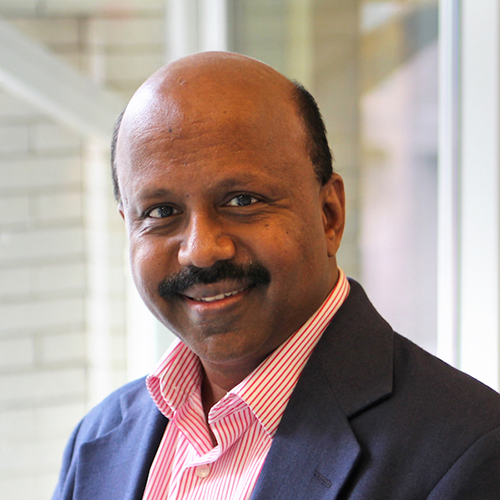
Dr. Raja Sooriamurthi is a Teaching Professor and Program Director of the Decision Analytics and Systems minor at the Information Systems Program of Carnegie Mellon University's Heinz College. His teaching and research focus on artificial intelligence, cognitive science, and educational pedagogy. Teaching Interests: Data science, database systems, big data, puzzle-based learning, system development lifecycle Research Interests: Case-based reasoning, knowledge management, distributed reasoning, machine learning, software development pedagogy Dr. Sooriamurthi leads curriculum innovation in information systems education, particularly through the IS2020 competency model . His work bridges AI applications with educational technologies, emphasizing authentic learning and generative AI tools for skill development. Key publication themes include: SQL instruction using AI-driven assessment Information systems curriculum design Puzzle-based learning for critical thinking Service-learning in leadership development Integration of NoSQL databases in education
Christoph Bernhardt is a Senior Researcher and former director of the research focus “Contemporary History and Archives” at the Leibniz Institute for Research on Society and Space (IRS) in Erkner. He is also an adjunct professor of modern and contemporary history at the Institute of History within the Faculty of Philosophy at Humboldt University of Berlin. His academic affiliations reflect a strong commitment to interdisciplinary urban and environmental history, particularly focusing on the built environment in the German Democratic Republic (DDR) and broader European contexts. Leibniz Institute for Research on Society and Space (IRS), Erkner: Senior Researcher, former Director (until April 2023), Deputy Director (2019–2022) Humboldt University of Berlin: Adjunct Professor, Institute of History, Faculty of Philosophy Member of the Sustainability Steering Group of the Leibniz Association and the Sustainable University Commission of Humboldt University Christoph Bernhardt’s research centers on European urban and environmental history, with a particular emphasis on Berlin, socialist urban planning in the DDR, Cold War architecture, and transnational urban development. His work critically examines the interplay between political power, spatial governance, and environmental change. He has explored topics such as the “autogerechte Stadt” (car-friendly city), polycentric governance along the Upper Rhine, and the role of urban spaces in totalitarian regimes. His methodological approach often bridges historical analysis with digital humanities, as seen in his work on 3D reconstructions of Nazi-era forced housing and digital archiving of architectural collections. An analysis of his most recent publications reveals a consistent focus on the political dimensions of urban space across different historical periods—from imperial Berlin and Nazi Germany to the DDR and Cold War transnational networks. His work increasingly engages with transnational and comparative frameworks, especially in environmental governance and socialist architecture, highlighting entanglements between East and West, Europe and Asia. He frequently collaborates on edited volumes and special journal issues, demonstrating a leadership role in shaping scholarly discourse in urban history. Christoph Bernhardt is actively involved in academic service and sustainability initiatives. He has served as co-editor of the journal Moderne Stadtgeschichte and the book series Beiträge zur Stadtgeschichte und Urbanisierungsforschung . He was a co-applicant for the DFG Research Training Group “Cultural and Technical Values of Historic Buildings” and a principal investigator in the Leibniz Research Network “Value of the Past”. He has also contributed to numerous third-party funded projects on urban transformation, Cold War planning, and historical governance. His leadership roles in academic commissions and editorial boards underscore his influence in the field. Co-editor, Moderne Stadtgeschichte Co-editor, Beiträge zur Stadtgeschichte und Urbanisierungsforschung (Franz Steiner Verlag) Full member, Historical Commission of Berlin Former board member, Society for Urban History and Urbanization Research (GSU, 2000–2022) Former member, International Committee of the European Association for Urban History (EAUH, 2018–2024) Bernhardt leads and participates in several major research projects, including “Crafting Entanglements: Afro-Asian Pasts of the Global Cold War” (2023–2026), “Urban Authenticity: Creating, Contesting, and Visualising the Built Heritage in European Cities Since the 1970s (UrbAuth)”, and studies on urban planning in Nazi Germany and the DDR. His work often involves interdisciplinary collaboration, especially in digital reconstruction, cartographic analysis, and transnational historical networks.
James Hodges is an Assistant Professor at the School of Information, San José State University, where he contributes to teaching and research in digital archives, preservation, and the history of computing. His academic background includes a Ph.D. from Rutgers University and postdoctoral fellowship at the University of Texas at Austin. He is also a Junior Fellow in the Andrew W. Mellon Rare Book School Society of Fellows. Ph.D. in Communication and Information, Rutgers University (2020) M.A. in Media, Culture, and Communication, New York University (2012) B.S. in Media, Culture, and Communication, New York University (2009) His research centers on digital preservation and the forensic analysis of digital objects, particularly in non-institutional contexts. He investigates the history of computing through early multimedia software and countercultural digital artifacts. His work bridges archival science, digital humanities, and science and technology studies. Hodges' recent publications reveal a consistent focus on authenticity, materiality, and epistemic value in digital preservation. His articles explore topics such as unreleased gaming software, forensic reconstruction of biomedical records during the pandemic, and the software legacy of figures like Timothy Leary. The methodological thread across these works is the application of digital forensics and bibliographic archaeology to recover lost or marginalized digital histories. Bullard Postdoctoral Research Fellow, University of Texas at Austin Junior Fellow, Andrew W. Mellon Rare Book School Society of Fellows in Critical Bibliography, University of Virginia Hodges has not publicly listed advisees, but his research profile suggests active mentorship in digital archiving and information science. He has held significant research roles and continues to contribute to the scholarly discourse through publications in top journals. He is affiliated with research initiatives exploring digital forensics and the preservation of cultural software.
Dr Gorkem Acaroglu serves as a Teaching Fellow at Deakin University's School of Communication and Creative Arts within the Faculty of Arts and Education, based at Melbourne Burwood Campus. His scholarly work critically examines the convergence of digital technologies with contemporary theatre practices, emphasizing Australian performance contexts and diversity frameworks. Education: PhD in Communication, Deakin University Acaroglu's research interrogates cyborg theory, robotic staging, and digital contamination in narrative theatre through lenses of cultural representation and technological ethics. His investigations span human-android interactions, virtual avatars, and authenticity in Australian theatrical spaces, consistently bridging theoretical discourse with practical experimentation in performance technologies. This interdisciplinary approach positions him at the forefront of digital performance studies within Australasian academia. Analysis of his publication trajectory since 2011 reveals persistent thematic focus on technology-theatre symbiosis, evolving from foundational explorations of digital contamination (2011) toward contemporary examinations of diversity in Australian theatre (2021). His work demonstrates methodological range across journal articles, conference proceedings, and collaborative artworks, with recurring emphasis on human-technology interfaces and cultural representation. Scientific Awards: No scientific awards documented in source materials Advising and Grants: Available documentation provides no explicit records of supervised students or secured research grants. His collaborative publication patterns suggest potential mentorship roles within Deakin Motion Lab projects, though formal advising relationships remain unspecified in current records. Dr Acaroglu maintains active involvement with Deakin Motion Lab as evidenced by his 2013 collaborative artwork "Robots, avatars and ghosts," which engaged 14 researchers in exploring motion-capture technologies for performance. This ongoing affiliation positions him within Deakin's interdisciplinary digital arts research ecosystem.
Frida Mannerfelt is an Associate Professor in Practical Theology at Lund University's Centre for Theology and Religious Studies , where she works as a Postdoctoral Fellow in the Scripture and Secularism research project. Her work examines how biblical interpretations in public discourse shape secular concepts, while maintaining active research in digital theology and church leadership. Academic title: Associate Professor Institution: Centre for Theology and Religious Studies (Lund University) Research focus: Bible, politics, digital culture Email: frida.mannerfelt@ctr.lu.se Her research on Digital Theology explores AI integration in sermon preparation, digital worship environments, and the evolution of preaching practices in online spaces. Current projects analyze algorithmic communication's theological implications and digitalization's impact on religious authority. Key Church Leadership studies include historical ordination of Swedish female clergy and contemporary digital leadership challenges. With 17 research outputs since 2019, her work spans articles, book chapters, and edited volumes on topics like digital homiletics, eucharistic adaptations post-pandemic, and theological responses to secularism. As Co-Principal Investigator for Scripture and Secularism (2022–2027), she collaborates with international scholars on biblical public discourse analysis. Previous research includes ordination history (2018–2020) and digital church presence frameworks. Teaching roles include advanced courses in Church and Mission Studies (KRMB27, KRMR12) and Religious Communication. She contributes to academic discourse through 35 recorded activities, including invited talks on AI theology, panel discussions about biblical politics, and presentations on digital worship practices.
Anders E. Johansson is an Associate Professor in Literary Studies at Mid Sweden University , affiliated with the Department of Humanities and Social Sciences . His work bridges literary theory, feminist critique, and cultural studies, often interrogating neoliberalism, postmodernism, and the Anthropocene. His research interests include: Literary responses to neoliberal governance Feminist and poststructuralist analysis of cultural norms Ecocritical approaches to literature Philosophical undercurrents in Swedish poetry Interdisciplinary collaborations with gender studies His recent publications explore topics like Derrida’s Geschlecht III, ecological ethics in literature, and the political implications of irony in Swedish avant-garde music. He has contributed to edited volumes on sustainability, feminist pedagogy, and Swedish cultural identity. Notable collaborations include co-authorship with Siv Fahlgren and Kari Nygren , as well as editorial work for Makadam Förlag and Routledge . He actively participates in conferences on ecocriticism, normalization processes, and interdisciplinary research.
Lydia Yun serves as an Assistant Professor in the Department of Sport Management at Brock University, advancing the field through empirical theory testing and novel conceptual frameworks to generate actionable industry insights. Her research concentrates on: Sport Marketing and Consumer Behavior Corporate Social Responsibility in Sport Social Media Big Data Analysis Sport Branding Employing experimental designs and AI-driven computational methods—including sentiment analysis and topic modeling—she investigates psychological and behavioral responses of sport consumers in social media environments. Her work provides strategic guidance for enhancing brand authenticity and socially responsible engagement within sport organizations. Dr. Yun actively recruits graduate students for research in sport consumer behavior, particularly focusing on corporate social responsibility and social media contexts.
Pia Marit Johanne Lane is Professor of Multilingualism at the Department of Linguistics and Nordic Studies, Faculty of Humanities, University of Oslo, and serves as Academic Chair for the Circle U. Multilingualism, Interculturality and Language Lab. She gained national prominence as a member of the Norwegian Truth and Reconciliation Commission, which investigated historical Norwegianization policies against Sami, Kven/Norwegian Finns, and Forest Finns, submitting its report to the Storting in June 2023. Professor Lane's research focuses on language revitalization, language policy, and the standardization of minority languages, with particular expertise in Kven and Sami communities in Northern Norway. Her scholarly approach integrates nexus analysis with indigenous, decolonial, and southern theoretical perspectives, examining language as part of a larger semiotic system. She has extensively documented how material objects function as identity markers during language shift, as evidenced in her influential works including 'Identities in action: A nexus analysis of identity construction and language shift' (2009) and 'We did what we thought was best for our children' (2010). Analysis of Lane's recent publications reveals a strong trajectory toward decolonial frameworks and the application of southern theory to northern contexts. Her work increasingly examines the psychological dimensions of linguistic colonization and the pathways to mental decolonization. The recurring themes across her scholarship include the tension between language standardization and community participation, the role of new speakers in language revitalization movements, and the complex relationship between historical trauma and contemporary language identity. Project leader for 'Standardising Minority Languages,' funded by Norges Forskningsråd Co-editor of 'Standardizing Minority Languages. Competing Ideologies of Authority and Authenticity in the Global Periphery' (Routledge, 2017) Member of the EU-funded COST Action IS1306 'New Speakers in a Multilingual Europe' Co-leader of the work group 'Indigenous minority languages' and current leader of 'New speakers: Subjectivities, trajectories, spaces' Member of AILA-network 'Home Language Maintenance and Development' Lane's fieldwork extends beyond traditional academic boundaries, including collaboration with Lightsource Productions on the documentary film 'Det hemmelige språket' (The Secret Language), which explores contemporary Kven language users. Her personal connection to the subject matter is profound—growing up in Bugøynes, Finnmark, she was the first generation in her family to be spoken to exclusively in Norwegian, only reclaiming her heritage Kven language as an adult researcher returning to her community.
Celine Taylor Parkins-Ozephius serves as Junior Assistant Professor at Utrecht University's School of Law, specifically within the Willem Pompe Institute for Criminal Law and Criminology. Her academic appointment falls under the Faculty of Law, Economics and Governance, where she focuses on the intersection of criminal procedure and digital technology. Her research centers on digital evidence reliability in criminal courts, with particular expertise in smartphone forensics, biometric authentication, and cross-border digital investigations. Current projects examine judicial frameworks for assessing technical evidence, EU standards for digital searches, and privacy implications of law enforcement's access to encrypted devices. Her work frequently addresses tensions between investigative needs and fundamental rights in digital contexts. Teaching responsibilities include coordination of the master's course "In-Depth Criminal Procedure Law," where she delivers lectures and tutorials. She actively supervises master's theses in criminal procedure and digital evidence topics. Her publications demonstrate consistent engagement with emerging challenges in digital criminal justice, including EncroChat investigations, two-factor authentication evidence, and ECHR compliance in digital evidence collection. Collaborative work appears across multiple Dutch legal journals and the EHRC Updates platform, often with Dave van Toor and other Willem Pompe Institute colleagues. Her research methodology combines doctrinal legal analysis with practical examination of investigative techniques, emphasizing the need for updated judicial frameworks in digital evidence assessment.
Dr. Michael Raupach is the Head of Section Hemiptera at the Zoological State Collection Munich (ZSM) within the Bavarian State Natural Science Collections (SNSB) . His research integrates molecular techniques with traditional taxonomy to address systematics, biodiversity assessment, and phylogenetic relationships in Hemiptera and other arthropod groups. Key affiliations: ZSM, SNSB, German Research Foundation (DFG) projects Primary roles: Section Head, Researcher, Scientific Editor Dr. Raupach specializes in DNA barcoding and phylogenetic analysis of marine and terrestrial invertebrates, particularly Carabidae beetles , Isopoda crustaceans , and Hemiptera bugs . His work reveals cryptic species , glacial refugia , and deep-sea colonization patterns . His publications demonstrate expertise in mitogenome phylogeny , species delineation , and bioinformatic approaches to biodiversity. Collaborations span Antarctic marine ecology , German freshwater arthropods , and global crustacean systematics . Scientific Awards Recipient of the Order of Merit of the Federal Republic of Germany Leadership in national DNA barcoding initiatives Dr. Raupach actively contributes to peer-reviewed journals , scientific conferences , and public biodiversity education . His work bridges morphological taxonomy with next-generation sequencing to resolve long-standing classification challenges.
Imre Blank serves as a Lecturer in the Department of Chemistry and Chemical Engineering at École Polytechnique Fédérale de Lausanne (EPFL), affiliated with the School of Basic Sciences. His research focuses on food chemistry and flavor science, particularly investigating taste-active compounds, aroma perception mechanisms, and sensory evaluation of food products. His recent work explores umami taste perception through EEG-based brain rhythm analysis Computational modeling of taste peptides Multi-omics characterization of odorants in plant-based and traditional foods Mechanistic studies of saltiness enhancement by volatiles His publications emphasize analytical chemistry techniques like LC–MS and GC-IMS for flavor profiling. Current research trends examine the molecular dynamics of odorant release, biosensor development for taste detection, and sustainable flavor production inspired by natural processes. He also investigates the impact of processing conditions on coffee aroma formation and bitterness reduction.
Hubert Kowalski is a Professor at the Faculty of Archaeology, University of Warsaw, specializing in Warsaw's cultural heritage with focus on the Vistula River archaeology, historical buildings like the Kazimierzowski Palace, and university museum systems. His academic profile combines active teaching duties (with published consultation hours) and interdisciplinary research bridging archaeology, history, and museum studies. Research interests center on urban archaeology of Warsaw across historical periods, particularly the Swedish Deluge era and 17th-century architecture. His work integrates underwater archaeology of the Vistula River, analysis of historical correspondence (including interwar period documents), and studies of academic heritage collections. Key methodologies involve interdisciplinary approaches combining material culture analysis with archival research, environmental history, and museum pedagogy to reconstruct Warsaw's layered historical identity. Analysis of his 2020-2025 publications reveals consistent focus on three interconnected themes: recovery of artifacts during Vistula River low-water events (e.g., 'Archaeological Kilometer of the Vistula'), documentation of university museums and academic heritage collections, and reinterpretation of Swedish Deluge impacts through newly discovered sources. His output demonstrates increasing methodological sophistication through hydrodynamic modeling applications while maintaining deep engagement with Polish cultural identity through material heritage. Scientific Awards: No awards documented in provided materials. Advising and grants: Text contains no references to graduate students supervised or external research funding secured, though extensive publication record suggests independent research leadership. His conference participation (e.g., 'Rome and Barbarians', 'Women’s Perspectives in the Nile Valley') indicates active scholarly networking. Labs and teams: Affiliation with University of Warsaw's Faculty of Archaeology is primary institutional context, with specific connections to museum studies initiatives and Vistula River research groups. The 'Archeologiczny kilometr Wisły' project represents his key collaborative framework for river archaeology.
Edgar Vadimovich Vatamanitsa serves as an Assistant Professor in the Department of Computer Science at Chernivtsi National University, specializing in cross-platform software development and cloud computing applications. His work bridges academic research with industry practice through active engagement in both university teaching and commercial software development. Education: Yuriy Fedkovych Chernivtsi National University (2013): Systems Software, Software Engineer Dr. Vatamanitsa's research centers on Java/Android pattern development, client-server architectures, and distributed systems. He pioneers practical implementations of design patterns in cloud environments, with significant contributions to optical field simulation, semiconductor modeling, and intelligent transportation systems. His methodology emphasizes cross-platform efficiency and real-world applicability of theoretical computing concepts. Analysis of his 2022-2024 publications reveals dominant themes in cloud-based optical computation (AWS infrastructure), Java pattern implementation for Android, and cross-platform solutions for traffic management and semiconductor physics. His work consistently integrates distributed systems with domain-specific challenges in optics, printing technology, and educational analytics, demonstrating exceptional versatility across engineering disciplines. Professional Activities: Member of Bukovina Information Technology Cluster (since 2022) Senior Software Developer at EPAM SYSTEMS Certificate in Cross-platform Programming and Information Security (Ternopil National Technical University, 2023) Tech Summer Bootcamp for Teachers participant (2023)
Brendan Murphy is a Full Professor in the School of Mathematical Sciences at University College Dublin since 2015, previously holding a Professor role at the same institution (2007-2015) and a Lecturer position at Trinity College Dublin (1999-2007). He is a Principal Investigator at the Insight Centre for Data Analytics and actively works in Machine Learning & Statistics. Research Focus: His work centers on Model-based clustering Mixture models Applications in sports analytics, food science, microbiome studies, and public health Bayesian statistical methods High-dimensional data analysis Article Trends: Murphy's recent publications (2024-2025) emphasize soft clustering techniques, Bayesian mixture models, and their applications across diverse domains including metabolomics, political science, and oceanography. His work addresses challenges in variable selection, robust classification, and multi-omics integration.
Chiara Petrioli is Full Professor at Sapienza University of Rome's Department of Computer, Control and Management Engineering and Deputy Rector for scouting, fundraising, and business incubation. She founded the spinoff WSENSE S.r.l. and coordinated the university's Computer Science Ph.D. program. Her research pioneers the Internet of Underwater Things, leading to breakthrough technologies featured in international media and the NT100 list. Her research interests center on wireless, embedded, IoT, and cyber-physical systems, with a focus on underwater networking. She designs and optimizes communication protocols, security mechanisms, and energy-efficient architectures for underwater sensor networks, enabling applications in environmental monitoring, archaeology, and deep-sea exploration. Recent publications highlight trends in underwater acoustic communications (e.g., dual-channel protocols, S2C modulation), security (authentication, key exchange), and energy efficiency (wake-up radio, UAV-assisted data collection). Applications span dissolved oxygen monitoring, submerged heritage preservation, and sustainable deep-sea mining impact assessment. Her scientific awards include: IEEE Fellow 2021 Fulbright Scholar Inspiring Fifty 2018 N2Women 2019 Star in Computer Networking and Communications Gamma Donna Women Startup Award 2022 Top 2% World Scientist by Stanford Repubblica D 100 Women to Change the World 2021 As principal investigator, she has led over twenty national and international projects, including EC projects GENESI and SUNRISE, and EASME projects ArcheoSub and Seastar. She founded WSENSE S.r.l., a spinoff that translates research into innovative technologies, resulting in international patents and features in BBC, RAI, Wired, and National Geographic. She actively contributes to the academic community as chair of IEEE SECON steering committee, associate editor of ACM/IEEE Transactions on Networking, and through leadership roles in ACM SIGMOBILE and IEEE Transactions on Mobile Computing.