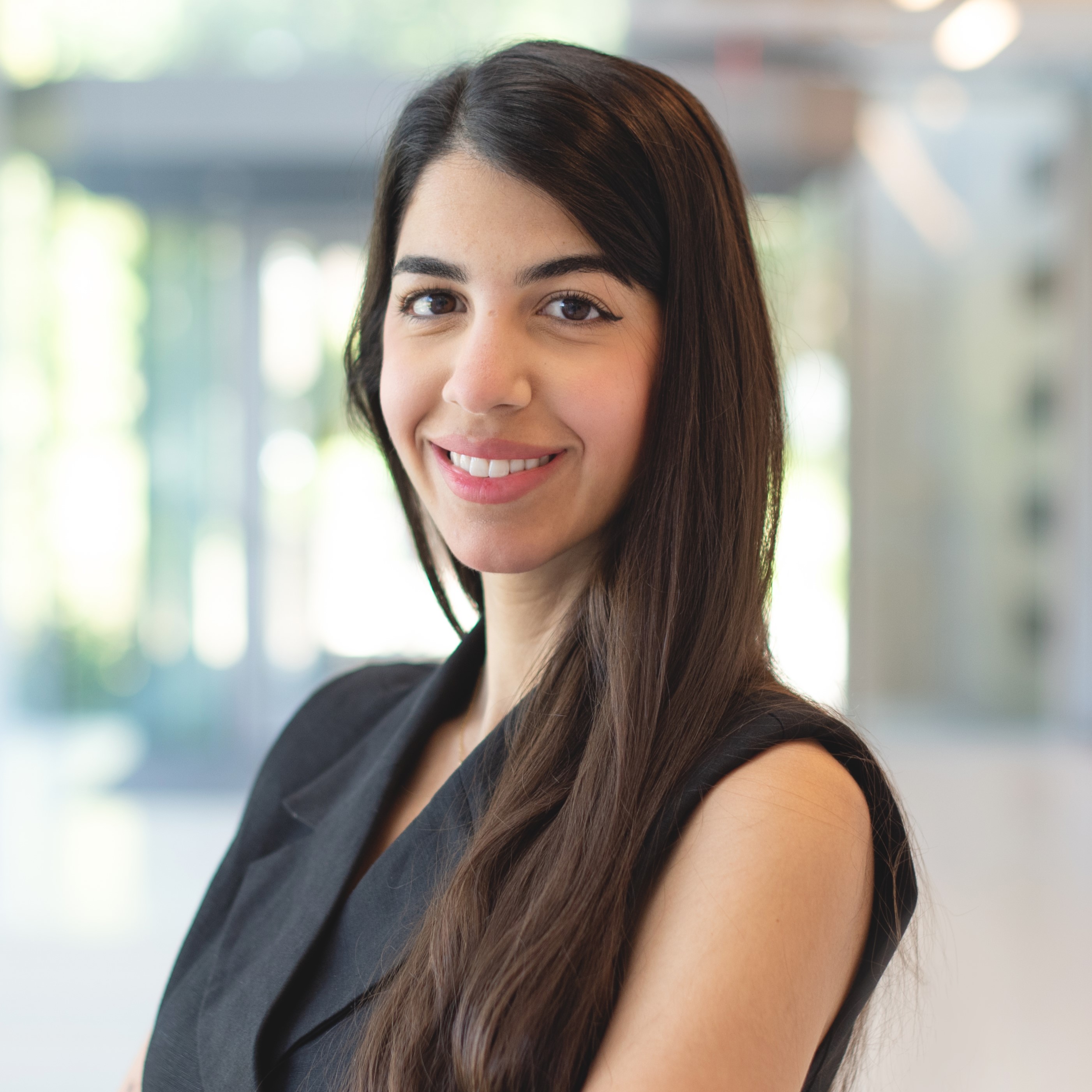
Aline Eid is an Assistant Professor in the Department of Electrical and Computer Engineering at the University of Michigan Ann Arbor, directing the Beam Dynamics research group. Her work bridges electromagnetics, wireless systems, and autonomous technologies, with a focus on mmWave/sub-THz sensing, backscatter communications, and wireless power transfer. PhD in Electrical and Computer Engineering (Georgia Tech, 2021) MS in Electrical and Computer Engineering (American University of Beirut, 2017) Postdoctoral Associate at MIT Media Lab (Signal Kinetics group) Research Interests: She pioneers systems that use electromagnetic waves to address societal challenges in Sustainable energy networks Smart cities/infrastructures Autonomous vehicles/robots Her group develops mmID tags for radar vision, batteryless sensors, and 5G-based wireless power grids. Scientific Impact: Recognized with awards including IEEE RFID Best Paper (2023) Proceedings of the IEEE Best Paper (2023) IEEE MTT-S Graduate Fellowship (2020) She leads commercialization efforts for warehouse robotics via MTRAC grant and startup Atheraxon. Advising: Mentors 8 students across PhD (Skanda Harisha, Sepideh Ghasemi, Yunfei Liu), Master's (Longyu Guo), and undergraduates (Mohamed Safawi, Katherine Shih, Andy Wang, Adrian Velazquez) in projects spanning robotics, IoT, and electromagnetic engineering. Labs: Beam Dynamics group at U-M Radiation Laboratory, collaborating with Atheraxon and MTRAC for technology translation.
Associate Professor Densil Cabrera is affiliated with the School of Architecture, Design and Planning at The University of Sydney, where he directs the Audio & Acoustics Program. He holds a PhD in psychoacoustics from the University of Sydney, along with degrees from UTS and Sydney in music and communication studies. His research focuses on architectural acoustics, retroreflective surfaces, room acoustics modeling, and auditory environments in built spaces. He explores applications in concert halls, open-plan offices, and historical structures like Indian stepwells. Key areas include acoustic retroreflection for speech support, sustainable acoustic materials, and the integration of digital fabrication techniques. Recent work addresses acoustic comfort in open-plan offices, adaptive acoustic models, and the impact of materials like mycelium composites. He has led projects on robotic fabrication for acoustic surfaces and the psychoacoustic effects of room design. Grants: Australian Research Council (DP23), Australian Acoustical Society (2019) Expertise: Stage acoustics, auditorium design, noise control, virtual reality simulations Labs/Teams: Audio & Acoustics Program at Sydney School of Architecture, collaborations with robotics and material science teams.
Dr. Karen Gipson is a Professor of Physics at Grand Valley State University's Department of Physics within the College of Liberal Arts & Sciences. Her academic roles include Department Chair (2007–2010, 2011–2012), Interim Assistant Dean of Curriculum (2009), and adjunct leadership roles. She holds a Ph.D. in Physics from Washington State University (1998), an M.S. from the University of North Texas (1987), and a B.S. from North Texas State University (1982). Her research focuses on Physical Acoustics (e.g., sonoluminescence, musical instrument acoustics), Philosophy of Science (integrating contemplative practices into education), and Contemplative Pedagogy . She has led over 15 undergraduate research projects, including studies on oboe reed construction, single-bubble sonoluminescence, and therapeutic ultrasound effects. Dr. Gipson has received awards such as Outstanding University Service (2014) and Professor of the Year (2001). She secured grants totaling over $20,000 for student research projects and has presented at conferences like the Acoustical Society of America and the Grand Dialogue on Science and Religion. Her service includes roles as Faculty Sponsor for Women in STEM Fields, Chair of the University Academic Senate’s Executive Committee, and Director of the Women in Science & Engineering Living Center. She also advocates for diversity in STEM and participates in outreach programs like Science IS for Girls and Gear-Up for College Days.
Dagmar Reinhardt is an Associate Professor at the School of Architecture, Design and Planning at The University of Sydney, where she leads the robotics research group and the Master of Digital Architecture Research stream. With a PhD from Sydney, a Master of Architectural (Concept Design) from Hochschule der Bildenden Künste in Frankfurt, and a Diploma in Architectural Studies from Hanover, she has established herself as a leading figure in digital architecture and robotic fabrication. Her educational background includes: PhD, University of Sydney Master of Architectural (Concept Design), Hochschule der Bildenden Künste, Frankfurt Diploma, Architectural Studies (Technical), Hanover Dagmar Reinhardt's research sits at the intersection of architecture, acoustics, structure, robotics, fabrication, and material science. She investigates how robotic fabrication methods can adapt geometry, materiality, and construction techniques within design technology, exploring new solutions for the relationship between human labor and construction automation. Her work spans from theoretical investigations of design robotics to practical applications in building environments. She leads two substantial industry and state-government funded projects on new robotic applications for workspace scenarios and for safer construction work environments. As an associate editor of the Springer Journal of Construction Robotics, she networks the Australian section and is currently writing a book on 'Design Robotics' that bridges robotic approaches between construction robotics, social robots, and collaborative and creative robotics. Analysis of her recent publications reveals a strong focus on human-robot collaboration in architectural contexts, with particular attention to accessibility applications, material innovation using mycelium-based composites, and the social implications of robotics. Her work demonstrates a consistent trajectory toward making robotic fabrication more accessible, inclusive, and integrated with human workflows in the architecture, engineering, and construction industries, while maintaining a strong emphasis on interdisciplinary approaches that connect architectural design with social and environmental concerns. As an educator, Reinhardt has led the Master of Digital Architecture Research stream and has taught courses including 3D Computer Design Modelling, Digital Architecture Research Studio, and Code to Production. Her design research studios have been regularly awarded the prestigious National Student Award for Structural Innovation and for Digital Innovation by the AIA Institute of Architects, Sydney. She was the Foundational Program Director of the Bachelor of Architecture and Environments (BAE, 2014-2018) and has lectured internationally. Reinhardt's current research students are working on innovative projects focused on acoustic retroreflection, techno-subjectivities, inclusive playground design for visually impaired children, eco-cartography, and human-robot collaboration toolkits. She serves as an External Examiner for multiple prestigious institutions worldwide and maintains active collaborations across architecture, computer science, and human-computer interaction fields.
Dr. Manuj Yadav is a Post Doctoral Researcher at the Chair for Hearing Technology and Acoustics , RWTH Aachen University, Germany. His work focuses on acoustic virtual reality , room acoustics , and psychoacoustics with applications in workplace environments, auditorium design, and vocal performance studies. Research Themes : Auditory distraction in open-plan offices, autophonic perception, speech intelligibility metrics, and retroreflective architectural design Projects : Involved in the Priority Program SPP2236 - AUDICTIVE (Auditory Cognition in Interactive Virtual Environments) Recent publications analyze indoor environmental quality in hybrid workspaces, biophilic sound interventions for stress recovery, and acoustic retroreflection in modern and historical architecture. His experimental studies employ auralization techniques and virtual reality to simulate real-world acoustic environments for empirical testing. Key Collaborations : RWTH Aachen University’s Institute of Hearing Technology and Acoustics (IHTA), University of New South Wales Technical Expertise : Acoustic measurement protocols, ISO 3382-3 compliance, binaural simulation systems