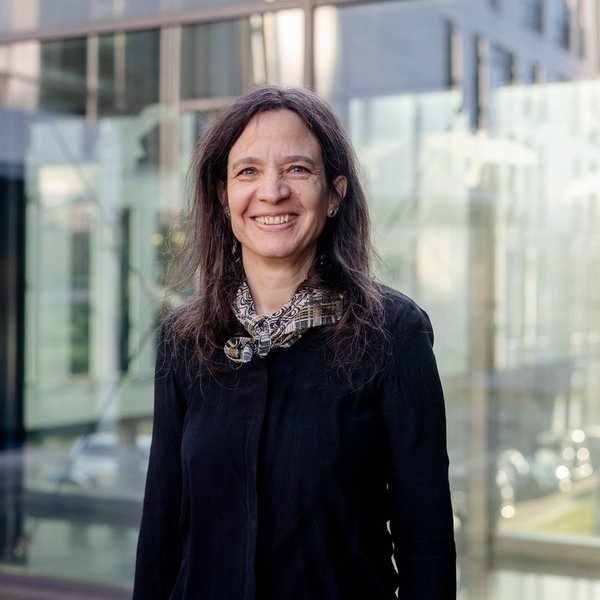
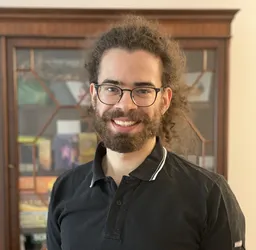
Guillaume Laplante-Anfossi is a Researcher in the Department of Mathematics and Computer Science at the University of Southern Denmark. His work bridges quantum mathematics, algebraic topology, and combinatorics, focusing on abstract structures and their applications. His research emphasizes Steenrod operations , Bruhat order , and co-product structures, contributing to homology and extreme point analysis. A recent publication in the Proceedings of the London Mathematical Society (2025) explores these themes through higher Bruhat orders.
Pol van Hoften is an Assistant Professor in the Department of Mathematics at the Faculty of Science, Vrije Universiteit Amsterdam (VU Amsterdam). His research focuses on advanced topics in number theory and algebraic geometry, particularly related to Shimura varieties and the Langlands program. Dr. van Hoften's research interests span several specialized areas within mathematics: Shimura Varieties and their integral models Irreducibility properties of Igusa varieties Automorphic representations and the Langlands program Cohomology of arithmetic varieties Monodromy theory in p-adic geometry Linear subspaces in algebraic contexts His recent publications demonstrate a consistent focus on the geometry and arithmetic of Shimura varieties. A significant portion of his work addresses questions related to the structure of these varieties at prime levels, particularly examining irreducibility properties, monodromy actions, and connections to the Langlands correspondence. His research often bridges abstract algebraic geometry with concrete number-theoretic questions, particularly through the lens of p-adic methods and modular forms. Dr. van Hoften has taught several courses at VU Amsterdam, including Fourier Analysis and multiple Linear Algebra courses for different programs.
Alastair King is a Professor in the Department of Mathematical Sciences at the University of Bath. His research spans algebra, geometry, and theoretical physics, with primary affiliations in mathematical sciences. His research focuses on non-commutative algebraic geometry, particularly moduli spaces of coherent sheaves, derived equivalences, cluster algebras, and their connections to dimer models in string theory. Key areas include: Non-commutative Algebraic Geometry Cluster Algebras and Categories Dimer Models and Theoretical Physics Moduli Spaces and Representation Theory Recent publications (2020-2024) reveal strong trends in cluster algebra applications, mirror symmetry for Grassmannians, and dimer partition functions. His work consistently bridges abstract algebra with theoretical physics, particularly through string theory frameworks and geometric representation theory. Scientific contributions include: 32 research outputs (29 articles, 2 preprints, 1 book chapter) Supervision of 8 research students Active collaborations across international networks His advising record shows consistent mentorship of graduate researchers, with recent supervised work focusing on categorification, quantum Grassmannians, and cluster exchange groupoids. While specific grants aren't detailed, his international collaborations indicate significant research funding support. His work maintains strong connections to both pure mathematics and theoretical physics communities through ongoing projects in non-commutative geometry.
John E. McCarthy is the Spencer T. Olin Professor of Mathematics at Washington University in St. Louis, with a courtesy affiliation as Professor of Statistics and Data Science. He holds a PhD from the University of California at Berkeley and maintains an active research program spanning multiple mathematical disciplines. His research interests focus on Operator Theory, Complex Variables, and their interaction , with particular emphasis on One and Several Complex Variables. Professor McCarthy believes that pure mathematicians can bring valuable perspectives to many areas of science and actively seeks collaborations with scientists open to mathematical approaches. His scholarly output shows consistent engagement with fundamental questions in functional analysis and complex variables, with recent work extending into applications including ultrasound signal interpretation and mathematical perspectives on public health issues like the COVID-19 pandemic. His publications reveal a trajectory from deep theoretical work in operator theory and interpolation problems toward increasingly interdisciplinary applications while maintaining rigorous mathematical foundations. Faculty member in the Neuroscience Program of the Division of Biology and Biomedical Sciences (DBBS) Founder/editor of the Journal of Xenomathematics, exploring alternative mathematical systems Author of multiple influential books including Pick Interpolation and Hilbert Function Spaces and Operator Analysis: Hilbert Space Methods In Complex Analysis Professor McCarthy is married to Suzanne Langlois, founder of Kaldi's Coffee and interim CEO of Meds and Food for Kids, indicating his connection to entrepreneurial and humanitarian efforts beyond academia.
Haydee Lindo is an Associate Professor of Mathematics at Harvey Mudd College. She holds a PhD in Mathematics from the University of Utah, an M.S. from the University of Nebraska, Lincoln, and a B.A. in Mathematics and Political Science from Williams College. Previously, she served as an Assistant Professor at Williams College. Her research focuses on commutative algebra, homological algebra, and representation theory. Lindo’s work contributes to foundational areas of pure mathematics, exploring abstract algebraic structures and their theoretical implications. Originally from Jamaica, Lindo’s academic journey reflects her dedication to advancing mathematical scholarship. While no specific grants, awards, or recent publications are listed, her affiliations and academic progression highlight her active role in the mathematics community.
Dr. Gail Hartsock is an Associate Professor of Mathematics, actively contributing to undergraduate education and mathematical scholarship. Her academic work spans abstract algebra, combinatorics, and the philosophical foundations of mathematics. Educational Background: B.S. in Mathematics, Buena Vista University Ph.D. in Mathematics, Baylor University Her research interests lie at the intersection of algebra and combinatorics, particularly representation theory and algebraic combinatorics. She has a deep interest in the history and philosophy of mathematics , emphasizing its role in cultivating logical reasoning as articulated by Plato. She is passionate about making mathematics accessible through public presentation and frequently explores Fibonacci numbers as a rich area for undergraduate research projects. Dr. Hartsock teaches a broad range of courses including Calculus I–III, Linear Algebra, Foundations of Advanced Mathematics, Elements of Geometry, and Senior Capstone, reflecting her commitment to foundational and advanced mathematical training. She places strong emphasis on mathematical exposition and reasoning, aiming to equip students with critical thinking skills beyond computational techniques.
Erika L. C. King is an Associate Professor in the Department of Mathematics and Computer Science at Hobart and William Smith Colleges, where she has been a faculty member since 2001. She holds a Ph.D. from Vanderbilt University, which she earned in 2002, and her academic career began with teaching roles at Vanderbilt prior to joining HWS. University: Hobart and William Smith Colleges School: Department of Mathematics and Computer Science Academic Rank: Associate Professor Email: eking@hws.edu Office: Lansing 304 Phone: (315) 781-3355 Her research is deeply rooted in graph theory, with a focus on domination theory, well-covered graphs, and zero forcing in graphs. These areas reflect her interest in structural and combinatorial properties of graphs, with applications in discrete mathematics and theoretical computer science. King teaches a broad range of undergraduate courses, including MATH 110 (Discovering in Mathematics), Calculus I and II, Linear Algebra, Number Theory, Graph Theory, Abstract Algebra, and advanced topics in combinatorics. She has also supervised honors projects and independent studies, particularly in graph theory and algebraic graph theory. Her recent publications, spanning from 2024 to 2003, demonstrate sustained scholarly output in graph theory. Key themes include domination, labeling games, well-covered graphs, and structural analysis of specific graph families. She frequently collaborates with undergraduate researchers, especially through the HWS-REU program, mentoring students like Rayan Ibrahim, Rebecca Jackson, Naima Nader, and Michael Rivera. Her 2024 paper on "Well-Forced Graphs" continues her exploration of zero forcing, while earlier works establish foundational results in domination and graph classification. King is professionally active, with affiliations in the Association for Women in Mathematics, the Mathematical Association of America, and the American Mathematical Society. She supports student development by writing recommendation letters and encouraging participation in research, graduate studies, and professional conferences such as the Nebraska Conference for Undergraduate Women in Mathematics. She has advised several students on senior honors projects and independent studies, including Adam Giambrone on vertex magic labelings and Leya Tesmenitsky. She also plays a role in departmental outreach, such as organizing colloquia and supporting alumni panels on careers in mathematics and computer science. Her sabbatical in Fall 2025 for research underscores her ongoing commitment to scholarly advancement.
Daniel Studenmund is an Assistant Professor in the Department of Mathematics and Statistics at Binghamton University. His research lies at the intersection of geometric group theory and discrete subgroups of Lie groups, focusing on abstract commensurators and quantifying residual finiteness through invariants like Comm(G). PhD and MS in Mathematics from the University of Chicago BA in Mathematics from Haverford College His research explores the structure of finite-index subgroups, superrigidity, and cohomology of arithmetic groups using algebraic and geometric methods. Recent work includes studies on topological models of commensurators, surface group invariants, and growth rates of lattice functions. He has held positions supported by NSF Research Training Group grants at the University of Notre Dame and the University of Utah. His office contact is dstudenm@binghamton.edu and Binghamton University's address.
Ana Jeremías López is a Professor at the University of Santiago de Compostela, specializing in Algebra. She teaches courses such as Algebraic Equations and Linear Geometry across various degree programs, including Mathematics, Biotechnology, and dual degrees with Physics and Computer Engineering. Her research is affiliated with the Mathematics Research Group. Teaching Subjects: Algebraic Equations, Linear Geometry, Mathematics (Basic Training) Academic Roles: University Professor, Researcher in Mathematics Her research interests focus on algebraic structures and linear geometry, contributing to foundational mathematical education and interdisciplinary applications. No specific scientific awards or publications were detailed in the provided text.
Florian Frohn is a tenured lecturer ("Lehrkraft für besondere Aufgaben") in the Programming Languages and Verification research group at the Department of Computer Science, RWTH Aachen University. He holds a Dr. rer. nat. (2018), MSc (2013), and BSc (2011) in Computer Science, all from German institutions, with his bachelor's studies completed part-time. His research interests center on formal methods for software verification, including automated termination and complexity analysis of imperative programs, satisfiability of Constrained Horn Clauses (CHCs), SMT solving with integer exponentiation, loop acceleration, term rewriting systems, and abstract interpretation. He is a key contributor to several influential tools: LoAT (Loop Acceleration Tool), AProVE (Automated Program Verification Environment), and SwInE; he also worked on Astrée and the CAGE toolchain developed under the DARPA STAC program. His recent publications (2023–2024) demonstrate continued leadership in top venues such as FM, IJCAR, FoSSaCS, and SAS, with work advancing loop acceleration, non-termination proofs, and SMT solving. These contributions reflect a strong trend in developing practical, automated techniques for program verification and analysis. IJCAR Best paper honourable mention (2024) EASST Award for best ETAPS paper (2020) iFM Best Tool Paper Award (2017) ISR Best Poster Award (2017) SEFM Recognition Award (2016) CADE Woody Bledsoe Travel Award (2016) Florian Frohn actively contributes to the research community through program committee roles for major workshops and conferences including TACAS, HCVS, WST, SMT, and LPAR. He has advised no listed students but has been involved in mentoring through research collaborations. His teaching portfolio includes courses on verification techniques, satisfiability checking, and advanced programming concepts. He leads the Termination and Complexity Competition (termCOMP) and participates in organizing key events in the formal methods community.
Marie Roth is a Senior Research Fellow at the University of East Anglia's School of Engineering, Mathematics and Physics and an active member of the Algebra, Number Theory, Logic, and Representations (ANTLR) research group. Her academic background includes: Bachelor of Mathematics from EPFL (2017-2020) Master in Mathematics from EPFL (2020-2022) PhD in Mathematics (Dr.rer.nat) under joint supervision by Gunter Malle (RPTU Kaiserslautern-Landau) and Olivier Dudas (Aix-Marseille Université) (2022-2025) Her research centers on representation theory, with specialized focus on decomposition matrices of finite groups of Lie type and the application of character sheaves. This work bridges abstract algebra and group theory, contributing to structural understanding of finite groups through their representations. As part of the ANTLR group, she engages in collaborative research spanning algebraic structures, number-theoretic methods, and logical frameworks in mathematical representations. The ANTLR research group provides her primary academic environment for advancing these theoretical investigations in pure mathematics.
Prof. Dr. Karin Baur is a Professor in the Algebra department at the Faculty of Mathematics, Ruhr University Bochum. She has held academic positions at several prestigious institutions including University of Leeds (since 2018), University of Graz (since 2011), and ETH Zurich (2007-2011). Her research focuses on algebra, representation theory, cluster algebras, cluster categories, combinatorics, and Lie algebras. Professor Baur's research investigates the geometric and combinatorial structures underlying algebraic systems, with particular emphasis on cluster algebras and their connections to representation theory, geometry, and topology. She develops geometric models for algebraic structures, studies frieze patterns and their generalizations, and explores combinatorial aspects of Lie theory. Her work often bridges abstract algebraic concepts with concrete combinatorial models through the study of triangulations, quiver representations, and Grassmannian geometries, revealing deep connections between different mathematical disciplines. Her recent publications demonstrate continued innovation in cluster theory, geometric representation, and combinatorial algebra, with applications extending to mathematical physics and interdisciplinary projects connecting mathematics with the arts. Professor Baur's research program shows consistent evolution from foundational work on cluster categories to increasingly sophisticated investigations of their geometric and combinatorial manifestations. Royal Society Wolfson Fellowship (2018-2023) Marie Curie Intra-European Fellowship (2011-2013) SNSF Professorship (2007-2011) Professor Baur has secured substantial research funding as Principal Investigator, including the major project 'Combinatorial Representation Theory: Algebra and its interfaces with geometry, topology and combinatorics' (2,554,972£) running from 2022-2027. She actively mentors junior researchers and has supervised numerous PhD students throughout her career. Her research group at Ruhr University Bochum includes Amandine Favre, Dr. Azzurra Ciliberti, and Dr. Tal Gottesman, working on related topics in algebra and combinatorics. Professor Baur is an active organizer of academic events, having coordinated numerous international conferences including the upcoming ARTIG-6 Conference at Ruhr University Bochum in July 2025. She has also been involved in interdisciplinary projects such as 'Listen to Intuition,' a mathematics and arts exhibition project that demonstrates her commitment to public engagement with mathematical concepts.
Bernat Plans Berenguer is a researcher in the Department of Mathematics at the Universitat Politècnica de Catalunya (UPC), affiliated with the Escola Tècnica Superior d'Enginyeria Industrial de Barcelona (ETSEIB). His research focuses on algebraic number theory, Galois theory, and arithmetic geometry, with particular emphasis on rationality problems, field extensions, and group actions. He has contributed to foundational studies on Noether’s rationality problem, ramification theory, and special linear group extensions. Plans Berenguer has led and participated in numerous research projects, including those funded by competitive grants from the Catalan Government and Spanish national programs. His work spans pure mathematics, with applications in cryptography and computational algebra. Notable collaborations include projects on algebraic varieties, modular forms, and geometric mechanics through the GEOMVAP research group. He has published extensively in top-tier journals like Proceedings of the American Mathematical Society and Journal of Algebra , and has presented at international conferences such as the Journées Arithmétiques. His research bridges abstract algebraic structures with concrete computational methods in number theory.
Dr. Yurii Khomskii holds multiple academic positions across European institutions. He serves as a Lecturer and Academic Tutor at Amsterdam University College, a Privatdozent (equivalent to Senior Lecturer/Associate Professor) in the Department of Mathematics at Universität Hamburg, and a Guest Researcher at the Institute of Logic, Language and Computation (ILLC) at the University of Amsterdam. His work bridges mathematical logic, set theory, and foundations of mathematics across these institutions. Dr. Khomskii obtained his PhD from the University of Amsterdam in 2012 under the supervision of Prof. Benedikt Löwe and Prof. Jörg Brendle, with a dissertation titled Regularity Properties and Definability in the Real Number Continuum . He completed his Habilitation at Hamburg University in 2018 with the work Cardinal Characteristics, Regularity Properties, Definability and the Structure of the Real Line and the Generalised Real Line . Prior to these achievements, he held postdoctoral positions at the Kurt Gödel Research Center for Mathematical Logic at the University of Vienna and Universität Hamburg, and was a Marie Sklodowska-Curie research fellow. His research focuses on mathematical logic and set theory, specifically exploring the structure of the real line, regularity properties of sets of reals, descriptive set theory, forcing techniques, and generalized real numbers and Baire spaces. His work combines deep theoretical investigations with connections to foundational questions in mathematics. Dr. Khomskii's approach often involves analyzing cardinal characteristics, investigating definability constraints, and examining the interplay between combinatorial principles and regularity properties in various set-theoretic contexts. Analysis of his recent publications reveals a consistent trajectory in advanced set theory, with increasing focus on generalized Baire spaces and alternative set-theoretic frameworks. His work spans from concrete investigations of cardinal characteristics and regularity properties to more foundational explorations of paraconsistent and paracomplete set theories. The evolution shows a progression from classical descriptive set theory toward more abstract and generalized frameworks, while maintaining rigorous mathematical standards. Dr. Khomskii has been actively involved in teaching and mentoring across multiple institutions. He regularly coordinates intensive projects at the ILLC on advanced topics in set theory, forcing, and mathematical logic. At Universität Hamburg, he guides student seminars on logic and set theory topics. His teaching spans foundational courses like propositional logic and Boolean algebras to advanced topics such as infinite games, forcing, and generalized Baire spaces. He has supervised numerous student projects and coordinated semester-long intensive courses that combine theoretical instruction with practical problem-solving sessions. His research activities include directing student projects like the 2023 Forcing and Independence Proofs coordinated project at ILLC, where students explored forcing techniques and independence proofs in set theory. He has also led seminars on topics including infinite computability, descriptive set theory, and advanced set theory at both Universität Hamburg and the ILLC. His research collaborations span across Europe, with frequent co-authorships with researchers from Vienna, Amsterdam, and other mathematical logic centers.
Dr. Tashi Walde is a Researcher at the Department of Mathematics, Technische Universität München (TUM), affiliated with the TUM School of Computation, Information and Technology (CIT). His academic background includes a Ph.D. from the University of Bonn under Professors Catharina Stroppel and Tobias Dyckerhoff, focusing on On the theory of higher Segal spaces . He has been a member of the DFG-funded SFB 1085 Higher Invariants since April 2022. His research interests span higher category theory, homotopy type theory, homological/homotopical algebra, and their applications in representation theory, categorification, and topological field theories. Key contributions include works on factorization algebras, Dold-Kan correspondences, and higher Auslander-Reiten theory. Walde has taught courses such as Homological Algebra and coordinated exercises in Linear Algebra and Topology. His publications focus on advanced categorical structures and their geometric/topological implications, with collaborations involving prominent researchers like Claudia Scheimbauer and Tobias Dyckerhoff. He is affiliated with the Department of Mathematics at TUM, located in Garching bei München, and holds office MI 02.12.038. His work bridges abstract algebraic frameworks with geometric applications, contributing to foundational aspects of modern algebraic topology and representation theory.