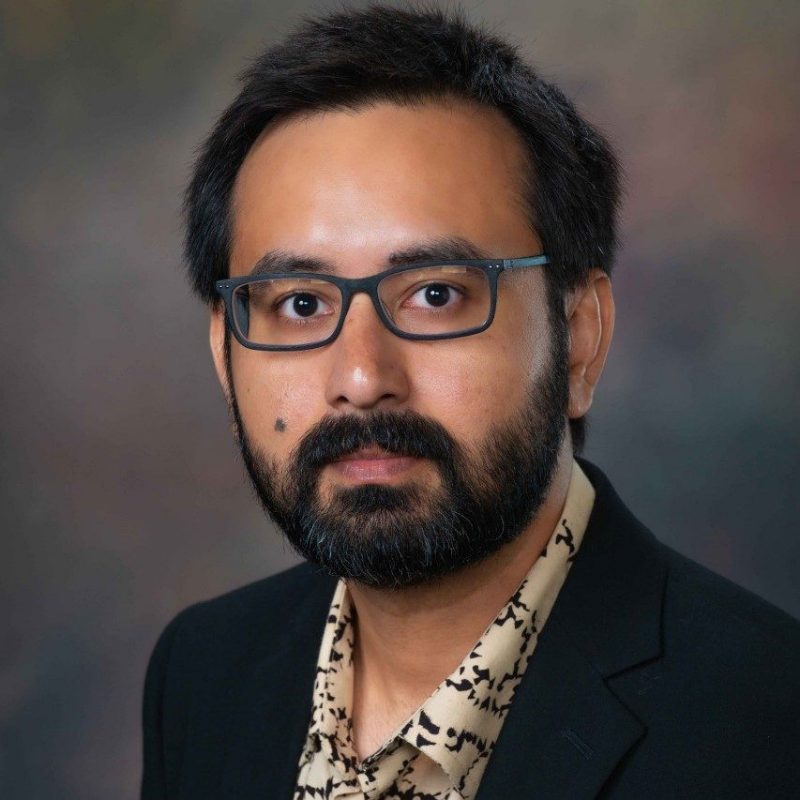
Debswapna Bhattacharya is an Associate Professor in the Department of Computer Science at Virginia Tech. Her research focuses on computational biology, bioinformatics, and machine learning with applications in structural biology. She holds a Ph.D. from the University of Missouri-Columbia (2016) and previously served as an Assistant Professor at Auburn University (2017–2021). Her work develops AI-driven methods for biomolecular modeling, including RNA and protein structure prediction, quality assessment, and refinement. Notable contributions include software tools like lociPARSE, RNAbpFlow, and EquiPNAS. She has received prestigious awards such as the NSF CAREER Award (2020) and NIH MIRA Award (2020). Teaching includes courses on machine learning and AI in molecular modeling. Her lab collaborates on NIH-funded projects (R35GM138146) and NSF initiatives (DBI2208679). Recent work emphasizes equivariant neural networks and transformer-based models for biomolecular analysis.
Mingda Li is an Associate Professor in the Department of Nuclear Science and Engineering at the Massachusetts Institute of Technology (MIT), holding the Class of 1947 Career Development Professorship. His research spans quantum materials, nanoscale energy transport, and AI-driven materials discovery, utilizing neutron/X-ray scattering techniques and machine learning to address challenges in quantum computing, thermal management, and energy conversion. He leads the Quantum Measurement Group and teaches graduate courses including Quantum Theory of Materials Characterization. Education: Bachelor of Science in Engineering Physics, Tsinghua University, 2009 Doctor of Philosophy in Nuclear Science and Engineering, MIT, 2015 Postdoctoral Research, MIT Mechanical Engineering Department Research Interests: Dr. Li's quantum research develops theoretical frameworks for topological order and defect-engineered quantum materials, with applications in microelectronics and quantum computing. His energy transport studies investigate phonon/electron dynamics at interfaces under non-equilibrium conditions to design materials for thermal management in electronics. The AI program creates symmetry-aware generative models that integrate ab initio calculations with experimental data, enabling closed-loop materials discovery for quantum and energy technologies. Publication Trends: Analysis of 15 recent 2025 publications reveals dominant themes in quantum materials (topological semimetals, 2D magnets), AI-driven design (generative models, symmetry-equivariant networks), and advanced characterization (neutron/X-ray spectroscopy). Key innovations include defect engineering for thermal transport, machine learning for spectroscopic data interpretation, and quantum phenomenon discovery in complex materials, reflecting strong interdisciplinary integration. Scientific Awards: No scientific awards were mentioned in the provided text. Advising and Grants: Dr. Li mentors graduate students in the Quantum Measurement Group, guiding research in quantum materials characterization and AI applications. He has taught core courses including Applied Nuclear Physics and Machine Learning in Nuclear Science and Engineering. His research is supported by grants focused on quantum engineering and nuclear materials, with collaborations spanning national laboratories and industry partners for quantum computing and energy applications. Labs and Teams: The Quantum Measurement Group operates at the intersection of experimental physics and computational science, utilizing neutron scattering facilities (including Spallation Neutron Source) and ultrafast X-ray techniques. The team develops custom software for data analysis and collaborates with institutions like MIT.nano for materials synthesis, maintaining a pipeline from theoretical prediction to device-level validation for quantum and thermoelectric materials.
Stephen Bradforth is a Professor of Chemistry at the University of Southern California and Senior Advisor to the Dean for Research Strategy and Development in the Dornsife College of Letters, Arts and Sciences . He earned his PhD in Physical Chemistry from the University of California, Berkeley (1992) and conducted postdoctoral research at the University of Chicago . B.A., Natural Sciences, Cambridge University (1987) Ph.D., Physical Chemistry, UC Berkeley (1992) Postdoctoral Associate, University of Chicago (1993–1996) His research focuses on ultrafast laser spectroscopy to study chemical reactions in complex environments like aqueous systems and molecular materials . Key projects include: Solar Energy Conversion : Investigating photosensitizers based on earth-abundant elements (Cu, Zn, Zr) and organic photovoltaics with BODIPY cores. DNA Photodamage : Mechanisms of cyclobutane pyrimidine dimer (CPD) formation under UV exposure, emphasizing base-stacking effects. Electronic Structure in Ethereal Solvents : Studying solvated electrons in liquid ammonia and their role in carbanion stabilization. His 15 most recent articles (2004–2024) highlight advancements in photoelectron spectroscopy , singlet fission for solar cells, and DNA damage pathways . Collaborations span medicine, physics, and engineering . Scientific Awards include the ACS Physical Chemistry Division Senior Experimental Award (2023) , STAR Awardee (2019) , Cottrell Scholar , and Fellow of APS and AAAS . He has received both Junior (2001) and Senior Raubenheimer Awards (2022) at USC. Advising has been a cornerstone, with 23 PhD students graduated and 4 current candidates. His 15 most recent publications (2012–2024) emphasize ultrafast dynamics , charge transfer mechanisms , and environmental photochemistry . Labs & Teams : The Bradforth Group operates advanced time-resolved photoelectron spectrometers , liquid microjet systems , and high-repetition-rate laser facilities . Current projects include metallic water solutions (Nature 2021), DNA photophysics (FASEB J 2011), and carbanion electronic structure in ammonia.
Prof. Dr. Ferdinand Evers is a Chair of Computational Condensed Matter Theory at the Institute of Theoretical Physics , University of Regensburg. His research spans quantum transport , spintronics , molecular electronics , and many-body localization , with a focus on ab initio and DFT-based modeling of nanostructures and low-dimensional systems . Key Research Areas: Quantum transport in molecular junctions Spin-orbit coupling and chiral effects Multifractality at quantum phase transitions Electronic structure of topological materials Ultrafast laser-driven electron dynamics Anderson localization and disorder Recent Article Trends (2021–2024): High-harmonic generation in topological insulators Spin-selective transport in chiral systems Mechanical torque in molecular rotors Self-consistent GW methods for molecular electronics Quantum interference in graphene nanoribbons Teaching: Lecturer for Theoretical Physics I-IV , Advanced Quantum Mechanics , and Scientific Perspectives courses at the University of Regensburg Focus on statistical mechanics , quantum transport , and computational nanoscience
Dr David Cooke is a Subject Area Leader in Chemistry & Chemical Engineering at the Department of Physical and Life Sciences, School of Applied Sciences, University of Huddersfield. He is a member of the Structural, Molecular and Dynamic Modelling Centre and Associate Member of multiple research centers including the Centre for Functional Materials and Catalysis Research Centre. Background: PhD in Computational Solid State Chemistry (Prof SC Parker, University of Bath) Postdoctoral Research: University of Bath and Materials Science department at the University of Cambridge Research Interests: Computational Solid State Chemistry, mineral surface modeling, biomineralization processes, crystal growth, and surface defect analysis. His work aligns with UN Sustainable Development Goals for environmental and health applications. Publications: 15 recent works focus on cerium oxide interfaces, plutonium hydration, oxide-polymer composites, and defect dynamics using Density Functional Theory and Molecular Dynamics. Key collaborations include M. Molinari, L. Gillie, and S. Parker. Scientific Activities: Active in research output since 2001 (50+ publications) 5 supervised works 35+ research activities including oral presentations
Xifan Wu is a Professor of Physics at Temple University, specializing in computational methods and materials science. His research focuses on first-principles computational approaches, particularly exploring the locality of Wannier orbitals to address physical problems in solids and liquids. Key interests include superlattice design and applications of order-N exact exchange functionals like PBE0 and GW quasi-particle approximations. He has authored numerous high-impact publications in journals such as Physical Review Letters and Physical Review B , covering topics like ferroelectric superlattices, X-ray absorption spectroscopy, and the dielectric properties of electrolyte solutions. His work bridges quantum mechanical models with machine learning potentials, advancing large-scale simulations of complex materials. Education/Background: Not explicitly detailed in the provided text. Grants/Awards: No specific awards listed, but his research is supported by Temple University’s Center for the Computational Design of Functional Layered Materials (CCDM). Labs/Teams: Collaborates with teams focused on computational design and materials modeling, possibly through Temple’s physics department and affiliated research centers. His recent work explores molecular-scale insights into electrical double layers at oxide-electrolyte interfaces and the impact of ions on X-ray spectra, demonstrating expertise in linking theoretical models with experimental phenomena.
Igor Di Marco is a Researcher at Uppsala University's Department of Physics and Astronomy, specializing in Materials Theory. He has maintained continuous research activity at Uppsala since 2009, initially as a postdoctoral fellow and subsequently as a researcher, with a temporary leave in 2017 to lead a group at the Asia-Pacific Center for Theoretical Physics in South Korea. Dr. Di Marco earned his PhD in condensed matter theory from Radboud University of Nijmegen in 2009. His academic trajectory has focused on computational approaches to understanding complex quantum materials, particularly those exhibiting strong electron correlations. His research centers on computational physics and condensed matter theory , with emphasis on developing methods to determine electronic and magnetic properties of strongly correlated materials . Dr. Di Marco is one of the principal developers of the all-electron DFT code RSPt (a Sweden-USA-France collaboration), which utilizes the full-potential linearized muffin-tin orbitals method. His expertise spans density-functional theory (DFT) , dynamical mean-field theory (DMFT) , and their integration (DFT+DMFT). Current research extends to X-ray absorption spectroscopy (XAS) and resonant inelastic X-ray scattering (RIXS) . Analysis of his recent publications reveals a consistent focus on electronic correlations in quantum materials, particularly in kagome metals, van der Waals magnets, and complex alloys. His work bridges theoretical method development with practical materials applications, frequently examining magnetic properties and electronic structure calculations across diverse material systems. Dr. Di Marco has made significant contributions to computational methodologies for strongly correlated electron systems, including the development of the DFT+DMFT framework within RSPt featuring full self-consistency over electron density and self-energy. His research projects have addressed magnetic properties of transition metals, excitation spectra of metal oxides, theoretical frameworks for lanthanides, and prediction of novel 2D materials.
Angel Rubio is a distinguished Professor of Physics at the University of Hamburg and holds concurrent roles as Director of the Max Planck Institute for the Structure and Dynamics of Matter, and Distinguished Professor at the University of the Basque Country (UPV/EHU). He leads the Wolfgang Pauli Centre and the Nano-bio Spectroscopy group. His academic journey includes Full Professorships at UPV/EHU (2001–2014) and positions at the Simons Foundation’s Flatiron Institute, UC Berkeley, and the Fritz Haber Institute. Rubio is a global leader in computational quantum physics, particularly in TDDFT and nanomaterials. Education : Ph.D. in Physics, University of Valladolid, 1991 (Summa Cum Laude) B.S. in Physics, University of Valladolid, 1988 (Summa Cum Laude) Research Focus : Rubio’s work centers on electronic structure methods, time-resolved spectroscopy, and quantum many-body theory. He pioneered the open-source octopus code for ab initio simulations, widely used globally. His contributions span nanocapillarity, nanoplasmonics, and strong light-matter interactions, with applications in novel materials and energy systems. Grants & Leadership : Holder of two ERC Advanced Grants (DYNamo and QSpec-NewMat), Rubio directs the European Theoretical Spectroscopy Facility (ETSF). His research has garnered over 28,000 citations (H-index 82) and 65 papers with >100 citations. He is a vocal advocate for computational physics, organizing >50 international workshops and advising major institutes like the Psi-k Network. Recognition : Top 0.3% in the American Physical Society’s Author Rank Honor Prize for Best Ph.D. Thesis (1992) Member of multiple national academies and advisory boards
Dr. Andrew Logsdail is a Reader in Catalytic and Computational Chemistry at Cardiff University’s School of Chemistry, part of the Cardiff Catalysis Institute (CCI). He holds a PhD in Chemistry (University of Birmingham), an MRes in Materials and Nanochemistry, and a BSc in Natural Sciences. His research focuses on computational modeling of catalytic materials, software development (e.g., ChemShell), and heterogeneous catalysis with applications in energy and sustainability. He is a Fellow of the Higher Education Authority and a Chartered Chemist with the Royal Society of Chemistry. Key roles include UKRI Future Leaders Fellow (2020–2024) and leadership in international organizations like the IUPAC Division II. His work is funded by UKRI, EPSRC, and industry partners like BP and Johnson Matthey. Research interests span computational catalysis, nanomaterials, and data-driven materials discovery. Notable projects include QM/MM simulations for catalytic systems, development of the ChemShell software, and studies on zeolites, palladium catalysts, and CO₂ reduction. He supervises PhD students and contributes to teaching at undergraduate and postgraduate levels. Dr. Logsdail’s achievements include over 100 peer-reviewed publications and significant contributions to software development in computational chemistry. His awards include the UKRI Future Leaders Fellowship and leadership roles in national and international scientific committees. He actively engages in outreach, promoting chemistry education and catalysis research.
Malin Selleby is a Professor at KTH Royal Institute of Technology, affiliated with the Digital Futures research center and the UNIT STRUCTURES unit. She holds the role of Head of Unit within her department. Her research focuses on computational materials science, thermodynamics, and alloy design, with a particular emphasis on phase equilibria, Calphad modeling, and high-entropy alloys. She teaches courses such as Thermodynamic Modeling and supervises degree projects in materials and process design. Research Interests: Materials Science, Thermodynamics, Metallurgy, Computational Modeling. Key Projects: Third-generation Calphad databases, phase stability analysis, machine learning applications in materials research. Her work bridges fundamental material science with industrial applications, addressing challenges in sustainable materials and alloy development. Over 100 peer-reviewed publications highlight her contributions to thermodynamic modeling, phase equilibria studies, and material characterization. Collaborations span academia and industry, including RISE Research Institutes of Sweden and Stockholm University through Digital Futures. Labs/Teams: Active in the Digital Futures interdisciplinary center and leads research groups focused on computational thermodynamics and advanced materials innovation.
Wolfgang Windl is a Professor in the Department of Materials Science and Engineering at The Ohio State University with a joint appointment in Physics. He co-founded Goniotech LLC and previously worked at Motorola as a Principal Staff Scientist. He holds a doctoral degree in physics from the University of Regensburg and completed postdoctoral research at Los Alamos National Laboratory and Arizona State University. His research specializes in computational materials science, focusing on: Atomistic simulations and density-functional theory Machine learning applications in materials design Semiconductor transport and layered materials (e.g., Dirac semimetals) Atom probe tomography and characterization techniques Analysis of his 15 most recent publications (2023-2025) reveals dominant themes: advanced simulations of field evaporation, topological quantum materials (PtTe 2 , PdTe 2 ), and computational frameworks for materials characterization. His work frequently integrates spectroscopy, tomography, and Bayesian methods to study alloys, 2D materials, and additive manufacturing defects. Awards and Honors Fraunhofer-Bessel Research Award (2006) Four Lumley Research Awards Boyer Award for Teaching Excellence (2015) Faculty Diversity Excellence Award (2020) Two Mars Fontana Best Teacher Awards (2006, 2015) ASEE Best Paper & Diversity Awards (2019) He advises 11+ graduate students (7 alumni, 5 current) and leads the Windl Group research team focused on computational materials modeling. His group develops simulation tools for atomic-scale characterization and collaborates with national laboratories.
Paulo Manuel Antunes Mendes Gordo is an Assistant Professor at the University of Coimbra’s Faculty of Science and Technology since 2005. He holds a PhD in Experimental Physics (2005, University of Coimbra) and a Bachelor’s degree in Physics (1988, University of Coimbra). His research focuses on defects in materials, utilizing positron annihilation techniques, and spans fields like condensed matter physics, polymer science, and nuclear medicine. Key research interests include characterizing defects in semiconductors, polymers, and ceramics using advanced spectroscopic methods. He has explored topics such as hydrogen interactions in zirconia, drug delivery systems via polyurethane nanotechnology, and radiation detection instrumentation for medical imaging. His work bridges computational modeling and experimental validation, addressing challenges in material stability and structure-property relationships. Publications trends reflect a strong emphasis on materials science, with contributions to journals like Physical Review B , Journal of Pharmaceutical Sciences , and Physica Scripta . Research often intersects interdisciplinary applications, such as medical imaging devices and polymer-based drug carriers. No scientific awards are explicitly mentioned in the provided information. His career includes prior roles as a junior researcher at the University of Aveiro (1990–1992) and early-career positions at the University of Coimbra (1993–2005). No grants or lab affiliations were detailed in the text, though collaborations with institutions like the University of Aveiro and international teams are evident from co-authorship patterns.
Péter Szalay is a Full Professor at the Department of Physical Chemistry, ELTE Eötvös Loránd University (since 2004). He served as Director of the Institute of Chemistry (2005–2008) and Vice Rector for Research at ELTE (2015–2019). Currently, he is President of the Hungarian Chemical Society (since 2023). His research focuses on quantum chemical methods, electronic structure theory, and molecular spectroscopy, with notable contributions to coupled-cluster methods and excited-state calculations. He holds leadership roles in international scientific organizations, including membership in the Academia Europaea and European Academy of Sciences and Arts. Educations: Ph.D. in Chemistry (1989), University of Vienna C.Sc. (Candidate of Sciences, 1991) and D.Sc. (Doctor of Sciences, 1999) from Hungarian Academy of Sciences Habilitated Doctor (2001), Eötvös University Research Interests: Development of quantum chemical methods, excited-state dynamics, electron correlation effects, and computational thermochemistry. His work bridges theoretical and applied aspects, with applications in molecular spectroscopy and biomolecular systems. His awards include the prestigious Széchenyi Prize (2017) and Polányi Prize (2015). He has held visiting positions at the University of Florida (2010–2011, 1991–1993) and University of Texas at Austin (2003–2004). His publications span high-impact areas like the CFOUR program package and HEAT thermochemistry framework. Labs/Teams: Leads the Laboratory of Theoretical Chemistry at ELTE, focusing on cutting-edge computational methods and their applications in chemistry and materials science.
Frank Neese is the Director and Managing Director (since 2024) of the Max-Planck-Institut für Kohlenforschung in Mülheim an der Ruhr, Germany, where he leads the Department of Molecular Theory and Spectroscopy. He holds honorary professorships at the University of Bonn (since 2013) and the University of Duisburg-Essen (since 2020), reflecting his strong academic affiliations. His research program bridges theoretical chemistry, quantum mechanics, and spectroscopy with applications in bioinorganic and materials chemistry. Education: Diploma in Biology, University of Konstanz (1993) Ph.D. (Dr. rer. nat.), University of Konstanz (1997) Postdoctoral Research, Stanford University (1997–1999) Habilitation, Universität Konstanz (2001) Frank Neese's research focuses on the development and application of advanced quantum chemical methods for understanding molecular electronic structures, particularly in transition metal complexes and metalloenzymes. His work emphasizes spectroscopic simulations (EPR, XAS, MCD, etc.) and reaction mechanisms in catalysis. He is renowned as the lead developer of the ORCA quantum chemistry software, a widely used tool in computational chemistry. His theoretical frameworks integrate density functional theory, wavefunction-based methods, and multiscale modeling to achieve high accuracy in predicting chemical properties. The 15 most recent publications highlight a consistent trajectory in electronic structure theory, with strong emphasis on spectroscopy, transition metal chemistry, and method development. Key themes include double-hybrid functionals, spin-state energetics, spin-orbit coupling, and QM/MM modeling of biological systems. The interdisciplinary nature of his work spans chemistry, biochemistry, and materials science, often targeting challenges in catalysis and energy conversion. Scientific Awards: Gottfried Wilhelm Leibniz Prize (2023) Humboldt Research Award ISACS Award Fellow of the Royal Society of Chemistry Member of the North Rhine-Westphalian Academy of Sciences Member of the Leopoldina Neese has secured extensive third-party funding for his research, enabling a large, interdisciplinary team of scientists and students. He actively mentors PhD and postdoctoral researchers, fostering the next generation of theoretical chemists. His leadership extends to official functions in scientific societies and editorial roles in major chemistry journals. The ORCA development team, which he heads, is a central hub for innovation in computational chemistry software. He leads a vibrant research group focused on method development and applications in molecular spectroscopy and reactivity. The team collaborates internationally and organizes the ORCA User Meeting, fostering a global community of users and developers in quantum chemistry.
Prof. Dr. Hasan Göçmez is a Professor in the Department of Materials Science and Engineering at Dumlupinar University's Faculty of Engineering. With over two decades of academic experience, he has established himself as a leading researcher in ceramic materials and nanotechnology. His career spans multiple prestigious institutions including Rutgers University and Stevens Institute of Technology, where he served as a Research Assistant and Post-Doc respectively before joining Dumlupinar University in 2003. Dr. Göçmez earned his Bachelor's degree in Metallurgical and Materials Engineering from Middle East Technical University (1989-1994). His academic journey progressed from Research Assistant (1995-2002) to Assistant Professor (2003-2006), Associate Professor (2006-2011), and finally to Professor (2011-present) at Dumlupinar University. He has also held significant administrative roles including Institute Director (2012-2018), Deputy Institute Director (2009-2012), and Deputy Head of Department (2005-2011). Dr. Göçmez's research interests span multiple areas of materials science with a particular focus on advanced ceramics and nanomaterials. His work encompasses: Ceramic Materials: Zirconia-based ceramics, boron compounds, and perovskite structures Energy Applications: Battery technologies, supercapacitors, and solar cell materials Sustainable Materials: Waste recycling in composite production and eco-friendly manufacturing processes Nanostructured Materials: Nanopowder synthesis, nanocomposites, and surface engineering Advanced Processing Techniques: Spark plasma sintering, hydrothermal synthesis, and citrate gel methods His extensive publication record spanning over two decades demonstrates a consistent focus on materials characterization and development. Dr. Göçmez has made significant contributions to the understanding of zirconia ceramics, perovskite materials for energy applications, and sustainable composite manufacturing. His work bridges fundamental materials science with practical industrial applications, particularly in the automotive and energy sectors. Dr. Göçmez has received several notable awards including the Micro Enterprise Productivity Project Award from the Ministry of Science, Industry and Technology (2016), a JSPS fellowship (2006), and the YLS scholarship from the Higher Education Board (1995). As an active researcher, Dr. Göçmez has led numerous projects funded by various institutions, focusing on advanced materials development for energy storage, structural applications, and sustainable manufacturing. His editorial work for the Journal of the Ceramic Society of Japan demonstrates his standing in the international ceramics community.