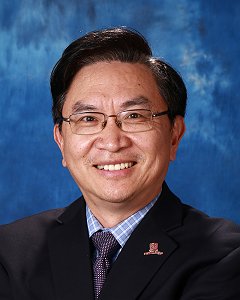
Zhenchang Xing is a Research Professor at CSIRO's Data61 and holds a Hans Fischer Senior Fellowship at TUM-IAS. With a Ph.D. in Computer Science from the University of Alberta (2008), he previously served as Associate Professor at Australian National University and Assistant Professor at Nanyang Technological University. His research focuses on software engineering for AI systems and human-centered computing. Current projects include: Automated Software-Hardware Co-Design for AI Systems Software Supply Chain Security frameworks Data Bill of Materials (DataBOM) for verifiable data ecosystems Software Testing Knowledge Graph development Professor Xing has received 10 Distinguished Paper Awards from ACM and IEEE, including the 2005 Most Influential Paper Award for UMLDiff. His work combines software engineering with responsible AI development.
Prof. Dr.-Ing. Michael Möhring is a Professor of Data Science at Reutlingen University's Faculty of Informatics. He serves as Prodekan for the Herman Hollerith Zentrum (HHZ) and leads research in data analytics, Industry 4.0, and process mining. Previously, he held roles as an IT consultant, project manager at Bosch Group/BSH, and academic researcher. Education: Dr.-Ing. (PhD) in Business Informatics M.Sc. in Business Informatics B.Sc. in Business Informatics Research Interests: Focuses on leveraging structured/unstructured data for industrial applications, enterprise architecture management, digital twins integration, and AI-driven decision support. Specializes in bridging technical systems with organizational processes in manufacturing and service industries. Lab Affiliations: AI-Real Lab AIDA Future Mobility Lab Internet of Things Lab Virtual Reality Lab Articles Trends: Recent work emphasizes practical implementations of AI in production failure analysis (language models), energy optimization systems (HollerithEnergyML), and technical debt management in SMEs. Consistently explores data integration challenges across manufacturing, service ecosystems, and digital twin frameworks. Grants & Collaborations: Active in EU-funded projects like 5G-PreCiSe and bwHealthApp. Collaborates with industry partners on digital transformation initiatives through HHZ's applied research programs.
Mohamed Sarwat is an Associate Professor at Arizona State University specializing in databases , spatial data management , and recommender systems . His research focuses on GeoSpark —a cluster computing framework for spatial data—and its extensions like GeoSparkViz for visualization and GeoSparkSim for traffic simulation. Key Contributions: LARS* (Location-Aware Recommender System), Horton* (Graph Reachability), Sindbad (GeoSocial Platform), and Riso-Tree (Graph Database Indexing) Research Themes: Integration of spatial/temporal data with machine learning, efficient indexing for big geospatial datasets, and scalable frameworks for mobility data science His work spans collaborations with 23+ co-authors across institutions like University of Minnesota, University of Melbourne, and University of Salzburg. Current projects emphasize GeoTorchAI —a spatiotemporal deep learning system—and mobility data science infrastructure.
Oleg Lashinin is an active researcher in the field of Recommender Systems , with a focus on Machine Learning , Temporal Modeling , and User Behavior Analysis . He has contributed to 15 recent publications spanning 2021–2025, including conference papers at ECIR, SIGIR, RecSys, and workshops like KaRS@RecSys and ORSUM@RecSys. His work explores advanced techniques such as Self-Attention Models , Time-Aware Item Weighting , and Cost-Constrained Recommendations . Key research trends in his publications include Deep Learning for sequential recommendation tasks, Crowdsourcing for explanation evaluation, and Temporal Dynamics in user behavior. Notable projects include the GPT3RecBot Telegram chatbot and the RecBaselines2023 dataset for benchmarking recommender systems.
Koushik Sen is a Professor in the Department of Electrical Engineering and Computer Sciences at the University of California, Berkeley. His research focuses on developing software tools and methodologies to enhance programmer productivity and software quality, with expertise in Software Engineering, Programming Languages, and Formal Methods. Education: B.Tech from Indian Institute of Technology, Kanpur M.S. and Ph.D. in Computer Science from University of Illinois at Urbana-Champaign Research Focus: Professor Sen pioneers automated testing techniques including concolic testing and DART (Directed Automated Random Testing). His work bridges formal methods with practical software development, emphasizing bug detection, program synthesis, and AI-driven software analysis tools. Recent innovations include machine learning approaches for code recommendation and fuzzing. Publication Trends: His recent publications (2019-2023) demonstrate strong emphasis on fuzzing techniques, program synthesis, and AI/ML applications in software engineering. Notable domains include smart contract security, automated testing, and developer tooling, with frequent collaborations in top-tier conferences. Awards and Honors: NSF CAREER Award (2008) Sloan Foundation Fellowship (2011) IFIP TC2 Manfred Paul Award (2010) Okawa Foundation Research Grant (2015) Multiple ACM SIGSOFT Distinguished Paper Awards UIUC Distinguished Alumni Educator Award (2014) Leadership: Active program committee member for premier conferences (PLDI, ICSE, ISSTA) and keynote speaker. His research is supported by NSF, Okawa Foundation, and Sloan Foundation.
Max Planck Institute for Security and PrivacyGermany
Daye Nam is an Assistant Professor in the Department of Informatics at the University of California, Irvine, where they design, build, and evaluate AI tools for developers using natural language processing techniques. Their work sits at the intersection of software engineering, artificial intelligence, and human-computer interaction, with a strong focus on creating useful and usable tools that make software development more accessible, efficient, and enjoyable. Education PhD in Software Engineering, Carnegie Mellon University (2018-2024) MS in Computer Science, University of Southern California (2016-2018) BS in Computer Science, Yonsei University (2012-2016) Research Interests Dr. Nam's research focuses on designing, building, and evaluating AI tools for programmers at all levels, with an emphasis on making these tools both useful and usable. Their work spans several key areas including machine learning for software engineering (ML4SE), developer experience, and human-AI interaction. They employ a user-centered approach that involves conducting empirical studies to understand programmers' needs, building and training machine learning models based on those insights, creating tools for programmers, and evaluating them using human-computer interaction methods. Their research has particular relevance to AI-powered developer tools, API documentation and discovery, and educational applications of AI for programming students. Publications and Research Trends Dr. Nam's recent publications demonstrate a clear trajectory toward understanding and improving how developers interact with AI systems. Their work increasingly focuses on empirical studies of developer-AI interaction, particularly with large language models for code generation and understanding. There's a strong emphasis on understanding trust in AI systems among developers, measuring the actual impact of AI on development speed, and designing tools that balance automation with user control. Their research methodology often combines log analysis, user studies, and the development of novel AI-powered tools that address specific developer pain points. Scientific Awards and Honors Best Tool Paper Award at ASE ACM Student Research Competition 2nd Place SIGSOFT CAPS Student Travel Award for FSE ACM SIGSOFT NSF Travel Award NSF Travel Award for ICSE SIGSOFT Best Research Award from University of Southern California Teaching and Service Dr. Nam teaches SWE 233: Intelligent User Interfaces at UC Irvine, guiding students through the design and evaluation of AI-powered interfaces for software development. They have previously served as a Teaching Assistant and Co-Instructor for Foundations of Software Engineering at Carnegie Mellon University. In terms of service, they've been on program committees for major software engineering conferences including ICSE, ASE, and FSE, and have reviewed papers for journals like TOSEM and Empirical Software Engineering. They've also been active in student support programs, organizing and mentoring for graduate applicant support initiatives.
Schloss Dagstuhl - Leibniz Center for InformaticsGermany
Catherine Faron is a Full Professor at Université Côte d'Azur , affiliated with the I3S laboratory and Inria center . She serves as vice-head of the Wimmics joint research team and leads the Artificial Intelligence and Data Engineering (IAID) program at Polytech Nice Sophia engineer school. Habilitation à diriger les recherches (HDR) in Computer Science, UCA (2017) PhD in Computer Science, Univ. Paris 6 (1997) Her research focuses on Artificial Intelligence , particularly in Knowledge Representation and Reasoning (KRR) and Semantic Web technologies. She develops hybrid intelligent systems combining KRR with machine learning for knowledge extraction, integration, and exploitation across education, health, and digital humanities. Recent publications highlight her work on: 2025 : Knowledge graphs for historical zoological data 2024 : Semantic annotation frameworks in agronomy 2023 : Agricultural data mapping and medical record enrichment 2022 : Visual exploration of big linked data Scientific recognitions include: 2023: Best Paper Award, ESWC 2017: Scientific Excellence Award, UCA 2016: Best Demo Award, ISWC 2015: Best Paper Award, IC 2008: Best PhD Paper Award, ECPPM She has supervised 19 PhD/Master's students and leads/has led projects like D2KAB , DEKALOG , and ZOOMATHIA , with partnerships across academic and industrial institutions.
Max Planck Institute for Security and PrivacyGermany
Hoa Khanh Dam is Professor and Deputy Head of School (Research) & Head of Postgraduate Studies in the School of Computing and Information Technology at the University of Wollongong, Australia. He serves as Co-Director of the Decision System Lab where he leads research at the intersection of Software Engineering and Artificial Intelligence. His research focuses on developing AI-driven solutions for software quality, cybersecurity, and productivity enhancement. Key interest areas include: AI/IoT autonomous and cyber resilient systems Software Analytics and Mining Software Repositories Large Language Models for software engineering tasks Defect prediction and vulnerability analysis Agile project management optimization Analysis of Dam's 12 publications from 2018-2025 reveals consistent application of machine learning to software engineering challenges. His work shows progressive evolution from traditional ML techniques toward LLM-based frameworks, with major contributions in defect prediction (DeepJIT), vulnerability analysis, microservice recommendation, and agile effort estimation. The research demonstrates strong industry relevance through practical implementations in code review, component prediction, and security systems. Dam co-leads the Decision System Lab at UOW, which develops intelligent decision support systems using AI and data analytics. The lab's work bridges theoretical AI advancements with real-world software engineering applications, particularly in cybersecurity and autonomous systems development.
Max Planck Institute for Security and PrivacyGermany
Michael Lyu is a Professor at The Chinese University of Hong Kong specializing in software engineering with a focus on cloud reliability, AIOps, and log analysis. His research bridges the gap between theoretical advances and practical industrial applications in large-scale cloud systems. His research interests span Software Engineering , Cloud Computing Reliability , AIOps , and Log Analysis . Dr. Lyu's work addresses critical challenges in modern cloud operations, including failure diagnosis, anomaly detection, and reliability engineering. His recent research has pivoted toward leveraging large language models for software engineering tasks, particularly in code generation and log analysis. His publication portfolio demonstrates consistent contributions to major software engineering conferences (ASE, ICSE, ESEC/FSE) from 2018-2025, with a noticeable increase in LLM-related research since 2023. The trend shows a clear evolution from traditional software engineering topics toward AI-driven approaches for cloud operations. ICSE 2021 Keynote: "Reliability-Driven AIOps for Cloud Resilience" ASE 2023: Maat: Performance Metric Anomaly Anticipation for Cloud Services ASE 2024: LILAC: Log Parsing using LLMs with Adaptive Parsing Cache Dr. Lyu actively mentors students, with numerous co-authored publications showing his advisees as first authors. His work receives significant attention in both academic and industrial software engineering communities, addressing practical problems faced by large-scale cloud service providers. His research group appears focused on developing data-driven approaches for improving cloud system reliability through advanced analytics of logs, traces, and KPIs.
Tingting Han is a Lecturer in Computer Science at Birkbeck, University of London since October 2013. She holds a BSc and MEng in Computer Science from Nanjing University (2003, 2006) and a PhD from RWTH Aachen University and University of Twente (2009), supervised by Joost-Pieter Katoen. Prior to her current role, she was a postdoc at RWTH Aachen University (2009–2011) and a research assistant at the University of Oxford (2011–2013) under the VERIWARE project. Her research focuses on formal verification of probabilistic systems, machine learning applications in verification, and software model checking. She has contributed to advancements in adversarial robustness, code generation, and automated analysis of probabilistic programs. Her work integrates formal methods with machine learning to enhance software correctness and security. Han has taught courses such as 'Problem Solving for Programming', 'Big Data Analytics using R', and 'Introduction to Programming'. She actively participates in academic service, including PC memberships in QAPL 2014 and SAC SVT 2015–2017.
Max Planck Institute for Security and PrivacyGermany
Ajay Jha is an Assistant Professor in the Department of Computer Science at North Dakota State University (NDSU), where he leads the Software Testing and Maintenance (STAM) Lab. His academic journey began with industry experience, followed by graduate studies and postdoctoral research that shaped his current focus on software engineering research. His educational background includes: Ph.D. in Computer Science from Kyungpook National University (2017) Master's degree from Kyungpook National University (2013) Over five years of industry experience before graduate studies, including co-founding two startups Postdoctoral research at University of Alberta (over two years) and Kyungpook National University (three years) Dr. Jha's research focuses on software engineering, particularly in the areas of software testing, maintenance, and evolution. His work centers on mining large-scale software repositories to uncover real-world issues in software quality, reliability, and maintainability. He develops innovative tools and techniques to address challenges in regression testing, library migration, and mobile application development. His research has significant practical implications for improving software development processes and enhancing the reliability of modern software systems, particularly in mobile and Python environments. His publication record shows a clear progression from Android-focused research to broader software engineering challenges, with recent work emphasizing Python library migration and large language models for software engineering tasks. His research methodology typically involves empirical studies of real-world software repositories combined with tool development to address identified challenges. Dr. Jha is actively involved in academic service, serving on program committees for major software engineering conferences including MSR, ICSME, SANER, ASE, and ICSE. He also reviews for prestigious journals such as IEEE Transactions on Software Engineering and ACM Transactions on Software Engineering and Methodology. At NDSU, he teaches a range of courses from undergraduate to graduate level, including Mobile Software Engineering, Software Development Processes, and Software Project Planning and Estimation. He also leads graduate seminars on specialized topics like 'LLMs for Software Testing and Maintenance' and 'Code Smell and Refactoring.' He leads the Software Testing and Maintenance (STAM) Lab at NDSU, which focuses on mining software repositories to identify quality issues and developing practical tools to address software maintenance challenges. The lab's research has produced several benchmarks (PyMigBench, JTestMigBench) and tools (TRec) that have been shared with the research community.
Max Planck Institute for Security and PrivacyGermany
Alberto Martin-Lopez is a postdoctoral fellow in the SEART research group at the Software Institute of Università della Svizzera Italiana (USI) in Lugano, Switzerland. His academic journey includes a PhD from the SCORE Unit of Excellence at the University of Seville (Spain), where he also earned a Bachelor's degree in Telecommunications Engineering and a Master's degree in Software Engineering and Technology. He has held positions as a Fulbright fellow at the University of California, Berkeley and as an external lecturer at Kristiania University College in Oslo, Norway. His research focuses on software testing, service-oriented computing, and neuro-symbolic AI applications to software engineering problems. Martin-Lopez has made significant contributions to automated testing of web services, particularly RESTful APIs, developing tools and techniques for test oracle generation, test input generation, and metamorphic testing. His work bridges traditional software engineering methods with modern AI techniques to address longstanding challenges in software verification. His publications in top-tier venues like ESEC/FSE, ISSTA, and TSE demonstrate consistent impact in the software engineering community. Analysis of his recent work shows a clear trajectory toward integrating neuro-symbolic AI approaches with traditional testing methodologies, particularly for solving the oracle problem in API testing and enhancing code generation systems. His scientific achievements have been recognized with prestigious awards: First Prize of the ACM Student Research Competition at ICSE'20 ACM SIGSOFT Distinguished Paper Award at ESEC/FSE'22 2023 Early Career Researcher Award by the Spanish Society of Computer Science and Fundación BBVA Martin-Lopez actively contributes to the software engineering community through service on program committees for major conferences including ASE, ESEC/FSE, ICSE, and ISSTA. His collaborative work spans institutions across Spain, Switzerland, the United States, and Norway, reflecting a strong international research network. At USI, he works within the SEART research group, focusing on advancing the state of the art in automated software testing through innovative combinations of traditional software engineering techniques and artificial intelligence.
Max Planck Institute for Security and PrivacyGermany
Dr. Mingwei Liu is an Associate Professor at the School of Software Engineering, Sun Yat-Sen University, China. Previously, he completed postdoctoral research at Fudan University in 2024 and received both his Ph.D. (2022) and B.E. (2017) in Software Engineering from Fudan University under the mentorship of Xin Peng. Dr. Liu's research focuses on the intersection of Software Engineering (SE) and Artificial Intelligence (AI), specifically in the domains of AI4SE (AI for Software Engineering) and SE4AI (Software Engineering for AI). His primary interest lies in leveraging advanced AI technologies, particularly large language models (LLMs) and knowledge graphs (KGs), to address complex software engineering challenges and tackle system engineering problems in AI applications. His research portfolio demonstrates a strong focus on practical applications of AI in software development, with particular emphasis on code generation, vulnerability detection, test generation, and knowledge representation for software artifacts. Through his work, Dr. Liu has contributed significantly to understanding how LLMs perform in realistic software development scenarios beyond simple function-level code generation. Dr. Liu has published over twenty papers in top international journals and conferences including TSE, TOSEM, ICSE, FSE, and ASE. His research has been recognized with prestigious awards including the IEEE TCSE Distinguished Paper Award (ICSME 2018) and the ACM SIGSOFT Distinguished Paper Award (FSE 2023). IEEE TCSE Distinguished Paper Award (ICSME 2018) ACM SIGSOFT Distinguished Paper Award (FSE 2023) Dr. Liu actively contributes to the academic community as a program committee member for major conferences including ASE, ESEC/FSE, ICSME, and SANER. He leads the SYSUSELab research group, which has developed notable resources including the ClassEval benchmark for evaluating LLMs on class-level code generation tasks.
IU International University of Applied SciencesGermany
Prof. Marian Benner-Wickner is a Professor of Computer Engineering at IU University of Applied Sciences, where he has been a faculty member since 2018. He leads the Industrial Engineering & Management and Industry 4.0 online study programs, focusing on software engineering and gender-neutral e-learning methodologies. His professional background includes roles as an IT specialist trainer at CampusLab GmbH and a software developer at the Fraunhofer Institute for Software and Systems Technology. He holds a PhD in Software Engineering (2016) from the University of Duisburg-Essen, where he managed the “Agenda-Driven Case Management” research cluster. His research interests span software engineering, case management techniques, process flexibility, smart home technologies, and digital youth protection. Notable contributions include work on adaptive case management systems, ontology-based recommendation systems, and e-learning metadata frameworks. Prof. Benner-Wickner actively contributes to organizations like the Wikimedia Foundation, CPS.HUB NRW, and the Society for Computer Science. His publications address topics such as IT integration architectures, automated grading systems, and security frameworks in mobile networks. His recent projects emphasize integrating IT applications, enhancing educational technologies, and optimizing knowledge-intensive business processes through semantic web technologies and process mining. In advising and grants, he oversees company-specific final theses in IT and technology, emphasizing practical industry collaboration. He has developed guidelines for design science research in academic works and advocates for empirical approaches to software process improvement. His leadership in Industry 4.0 programs reflects his commitment to bridging academic research with industrial applications. Leveraging his role as department head, he fosters innovation in curriculum design, particularly in leveraging digital tools for inclusive and adaptive learning environments. His interdisciplinary work intersects computer science, education, and policy, addressing societal challenges like digital youth protection and smart home security.
Dr. Tim Gerrits is a researcher at the Institute for Visualization (VIS) at RWTH Aachen University, where he leads the Visualization Team. His work bridges scientific visualization, high-performance computing, and immersive technologies, with a strong focus on in-situ and in-transit analysis for large-scale simulations. University: RWTH Aachen University Institute: Institute for Visualization (VIS) Role: Lead of the Visualization Team Tim Gerrits' research centers on developing tools and frameworks for efficient and interactive visualization of complex scientific data. His interests include ensemble data analysis, uncertainty visualization, virtual reality interaction techniques, and leveraging game engines like Unreal Engine for scientific applications. He is particularly active in the domain of neuronal network simulations and oceanographic modeling. His recent publications highlight a strong trend toward accessible, real-time, and hybrid visualization workflows. He has contributed to the development of DaVE, a curated database of visualization examples to support HPC users, and Insite, a lightweight pipeline for in-transit processing in neuroscience simulations. His work emphasizes usability, performance, and integration with existing scientific workflows. Scientific Awards: Best Paper Award at IEEE Uncertainty Visualization Workshop, 2024 Honorable Mention Award at Eurographics Workshop on Visual Computing for Biology and Medicine (VCBM), 2022 Dr. Gerrits actively mentors and collaborates on interdisciplinary projects involving computational neuroscience and climate modeling. He has led the curation of datasets for the IEEE SciVis Contest and promotes open science through Zenodo-hosted resources. His lab focuses on building scalable, user-centered visualization systems that empower domain scientists to gain early insights from massive simulations.