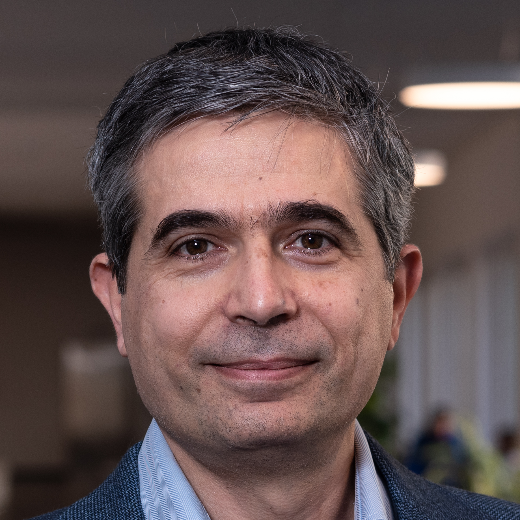
Luciano Lavagno is a Full Professor at the Department of Electronics and Telecommunications, Polytechnic University of Turin, with over two decades of academic and research contributions. His work bridges hardware acceleration, low-power electronics, and intelligent system design. Research Focus: Hardware-accelerated machine learning, high-level synthesis (HLS) for FPGA/ASIC, heterogeneous CPU/GPU/FPGA platforms Key Projects: SPACE (predictable acceleration), REBECCA (secure AI acceleration), HPC-National Center (quantum computing), and oral history preservation via "Ti racconto una storia" initiative His recent publications analyze CNN inference optimization, subgraph isomorphism, and superword-level parallelism exploitation. Lavagno supervises multiple PhD students working on FPGA acceleration, neural network hardware, and embedded systems. As Principal Investigator for national and EU-funded projects (PRIN, JTI-ECSEL, PNRR), he drives advancements in sustainable computing infrastructure. His patented technologies include MIx&Latch timing methodology, capacitive sensing innovations, and 5G acceleration frameworks.
Marco Aldinucci is a Full Professor and Head of the Parallel Computing group at the University of Torino's Computer Science Department. He leads the HPC Key Technologies and Tools (HPC-KTT) national lab under CINI, involving 38 Italian universities. His expertise spans parallel programming models, HPC systems, federated learning, and energy-efficient computing. Aldinucci has secured over €10M in EU research funding, contributed to frameworks like Fastflow and Streamflow, and pioneered initiatives like the HPC4AI lab and the CINI HPC-KTT lab. His research focuses on advancing exascale computing, cloud-HPC integration, and AI-driven medical solutions. Notable projects include the Gaia AVU-GSR solver for exascale systems and the DeepHealth Toolkit for medical AI. He has held governance roles in EuroHPC and chairs the Observatory on Trends and Applications of Supercomputing in Italy. Aldinucci’s publications (150+) address parallel algorithms, distributed learning, and sustainable HPC infrastructure. His work has been recognized with awards from HPC Advisory Council, NVIDIA, IBM, and Autodesk. Current initiatives include the Software & Integration lab at the Italian National HPC Centre (ICSC) and leadership in the OpenScience working group at Torino. His advising includes Iacopo Colonelli, whose thesis won CINI’s 2023 best award. He actively engages in EU projects, workflow systems, and standards for hybrid computing environments. Aldinucci’s labs and collaborations drive innovations in HPC portability, energy efficiency, and AI scalability.
Ivano Bilenchi is a postdoctoral researcher at the Polytechnic University of Bari's Information Systems Laboratory (SisInf Lab). He holds a Master's in Computer Science Engineering (2020) and a Ph.D. in Electrical and Information Engineering (2024) from the same institution. His research focuses on AI, Semantic Web technologies, edge computing, and IoT applications, with notable contributions to embedded OWL reasoners and cloud-edge intelligence frameworks. He teaches courses such as Formal Languages and Compilers, Secure Programming, and Information Systems Security. His work bridges academic research with practical applications, including iCleaner (iOS system cleaner), Tiny-ME (Semantic Web reasoner), and AI-LMD (fleet optimization tool). He actively participates in conferences like ICWE and I-CiTies, and has contributed to initiatives like the sustainable development project HowtUyoga. His awards include a First Prize at the Sustainable Development Festival (2018). Research highlights include developing Cowl (lightweight OWL library for edge devices) and proposing innovative architectures for cloud-edge AI in sensor networks. Collaborations span semantic blockchain marketplaces (RideMATCHain) and UAV autonomy using knowledge representation.
Giuseppe Bellantuono is a Full Professor of Comparative Private Law at the Faculty of Law, University of Trento. His academic journey includes a Ph.D. and post-doc in Comparative Private Law from the University of Trento, following a Magna cum Laude law degree from the University of Bari. He has held visiting professorships at institutions like the Federal University of Minas Gerais and the University of Lisbon, focusing on energy law and comparative legal frameworks. His research interests span AI and law, climate change law, comparative contract law, and the regulation of network industries. He has taught extensively in Italy and abroad, including courses on energy law, contract law, and law and economics. Notably, he served as a secondee at the European Commission's DG Energy (2014–2015). Bellantuono’s recent publications address legal challenges in decarbonization, low-carbon transitions, and comparative energy governance. His work bridges legal systems through interdisciplinary approaches, emphasizing policy transfer and regulatory innovation. He holds the title of Professor Colaborador at the Federal University of Minas Gerais’s Law School since 2018.
Niccolò Galli is a Research Associate at the Robert Schuman Centre for Advanced Studies, European University Institute, and Contract Professor of Intellectual Property and Competition Law at the University of Florence. His work bridges law, innovation policy, and digital regulation, with a focus on EU competition law and intellectual property rights in digital markets. European University Institute, Research Associate, Robert Schuman Centre for Advanced Studies University of Florence, Contract Professor, IP and Competition Law His research interests lie at the intersection of innovation, antitrust, and intellectual property law, particularly in the context of digital transformations and ICT sector regulation. He employs empirical legal methods to analyze competition dynamics in multi-sided platforms, algorithmic collusion, and patent aggregation. The most recent publications reflect a strong trend in digital competition law, focusing on market definition for digital platforms, algorithmic collusion, and judicial enforcement of EU competition law. These works combine doctrinal analysis with interdisciplinary insights from economics and data science. His scientific recognition includes: 2024 Jacques Lassier Prize (International League of Competition Law) 2024 Licensing Executive Society - Italian Chapter Award for best IP research 2016 Elena Messina Dissertation Prize Galli has advised and collaborated on research projects related to digital markets and competition law, including the ENTraNCE for Judges series and studies on multi-sided platforms. While no formal grants are listed, his Marie Skłodowska-Curie fellowship and PhD funding indicate substantial research support. He has not supervised any students listed in the text but contributes to academic discourse through collaborative research and policy-relevant outputs. He is part of the research cluster on Digital transformations and society and the Innovation and intellectual property in the Digital Age working group at the EUI, contributing to interdisciplinary dialogue on the future of digital regulation in Europe.
Francesco Bianchini is an Associate Professor of Logic and Philosophy of Science at the University of Bologna's Department of Philosophy and Communication Studies. He serves as the scientific coordinator of the Knowledge and Cognition Research Center. His research focuses on artificial intelligence, cognitive science, and the philosophy of science, with emphasis on simulative cognitive modeling, biologically inspired architectures, and analogical reasoning. He holds a PhD in Philosophy from the University of Bologna (2007) and has held academic roles since 2008, including Senior Assistant Professor (2016–2019) and Junior Assistant Professor (2013–2016). Education includes a first-class degree in Philosophy (2001) and a specialization in History and Philosophy education (2003). His work bridges theoretical philosophy, ethics, and empirical studies, addressing topics like AI's ethical dimensions, cognitive architecture design, and historical perspectives on scientific thought. He coordinates university initiatives in AI and interdisciplinary research, such as roles in the ALMA-AI Center and Horizon Europe thematic groups. Research interests span AI philosophy, cognitive modeling, and the epistemology of mind. His articles analyze AI's conceptual foundations, robo-ethics, and the interplay between synthetic biology and artificial systems. Recent work includes studies on generative AI, large language models, and Cartesian influences on cognitive theories. Bianchini’s contributions reflect a commitment to interdisciplinary dialogue, integrating philosophical analysis with scientific methodologies. His articles frequently explore foundational questions about intelligence, knowledge representation, and the societal implications of emerging technologies.
Hironori Washizaki is a Professor at Waseda University 's School of Fundamental Science and Engineering and a Visiting Professor at the National Institute of Informatics. He serves as IEEE Computer Society 2025 President and has led initiatives in software engineering, ML design patterns, and IoT systems. His work bridges academia and industry through roles at SYSTEM INFORMATION CO.,LTD. and eXmotion Co., LTD. Research Interests: His work spans software engineering, quality assurance, ML/IoT design patterns, and education innovation. He leads the SmartSE professional education program and standardizes software engineering bodies of knowledge through ISO/IEC/JTC1/SC7/WG20 . Scientific Awards: Golden Core Member (IEEE CS) Spirit of Computer Society Award KDDI Foundation Award Science and Technology Award, MEXT Best Paper Awards at ICSE, CSEE&T, and IWESEP Leadership & Grants: He has secured major grants (JSPS, MEXT) and held editorial roles at IEEE Transactions on Emerging Topics in Computing, IJSEKE, and IEICE journals. As IEEE CS Japan Chapter Chair and SEMAT Japan Chapter Chair , he fosters international collaborations. Labs & Teams: He leads the Global Software Engineering Laboratory at Waseda, focusing on traceability, reuse, and quality. This lab drives projects like ProMeTA (program metamodel taxonomy) and Trace ANY (software maintenance metrics).
Luigi Palopoli is a Full Professor and Director at the Department of Information Engineering and Computer Science (DISI), University of Trento, Italy. He is also a member of the University Council. His research spans hybrid systems, real-time scheduling, quality of service control, robotics, embedded systems, and cyber-physical systems. His research interests include: Hybrid Systems and Real-Time Scheduling Service and Assistive Robotics for Elderly Support AI Applications in Robotics and Embedded Systems Outlier Detection and Anomaly Explanation Audio Super-Resolution and Signal Processing Biological Network Analysis and Graph Alignment His recent publications reflect a strong interdisciplinary focus, combining AI, robotics, real-time systems, and bioinformatics. Trends show increasing work in explainable AI, assistive technologies, and multimodal learning (e.g., vision transformers for audio). He has made notable contributions to robotic navigation for the elderly, real-time embedded systems, and logic-based outlier detection. Scientific awards include: Outstanding Paper Award at RTAS 2017 He advises students and collaborates widely, especially with Daniele Fontanelli, Luca Abeni, and other researchers in robotics and AI. He maintains an active research group, evidenced by a dedicated YouTube channel for the Embedded Intelligence and Robotic Systems group. He is involved in teaching, including courses on Robot Planning and Real-Time Operating Systems, and participates in AI seminar series. There is no indication of retirement or former status; he is actively engaged in research, teaching, and academic service.
Erica Scarpa is a Researcher at the Department of Humanities, Ca' Foscari University of Venice. Her work focuses on the intersection of Ancient Near East Studies , Digital Humanities , and Prosopography , with particular emphasis on Eblaite society and Kassite Babylonian administration. University: Ca' Foscari University of Venice Department: Department of Humanities Academic Rank: Researcher Her research involves advanced spatial data analysis and data mining techniques applied to cuneiform archives, including the digitization of epigraphic material from the Ebla Central Archive (L.2769). She contributes to projects like the Ebla Digital Archives and a Digital Prosopography Project on Kassite Babylon. Publication Trends reveal expertise in Eblaite administrative structures , Kassite official activities , and historical network analysis . She actively publishes in journals (e.g., Studia Eblaitica ) and conference proceedings (e.g., Egypt and the Ancient Near East between Past and Future ). Contact: Email: erica.scarpa@unive.it Email: 835553@stud.unive.it
Giorgio Alberti is a Full Professor at the University of Udine , Department of Agri-Food, Environmental and Animal Sciences. His research focuses on forest ecology, carbon sequestration, remote sensing applications, climate change impacts on tree species, and ecosystem services. He leads projects like CarboMark and contributes to Horizon Europe initiatives. Key Research Areas Forest carbon dynamics and biodiversity conservation Integration of field measurements with remote sensing Climate change adaptation in agricultural and forest systems Ecosystem service trade-offs in protected areas His recent work involves machine learning for forest carbon estimation, ecohydrological studies in vineyards, and global biodiversity assessments. He actively participates in international collaborations, including the LATEST Erasmus+ project and Dinaric Alps old-growth forest research. Project Involvement PRI. FOR. MAN Dashboard for wood resource mapping Horizon Europe Project 101081177 on carbon-biodiversity datasets Post-windstorm forest regeneration studies in the Alps Governance of Natura 2000 protected areas
Daniele Jahier Pagliari is an Associate Professor in the Department of Control and Computer Science (DAUIN) at Politecnico di Torino, where he is also a member of the Interdepartmental Center PEIC - Power Electronics Innovation Center. He is actively involved in teaching and research, focusing on embedded systems, electronic design automation, and machine learning for edge computing. He teaches courses such as Optimized Execution of Neural Networks at the Edge, Machine Learning for IoT, and Hardware/Software Codesign of Flexible Computing Systems for Edge AI across various engineering programs including Computer Science and Systems Engineering, Data Science, and Automotive Engineering. His research interests span electronic design automation, embedded systems, energy-efficient computing, low-power design, and machine learning. He is particularly engaged in applying machine learning techniques to improve the design and performance of digital and analog circuits, with a focus on edge AI applications. His work aligns with key scientific areas including computer architecture, cyber-physical systems, and scientific computing. The recent publications highlight a strong trend in optimizing deep learning models for resource-constrained environments, accelerating neural network inference on ultra-low-power devices, and integrating physics-based models with AI for battery state estimation. There is also significant focus on using machine learning to enhance electronic design automation, particularly for analog and mixed-signal circuits, reflecting a convergence of AI and hardware design. He leads and participates in several high-impact research projects, including EU-funded initiatives like HAL4SDV, ISOLDE, TRISTAN, and AMBEATion, as well as commercial projects such as MASAI and software platform development for production support. He serves as the Scientific Responsible or Director in multiple projects, demonstrating leadership in both academic and industrial research contexts. He supervises multiple PhD students in the Computer and Systems Engineering program, including Luca Benfenati, Mohamed Amine Hamdi, Beatrice Alessandra Motetti, Giovanni Pollo, and Matteo Risso, whose research topics include latency-optimized inference, compiler optimization for edge devices, and hardware-aware deep learning design. He is also involved in patent development, notably for an instrumentation method to dynamically modify circuit precision. He is a member of the College of Computer, Film and Mechatronics Engineering and contributes to various degree programs. His work supports UN Sustainable Development Goals related to good health, affordable and clean energy, industry innovation, and sustainable cities.
Vadim Zaytsev is an Associate Professor of Software Evolution at the University of Twente, specializing in software analysis, modelling, and restructuring since 2004. He has previously worked as a Chief Science Officer, developing compilers and analyzing migration projects, and his past affiliations include institutions in the Netherlands, Belgium, Germany, and Russia. His work bridges academia and industry, focusing on industrially relevant research, teaching, and prototype software development. Research Interests: Software evolution and structure elicitation Domain-specific languages (DSL) and cyber-physical systems (CPS) Automated program repair using large language models Modernity signatures in programming languages (PHP, Python, C#, Rust) Educational software assessment (Apollo++ tool, BabyCobol) Grammarware and code transformation (CFG to VPG converter) Recent Article Trends: His 2025 work explores large language models for automated program repair (SAC, GPCE), while earlier studies (2024) focus on DSL-based CPS modelling, learning-by-doing assessment pipelines, and modernity signatures in programming languages. His research often involves collaboration with students and interdisciplinary groups like HMI at UTwente. Teaching and Practice: He supervises students in research projects, teaches the MSc course Software Evolution , and contributes to curriculum re-accreditation efforts. His practice includes open-source tools (GPL-licensed CFG to VPG converter) and conference leadership roles (Program Co-Chair for SLE 2025 and ICT.OPEN 2025).
Francesco Daghero serves as a Research Fellow at the Interuniversity Department of Territorial Sciences, Planning and Policies (DIST) of the Polytechnic University of Turin, maintaining active teaching roles across multiple engineering disciplines. His institutional email (francesco.daghero@polito.it) confirms primary affiliation with Politecnico di Torino, where he has collaborated on: Master's Degree Course in Operating Systems for Embedded Systems (2021/22, Computer Engineering) Computer Science courses in Management Engineering (2023/24, 2022/23) Computer Science courses in Aerospace Engineering (2021/22, 2020/21) His research bridges computer and electrical engineering through machine learning applications in semiconductor design and hardware optimization. Core focus areas include: Embedded systems and edge computing architectures ML-driven VLSI layout prediction and feasibility analysis Deep learning acceleration for ultra-low-power devices Compiler techniques for heterogeneous edge hardware Analysis of his 2024-2025 publications reveals a cohesive research trajectory targeting hardware-software co-design challenges. Key trends include applying ML to analog-digital integration problems, optimizing convolution operations for resource-constrained environments, and developing gradient-aware IC matching algorithms—demonstrating significant contributions to semiconductor manufacturing and efficient AI deployment. Scientific awards: No honors, fellowships, or medals were documented in source materials. Advising and grants: The provided texts contain no information regarding student supervision, research funding, or grant acquisition activities.
Emanuele Panizzi is an Associate Professor in Computer Science at Sapienza University of Rome, Italy. He is affiliated with the Department of Computer Science within the Faculty of Information Engineering, Computer Science, and Statistics. His research focuses on AI-driven Human-Computer Interaction (HCI), particularly in smart parking systems and earthquake early warning systems. Previously, he explored usability testing, compiler design, and parallel computing. Panizzi teaches HCI and Software Architecture courses in Sapienza’s AI and Computer Science programs. He advises four Ph.D. students and over 10 master’s/bachelor’s students, having supervised 350+ theses. His consulting experience includes firms like Telepass and Immobiliare.it, emphasizing technology transfer and team leadership in R&D. Research interests span AI applications in urban mobility, disaster response, and cultural heritage. He coordinates interdisciplinary projects and has led teams of 4–80 people, emphasizing practical innovation. His work bridges academia and industry through collaborative frameworks and prototyping. Panizzi’s contributions include over 50 publications, with recent work addressing LLMs in design, implicit interaction systems, and AI ethics. His labs focus on HCI innovations and IoT-based solutions for societal challenges.
Giuseppe Di Fatta is a full professor at the Faculty of Engineering of the Free University of Bozen-Bolzano since 2022. Previously, he served as Head of the Computer Science Department at the University of Reading (2016-2021) and contributed to KNIME's early development at the University of Konstanz (2004-2006). His research focuses on machine learning algorithms, data science tools, and interdisciplinary applications in science and industry. He actively participates in IEEE SMC Society's Technical Committee on Machine Learning. He teaches courses such as 'Codeless Machine Learning in KNIME' and 'Data-Driven Decision Making' in the Doctoral Program in Computer Science. His work integrates advanced methods like multi-task learning, transfer learning, and data-driven healthcare solutions. He leads projects such as the 5VREAL volleyball analytics initiative and contributed to BodyCloud, a cloud-assisted platform for wearable device monitoring. Recent research trends include optimizing deep learning models for imbalanced datasets, applying AI to Alzheimer’s disease prediction, and developing scalable data mining techniques for edge computing systems. His publications span topics from neural network optimization to financial market analysis. Key Projects: BodyCloud, 5VREAL, KNIME integration Professional Roles: IEEE SMC TC-ML member, former Head of Computer Science (Reading) Teaching: Doctoral, master's, and bachelor's programs in data science and computer science Collaborations: EU projects, industry partnerships in healthcare and sports analytics