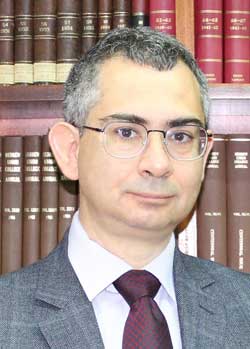
Paschalis Vassilios is an Assistant Professor at the Department of Visual Arts and Art Sciences, University of Ioannina. He serves as the Laboratory Manager for the Animation Workshop-3D Animation, contributing to multimedia research and education with expertise in drawing, sketching, 3D animation, and digital imaging. His contact details include the email vpaskalis@yahoo.gr and a direct line at 26510-05923.
Manolis Koubarakis is a Professor and Director of Graduate Studies at the Department of Informatics and Telecommunications, National and Kapodistrian University of Athens. He is affiliated with the Archimedes Unit at Athena Research Center and is a member of ELLIS. His research focuses on Artificial Intelligence and Data Science, particularly in Linked Geospatial Data, Earth Observation, and Knowledge Graphs. Education: PhD in Computer Science (National Technical University of Athens), M.Sc. in Computer Science (University of Toronto), and B.Sc. in Mathematics (University of Crete). Research Interests: His work spans AI applications in geospatial data, entity resolution, ontology-based data access (OBDA), and semantic web technologies. He leads projects like ExtremeEarth (AI for Copernicus data) and LEO (linked Earth Observation data). Awards: 2015: Fellow of the European Association of Artificial Intelligence (EurAI) 2022: Best Demo Award at CIKM for Copernicus App Lab Advising & Grants: Supervises students in AI and data science. Collaborates on EU-funded projects like BigDataEurope and participates in initiatives like the Standing Scientific Committee for AI in Greece's justice system. Labs & Teams: Heads the AI Lab (ai.di.uoa.gr) and contributes to the MaDgIK group, focusing on data and knowledge management systems.
Dimitris Maroulis is a Professor at the Department of Informatics and Telecommunications, University of Athens, leading the Real-Time Systems and Image Analysis Lab (RTS-image). With over 20 years of experience in data acquisition and real-time systems, and 15 years in image/signal analysis, he collaborates extensively with Greek and European hospitals in biomedical informatics. He has led 5 R&D projects and authored 150+ papers with 1400+ citations. University of Athens: Professor (2000–present) Meudon Observatory: Research Fellow (3 years) & Long-term Collaborator (10+ years) Research Interests focus on real-time systems , image/signal processing , and biomedical applications . Key areas include automated segmentation of proteomic images, noise removal methods, and stereo image coding. His 15 most recent publications (2003–2012) span 3D imaging , medical image analysis , and biomedical informatics , with sub-fields like autostereoscopic displays, wavelet-based coding, and computer-aided diagnosis. Awards : Best Paper Award (2012: Integral Image Analysis) Projects include European and national R&D initiatives in image analysis and real-time systems. Labs : RTS-image Lab develops methodologies for biomedical and proteomic applications.
Professor Manolis Koubarakis is a faculty member at the Department of Informatics and Telecommunications, National and Kapodistrian University of Athens. His research focuses on geospatial data science, knowledge graphs, entity resolution, and AI applications in Earth observation. He leads projects like ExtremeEarth and Plato, advancing semantic data cube systems and geospatial question answering engines. His work bridges AI and geospatial technologies, with contributions to frameworks like pyJedAI and Strabo 2 for managing big geospatial data. Research Interests include: Geospatial Question Answering Systems Entity Resolution and Entity Linking Ontology-Based Data Access (OBDA) Knowledge Graph Construction and Applications Earth Observation Data Analytics AI for Geoinformatics Notable Projects: ExtremeEarth: Combines Copernicus satellite data with machine learning for environmental analytics. Plato: Semantic data cube system enabling advanced querying of multidimensional datasets. GeoQA2: A geospatial question answering engine evaluated on large benchmarks. JedAI Family: Tools for scalable entity resolution in structured/semi-structured data. His publications span 20+ years, with recent emphasis on: AI-driven Earth observation systems Geospatial RDF benchmarking 3D geospatial interlinking Large language models for legal and health content delivery
Sotiris Christodoulou is an Associate Professor at the Department of Electrical and Computer Engineering within the College of Engineering at the University of Peloponnese. He also serves as a research associate at the 'Diofantos' Institute of Computer Technology and Publishing. His academic career spans multiple institutions where he has taught graduate and undergraduate courses across seven different universities since 2004. Dr. Christodoulou earned his B.A. in Computer Engineering and Informatics from the University of Patras in 1994 and completed his PhD in Web Engineering from the same institution in 2004. His educational background established the foundation for his extensive research career focused on web technologies and applications. His primary research interests include Web Engineering, Web Application Performance Optimization, Web Code Quality, Semantic Web technologies, Hypermedia Systems, and emerging Web 2.0 and Web 3.0 technologies. His work extends to Virtual Interactive Environments, 3D and Augmented Reality applications, and Spatial Hypertext systems. Christodoulou's research bridges theoretical web engineering principles with practical applications in cultural heritage, education, and urban infrastructure systems. His research output comprises over 45 publications in international journals, book chapters, and conferences, accumulating more than 450 citations. He has participated in over 23 European and National Research and Development Projects focused on web software technology, hypermedia applications, and 3D educational and cultural applications. Professional member of ACM Professional member of IEEE Member of organizing committees for over 15 international scientific conferences Reviewer for recognized international journals (ACM, IEEE, etc.) Christodoulou has extensive teaching experience across seven universities, specializing in programming languages, web software engineering, software quality, and data management. His research projects typically combine applied research with cutting-edge technology implementation for real-world problems in large organizational information systems. He maintains regular office hours at Building K, Office K2.02 at the University of Peloponnese, with appointments available on Mondays and Thursdays.
Panagiotis Kyriakoulakos is an Assistant Professor in Computer Animation at the Department of Product and Systems Design Engineering, University of the Aegean. He previously served as Lecturer at the same department (2010-2018) and Adjunct Lecturer at Paris 1 University (1987-1992). His academic career spans over 35 years with expertise in digital arts, animation, and new media. Education: Electrical Engineering (Aristotle University of Thessaloniki), DEA in Cinema/Television (Paris I), PhD in Art Sciences (Paris X). Professional Experience: Managing Director at Post Reality (1994-2006), New Media Director at PLD Production (2006-2010), awarded SCAM (1991) and Chevalier des Palmes Academiques (2014). Research Focus: Creative processes in animation, digital aesthetics, interactive systems, and cultural heritage projects like ARCHEOGUIDE and HIST3D. His research explores intersections between technology and artistic expression, emphasizing entrepreneurship in creative industries. Key contributions include the first Greek 30-minute computer-animated TV special Alexandra Meets the Space Toons (2003) and the Homeweb VOD platform pilot (2010). Dr. Kyriakoulakos coordinates the XARTS International Conference/School since 2013 and leads the Interactive Systems Design Lab. His work bridges academic research with practical applications through projects like the HIST3D framework and Paris-based research grants (2013). Awards: SCAM Video Magazine Editor Award (1991), Paris Research Grant (2013), French Academic Palms (2014). Labs/Teams: Interactive Systems Design Lab (since 2000), XARTS Conference Leadership. Publications: Over 30 articles, 3 books including 70 Years of Greek Animation (2016) and foundational texts on animation techniques.
Georgios Bardis is a permanent Assistant Professor at the Department of Informatics and Computer Engineering , School of Engineering , University of West Attica . He holds a PhD in Informatics from University of Limoges (2006), an MSc in Software Systems from University of California, Santa Barbara (1994), and a Diploma in Computer Engineering & Informatics from University of Patras (1992). His career spans multiple academic roles, including Lecturer at University of West Attica (2018-2021) and Professor of Applications at TEI of Athens (2010-2018). Research Interests : Focus on Intelligent Computer Graphics , Declarative Modeling , and Multicriteria Decision Analysis . His work integrates AI into 3D scene synthesis, urban planning, and semantic decision systems. Awards : Master Microsoft Office Specialist (MOS), 2003 NAT Scholarships for Academic Excellence (1989-1992) 1984 Monetary Prize from Hellenic Mathematical Society Leadership : Member of AKIIS Research Lab (University of West Attica), Editorial Board of International Journal of Systems Biology and Biomedical Technologies , and Reviewer for International Journal of Digital Earth . Publications : 5 peer-reviewed journals, 2 books, 8 book chapters, and 22 conference papers. Key areas include WebGL avatars, urban data analysis, and 3D modeling with AI.
Ioannis Stamelos is a Professor of Software Engineering at the School of Informatics, Aristotle University of Thessaloniki (since 2015, research/teaching staff since 1997). He serves as Director of the Postgraduate Master Course in Interactive Hardware & Software Technologies. Major Research Areas: Open Source Software, Software Effort/Quality Estimation, Agile Methods, Enterprise Information Systems Key Projects: Deep Blue/AUTH Research Hub (2018-2022), BlockAdemic (blockchain-based micro-credentials), European Commission Open Source Policy Studies Research Trends from recent publications include: Process mining in library information systems Reusability metrics for software assets Bayesian networks in software project management Impact of design patterns on gaming software defects Technical debt assessment via structural metrics Blockchain applications in supply chain management Scientific Awards: Best Paper Award at IEEE DEST’09 Best Student Paper Award at ICSR 2012 Best Paper Award at QUATIC2012 Education & Leadership: PhD in Computer Science (1988), Diploma in Electrical Engineering (1983). Led numerous EU-funded projects (IST, ERASMUS, FP7) and national initiatives (ΓΓΕΤ, ΕΠΕΑΕΚ). Supervised PhD/MSc students in software reuse, OSS quality, and agile practices.
Dr. Sotirios Kontogiannis is a Researcher and Director of the Distributed MicroComputer Systems Laboratory (MCSL) at the Department of Mathematics, University of Ioannina. He holds a PhD in Software Engineering from Democritus University of Thrace (2012), with a focus on load balancing algorithms for distributed systems. His career spans academic and private sector roles, including software development, research in FP7 projects, and technical leadership at TEKMON Geomatics. He currently teaches courses on Database Systems, Parallel Algorithms, and Educational Technologies at the University of Ioannina. Education: 5-year Engineering Diploma (DUTH, 2003), MSc in Microelectronics and Information Systems (DUTH, 2006), PhD in Load Balancing Algorithms (DUTH, 2012). Research Focus: Distributed systems, IoT protocols, sensor networks, big data, and smart agriculture technologies (e.g., beekeeping monitoring systems, wine fermentation frameworks). His work integrates IoT, AI, and edge computing to address challenges in agriculture, accessibility, and environmental monitoring. Notable inventions include patented smart beehive systems and tactile navigation tools for visually impaired individuals.
Irene Koronaki is a Professor at the National Technical University of Athens , affiliated with the School of Mechanical Engineering and the Thermal Engineering Section . She serves as Director of the Laboratory of Applied Thermodynamics, Cooling Technology & Refrigerated Vehicles since 2022 and has held academic roles at NTUA since 1999. Her research focuses include thermodynamics, heat pumps, energy efficiency, and renewable energy systems. Diploma in Mechanical Engineering, NTUA (1996) PhD in Thermal Engineering, NTUA (2000) Postdoctoral Researcher, NTUA (2002) Her research spans thermodynamics of cooling cycles, heat pumps, power cycles, energy saving in buildings, and thermal energy storage. She has pioneered work in nanofluids, solar cooling, and CO2 absorption systems. Her publications and projects reflect expertise in Stirling engines, hybrid solar collectors, and building energy optimization. Her recent articles highlight advancements in superfluid thermodynamics, solar PV/T systems, and medical robotics. Awards include the Edward F. Obert Award (2022) and leadership of the 2021 ASHRAE Student Design Competition winning team. She serves on ASME and ASHRAE committees and co-authored educational materials for refrigeration and energy inspection standards.
Ekaterini Manias is a Professor at the School of Electrical and Computer Engineering, Technical University of Crete . She specializes in perception-based computer graphics, virtual reality, and haptic technologies, leading the SURREAL research group . Education : Ph.D. in Computer Science (University of Bristol, 2001), M.Sc. in Computer Science (University of Bristol, 1996), B.Sc. in Mathematics (University of Crete, 1994). Research Interests span 3D spatial cognition, distributed graphics, human-computer interaction, and gaze-contingent displays. Her work integrates psychophysics, usability engineering, and real-time rendering techniques. Professional Roles : Professor at Technical University of Crete (since Dec 2005) Assistant Professor (tenure 2004) and Lecturer at University of Sussex Researcher at Hewlett Packard Research Laboratories (1996-1998) Coordinator of SURREAL research group Associate Editor for ACM Transactions on Applied Perception and Presence, Teleoperators and Virtual Environments Chair/co-chair roles at ACM Siggraph, Eurographics, and other international conferences
Konstantinos A. Tsintotas is an Assistant Professor at the Department of Information and Electronic Engineering, International Hellenic University. His research focuses on artificial intelligence, robotics, computer vision, and their applications in smart cities, healthcare, and manufacturing. He is actively involved in advancing AI-driven systems for critical infrastructure management, robotic vision, and embedded device technologies. His work spans theoretical advancements and practical implementations, including projects like SLAM algorithms for autonomous navigation, deep learning models for medical diagnosis, and IoT-integrated smart supply chains. Tsintotas also explores ethical implications of AI in human action recognition and contributes to neuromorphic computing through spiking neural networks. Key technical contributions include ReJSHand (real-time hand pose estimation), fall detection systems for embedded devices, and visual place recognition frameworks. His interdisciplinary approach bridges computer science, electrical engineering, and biomedical applications, reflecting a strong commitment to innovation at the hardware-software interface. Notable trends in his publications emphasize AI ethics, multimodal perception for robotics, and low-power embedded solutions. Ongoing work includes advancing digital twin technologies for supply chains and refining bio-inspired neural architectures for robotics applications.
Panos Trahanias is Professor and Vice Chair in the Department of Computer Science at the University of Crete, and heads the Computational Vision and Robotics Laboratory (CVRL) at Foundation for Research and Technology - Hellas (FORTH). His research bridges computational vision, robotics, and embedded systems, with specific focus on humanoid robot navigation, real-time SLAM implementations, and adaptive control systems. Recent investigations include developing climbing quadruped robots, robust grip-lifting mechanisms, and probabilistic contact estimation methods for dynamically challenging terrains. Medical applications feature prominently through neural network approaches for ventilator waveform analysis in critical care settings. Hardware innovation is demonstrated through FPGA-accelerated visual SLAM architectures and reconfigurable embedded systems designed for resource-constrained robotic platforms. His work consistently advances the integration of probabilistic methods, deep learning, and adaptive control in autonomous systems.
Giorgos Vavouranakis is an Associate Professor of Prehistoric Archaeology at the National & Kapodistrian University of Athens , Department of History and Archaeology. He earned his PhD from the University of Sheffield and has held academic roles including post-doctoral fellowships and adjunct faculty positions at multiple Greek institutions before joining the University of Athens in 2012. Educational Background : BA in History and Archaeology (Athens), MA and PhD in Prehistoric Archaeology (Sheffield) Research Interests include Aegean Prehistory (especially Minoan Crete), Archaeological Theory, Public Archaeology, and the Historical Development of the Discipline. His work emphasizes cultural hybridization, maritime interaction, and the sociohistorical significance of funerary rituals. Publications span studies on Minoan architecture, Bronze Age seascapes, and the application of phenomenological and posthumanist theories to funerary landscapes. Recent articles explore maritime connectivity in the Early Bronze Age and the role of social 'multitude' in Minoan political structures. Collaborative Projects include digital archaeology initiatives and interdisciplinary conferences addressing heritage management during crises. His work challenges traditional island-centric views of Aegean prehistory, advocating for mobility and relationality frameworks.
Prof. Christos Douligeris is a faculty member at the Department of Informatics of the University of Piraeus. He previously served as an Associate Professor at the University of Miami, USA, and holds a Diploma in Electrical Engineering (1984) from the National Technical University of Athens and a PhD (1990) from Columbia University. His career spans academia, industry, and policy-making, including leadership roles in Greek government agencies like Electronic Government S.A. and the Communications Privacy Authority. Diploma in Electrical Engineering, National Technical University of Athens (1984) MS, MPhil, PhD in Electrical Engineering, Columbia University (1985, 1987, 1990) His research focuses on computer networks, emphasizing security, protocols, and applications in precision agriculture, e-health, and IoT. He also explores the educational potential of information and communication technologies at all levels, from vocational training to higher education. His recent publications address cybersecurity in education, AI-driven threat landscape modeling, and immersive digital tools (AR/VR) for pedagogy and cultural heritage. Prof. Douligeris has received significant recognition, including the State Scholarship Foundation (IKY) award for transferring expertise from Greeks abroad to Greece (1987), a Fulbright scholarship (1988), and multiple honors for best work in telecommunications. His research has been funded by bodies such as the European Commission, National Science Foundation, and Greek General Secretariat for Research and Technology. He has supervised over 15 PhD theses and 100+ MSc theses, contributing extensively to academic training and mentorship. He co-authored the book Network Security: Current Status and Future Directions and edited special issues for the IEEE Communications Magazine. His work extends to policy development, curriculum design, and organizing international conferences in communications and security. Though not explicitly mentioning labs or teams, his activities include developing systems like NERO (Cybersecurity Awareness Ecosystem for SMEs) and ACSIS (Intelligent Medical System for Pre-hospital Healthcare).