معرفی
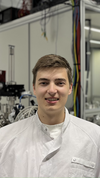
Dr. Yaroslav Gerasimenko serves as Group Leader of the Lightwave-STM research group within the Huber group at the University of Regensburg, Germany, where he directs the ERC-funded Orbital Cinema project. His position represents an independent faculty-level research role focused on ultrafast quantum material dynamics.
His academic training includes a PhD in Condensed-Matter Physics (2008-2014) from the P. N. Lebedev Physical Institute of the Russian Academy of Sciences and undergraduate studies in Physics and Microelectronics (2002-2008) at the Moscow Institute of Electronic Technology, Russia. Postdoctoral experience spans the University of Regensburg (2020-2022), Jozef Stefan Institute in Slovenia (2016-2020), and P. N. Lebedev Institute (2015).
Gerasimenko pioneers lightwave-controlled scanning tunneling microscopy to achieve simultaneous atomic spatial and subcycle temporal resolution. His research centers on quantum materials including transition metal dichalcogenides (e.g., 1T-TaS2) and metal halide perovskites, with emphasis on charge density waves, Mott physics, and non-equilibrium phase transitions. Key innovations involve terahertz plasmonics in graphene and quantum jamming transitions, often leveraging light-induced metastable states.
Recent publications (2023-2025) demonstrate breakthrough capabilities in atomic-scale ultrafast imaging, including Nature cover stories on subcycle microscopy and Nature Photonics cover stories on atomic-scale spectroscopy. The work establishes new paradigms for visualizing electron dynamics at fundamental spatiotemporal limits, with applications spanning quantum computing components and next-generation photovoltaics.
Scientific recognition includes:
- ERC Starting Grant for Orbital Cinema project (2023)
As principal investigator of the ERC project, Gerasimenko leads instrumentation development for lightwave-STM systems. His research program involves collaborations with the Jozef Stefan Institute (Slovenia), P. N. Lebedev Institute (Russia), and international quantum material consortia. Current efforts focus on extending ultrafast nanoscopy to topological materials and quantum annealers.
The Lightwave-STM laboratory at University of Regensburg houses custom cryogenic scanning probe microscopes integrated with multi-terahertz laser systems, enabling experiments at 0.1-atom spatial and 1-femtosecond temporal resolutions under extreme conditions.