معرفی
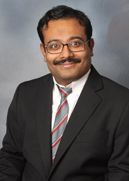
Vladimir Soloviev is an Adjunct Professor of Mathematics at Utah Valley University and an Adjunct Faculty member in Mathematics and Mechanical Engineering at Brigham Young University (BYU), where he has served as a Visiting Professor of Mechanical Engineering since 1999. His academic work spans both applied mathematics and thermal sciences, with a strong focus on modeling and analysis in heat transfer and radiation.
His educational background includes a Ph.D. in Mechanical Engineering (1999) and an M.S. in Mechanical Engineering (1995) from Brigham Young University, and an earlier M.S. in Mathematics and Applied Mathematics from Novosibirsk State University, Russia (1977).
His research centers on heat transfer, gas radiation, and applied mathematics, particularly the development and application of spectral methods such as SLW (Spectral Line-Based Weighted-Sum-of-Gray-Gases) and CW (Cumulative Wavenumber) for modeling radiative transfer in non-isothermal, non-homogeneous gaseous media. His work has significant applications in combustion systems, industrial furnaces, and solar energy systems. He has published extensively in high-impact journals including the ASME Journal of Heat Transfer and the Journal of Quantitative Spectroscopy and Radiative Transfer.
The recent publications reflect a consistent focus on advanced modeling techniques for radiative heat transfer, with particular attention to gas mixtures with soot, high-temperature environments, and industrial applications such as aluminum recycling. The articles demonstrate a strong integration of applied mathematics with engineering physics, often employing analytical methods like Green’s functions and inverse modeling. Key trends include the refinement of global spectral methods, sensitivity analysis, and the extension of models to complex, real-world conditions.
Although no formal scientific awards are listed in the provided text, his sustained publication record and collaborative work with prominent researchers like Brent W. Webb indicate recognition within the thermal sciences community.
Vladimir Soloviev has advised graduate students through advanced engineering mathematics courses and co-authored lecture notes for graduate-level instruction. His teaching portfolio includes a wide range of mathematics and mechanical engineering courses such as Calculus, Linear Algebra, Advanced Engineering Mathematics, Thermodynamics, and Heat Transfer at both undergraduate and graduate levels. While no specific grants are mentioned, his research output suggests involvement in funded projects, particularly during his time at BYU’s Advanced Combustion Engineering Research Center. His early career as a Scientific Researcher at the Kutateladze Institute of Thermophysics in Russia laid the foundation for his expertise in radiative transfer and thermal modeling.
He has contributed to the development of educational materials, including the multi-volume Advanced Applied Engineering Mathematics, used for graduate instruction. His ongoing teaching and research activities indicate active engagement in both academic and applied domains.