معرفی
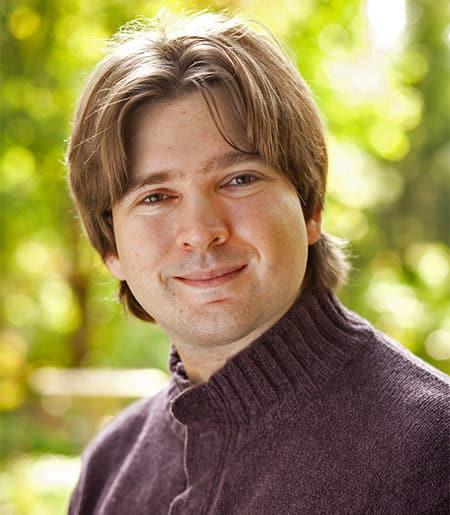
Vasily Dolgushev is a Professor in the Department of Mathematics at Temple University, where he maintains his office in Wachman Hall. His research program bridges several sophisticated areas of modern mathematics, with a particular focus on the deep connections between algebraic structures and geometric phenomena.
His primary research interests include geometric Galois actions, operad theory, and finite type invariants of knots. Much of his recent work centers on the Grothendieck-Teichmueller group (GT), GT-shadows, and their connections to the absolute Galois group of rational numbers. His investigations explore how these structures relate to embedding spaces, the theory of motives, and Grothendieck's dessins d'enfants (child's drawings). As a US-based participant in the International Research Network for Arithmetic & Homotopic Galois Theory, he contributes to cutting-edge research at the intersection of number theory and topology.
Analysis of his recent publications reveals a consistent focus on computational and theoretical aspects of GT-shadows, with increasing attention to their action on combinatorial structures related to Galois theory. His work demonstrates the power of operadic methods in understanding deep arithmetic phenomena, connecting seemingly disparate areas of mathematics through innovative structural frameworks.
Dolgushev actively mentors graduate students, including Jingfeng Xia who completed a master's thesis on GT-shadows for the gentle version of the Grothendieck-Teichmueller group. He has established significant collaborative relationships with researchers including Ivan Bortnovskyi, Jacob Guynee, K.Q. Le, A.A. Lorenz, and Geoffrey Schneider.
His technical contributions include developing software packages for working with GT-shadows and their action on child's drawings, demonstrating his commitment to making advanced mathematical concepts computationally accessible. His presentations at institutions including Bar-Ilan University, University of Minnesota, Penn, and University of Angers reflect his active engagement with the international mathematical community.