معرفی
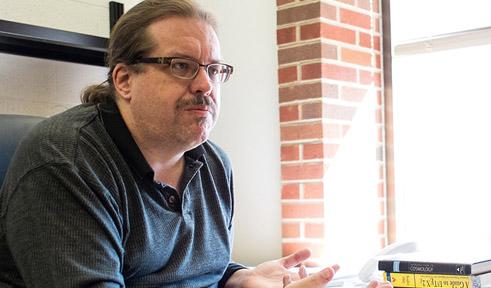
Tim Schrabback is a Full Professor at the Institute for Astro- and Particle Physics, Faculty of Mathematics, Computer Science and Physics, University of Innsbruck. He leads research in extragalactic astrophysics, focusing on weak gravitational lensing, galaxy clusters, and cosmology through major international collaborations such as the Euclid Mission, eROSITA, DES, SPT, and HSC.
His research interests include:
- Observational cosmology using galaxy clusters
- Weak and strong gravitational lensing
- Dark energy and large-scale structure
- X-ray and Sunyaev-Zel'dovich cluster surveys
- Machine learning applications in astrophysics
- Calibration of space-based instruments
His recent publications (2023–2025) span high-impact journals including Astronomy & Astrophysics, Physical Review D, and Monthly Notices of the Royal Astronomical Society. The work emphasizes cosmological parameter estimation, cluster mass calibration, systematic error mitigation in weak lensing, and multi-messenger cosmology. A strong trend is the integration of data from optical, infrared, X-ray, and microwave surveys to constrain models of dark energy and modified gravity.
Scientific contributions include:
- Leading roles in Euclid’s weak lensing and cluster science working groups
- Co-authorship on foundational Euclid mission papers
- Key contributions to eROSITA all-sky survey analysis
- Development of shear calibration techniques using deep learning
- Mass calibration of galaxy clusters via weak lensing
He actively participates in advising and collaborative research, working closely with postdocs and early-career scientists such as Sebastian Grandis, Florian Kleinebreil, Henrik Jansen, and Lukas Linke. He has secured access to major datasets and leads analysis efforts in joint cluster cosmology programs. His public engagement includes frequent outreach lectures on astrophysics and telescope observation, particularly through the annual Astronacht events at the University of Innsbruck. He has also contributed to media interviews on cosmological tensions and galaxy cluster physics.
He leads or participates in several research labs and teams:
- Euclid Weak Lensing Science Working Group
- eROSITA Cluster & Cosmology Working Group
- Institute for Astro- and Particle Physics Observing Team
- Alpine Cosmology Collaboration