معرفی
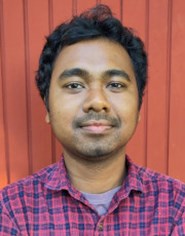
Suvam Roy serves as a Research Fellow at Umeå University's Department of Molecular Biology through the prestigious 'Excellence by Choice' Postdoc program, conducting interdisciplinary research across Peter Lind's experimental laboratory and Eric Libby's theoretical group at IceLab. His work centers on mathematical modeling of microbial gene regulation dynamics under antibiotic stress, investigating how bacterial populations balance adaptive mutations with fitness costs in stressful environments.
Dr. Roy holds a Master's degree in Physics from the University of Calcutta and earned his PhD in Mathematical Evolutionary Biology from the Indian Institute of Science Education and Research (IISER) Kolkata under Supratim Sengupta, where he developed models for primitive cell emergence on prebiotic Earth. His academic trajectory demonstrates a consistent fusion of physics-based quantitative methods with biological inquiry.
His research portfolio spans Mathematical Biology, Microbial Evolution, and Computational Systems Biology, with particular emphasis on evolutionary trade-offs in bacterial stress responses. He employs agent-based modeling and differential equation frameworks to simulate mutation accumulation dynamics, integrating these with experimental datasets from collaborating labs to validate theoretical predictions about gene regulatory stability.
Supported by the Excellence by Choice Postdoc Fellowship, Dr. Roy's current projects examine loss-of-function mutation impacts on bacterial fitness during antibiotic exposure. This fellowship provides dedicated computational resources and collaborative access to Umeå University's molecular biology infrastructure.
He actively contributes to both the Peter Lind Lab's experimental investigations of bacterial molecular mechanisms and IceLab's theoretical biology initiatives, participating in regular cross-disciplinary seminars that connect experimentalists with modelers. His position exemplifies modern academia's trend toward quantitative-biology integration, with future work targeting predictive models for antibiotic resistance evolution.