معرفی
Stephen Peters is an Associate Professor in the Department of Earth and Environmental Sciences at Lehigh University, specializing in environmental geochemistry and hydrogeology while directing the university's Field Camp program.
His academic credentials include:
- Ph.D. in Geology from the University of Michigan (2003)
- M.S. in Earth Sciences from Dartmouth College (1999)
- B.S. in Geology from Bates College (1992)
Dr. Peters' research centers on low-temperature geochemical processes with emphasis on mercury cycling in freshwater systems, trace metal fate in groundwater, paleosol analysis for paleoclimate reconstruction, and advanced analytical methods. His work integrates field measurements, laboratory analyses of isotopes and trace elements, and GIS applications to address environmental contamination and Earth surface processes. Current projects investigate mercury photochemistry in wetlands, silicate weathering at the Precambrian-Cambrian boundary, and metal transformations in contaminated watersheds.
Recent publications reveal strong interdisciplinary trends connecting geochemistry with hydrology and remote sensing, particularly in paleoclimate reconstruction through paleosol studies and mercury dynamics in northern wetlands. His work bridges fundamental geochemical processes with practical environmental monitoring applications.
Notable recognitions include the National Science Foundation Postdoctoral Fellowship (2001-2003), Environmental Science and Technology's Reviewer of the Year Award (2005), and multiple academic honors from Dartmouth and Bates Colleges.
As an educator, Dr. Peters teaches core courses including Hydrogeology (EES 316), Geochemistry of Natural Waters (EES 376), and Field Camp in Earth and Environmental Sciences (EES 341). His profile indicates active graduate student mentorship through research supervision, though specific advisees aren't listed, and suggests ongoing grant-funded research in environmental geochemistry based on his publication record.
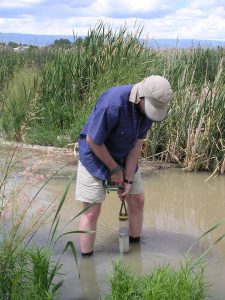
His research operates through collaborative fieldwork across diverse environments including Wyoming's Wind River Canyon, New Jersey's Hackensack Meadowlands, and sub-Arctic peatlands, utilizing both traditional geochemical sampling and remote sensing technologies.