معرفی
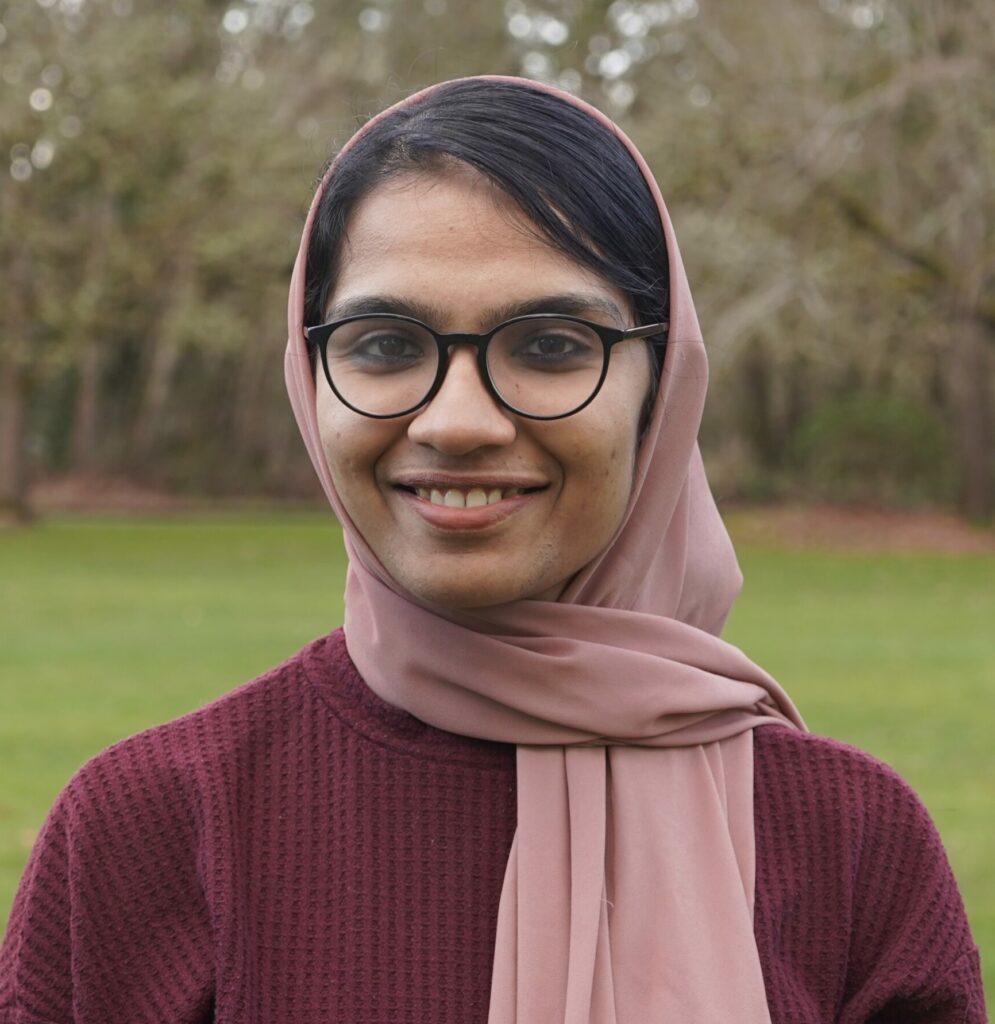
Shahana Ibrahim is a tenure-track Assistant Professor at the University of Central Florida under the AI Initiative, holding a joint appointment in the Department of Electrical and Computer Engineering and Computer Science. Her research develops provable methods for robust machine learning systems with applications in critical real-world scenarios.
Education:
- Ph.D. in Electrical and Computer Engineering, Oregon State University (advised by Dr. Xiao Fu)
- Prior industry experience: System Validation Engineer at Texas Instruments (2012-2017) and NVIDIA GPU intern (2018)
Her research spans machine learning, signal processing, and optimization with core expertise in weakly supervised learning, tensor decomposition, and stochastic algorithms. She focuses on enhancing AI reliability through theoretical guarantees for noisy data environments, particularly addressing label noise, incomplete annotations, and structured factorization challenges. Her work bridges signal processing theory with modern AI to solve practical problems in data quality and system robustness.
Recent publications (2023-2025) reveal strong thematic consistency in handling imperfect supervision. Key trends include crowdsourced label modeling, instance-dependent noise characterization, and tensor/matrix completion techniques. Her approach uniquely integrates signal processing perspectives with deep learning, emphasizing identifiability conditions and geometric regularization to extract reliable patterns from corrupted data.
Scientific Awards:
- Outstanding PhD Dissertation Award from EECS, Oregon State University (2024)
Dr. Ibrahim actively mentors graduate researchers including Faizul and Grey, who co-authored her ICIP 2025 and IEEE CAMSAP 2023 publications. She secured the AI-BTO DARPA grant (December 2024) for physics-informed machine learning research on intrinsically disordered proteins. Current funding supports multiple RA/TA positions for PhD students in her lab. She serves on program committees for AISTATS, AAAI AI for Social Impact, and WiML at NeurIPS.
Her research group develops end-to-end learning frameworks for noisy data environments, with active projects funded by DARPA focusing on biomedical applications and robust AI validation. The lab maintains strong industry connections through NVIDIA and Texas Instruments collaborations.