معرفی
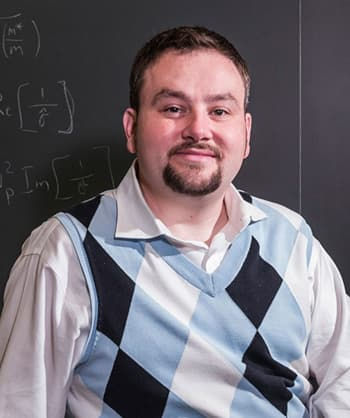
Samaresh Guchhait is an Associate Professor in the Department of Physics and Astronomy at Howard University's College of Arts & Sciences. He leads the Quantum Materials and Magnetism Laboratory, focusing on experimental condensed matter physics with emphasis on quantum and magnetic materials. His research spans multiple interdisciplinary areas including topological materials, magnetocaloric effects, and mesoscale magnetic phenomena.
Dr. Guchhait received his educational training through a rigorous academic path:
- Ph.D. in Physics from The University of Texas at Austin, USA
- M.Sc. in Physics from Indian Institute of Science, Bangalore, India
- B.Sc. in Physics with Honors from Presidency College, Kolkata, India
His research interests center on experimental condensed matter physics with particular focus on quantum materials and magnetic systems. Dr. Guchhait's work explores topological insulators, Weyl semimetals, axion insulators, two-dimensional magnetic materials, and magnetocaloric materials. His research group investigates how electron-electron and electron-phonon interactions influence electronic and magnetic properties of matter, with applications ranging from next-generation computing to energy conversion technologies.
Analysis of his recent publications reveals consistent focus on chromium-based magnetic materials (Cr2Te3, Cr3Te4), spin glass dynamics, and topological quantum phenomena. His work demonstrates strong experimental expertise in molecular beam epitaxy, magnetic characterizations, and transport measurements across multiple material systems. The research shows evolution from fundamental spin glass studies toward more applied quantum materials research with potential technological applications.
Dr. Guchhait actively mentors graduate and undergraduate students in his laboratory, currently advising Chetanath Neupane as a PhD student with several former students including Anirban Goswami, Malcolm Bogroff, Sahil Pradhan, and Emmanuel Yakubu. His laboratory is equipped with a Quantum Design Physical Property Measurement System (PPMS) DynaCool model that enables variable temperature (2-400 K) and magnetic field (up to 9 Tesla) dependent magnetic, magneto-transport, and heat capacity studies.