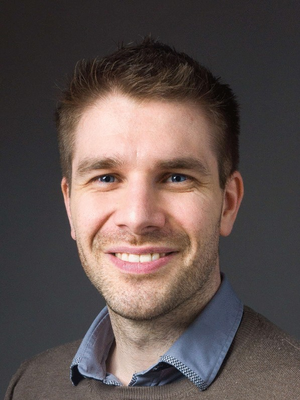
معرفی
Ross Friel is a Professor at Halmstad University's School of Information Technology, where he serves as Programme Manager for the Master's Programme in Electronics Design (TAELD) and is responsible examiner for courses DT4030, DT2019, and ET8012. His academic career includes previous positions as an Engineer at Lund University's MAX IV Laboratory (2016-2018) and as a Lecturer at Loughborough University (2012-2015).
His educational background includes:
- PhD in Mechanical Engineering from Loughborough University (2006-2011)
- MSc in Engineering Design from Loughborough University (2005-2006)
- BEng (Hons) in Manufacturing Engineering and Management from Loughborough University (2001-2005)
Ross Friel's research focuses on cutting-edge digital manufacturing processes, specifically in Additive and Hybrid Manufacturing techniques, material and surface optimizations, and applications in Space, electromagnetic components, and X-ray synchrotron uses. His practical interests include Industry 4.0 and 5.0 development, embedding electronics within components, developing mechatronic and fluidic systems, and creating scientific instrumentation based on in-situ monitoring and adaptation. His work explores advanced digital manufacturing to enhance engineering capabilities in electronics, composites, sensors, and devices through direct cyber-to-physical manufacturing processes for high-demand environments.
Analysis of his recent publications reveals a strong focus on applying additive manufacturing to specialized fields including automotive radar technology, microfluidic devices for synchrotron applications, space resource utilization, and electromagnetic component design. His work demonstrates a consistent integration of manufacturing innovation with practical applications across multiple high-tech sectors.
His notable scientific achievement includes being awarded Docent status in 2020, recognizing his significant contributions to research and academic development.
Ross Friel has secured research funding for projects such as "AdaptoCell for MAX IV Laboratory Users," "Quantifying Sensor Surface Contamination for Safe Vehicle Automation (QonSense)," and "Millimeter-wave Graphene Enabled Wireless Communication." His teaching encompasses Mechatronic Construction with CAD, Introduction to Engineering Studies, Perspectives on Mechatronic Systems, Design of Mechatronic Systems, and Innovative Electronics Design, Construction and Production.
He maintains active research collaborations with MAX IV Laboratory, a synchrotron radiation facility providing high-quality X-ray sources that support advanced scientific research across multiple disciplines.