معرفی
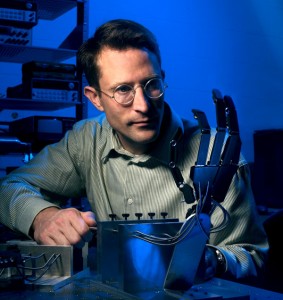
Philip Voglewede is a Professor and Associate Department Chair in the Department of Mechanical Engineering at Marquette University's College of Engineering. He directs the WEDE Lab (Dynamics and Controls Laboratory), where his research focuses on engineered motion systems and their applications in robotics, prosthetics, and industrial automation.
- Ph.D. in Mechanical Engineering from Georgia Institute of Technology (2004)
- M.S. in Mechanical Engineering from University of Michigan (1996)
- B.S. in Mechanical Engineering from University of Notre Dame (1994)
Dr. Voglewede's research spans dynamics and controls, robotics, active lower limb prostheses, industrial automation, and mechanism analysis and synthesis. His work has significant applications in rehabilitation engineering, particularly in developing advanced prosthetic devices that mimic natural human gait. The WEDE Lab investigates motion systems including robotic manipulators and custom-designed mechanisms for various applications.
His recent publications demonstrate a strong trend toward predictive modeling of human gait, sensitivity analysis of mechanical systems, and advanced control systems for prosthetics. His research increasingly integrates uncertainty quantification methods like polynomial chaos theory with biomechanical modeling to create more robust and adaptive systems. The interdisciplinary nature of his work bridges mechanical engineering, robotics, and rehabilitation science.
Dr. Voglewede has secured substantial research funding from diverse sources including DOD, NIH, NSF, and industry partners like Eaton and Joy Global. His grants focus on areas such as intelligent monitoring systems, prosthetic device development, and advanced robotics for industrial applications.
He has advised numerous graduate students through their MS and PhD programs, with many going on to careers at major companies including GE Healthcare, Medtronic, and Komatsu Mining. His lab maintains several engineered motion systems including industrial robots and custom-designed mechanisms for research in motion control and prosthetics development.