معرفی
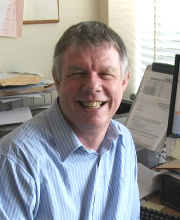
Dr. Peter K. Sweby is an Associate Professor and Acting Head of the Department of Mathematics and Statistics at the University of Reading. He holds roles including Departmental Examinations Officer and MMath Project Coordinator. His professional affiliations include Chartered Mathematician (CMath), Fellow of the Higher Education Academy (FHEA), and Membership of the Institute of Mathematics and its Applications (MIMA).
Dr. Sweby has a B.Sc. (1st class honours) in Mathematics from Bristol University (1979) and a Ph.D. in Mathematics from the University of Reading (1983). His research focuses on numerical methods for hyperbolic conservation laws, particularly Total Variation Diminishing (TVD) schemes, grid adaptation, sediment transport dynamics, and mathematical biology applications like cholesterol biosynthesis modeling.
His work spans computational fluid dynamics, including adaptive mesh ALE methods and ghost fluid approaches for compressible flows. Key contributions include high-resolution schemes for bed-load sediment transport and box schemes for transcritical flow. His publications highlight advancements in numerical stability, spurious solution analysis, and morphodynamic modeling with data assimilation.
- Research Trends: Focus on numerical methods for hyperbolic systems, adaptive mesh techniques, and interdisciplinary applications in environmental and biological systems.
- Key Themes: Development of robust numerical algorithms, analysis of discretization dynamics, and integration of mathematical models with real-world phenomena.
Dr. Sweby has supervised 14 PhD/MSc students, including work on flux limiter schemes, water wave scattering, and morphodynamic equations. He has led research on coastal sediment modeling and contributed to projects like 'Changing coastlines: data assimilation for morphodynamic prediction.'
- Grants/Labs: Involved with Numerical Analysis and Computational Modelling research groups, and contributed to EPSRC-funded morphodynamic studies.
- Labs/Teams: Active in the School of Mathematical, Physical and Computational Sciences, collaborating on interdisciplinary projects linking mathematics with environmental science and biology.