معرفی
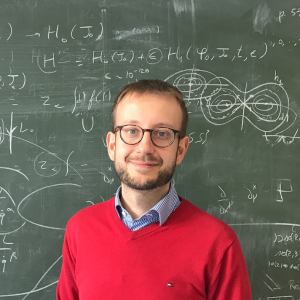
Nicolas Boulanger serves as a full-time Associate Professor at the University of Mons (UMONS) and holds a Senior Research Associate position with the F.R.S.-FNRS. He founded and leads the research unit "Physics of the Universe, Fields and Gravitation" at UMONS, specializing in theoretical physics. His academic engagements include visiting professorships at the Universities of Tours and Aix-Marseille, along with multiple invitations to the Institut des Hautes Études Scientifiques (IHES) in France.
Boulanger earned his Ph.D. in Physics from ULB Brussels in 2003 under Marc Henneaux's supervision, following post-doctoral research at DAMTP (Cambridge), the University of Mons, and Scuola Normale Superiore (Pisa). His educational trajectory reflects deep immersion in theoretical physics institutions across Europe.
His research spans higher spin gravity, higher symmetries, duality in supergravity, Weyl-invariance in extended gravity models, and quantization of gauge systems. He also actively collaborates on interdisciplinary biomechanics projects with engineers and physiotherapists, applying theoretical frameworks to human motor control systems. This dual focus bridges abstract mathematical physics with practical biological applications.
Analysis of his publications reveals a consistent thread exploring mathematical structures in quantum gravity, particularly higher-spin systems and dualities. His work demonstrates evolution from foundational anomaly studies (2003-2007) to comprehensive higher-spin frameworks (2012-2017), with increasing interdisciplinary reach into biomechanics. The publications consistently integrate advanced group theory and geometric formulations.
Boulanger received the Théophile De Donder prize for Mathematical Physics from the Royal Academy of Belgium in 2015, recognizing his contributions to theoretical physics. This award coincided with the formal establishment of his research unit at UMONS.
He directs the "Physics of the Universe, Fields and Gravitation" unit at UMONS, fostering collaborative theoretical research. His biomechanics work involves a pluri-disciplinary team integrating engineering expertise with clinical physiotherapy perspectives, creating a unique cross-departmental research environment focused on movement science.