معرفی
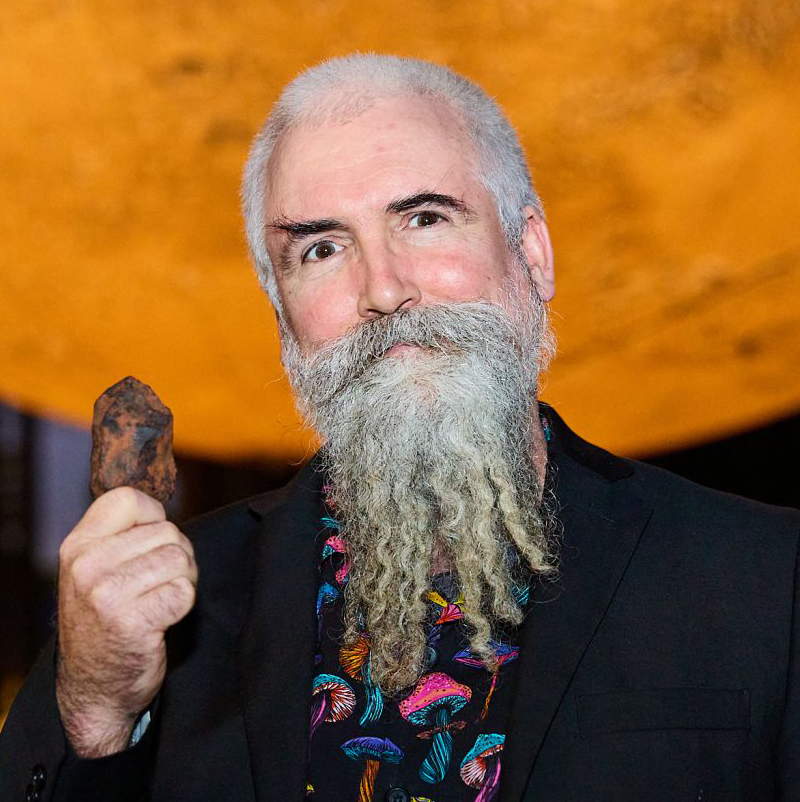
Nick Timms is an Associate Professor at the School of Earth and Planetary Sciences within the Faculty of Science and Engineering at Curtin University in Perth, Australia. He serves as Director of the Space Science and Technology Centre at Curtin University and is a Mission Science Team member for NASA's OSIRIS-REx asteroid sample return mission, as well as a member of the CASA Moon NASA Solar System Exploration Research Virtual Institute (SSERVI).
Dr. Timms holds a BSc(Hons) from Liverpool University and a PhD from James Cook University. His academic career at Curtin University progressed from Postdoctoral positions (2005-2012), to Australian Research Council Linkage International Fellow (2004-2005), to Senior Lecturer (2013-2018), and finally to Associate Professor (2019-present).
Dr. Timms is a leading expert in rock and mineral deformation and geochronology, with recent research focusing on impact cratering and extra-terrestrial geology. His expertise primarily lies in structural and microstructural geology, with current work exploring how rock and mineral deformation links with geochemistry and the implications for tectonics, meteorite impact science and lunar geology. He is particularly studying the role of crystal-plasticity in modifying geochemical systems in zircon by linking quantitative microstructural, geochronological and geochemical analysis.
Dr. Timms is an accomplished field geologist with extensive experience in micro-analytical techniques, including electron backscatter diffraction. His research spans deformation of ore minerals, structural evolution of gold deposits, fault damage in carbonates, quartz deformation, porphyroblast inclusion trails, and petroleum reservoir evolution. His publications from 2023-2025 show a strong focus on planetary science, lunar geology, and advanced analytical techniques.
Dr. Timms has supervised 15 PhD students, 6 Masters students, and 22 Honours students. His research students describe him as 'motivating', 'patient', 'caring', and 'encouraging'.
His research has been widely covered in media outlets including The Conversation, Science, New Scientist, The Economist, and ABC News, with coverage spanning from 2009 to 2025 on topics ranging from asteroid sample analysis to lunar geology and impact cratering.