معرفی
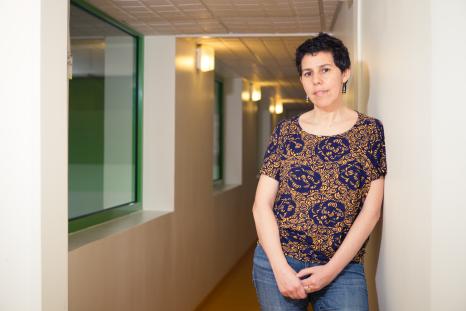
Nabila Aghanim is an astrophysicist and cosmologist at the Institute of Space Astrophysics (IAS), a joint research unit of Université Paris-Saclay and the French National Center for Scientific Research (CNRS). Appointed as a CNRS Director of Research in 2010, she has held significant leadership roles including Deputy Director of the IAS and Director of the Science Observatory at Université Paris-Saclay from 2017 to 2021.
Dr. Aghanim completed her PhD thesis at the IAS under the direction of Jean-Loup Puget in 1996. Following her doctorate, she served as a temporary teaching fellow (ATER) at Université Paris-Sud (now Université Paris-Saclay) for one year before undertaking post-doctoral fellowships at the University of California at Berkeley and with CNES.
Nabila Aghanim's research focuses on cosmology and astrophysics, with particular emphasis on the cosmic microwave background (CMB), dark matter, and dark energy. Her work involves predicting physical models to measure theoretical scenarios and translating instrumental data into testable theories. She has been instrumental in major international space telescope projects, particularly the Planck mission which measured tiny temperature variations in the CMB - the fossil radiation from the Big Bang. Her current research includes the ByoPIC project (the Baryon Picture of the Cosmos), which aims to locate the 'missing' ordinary matter in the universe by combining Planck data with other information sources. She is also actively involved in the Euclid space telescope mission, contributing to the construction and scientific use of the VIS imager.
- 2022: Huy Duong Bui Grand Prize from the French Academy of Science
- 2017: CNRS Silver Medal
- 2017: ERC Advanced Fellowship for the ByoPIC project
Dr. Aghanim serves on the scientific committee of CNES and the Council of the European Astronomical Society. Her research has significantly advanced our understanding of the cosmic web and the distribution of matter in the universe. She has coordinated international teams while analyzing satellite measurements, particularly during her leadership of one of the Planck scientific programs from 2009 to 2016. Currently, she is exploring mission concepts for observing fossil radiation to detect variations in its emission spectrum, which could reveal the thermal and energetic history of the universe from the Big Bang to the present day. She also participates in the CNES stratospheric balloon project 'BISOU' (Balloon Interferometer for Spectral Observations of the primordial Universe), focusing on scientific instrumentation.