
معرفی
Dr. Matthias May leads the SPECSY research group at the University of Tübingen's Institute of Physical and Theoretical Chemistry, where he serves as an Assistant Professor. His research focuses on understanding solid-liquid interfaces through a combination of electronic structure modeling and experimental optical spectroscopy. May directs several major projects including H2Demo (solar hydrogen prototypes) and NETPEC (solar-driven electrochemical approaches to negative emissions).
May's research interests center on photoelectrochemistry for sustainable energy applications. His SPECSY group investigates the atomistic structure of electrochemical interfaces as a function of applied potential, employing reflection anisotropy spectroscopy in electrochemical environments. The group's work bridges computational and experimental approaches to study semiconductor-electrolyte interfaces, with applications in solar fuel devices and batteries. Their research spans fundamental interface science to practical renewable energy technologies.
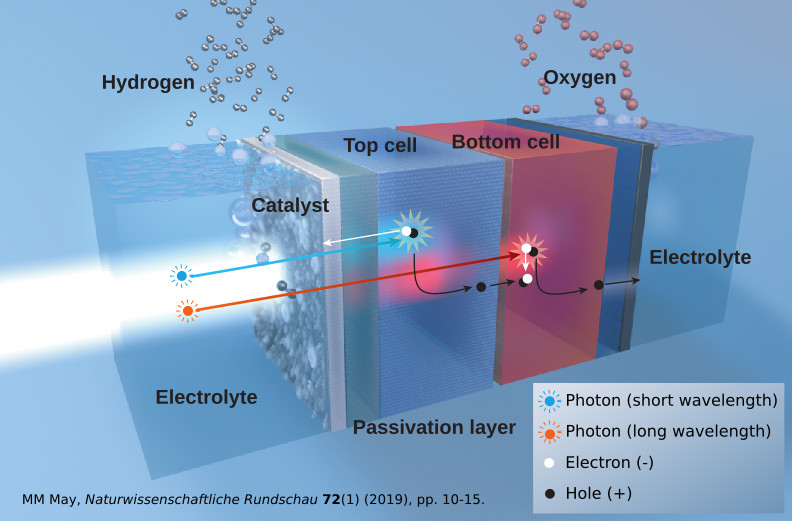
Analysis of May's recent publications reveals a strong focus on semiconductor-electrolyte interfaces, particularly with III-V materials like InP. His work integrates computational modeling (primarily DFT) with advanced experimental spectroscopy to understand interface structure and dynamics. The research spans multiple applications including solar water splitting (achieving 19% solar-to-hydrogen efficiency), CO2 reduction to solid carbon, and battery electrochemistry with liquid metal electrodes. A distinctive feature is the development and application of reflection anisotropy spectroscopy for in situ and operando studies of electrochemical interfaces.
- Curious Mind Award in Mobility and Energy category (Manager Magazin Hall of Fame of German Research)
- Försterpreis awarded to his student Erica Schmitt for work on solar water splitting
May actively supervises PhD and Master's students, with recent PhD completions including Mario (University of Ulm) and Margot Guidat (first PhD student in the group to defend on electrochemical RAS). His group has secured significant funding including DFG support through the Emmy-Noether program and participation in the H2Demo and NETPEC projects. The NETPEC consortium's work on turning CO2 into carbon flakes has received media attention, including features on the science TV show Nano on 3Sat.
The SPECSY group operates advanced experimental facilities including electrochemical reflection anisotropy spectroscopy setups and a dedicated Apium P220 3D printer for creating electrochemical sample environments. The group collaborates with multiple institutions including the California Institute of Technology and industry partners like AZUR SPACE for solar water splitting technologies.
Matthias May در سایتهای دیگر
جستوجوهای مرتبط
شاید اینها هم برایتان مناسب باشند
 Aliaksandr S. BandarenkaTechnical University of Munich · استاد
 Michael BronMartin Luther University Halle-Wittenberg · استاد
 Chinmoy RanjanIndian Institute of Science · استادیار
 Rüdiger-A. EichelJülich Research Center · استاد
 Yongchao ZhangCatalan Institute of Nanoscience and Nanotechnology (ICN2) · پژوهشگر
- TTheresa SchoetzUniversity of Illinois Urbana-Champaign · استادیار