معرفی
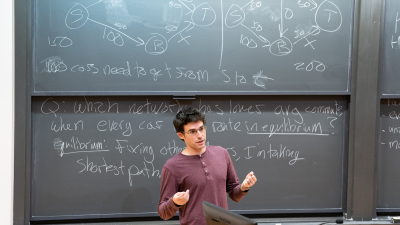
Matthew Weinberg serves as an Associate Professor in the Department of Computer Science at Princeton University's School of Engineering and Applied Science (SEAS), where he joined the faculty in 2017. He maintains dual affiliations with the Department of Computer Science and the Program in Applied and Computational Mathematics (PACM), reflecting his interdisciplinary research at the intersection of theoretical computer science, economics, and public policy.
Education:
- Ph.D. in Computer Science, Massachusetts Institute of Technology, 2014 (Advised by Costis Daskalakis)
- B.A. in Mathematics, Cornell University (Collaborated with Bobby Kleinberg)
Research Interests:
Professor Weinberg specializes in Algorithmic Mechanism Design, focusing on algorithm development for strategic environments where participants act in self-interest. His work extends to Economics and Computation, Algorithms Under Uncertainty, and foundational Theoretical Computer Science, with notable applications in blockchain systems. He approaches decentralization as a strategic tool rather than an end goal, emphasizing practical implementations through rigorous theoretical frameworks.
Scientific Awards:
- President’s Award for Distinguished Teaching (2022)
- School of Engineering and Applied Science Excellence in Teaching Award (2023)
Professional Experience:
Prior to his faculty appointment, Weinberg completed a two-year postdoctoral fellowship in Princeton's Computer Science Theory group and served as a research fellow at the Simons Institute for the Theory of Computing during Fall 2015 and Fall 2016. His doctoral research at MIT established foundational contributions to algorithmic game theory under Costis Daskalakis. While specific grant details and student mentorship records aren't documented in the source material, his research impact is evidenced by media recognition including a 2023 feature on blockchain algorithm development.
Research Environment:
Weinberg operates within Princeton's Computer Science Theory group and collaborates through the Program in Applied and Computational Mathematics (PACM), leveraging these interdisciplinary hubs to advance his work on incentive-compatible algorithm design and computational economics.