معرفی
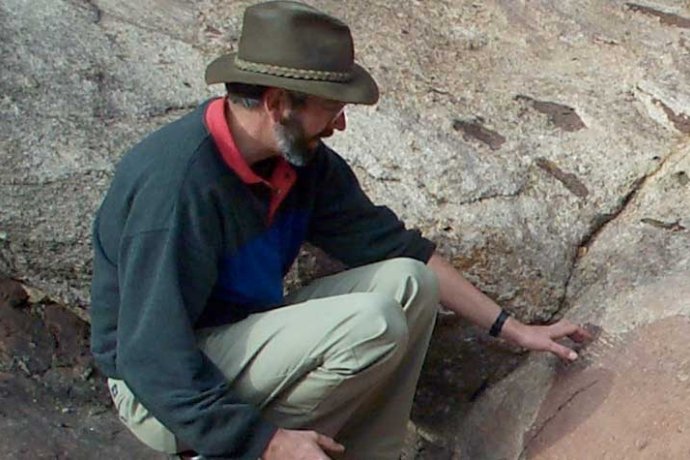
Mark McMenamin is a Professor of Geology at Mount Holyoke College, known for groundbreaking theories like the 'Hypersea' concept challenging traditional views on land-based evolution and the discovery of Ediacaran fossils in Mexico suggesting convergent evolution. He is on leave for the 2024-2025 academic year.
Education: Ph.D. in Geology from the University of California, Santa Barbara (UCSB), and B.S. from Stanford University. His research focuses on evolutionary biology, Cambrian explosion dynamics, Proterozoic environments, and paleontological fieldwork in locations like Nevada, Mexico, and Massachusetts.
- Key Contributions:
- Hypersea theory (life on land as a 'second ocean')
- Discovery of 600-million-year-old Mexican fossils indicating extinct life forms with nervous systems
- Proposed Carthaginian voyages to America in 350 BC
- Recent finds include a Jurassic dinosaur and pterosaur in New England
- Awards: Presidential Young Investigator Award (1988), Sigma Xi National Lecturer (1992-1993).
Research interests span Ediacaran biota, Cambrian diversification, and the interplay between environment and evolution. Recent studies include Permian vertebrate pigmentation and Triassic clam paleobathymetry. His work frequently integrates field discoveries with theoretical frameworks, such as 'environmental convergence' and 'hypertopia' models.
McMenamin's labs and fieldwork teams have produced notable findings, including the first direct evidence of Permian vertebrate coloration and a Jurassic neotheropod in Massachusetts. His publications bridge paleontology with broader ecological and philosophical questions about life's evolution and potential beyond Earth.