معرفی
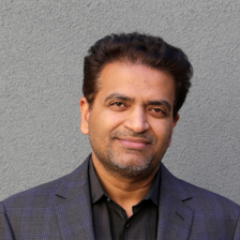
Kaustav Banerjee is a Professor in the Department of Electrical and Computer Engineering at the University of California, Santa Barbara (UCSB). He is a globally recognized leader in nanoelectronics, specializing in 2D materials such as graphene and van der Waals heterostructures. His research focuses on energy-efficient electronics, photonics, bioelectronics, and 3D integrated circuits. Banerjee holds visiting/adjunct professorships at institutions including Tokyo Institute of Technology, Universität der Bundeswehr München, and Shanghai Jiao Tong University.
Banerjee earned his PhD in Electrical Engineering and Computer Sciences from the University of California, Berkeley. His work has led to commercialized innovations in nanoscale interconnects and 3D ICs, including the groundbreaking Kinetic Inductor overcoming Faraday's 200-year-old inductance density limit.
His research interests emphasize strain engineering in 2D FETs, quantum computing interconnects, and cryogenic CMOS integration. Notable contributions include high-performance monolayer 2D stacked nanosheet FETs and advancements in ferroelectric FET-based memory systems.
Banerjee has been honored with prestigious awards, including the IEEE Kiyo Tomiyasu Award, Friedrich Wilhelm Bessel Research Award, and recognition as a Highly Cited Researcher by Clarivate Analytics. He advises students who have won multiple awards, including the UCSB Lancaster Dissertation Award and IEEE Electron Devices Society PhD Fellowships.
His interdisciplinary work spans collaborations with industry and academia, addressing challenges in next-generation electronics, quantum computing, and biomedical applications.