
معرفی
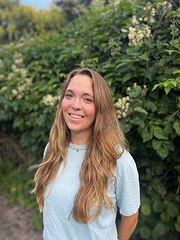
Juliane Schulte is a Doctoral Researcher at the University of Hamburg, working within the Molecular Animal Physiology group in the Institute of Animal Cell and Systems Biology, which is part of the Department of Biology in the Faculty of Mathematics, Computer Science and Natural Sciences. She is currently pursuing her PhD in "Molecular Stress Response in Estuarine Fish" as a member of Research Training Group 2530 "Biota-mediated effects on Carbon cycling in Estuaries" with external funding from October 2023 to September 2026.
Her academic journey includes a Master's degree in Environmental Science: Toxicology, Chemistry and Health from the University of Copenhagen (2020-2022), where she completed her thesis on "In Vitro Toxicological Assessment of Subchronic PET Nanoplastic Exposure of A549 cells" with the Molecular Epidemiology and Toxicology research group. Prior to that, she earned an International Bachelor in Natural Science: Environmental and Molecular Biology from Roskilde University, Denmark (2017-2020), with a thesis examining climate change impacts on the spread of vector-borne diseases.
Dr. Schulte's research sits at the dynamic interface of environmental science and molecular biology, with a specialization in assessing environmental and anthropogenic impacts through sophisticated molecular techniques. She has developed particular expertise in multiple stressor interactions in aquatic environments, where organisms face simultaneous challenges from pollution, climate change, and habitat alteration. Her work in in vitro toxicology focuses on understanding cellular responses to contaminants, while her interest in stress adaptation explores how organisms evolve mechanisms to survive in changing environments. This interdisciplinary approach allows her to address complex environmental challenges through both laboratory-based investigations and field-relevant applications.
Her publication record, though representative of an early-career researcher, demonstrates a cohesive research trajectory focused on environmental toxicology and molecular response mechanisms. Both publications address critical environmental challenges through molecular approaches - one examining the genotoxic effects of nanoplastics derived from consumer products, and the other providing a conceptual framework for environmental science in the Anthropocene era. These works reflect her ability to bridge fundamental molecular research with broader environmental implications, particularly concerning emerging contaminants and systemic environmental change.
Before her current doctoral position, Juliane gained practical experience as an Environmental Toxicologist at Braungart EPEA – International Umweltforschung GmbH from January to September 2023, where she applied her expertise in real-world environmental assessment contexts. This industry experience complements her academic research, providing valuable perspective on the application of scientific findings to environmental policy and management.
She conducts her research within the Molecular Animal Physiology group at the University of Hamburg, working under the supervision of Prof. Dr. Thorsten Burmester (now retired, as indicated by "i.R." which stands for "im Ruhestand" in German). The group is situated within the Institute of Animal Cell and Systems Biology, which focuses on understanding physiological processes at molecular, cellular, and organismal levels, with particular relevance to environmental adaptation and stress responses.
Juliane Schulte در سایتهای دیگر
جستوجوهای مرتبط
شاید اینها هم برایتان مناسب باشند
- RRalf PöhlandResearch Institute for Farm Animal Biology · پژوهشگر
 Claudia KalbeResearch Institute for Farm Animal Biology · پژوهشگر
 Martin RoursgaardUniversity of Copenhagen · دانشیار
- HHans BouwmeesterWageningen University & Research · استاد
 Sarah AldermanUniversity of Guelph · استادیار
 Juliane HelmHelmholtz Centre for Environmental Research · پژوهشگر