معرفی
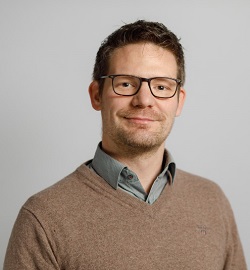
Professor Jose Verdu Galiana is a Professor of Physics specializing in Quantum Technology with trapped electrons and ions at the University of Sussex, within the School of Mathematical and Physical Sciences and the Physics and Astronomy department. He has been in his current position since October 2023, having previously served as Reader in AMO Physics (2017-2023), EPSRC Fellow in Quantum Technology (2015-2020), Senior Lecturer (2014-2017), and Lecturer (2009-2014) at the same institution.
His educational background includes a Licenciatura en Ciencias Físicas from Universidad de Valencia, Spain (1996), followed by PhD studies at the University of Mainz, Germany (2000-2004). Prior to joining Sussex, he completed postdoctoral work at University of Mainz (2004-2005), University of Heidelberg (2005-2006), and served as a Marie Curie Research Fellow at Vienna University of Technology (2007-2008).
Professor Verdu Galiana's research focuses on quantum technology applications using trapped electrons and ions, most notably through his invention of the Geonium Chip - a planar Penning ion trap technology that integrates the trap and magnetic field source into a single scalable chip. His work spans quantum sensing, particularly single microwave photon detection, quantum illumination for radar applications, and ultra-high resolution mass spectrometry. His research bridges fundamental quantum physics with practical quantum technology applications.
His publication record shows consistent output in high-impact journals with several highly cited papers, particularly in Penning trap physics and quantum sensing applications. Recent work demonstrates the practical implementation of his Geonium Chip technology for quantum applications.
- EPSRC Fellow in Quantum Technology (2015-2020)
Professor Verdu Galiana actively supervises BSc and MSc final year research projects focused on experimental research in Penning ion traps for quantum microwave sensing, quantum radar, and quantum mass sensing. His lab is well-funded with multiple current grants from STFC, EPSRC, and industry partners including LEONARDO MW LTD and DSTL, supporting research in quantum illumination systems and microwave quantum sensors.
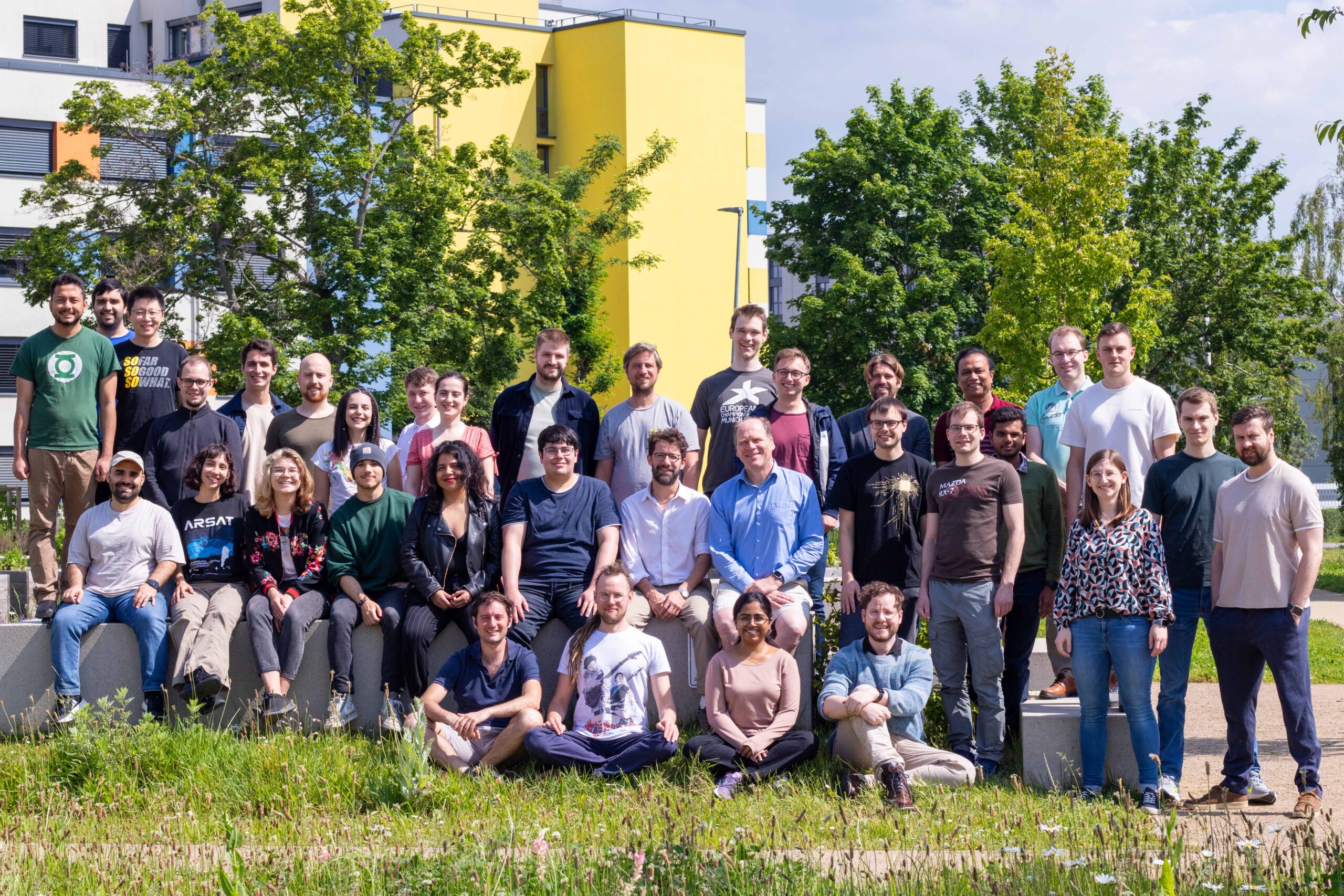
The Geonium Chip Group, which he leads, is developing practical applications of trapped electron technology with a focus on making quantum sensing more accessible through chip-scale integration. The group maintains an active research website at www.geoniumchip.org detailing their ongoing work.