معرفی
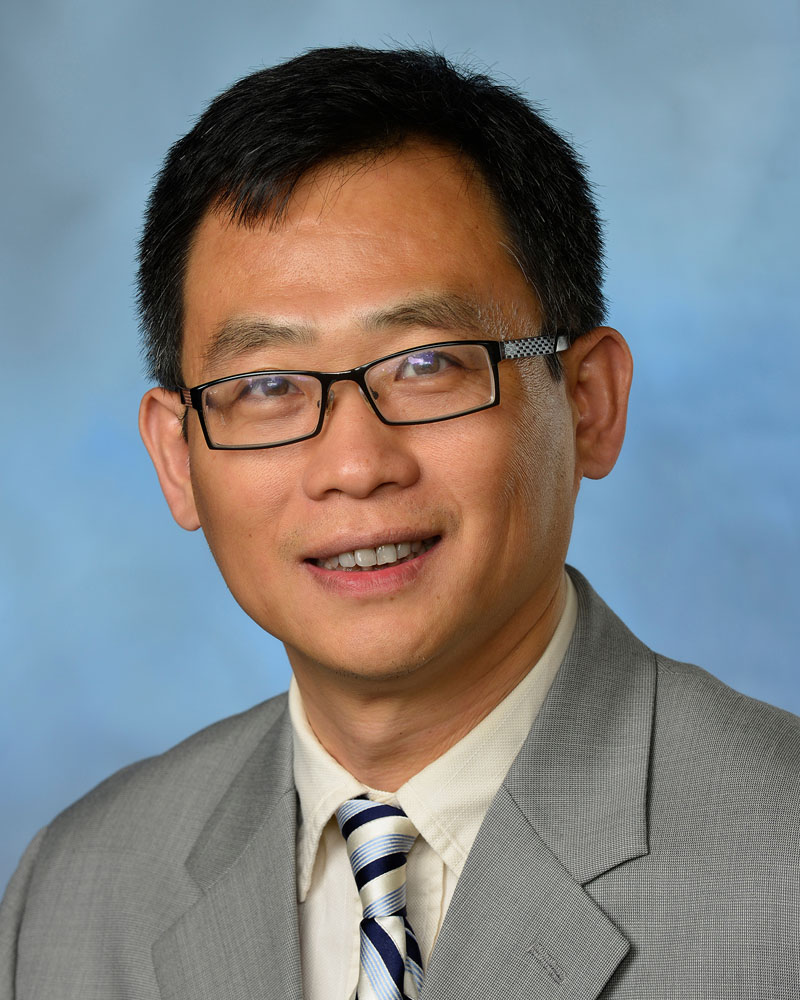
Jianjun Dong is a Professor in the Department of Physics at Auburn University, holding the Thomas and Jean Walter Professorship from 2012 to 2017. His research focuses on theoretical and computational studies of condensed matter physics and materials physics, particularly lattice dynamics, thermal conductivity, and high-pressure phenomena. He has held positions including Visiting Professor at Vanderbilt University (2008) and Visiting Investigator at the Carnegie Institution’s Geophysical Lab (2007).
Education:
- Ph.D., Physics, Ohio University, 1998
- M.S., Physics, Ohio University, 1995
- B.S., Physics, Beijing University, China, 1992
Research Interests: Professor Dong investigates thermal transport in materials under extreme conditions, including phonon dynamics, anharmonicity effects, and interfacial heat transfer. His work spans theoretical modeling, computational simulations, and applications to Earth’s mantle minerals, semiconductors, and novel materials. He has contributed to understanding thermal conductivity in rocksalt structures, clathrate materials, and high-pressure phases of oxides and nitrides.
Key Technical Trends in Articles: His publications emphasize first-principles calculations, advanced algorithms for phonon lifetimes, and interdisciplinary approaches linking condensed matter physics to geophysics. Recent work explores unified statistical theories for heat conduction in nonuniform media and transient heat dynamics.
Awards:
- Thomas and Jean Walter Professor of Physics (2012–2017)
- SPS Faculty Teaching Award: The Enthusiasm Award (2004)
Grants and Advising: While specific grants are not detailed, his research has been supported by institutional and collaborative funding. He has advised students on topics in materials physics and computational modeling, though no named advisees are listed in available texts.
Labs and Collaborations: His research group focuses on computational materials physics, with collaborations involving geophysical institutions and materials science groups. Key tools include density-functional theory and molecular dynamics simulations.